Day 1223: To Kill a Tsar

Cover for To Kill a TsarI have such a struggle with reading eBooks that I often put them aside while I’m charging my iPad and pick up a paper book, only to not return to the eBook until I finish the paper one. This is what happened with To Kill a Tsar, which was the paper book I picked up. Sometimes, the reason for continuing with the paper book is that I’m engrossed in it, but this time, it was just because I was finding the eBook no better.

The main character of To Kill a Tsar, Dr. Frederick Hadfield, is a Russian of British ancestry whose uncle is high up in Russian political circles. Hadfield has recently returned from studying in Switzerland and has liberal tendencies, which in Russia makes him a radical.

At a radical social event, he meets Anna Kovalenko and agrees to help her on Sundays at a free clinic. He is drawn to her, but he realizes very soon that she is part of a political group who just attempted to assassinate Tsar Alexander II. Does he avoid her despite his belief in nonviolence? No, of course not.

For me, this is one of the many places where the novel breaks down. To keep us interested in this story about terrorists, we are presented with a wholly unconvincing love story. Then, there is the question of what the author is asking of us. Are we supposed to sympathize with these people, who don’t care how many people are killed, as long as they make their point? Certainly, Williams doesn’t spend enough time revealing the characters of the police for us to sympathize with them. In fact, there is a subplot of an informer inside the police, but when his identity was revealed, I didn’t even know who he was.

I honestly couldn’t figure out what Williams was thinking when he made his choices. There were lots of things he could have done to make this novel interesting. He could have, for example, worked more to make us sympathize with one side or the other instead of assuming, in this age of terrorism, that we would think “No rights? Of course, kill the tsar!” never mind that, as tsars go, Alexander II was one of the most liberal. If Williams simply wanted to report what happened without following a side, he could have left out the lame love affair and spent equal time with both sides. If he wanted us to sympathize more with Hadfield, then make his reactions more understandable.

This is one of the books on my Walter Scott Prize list that I didn’t enjoy that much. That has happened before, but in this case, I also didn’t think it was a very good novel. I don’t think that has happened before.

Related Posts

The House of Special Purpose

Eye of the Red Tsar

The Idiot

Day 1220: Tightrope

Cover for TightropeYet again, I had no idea that Tightrope, which I read for my Walter Scott project, was a sequel until I went into Goodreads to indicate I had started reading it and saw that it was “Marian Sutro #2.” In this case, the novel seemed to recap the events of the first novel rather heavily, so I don’t think I missed anything by skipping the first book except maybe some feeling for Marian.

I found Mawer’s The Glass Room to be icy in its distance from the characters, so I wasn’t excited about reading Tightrope. It turned out to be better than I expected but not much.

Tightrope begins toward the end of World War II, when Marian Sutro returns to England. She was one of the women sent over to infiltrate Europe during the war, where she worked with the French resistance. But she was betrayed and spent the last two years in Ravensbrück. Shortly before the liberation, she and some other women managed to escape.

Because of Marian’s background, she is of interest to the British secret service. She is of interest to the Russians, too, primarily because her brother Ned is a nuclear physicist. Her own beliefs that knowledge of nuclear weapons must be shared to maintain peace also draws her into the midst of the Cold War.

This novel is narrated by Sam, the son of one of Marian’s friends, and his story contains lots of details he couldn’t have known, even though he had access to her file and she tells him parts of her story. This narrative also allows Mawer to insert a certain amount of salacious detail, as Sam has a mad adolescent crush on Marian. I think I mentioned Mawer’s fascination with labia in my last review.

Marian is essentially an unknowable character, which kept me, as a reader, from becoming very engaged with her story. It didn’t help that she seemed to be the product of some adolescent idea of a perfect woman—a beautiful woman who sleeps with just about every man she meets and cares for none of them. Yet we are to believe she cares for one, even though there is little evidence for it. I found the book blurb, which says “Marian must risk everything to protect those she loves . . .” laughable.

Quotes on the cover call Mawer “a true master of literary espionage” and call the novel “gripping.” If you want gripping, try John Le Carré or Robert Harris instead.

Related Posts

The Glass Room

Sweet Tooth

Code to Zero

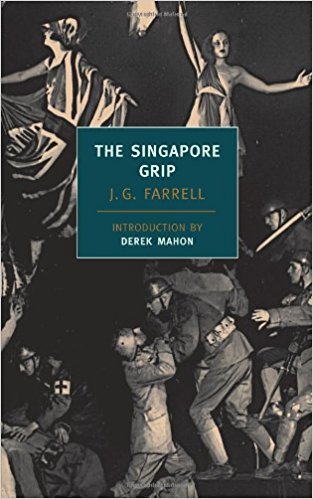
Day 1218: The Singapore Grip

Cover for The Singapore GripThe Singapore Grip is the third of J. G. Farrell’s Empire trilogy, which takes a sardonic look at various parts of the British Empire. The Siege of Krishnapur is set in the nineteenth century during the Sepoy rebellion. Troubles takes place in Ireland during the Troubles in the early 20th century. The Singapore Grip is set during the Japanese invasion of Malaya in World War II.

The novel begins in 1939. Walter Blackett is a powerful Singapore businessman whose sole concern is the profits of his company, Blackett and Webb. Despite the Allies’ need for rubber, Blackett is concerned with keeping the price up and spends his time fixing prices and manipulating the market.

His senior partner dies, and Walter awaits the arrival of Matthew Webb, his partner’s heir. Although Walter’s beautiful daughter, Joan, spends her time tormenting various young men, she readily agrees to help her father’s ambitions by marrying Matthew.

Matthew is a naive and feckless young man, whose ideals have been somewhat battered during his work for the League of Nations. Although he is chubby and unprepossessing, Joan makes a dead set for him, dismaying Ehrendorf, the previous favorite. But Matthew is more interested in Vera Chiang, a Eurasian girl who may be a prostitute or possibly a Communist or maybe neither.

This novel is peopled with Farrell’s usual peculiar characters, including a figure from Troubles, Major Brendan Archer. As Singapore begins descending into chaos, the Major attempts to organize a volunteer fire department. But his efforts are hampered by a lack of interest, as the Singaporians concentrate on selling things and the Blacketts focus all their activities on a Jubilee celebration of the company.

Farrell’s cynical look at the last years of the British in Singapore is occasionally hilarious, with a dark and deadpan humor. It also contains much to consider, as various characters discuss the benefits of colonization (whether there are any), theories of commerce, and other ideas that obsess them.

Related Posts

Troubles

The Siege of Krishnapur

The Garden of Evening Mists

Day 1215: The Flamethrowers

Cover for The FlamethrowersSet in the mid-1970’s, The Flamethrowers evokes two distinct but frenetic movements. In New York, it is the art scene, where performance art is coming to the fore and artists are trying to live their art. In Italy, it is revolution and the Red Brigade, where common people are rising up against business and political corruption.

The heroine, Reno, has grown up in Nevada ski racing and has a fascination with motorcycles and speed. She moves to New York to become an artist (although we never see her making any art) and eventually becomes the girlfriend of Sandro Valera, a well-known, older artist.

Sandro’s family in Italy made its money in motorcycles and tires, and when Reno travels to the Great Salt Flats to do a time trial on her Valera motorcycle, she accidentally gets involved in the family business. As a result, Sandro reluctantly brings her to Italy during a time of great instability and confusion.

Kushner evocatively depicts both the New York art scene and the seething streets of Rome, although often the artists seem like poseurs to me. I don’t think the depiction is meant to be satirical, though.

However, Reno as observer seems to be a different person than the risk-taker who went to New York. Further, the narrative, which occasionally jumps to the story of Sandro’s grandfather, who started the company, feels disjointed and as if it doesn’t really add up. Although I was entranced by long passages of this novel, I ended up wondering what it really was about. In particular, the novel relies on Reno’s relationship with Sandro to tie it all together, but that relationship is barely touched on.

This is the first book I read specifically because it is part of my James Tait Black Fiction Prize project.

Related Posts

Suzanne

The Blazing World

How to Be Both

Day 1213: A Country Road, A Tree

Cover for A Country Road, A TreeBest of Five!
I know little about Samuel Beckett except that he was Irish, and I have the most basic knowledge of Waiting for Godot and Krapp’s Last Tape. (“A country road, a tree” is his setting for Godot.) So, I would not be able to say whether the novel at all conveys a true sense of what Becket was like. I can say, though, that I’ve read other works of biographical fiction that felt as if they gave a false or poor sense of their main character. A Country Road, A Tree is much more plausible in depicting Beckett.

The novel does not cover his entire life but concentrates on the war years, 1939-1945. Beckett is already a published writer, although probably not to much attention. He is friends with James Joyce and other writers and artists in Paris.

At the beginning of the war, Beckett is in Ireland. He feels stifled there, though, and chooses to return to Paris despite the instability. There he lives an increasingly stressful and straitened existence with his lover, Suzanne. At first, he has no papers, which complicates things when he and Suzanne are forced to evacuate Paris with the German invasion. Later, he decides to work with the French underground, which makes their lives even more precarious. Finally, they must flee to the countryside again.

Although this novel does not concentrate on the literary side of Beckett’s life—in fact, during much of it he is unable to write—it grabs your attention and keeps it. It also provides some insight into the man who produced his later works. I loved Jo Baker’s Longbourne and have been waiting for her to produce a work equal to it. This is that work, which I read for both my Walter Scott Prize and my James Tait Black projects.

Related Posts

Longbourn

The Mermaid’s Child

Ghost Light

Day 1211: Days Without End

Cover for Days Without EndI so much enjoyed Sebastian Barry’s On Canaan’s Side when I read it for my Walter Scott Prize project that I was excited to see his Days Without End on the shortlist, too. Again, his protagonist is an Irish immigrant to the U. S., but this time a man, Tom McNulty.

Tom and his best friend, John Cole, enlist in the army sometime in the mid-nineteenth century. Their job in Daggsville has disappeared with the miners. That job, which they have had since they were boys, was to dress up like women and dance with the miners.

Tom and John enjoy the army but have some difficult experiences when their unit is sent west to deal with Native Americans. After some brutal experiences, they leave the army, taking with them a little Native American girl they call Winona. Although she is purportedly their servant, they treat her as a daughter.

Tom and John are lovers, and they have adventures that have raised some skepticism among other bloggers, particularly when Tom goes back to cross dressing to entertain miners in Grand Rapids. Some commenters did not believe this act would be accepted so easily during that time. I’m not sure what I think about that, except that Barry presented it in a convincing way.

In Tom, Barry creates an engaging character, and his descriptions of events, many of them horrific, as Tom and John go from serving in the Indian Wars to the Civil War, is masterful. However, none of the other characters in the novel were fully developed, including John.

This lack, and my doubts about the probabilities of some of the situations in which the pair find themselves lessened my enjoyment in this novel. It is certainly worth reading, but I didn’t like it as much as On Canaan’s Side.

Related Posts

On Canaan’s Side

Neverhome

A Place Called Winter

Day 1210: Le Morte D’Arthur

Cover for Le Morte D'ArthurIt’s time for my review for the latest Classics Club Spin, and the spin assigned me Le Morte D’Arthur to read by the end of April.

If I’d been aware of how long this book is, I might have thought twice about putting it on my Classics Club list. It’s not the length that made it so difficult to read, though, but the repetitiveness of one knight after another getting into a joust and smiting right and left.

I tried hard to finish this book, but after a month of reading it (interrupted by a few other books), I decided to skip to the last two books (out of twenty-one), which deal with Lancelot’s break with Arthur and the end of Arthur’s kingdom. All told, I read about 400 pages.

I actually began eager to read the original of the Arthurian legends or at least as original as we have. The introduction to Cassell’s unabridged edition says that we don’t know the source of the book, although Malory makes many references to “the French book.” The structure of the book suggests that it may be a compilation of every Arthurian story known to Malory, as it is full of chapters about fight after fight. In fact, after a while I pictured Britain, particularly Cornwall and Wales, as seething with wandering knights, who, when they encounter one another, go immediately into battle. I was also struck by how often they don’t recognize each other even when in the same room and presumably out of armor.

There are some sustained story lines, such as the tale of Tristram and La Beale Isoud, and they are interesting, but they’re broken up and sprinkled in among the fights, and of course they too involve fights.

Women are fairly negligibly treated, not surprising for the time despite the patina of chivalry, which is supposed to suggest otherwise. We don’t see much of them or learn what they are like. In fact, Arthur says at the end of the book that he isn’t as upset about losing Guenever as the loss of his knights “. . . for queens I might have enow, but such a fellowship of good knights shall never be together in no company.” Which might give us a clue why Guenever preferred Lancelot. In any event, characterization isn’t a strong suit of medieval literature.

I would say that this book is best for dipping into rather than trying to read all at once. It is an important work of literature, and sometimes the language is quite charming. However, its form is very foreign to us now and shows us just how far literature has come. (There is a glossary in the back of the version I read, which unfortunately I didn’t discover until the end.)

Related Posts

The Lantern Bearers

Grave Goods

The Buried Giant

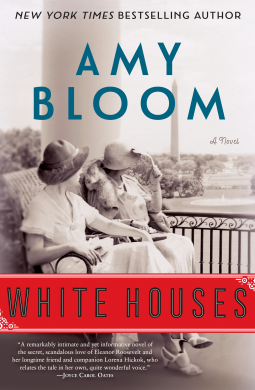
Day 1207: White Houses

Cover for White HousesAmy Bloom’s latest novel, White Houses, leads me to a topic that I’ve mentioned before. I think it is important, when writing fiction about real people, to keep their characters true to that of the original person. Historians disagree about whether Eleanor Roosevelt’s warm friendship with Lorena Hickok was a full-blown lesbian affair. Those who believe it was, base their supposition on Eleanor’s exuberant letters. Those who do not, base it on Eleanor’s dislike of being touched. I think that’s significant, and I think people these days misinterpret the tone of letters from earlier times, when friends expressed themselves more affectionately than we do.

Amy Bloom has chosen to believe that the women’s relationship was a lesbian affair, and that’s what White Houses is about—and all that it’s about. It is written from the point of view of Lorena Hickok—or Hicky, as she was called.

link to NetgalleyThe novel paints a relatively convincing portrait of Eleanor, although I don’t buy the bed bouncing, and it is a sad story and ultimately touching. Its premise, though, makes me uncomfortable for the reasons stated above.

Franklin does not appear in a positive light, and in terms of their marriage, he should not. The character study of Hicky as a downright, plain-speaking reporter who gave up her career for love is a good one, and one I can believe.

Related Posts

Lucky Us

No Ordinary Time

Rules of Civility

Day 1206: The Good People

Cover for The Good PeopleBest of Five!
Hannah Kent seems to be fascinated with historical true crime cases. Her Burial Rites was about a woman found guilty of murder in Iceland. The Good People is about the inhabitants of a poor, superstitious valley in Ireland in 1825.

Nóra Leahy has had a year of misfortune. Not long ago, her son-in-law arrived to tell her and her husband, Martin, that their only daughter had died. He brought with him their grandson, Micheál, to care for.

Unfortunately, Micheál at four is not the bright, babbling toddler he was the only other time they saw him. He does not seem to be able to use his limbs and does not talk. Instead, he screams all the time to be fed.

Martin cares for Micheál and gives him affection, but Nóra hides him away from the neighbors. Then Martin dies, falling down suddenly at a crossroads.

The manner of Martin’s death provokes comment but so does the hidden child.

Even after Nóra brings home a hired girl to help with the work of caring for the child, Micheál seems an unbearable burden. Nóra begins to believe that her grandson was “swept away” by the fairies, the Good People, and that she has a fairy child in his place. She consults Nance Roche, an old wise woman who treats the villagers’ ailments.

Nance herself has enemies in the valley. In particular is Kate Lynch, because Nance refuses to help her with a piseóg, or curse, against Kate’s husband, who beats her. Although Nance refuses to deal in curses, Kate leads others to talk of strange dealings when things begin to go wrong for the valley. Also, the new priest, Father Healy, has begun speaking against Nance at mass.

All of this builds a feeling of dread. Kent has beautifully evoked the way that superstition plays a part in the people’s everyday lives. We know something bad will happen; we’re just not sure what.

Although I would have read The Good People anyway, it is a novel for my Walter Scott Prize project. I found it mesmerizing.

Related Posts

Burial Rites

The Wonder

Harvest

Day 1199: Salt Creek

Cover for Salt CreekBest of Five!
Ten years after she left Australia in 1862, Hester Finch recollects the seven years her family spent in the Coorong, at Salt Creek, southeast of Adelaide. Her father brought the family there after all of his other business ventures had failed.

Originally from genteel stock, Mrs. Finch is appalled by the rusticity of the station, as are her children. Mrs. Finch, who moved to Australia for the sake of her husband, is depressed and apathetic, so Hester, the oldest girl, must take her place doing the housework and educating the younger children. Mr. Finch considers himself a godly man who must do his duty by bringing the natives to Christianity, so they take in a mixed race boy named Tully.

Life is difficult, and it slowly gets worse. Although Hester falls in love with Charles, a young artist doing a survey of the area with his father, she decides that she will never allow her fate to be determined by another.

As Hester tries to figure out a way to leave Salt Creek without abandoning her younger brothers and sisters, events occur that make the family understand the kind of man their father is.

Some readers may need patience for the beginning of this novel, as it is mostly setting the stage for events to come. I found the plaintive tone of the novel at first a little depressing. However, just before the halfway point, events get going, and the novel becomes absolutely gripping.

Although Treloar states that the novel is based very loosely on her family’s beginnings, the characters in the novel are completely fictional except for four of them. Those characters make up a subplot that involves an actual murder.

I felt the novel lacked descriptions that would give ideas of the appearance of the place (references are made to its beauty, but I was unable to form a mental picture), but the daily existence of the characters is fully realized. This is at times a harrowing read for my Walter Scott Prize project, but it is certainly worth it.

Related Posts

The Orchardist

Rush, Oh!

All the Birds, Singing