Day 1173: Atonement

Cover for AtonementBest Book of Five!
Ian McEwan is a master at turning everything you think you know about a novel on its head, and he does that effectively in Atonement. This novel is a reread for me, the first one by McEwan I ever read, and I found it breathtaking. It is just as enjoyable when you know its secrets.

On a hot summer day in 1935, Briony Tallis commits a terrible crime. At thirteen, she is an imaginative but naive girl, a budding novelist. She misunderstands some interactions she witnesses between her older sister, Cecilia, and Cecilia’s childhood friend, Robbie, and this misunderstanding provokes her to tell a dreadful lie that ruins lives.

Five year later, Briony is a nurse at the start of World War II. She is trying to get published as a writer, but she is also concerned to atone for the lives she ruined.

This novel draws you in to the hot summer day and carries you along. It is beautifully written, and it shows great insight into the mind of the romantic, self-important child that Briony was. I can’t say much more about this novel without giving it away to the few of you who haven’t read it or seen the movie, but I believe it to be a postmodern classic. In short, this is a great book. It is intelligent, with ideas to ponder but with a narrative that just sweeps you along.

Related Posts

Amsterdam

Sweet Tooth

The Child in Time

Day 1172: The Long Drop

Cover for The Long DropAlthough it too is set in Glasgow, The Long Drop is a departure from Denise Mina’s usual crime series. Instead, it is an account of the crimes and trial of Scotland’s first serial killer, Peter Manuel. In the 1950’s, Manuel was tried and found guilty of the murders of two families and a woman. Although he likely killed other women, a charge against him for the murder of another woman was found not proven.

The novel follows two paths—testimony about the events of a night following the murders in which Manuel met William Watt, a man whose family were Manuel’s victims and who almost certainly paid to have his wife killed, and the actual events. Pretty much everyone in the court is lying.

This novel is billed as a thriller, but it is more of a court procedural. Although it is interesting, it suffers from not having a single character you can feel sympathy for. The wild city of Glasgow in the 1950’s is very atmospheric, however.

Related Posts

Still Midnight

The Red Road

The End of the Wasp Season

Day 1168: Hodd

Cover for HoddI was never one for the romantic legends of Robin Hood. I always thought that, if he did exist, he was probably just the leader of a gang of thugs. And such, apparently, is indicated by the older ballads about him. In Hodd, Adam Thorpe weaves a story of the man that is closer to that told by the older ballads.

This novel is all about the manuscript, as the text of Hodd is supposedly the find of a medieval manuscript, written by a 13th century monk. The narrator, who remains unnamed, is writing the story of his youth. The novel includes scholarly notes from its translator and comments by its discoverer, a soldier in World War I. Some of these notes are funny, and some, I think, are meant to be parodic.

The narrator is about 14 when he is traveling with his master, a monk named Thomas, to Nottingham. They are held up by Hodd’s men and the narrator’s harp is stolen. He decides to go back and get it and is captured by Robert Hodd and his men.

Hodd is actually a sort of lunatic cult leader, who believes that there is no sin and that he is better than God. His followers believe him. He keeps himself intoxicated and has constant visions. He and his men are utterly ruthless and cruel. But rather than killing the narrator, Hodd decides to keep him as one of his men. He is a musician, and he can write songs about Hodd.

The narrator tells a parallel story of his education and upbringing by a holy hermit. This story continues throughout the book and comes in strongly at the end.

I think Thorpe realistically imagines the workings of the medieval mind, showing us strange beliefs. As such, this is a very unusual novel. I could have done without some of the religious moralizing, which filled the novel, as it would a medieval manuscript.

If you are a reader who needs a character to like, this is probably not the book for you, for even the relatively innocent narrator is perfidious. He so much wants to be loved that his jealousy turns him against people.

This is another interesting book I read for my Walter Scott Prize project.

Related Posts

Ulverton

The Scottish Chiefs

The Owl Killers

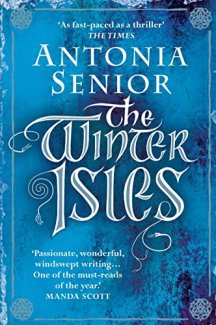
Day 1165: The Winter Isles

In the 12th century, a boy warrior named Somerled in the islands west of what would become Scotland began leading his father’s small band out of obscurity. His father was ineffectual. After a victory, he failed to post guards while his people celebrated, and they were nearly annihilated, driven from their home. Afterwards, the much smaller band moves back to the caves where they first lived when they came from the mainland. But Somerled’s friend Eimhear, nicknamed Otter, is taken away by her father, who returns to the mainland.

The Winter Isles follows the rise of Somerled as he becomes Lord of the Isles. It also follows the love story between Somerled and Eimhear. Much of the novel is devoted to battles, as Somerled takes on one lord after another.

Although the novel covers an interesting period and person, it is only a middling success as a historical novel. It does not have the depth of feeling of the period or character that I expect from a really good historical novel. Characters have a few characteristics rather than distinct personalities, and we are mostly left to imagine the details of ordinary life that make a good historical novel convincing.

It was interesting to read about Somerled, but for a fuller experience of a similar time and a similar character, try King Hereafter by Dorothy Dunnett, the queen of the historical novel.

Related Posts

King Hereafter

A Strange Scottish Shore

Edwin High King of Britain

Day 1164: A Brief History of Seven Killings

Cover for A Brief History of Seven KillingsI have so many thoughts about A Brief History of Seven Killings, but not many of them are positive. The novel is based around an assassination attempt on Bob Marley in 1976, the reasons behind the attempt, and the ramifications for 20 years later. It is about political skullduggery and the drug wars.

The novel begins days before an election in Jamaica. The political parties in the country have connections with gangs running specific areas of Kingston, and the areas of the city belonging to the wrong party get no services. So, an election is an excuse for an outbreak of violence.

Bob Marley, though, has been working with the dons of the two biggest gangs to bring about a peace concert. The CIA is worried about Jamaica turning communist if the JPL party is elected. One of the first narrators is the ghost of a politician who has already been killed in the battle for power. Out of what seems to be chaos comes Josey Wales, an enforcer for one of the gangs, who is more interested in getting involved with Columbian drug dealers than in following his gang’s agenda. The price for allowing him an in with Medellin—kill Bob Marley.

Although this beginning results in the flood of cocaine and crack into U. S. cities, I expected this novel to fit together more cleanly, a bit like Leif GW Persson’s trilogy about the assassination of a Swedish prime minister. It was much messier than that.

The novel was written from the points of view of many characters, most of whom are thugs. Much of the narrative is in Jamaican slang and a little hard to understand. All but one of the characters are abhorrent, and I had great difficulty reading the novel even though I was interested to see what would happen. The novel is brutal, the thoughts and conversations of most of its characters disgusting, and loaded with sexism. A lot more people are killed than seven (in fact, I wasn’t even completely sure which seven the title referred to), and at almost 700 pages, the novel is anything but brief. (I believe the title is meant ironically.) Occasionally, when reading some character’s narratives, especially the heroine addicts, I felt like screaming.

One Goodreads reviewer said the novel is not for the faint of heart. I am not generally squeamish, but I found the novel an agony to read, even though its subject matter is interesting. This novel was the 2015 winner of the Booker Prize. I am fairly sure that when it comes time for my article about which book I would have chosen, this won’t be it.

Related Posts

Between Summer’s Longing and Winter’s End

Red Sorghum

Tinker Tailor Soldier Spy

Day 1158: Mrs. Engels

Cover for Mrs. EngelsBest of Five!
Lately, I’ve realized that the novels I enjoy most have a strong narrative voice or sense of character. Mrs. Engels, the debut novel of Irish writer Gavin McCrea, is one of these. I had the fortune to read it as part of my Walter Scott Prize Project.

Lizzie Burns is the Irish mistress of Frederick Engels, long accepted as Mrs. Engels. She has a lot to put up with. Although Engels supports Karl Marx’s entire household, liberally, so that Marx can work on his book, he is very careful about what is spent on his own household. Further, Lizzy suspects him of yearning for her sister, Mary, who was his mistress before she died. And Lizzy is aware that Frederick is not faithful. Finally, he is completely devoted to a Communist revolution, so he often opens the house to his comrades or sends Lizzy on errands for the cause.

Mrs. Engels is a vivid imagining of Lizzy’s life, beginning in 1870 and looking backward to the past. A poor worker in Engels’s cloth mill, she leads a penurious life until Mary takes up with Frederick Engels. She becomes involved with the Fenian movement through her lover, Moss Óg. All in all, she’s a strong presence, funny and putting up with no nonsense. As she becomes more involved with the Marx family after she and Engels move to London, she begins to learn more about Frederick and what he will do for the cause, which to him means Marx.

This novel is beguiling, drawing me, at least, into a topic that I wasn’t much interested in. It tells Lizzy’s story with wit and creates a wonderfully realized setting and character.

Related Posts

Shirley

Z: A Novel of Zelda Fitzgerald

Charlotte and Emily

Day 1150: Snowdrift and Other Stories

Cover for Snowdrift and Other StoriesI keep saying I love Georgette Heyer, so of course when a volume of her short stories appeared on Netgalley, I requested it. Originally, the story collection was released as Pistols for Two, so I’m sure I read it years before but did not remember the stories.

Each of these stories is a romance in miniature. They involve some of Heyer’s hallmarks—cases of mistaken identity, elopements gone wrong, accidental encounters, and a couple of duels. Appealing heroines meet attractive men usually while they are engaged in some mistaken folly.

link to NetgalleyThese are delightful, light stories, perfect for a rainy day and a cup of tea. This is a very short review, but if you like a charming romance laced with humor, you can’t go wrong with Georgette Heyer.

Related Posts

Sylvester, or the Wicked Uncle

Black Sheep

Cotillion

Day 1148: A Strange Scottish Shore

Cover for A Strange Scottish ShoreHere I go again, starting a series at the second book. This time, I wasn’t aware it was part of a series until I went to enter it in Goodreads as currently reading. In some cases, it being the second in a series doesn’t matter, but if A Strange Scottish Shore sounds appealing to you, I advise that you start with the first Emmaline Truelove book, A Most Extraordinary Pursuit. I might just try to find a copy myself.

A lot is going on here, and it takes a while to figure out all of it. It is 1906, and Emmaline Truelove works for Max, the Duke of Olympia, in charge of some type of foundation. Emmaline is a practical, down-to-earth person, but she is helping Max try to learn about a power he doesn’t understand, the ability to move people through time.

Emmaline is on her way to Scotland with important documents when she meets two different men. A ginger-haired man seems to be stalking her until Lord Silverton comes to her train compartment. Lord Silverton, with whom she has had adventures in the previous book, is a handsome man with a reputation with the ladies, so Emmaline can hardly believe him when he claims to have fallen in love with her. Nevertheless, she spends the night with him, only to awaken the next morning and find her papers gone.

In Scotland, Emmaline and Max are summoned to a castle in the Orkney Islands to view a suit that the owner found hidden in a secret compartment of a chest that hasn’t been opened in centuries. The suit sounded to me like a wetsuit, which of course hasn’t been invented yet in 1906. The castle has a legend of the founder of the family having been married to a selkie, so Emmaline and Max begin calling it a selkie suit.

link to NetgalleyIn the meantime, Lord Silverton has disappeared. Emmaline finds clues that he has been in this castle at another time. She concludes that Max inadvertently sent him back in time, so she talks Max into sending her back for him.

This novel features a redoubtable heroine, a nasty villain, and plenty of action, plus time travel! If this sounds like your thing, you will probably enjoy the combination of historical novel, speculative fiction, action, and romantic suspense.

Related Posts

The River of No Return

The Bone Clocks

1Q84

Day 1147: The Light of Paris

Cover for The Light of ParisEleanor Brown’s first novel, The Weird Sisters, was just original enough to keep it interesting. Sadly, The Light of Paris is all too predictable.

Madeleine has never felt comfortable in her privileged life of debutantes and charity committees. When she was in high school, all she wanted to do was paint, but her mother considered her painting trivial. She finally married Phillip to please her mother and lives in a cold, sterile Chicago condo with a husband who insists on having everything his way.

Madeleine decides to take a break from Phillip, so she goes to visit her disapproving mother in Magnolia, her home town. She finds her mother preparing to sell the house. In helping her, Madeleine discovers her grandmother Margie’s diaries from her youth.

Margie is a naive, romantic young woman who is also a failed debutante in 1924. Her family considers her an old maid, and when she refuses the unromantic proposal of her father’s middle-aged business partner, they send her off to Paris to chaperone a difficult acquaintance, Evelyn. Evelyn almost immediately abandons her to go off on her own, but after some hesitation, Margie decides to get a job and stay in Paris.

While reading her grandmother’s story, Madeleine begins to work through her own issues, all the while wondering how the Margie from her diary became the distant woman she remembers.

Madeleine’s family secrets are fairly guessable, as is the resolution to the novel. That didn’t bother me so much as some other issues. A small point, perhaps, but in those days no one would have sent a 23-year-old unmarried girl to chaperone an 18-year-old. If Margie was 40, maybe.

A larger issue is my utter lack of sympathy with Madeleine’s problems. Many people seek the approval of their parents, but to think that Madeleine could see no alternative but her Junior League upbringing and marriage to Phillip is ridiculous in this day. I’m sure there are a few women in pearls and twinsets still around, but Brown has set this portion of the novel in the 1990’s, not the 1950’s. I had no patience with this heroine. She needed to grow a backbone when she was 16, not when she was in her 30’s.

Related Posts

The Weird Sisters

Empire Girls

Under the Lemon Trees

Day 1146: Birdcage Walk

Cover for Birdcage WalkBest of Five!
Lizzy Fawkes has a close relationship with her mother, Julia, who has worked all her life for the rights of common men. She revolted against her family’s guidance, though, in the choice of her husband, John Diner Tredevant, a property developer. Julia thinks him too concerned with money, while he thinks Julia’s support of the French revolution is naive. Unfortunately, because Lizzy was so adamant to have John, or Diner as he prefers to be called, she cannot confide to her mother her occasional doubts, as Diner behaves in a controlling manner.

Readers already know that at the beginning of the novel, a man murdered a woman and buried her in the woods near the gorge of the Avon River. Diner is building his homes in Bristol overlooking that gorge, and we slowly come to fear that he may have murdered his first wife, Lucie.

link to NetgalleyWith the success of the revolution comes the threat of war with France, and buyers back out of their agreements to purchase Diner’s houses. Diner’s behavior becomes erratic.

This novel is a real page turner. It makes the fourth Dunmore novel I’ve read, each one better than the last. It builds up a lot of suspense as you wonder what Lizzie’s fate will be.

Related Posts

The Lie

Exposure

The Greatcoat