Day 1111: The Gustav Sonata

Cover for The Gustav SonataUntil the very end of The Gustav Sonata I wondered what its point was. It is a novel detached from its characters even as it puts them through events that should make us sympathetic. Further, although it is set in a specific time and place, there is little feel for what it was like then and there. This effect is in strong contrast to Tremain’s two novels about Merivel, set in Restoration England.

The novel begins in 1947, when its main character, Gustav Perle, is five years old. Although Gustav is Rose Tremain’s exact contemporary, parts of the novel are set earlier, before Gustav was born.

Gustav’s father died when he was a baby. He was a member of the police force for their small town in Switzerland, but he lost his job before Gustav was born, under circumstances that Gustav’s mother does not fully understand. All she knows is that Erich died “helping the Jews.”

Gustav’s mother Emilie has raised him without a shred of affection but only with criticism. The lack of affection is tempered somewhat by his lifelong friendship with Anton, whom he meets the first day of Kindergarten. Emilie does not like Gustav’s friendship with Anton, because Anton is Jewish. But Anton and Anton’s family are all Gustav has, really.

Anton is always a self-absorbed person. He is nervous and highly strung, a musical prodigy. Anton’s mother thinks he will become a famous musician, but he is terrified in competition and performs badly.

An important theme in this novel is Swiss neutrality and its correspondence with personal neutrality. Gustav, although faithful to his friends, is always concerned with self-mastery and holds back from his own life events. But so does this novel hold back from its characters, as if observing them through a glass.

I found this novel interesting but not involving. I think it took too long to get to its point. It is another novel for my Walter Scott prize project.

Related Posts

Merivel: A Man of His Time

The Glass Room

A View of the Harbor

Day 1110: Margaret of Anjou

Cover for Margaret of AnjouMargaret of Anjou, the second book of Conn Iggulden’s Wars of the Roses series, begins in 1454 with an ambush. Angry at the lands that have been going to the Nevilles, York’s allies, Henry Percy, Earl of Northumberland, attacks a Neville wedding party on its way home from the wedding. York has been acting as Protector and Defender of the Realm while King Henry VI is suffering from mental illness. Although York has ruled well, he has favored his own allies over the friends of the King, even to murdering or imprisoning some, and has earned the enmity of the Queen, Margaret of Anjou.

But the tide is about to turn. Henry awakes from his stupor, amazed to find that Margaret has borne him an heir. He immediately dismisses York and Salisbury, Richard Neville, from his court. Soon after, he and his allies ride out to bring them to heel, starting the battles of the Wars of the Roses.

While the Yorkists reluctantly turn to treason, this book seems a little more balanced than the first between the two sides. Salisbury and York clearly have their reasons for resentment of the king’s favorites, and it is true that Henry is not an effective ruler. Still, no one hesitates in plunging the country into years of uproar and instability.

Margaret of Anjou

Like the first novel, this one switches point of view between the main characters, including Derry Brewer, the king’s spymaster, who is one of the few fictional characters. This technique allows us to understand the various positions, for some are self-righteously explaining away their own treachery. York is presented as a tragic character, while Margaret, who has often been reviled in history, is treated sympathetically. After her husband sinks back into his stupor, she does everything she can to protect her son.

I am continuing to enjoy this series, which, although it simplifies the many conflicts of this time, brings clarity to the main figures and events.

Related Posts

Stormbird

The Wars of the Roses

Henry VI, Part I

Day 1108: His Bloody Project

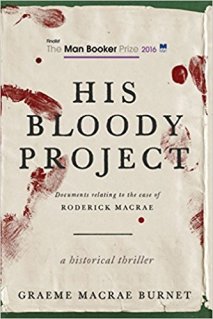
Cover for His Bloody ProjectI was actually reading another novel on my iPad when I picked up His Bloody Project because my iPad needed charging. I was so riveted by it that I couldn’t go back to the other novel until I finished this one.

In 1869 Scotland, 17-year-old Roddy Macrae is in jail awaiting trial for the murders of three people. Roddy has admitted the murders and is ready to take his punishment, which in this time means hanging. His advocate, Mr. Sinclair, thinks there are mitigating circumstances and asks him to write his account of the crimes.

The entire novel is made up of documents—first, Roddy’s account, then the medical reports of the victims and psychiatric evaluations, finally the account of the trial and what happened afterward. Although there is no doubt who committed the murders and little doubt of the outcome of the trial, Burnet manages to conjure up a great deal of sympathy for Roddy and a terrific amount of suspense.

Not only does Burnet create a complex psychological depiction of Roddy, he also deftly depicts the life of highland crofters in the mid-19th century. The novel deals with such issues as class discrimination, the inequities in the lives of crofters and their domination by the landlords, the limitations of our system of justice, and the beliefs held in the infancy of psychiatry. These observations make the novel sound heavy, but it is eminently readable. This is one of the books I read for my Booker Prize project, and I’m really glad I did.

Related Posts

Corrag

Burial Rights

Alias Grace

Day 1104: Vanity Fair

Cover for Vanity FairVanity Fair is a reread for me for my Classics Club list. It has been a long time since I’ve read it, though, and I was curious about whether I would have the same reaction to it.

The novel, of course, is Thackeray’s famous satire of society that follows two English girls through their launches into society and later lives. One is Amelia Sedley, the gentle, conventional heroine who has been the only girl to befriend Rebecca Sharp, the charity student. Amelia is only eager to marry George Osborne, her long-betrothed fiancé. Rebecca is determined to be a success and marry a rich man.

It may be perhaps predicted that good, honest Amelia suffers much more than conniving Becky. Early in the book, Amelia’s marriage to George is threatened when her father loses his fortune. Even though we readers already know that George cares for no one more than himself, Amelia goes into a decline.

Meanwhile, Becky makes her own improvident marriage. She runs off with Rawdon Crawley, the heir to her employer’s fortune, thinking that she will be able to bring Miss Crawley around.

The early days of both marriages are set against the backdrop of the battle of Waterloo, as both George Osbourne and Rawdon Crawley are serving officers. With them is George’s best friend, Dobbin, who falls madly in love with Amelia at first sight and helps her throughout the novel.

As a girl, I thought Amelia was completely insipid and admired Becky Sharp. But it must be said—Becky has no morals. This time through, although I still found Amelia a bit tiresome, I found myself sympathizing more with Rawdon and Dobbin.

In any case, this novel is often funny and always entertaining. Although Thackeray presents us with a conventional heroine for the time in Amelia, you can’t help thinking he had some admiration for the unsinkable Becky. By following her adventures, Thackeray shows us the foibles of members of polite society: the fights over inheritance, the sycophancy, the treatment of people as their fortunes wax and wane.

Related Posts

Viper Wine

The Twisted Sword

The Black Count: Glory, Revolution, Betrayal, and the Real Count of Monte Cristo

Day 1100: The Stranger’s Child

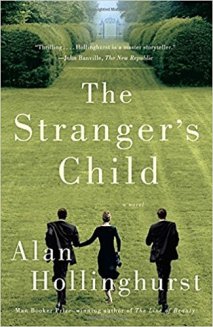
Cover for The Stranger's ChildI had the oddest experience with The Stranger’s Child. Although it was well written and sounded like something I would be interested in, for a while every time I started to read it, I fell asleep. There is very little movement to this novel, which isn’t necessarily a bad thing, but the end of it had me wondering what the point of it was.

The novel is multigenerational, beginning in 1913 and ending in 2008. In 1913, Daphne Sawle, who is 16, is attracted to her brother George’s friend, Cecil Valance, down for a visit from Cambridge. Cecil is an aristocrat and a poet. Unbeknownst to naive Daphne, he and George are having a wild affair.

The next section of the book takes place ten years after World War I. Cecil died in the war, and the family is dedicating a memorial to him. The family includes Daphne, as she has married Cecil’s younger brother, Dudley, and they have two children. However, she is in love with Revel Ralph, a set designer for the theater.

By far the bulk of the novel is set in the 1960’s and 70’s and is from the point of view of Paul Bryant. In the 1960’s, he is a shy bank clerk. He has become involved with the family through his boss, who has married into it, and through his affair with Peter Rowe, a schoolteacher at Corley House, which used to be the Valance home. Cecil is now regarded as one of England’s minor poets.

Ten years later, Paul is a biographer, determined to out Cecil as a gay man despite the claims of Daphne to have been his fianceé. It is unfortunate that I found this main character of the longest section to be so unappealing and completely focused on who was or was not gay, although I realize that the 1970’s was the time for that kind of revelation.

Part of my problem with the novel may have been the blurb, which really oversells aspects of the plot. For example, it says, “Over time, a tragic love story is spun . . . .” Well, there are several love stories that come out, but I wouldn’t call any of them tragic, and it’s actually difficult to tell which of them this comment refers to. One of the secrets is so understated during the novel that even though it is the last revelation, it seems anticlimactic. I suppose it’s supposed to be ironic that Paul is so focused on the possibility of one affair that he completely misses another.

Finally, this is a novel so focused on the sexuality of its characters that it gives the impression that the entire upper class male population of England is gay. We see a little into Daphne’s infatuations, but otherwise, only from the point of view of various gay men trolling for sex or obsessing about it. Those of you who know me will realize that I would have the same complaint if the sole focus was on heterosexual sex. So, not one of my favorites for my Walter Scott prize project.
Related Posts

Arctic Summer

A Place Called Winter

The Summer Before the War

Day 1098: Bella Poldark

Cover for Bella PoldarkI’ve finally finished the last of 12 books in the Poldark series with Bella Poldark. I enjoyed the first six books very much but was only mildly interested in the others and finally only continued because I wanted to finish the series.

This novel is not exactly what you might expect of the last of a series. It resolves some of the continuing subplots but not others. I was surprised to find it introducing some new characters while hardly mentioning some who featured strongly in the other books.

Set in 1818, Bella Poldark is principally concerned with the romances of the two Poldark daughters, Clowance and Bella. Clowance is now a widow, but she has two suitors, Captain Philip Prideaux, a former soldier, and Lord Edward Fitzmaurice, who has been in love with Clowance since she was a girl. But Clowance feels still half in love with Stephen and half hates him because of his lies.

Bella has been courted by Christopher Havergal for years, and he helps her find a voice teacher in London and begin her career as a singer. But a French empresario, Maurice Valéry, offers her a part in an opera in Rouen and himself.

Valentine Warleggan’s affairs are also a concern of the novel. They become entangled with another subplot, a murder mystery. Someone has been killing young women in the area. When Valentine’s latest mistress is a victim and he is questioned about it, his wife, Selina, has had enough and leaves with their son, George. Valentine at first leads a life of dissipation, but when he realizes that his putative father, George Warleggan, is interesting himself in his son, he decides he cannot leave young George to be raised by old George, as he was.

In all, although this novel was more interesting than some of the others, I felt sometimes as if Graham was trying to juggle too many balls. I am happy to have finished this series even though I only found the later books moderately interesting. So, I am happy in more ways than one.

Related Posts

The Twisted Sword

The Loving Cup

The Miller’s Dance

Day 1094: The Girls

Cover for The GirlsBest Book of the Week!
Sometimes a novel is imaginative in its approach or subject matter, but The Girls is an imaginative act of empathy. For Emma Cline has drawn a convincing portrait, in her main character Evie Boyd, of the kind of girl who could be attracted to a cult, inspired by the Manson Family.

In the summer of 1969, 14-year-old Evie is insecure and dying to fit in somewhere. Her parents are newly divorced, and she blames her mother for failing to hold her philandering father’s attention. She has just been abandoned by her childhood friend, Connie, as teenage girls will do.

She spots Suzanne at the park. She and her friends are different, dirty and sort of feral, but free. When Evie gets picked up by Suzanne and her friends after her bike breaks down, she goes with them to the ranch.

The ranch is centered around Russell, an older man whom his followers consider a genius. He uses various techniques to manipulate the girls surrounding him, and he befriends famous people in hopes of using them to become famous himself. He organizes the activities at the ranch around some half-baked philosophy.

Evie can actually see through some of this, but she willfully blinds herself to what is wrong at the ranch through a love for Suzanne. When things at home get worse, she ends up with only one place to go.

The novel is brilliantly written, and I was completely enthralled by the description of Evie’s journey. I found the story believable and watched in dread as Evie got pulled ever deeper into the dangerous group.

Related Posts

Arcadia

Wylding Hall

The Interestings

Day 1087: Stormbird

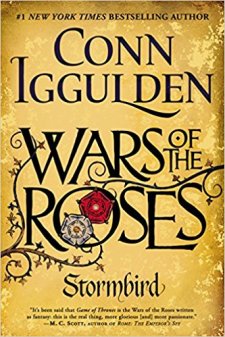
Cover for StormbirdBased on the recommendation of Helen of She Reads Novels, I decided to try Conn Iggulden’s series Wars of the Roses. This period of British history has always been fascinating to me, yet confusing, and I have read several nonfiction books about it, as well as a few stand-alone novels about major players in the wars.

When I picked up what I thought was the first book in the series, Margaret of Anjou, I realized it was the second. So, I had to hurriedly get a copy of Stormbird. This accident assures that I will be reading at least the first two of the series.

The novel begins in 1437. King Henry VI, who is clearly not the warrior his father was, has been ceaselessly praying for an end to the Hundred Years War with France. He commands his spymaster, Derry Brewer, to find a way to a truce.

The agreement made with France is that Henry will marry Margaret of Anjou in exchange for the lands of Anjou and Maine, which Henry’s father won back from the French. At no time does Henry give thought to the countless English families who will be displaced in these two provinces.

The point of view moves from person to person throughout the novel, but no one character is central to the story. Some of these characters are the young Margaret of Anjou; Derry Brewer; the loyal William de la Pole, Earl of Suffolk; Richard Plantagenet, Duke of York; Thomas Woodchurch, a former longbowman who is displaced from his farm by the truce and decides to fight; and Jack Cade, a resentful renegade who leads a band of Kentish men against London. Most of these characters were actual historical people, with the exception of Derry Brewer.  At first, I thought this constant shift in point of view would become annoying, but I finally realized it allowed me to get to know those characters better.

Iggulden admits to compressing time, making a period of almost 20 years seem like months. I think he could have just as easily indicated some passing of time, because it is occasionally jarring to think only a few months have passed, only to be brought up short by remarks, for example, that the king and queen have been married for years without issue.

Although most of the books I’ve read agree that toward the end of the wars, anyway, the Yorkists had the better claim to the throne, in this preamble to the wars, the Duke of York is definitely the villain. Although he is in charge of Normandy at the time of the truce, he does nothing to protect the fleeing English from the French armies and actively works to blame his inaction on Suffolk, who does the best he can when he takes over York’s position. I notice that the novel is dedicated to a descendant of John of Gaunt, whose immediate descendants made up the Lancastrian side of the conflict.

Overall, I found the novel quick moving and suspenseful, with interesting characters. I’ll be happy to read the second book in this series.

Related Posts

Henry VI, Part I

The Wars of the Roses

Richard III: England’s Black Legend

Day 1085: House of Names

Cover for House of NamesColm Toíbín has written some unusual novels, and such is House of Names. It is basically the Oresteia, and we can’t expect happy endings from the Ancient Greeks.

The novel begins with Clytemnestra. On his way to the Trojan War, Clytemnestra’s husband, Agamemnon, summons her and her daughter, Iphigenia, telling her that Iphigenia is to marry Achilles. But Agamemnon is lying. Iphigenia is to be sacrificed for the cause of favorable winds that will get the soldiers across the sea to Troy.

Clytemnestra despises Agamemnon for the deception and his readiness to sacrifice their daughter. She vows to murder Agamemnon when he returns from the war. To take command of the kingdom, she allies with Aegisthus, the enemy whom Agamemnon has kept captive for years. But Clytemnestra finds that she is not in charge after all.

link to NetgalleyOrestes is a boy when Iphigenia was sacrificed, but he sees what happens to her from afar. Returning home, he is imprisoned with the country’s other boys in Clytemnestra’s attempt to intimidate the villagers. But Orestes has been taken prisoner by Aegisthus. Clytemnestra did not intend him to go with the other boys.

And then there is Electra.

Beautifully written like all of Toíbín’s work, this novel is an interesting interpretation of an old legend, based on the plays by Aeschylus, Sophocles, and Euripedes. It is eerie and harrowing.

Related Posts

The Song of Achilles

The Greek Myths

The World’s Wife


Day 1084: Dictator

Cover for DictatorDictator is the final volume in Robert Harris’s trilogy about the great Roman statesman, Cicero. This trilogy has truly been spell-binding.

The novel begins in dark times for Cicero, when he and his family are hounded out of Rome by Julius Caesar, his greatest enemy. Cicero was made to look ridiculous in Colleen McCullough’s series about Caesar, but Harris sees him differently, as a man staunchly in support of the dying Republic. On the other hand, McCullough pictured Caesar much more sympathetically, while Harris shows him as a man run mad with the desire for power.

For me, this novel flagged just a little bit in the middle, while momentous events in Rome are described from afar. I think my reaction is partly because I thought I knew what happened to Cicero and was dreading it. But I actually didn’t know my Roman history that well, so I was a little bit off. In any case, the novel picks right up as soon as Cicero rejoins the action.

Robert Harris is rapidly becoming one of my favorite historical novelists. He writes a good, tight political thriller based on true events. I am already looking for his most recent novel.

Related Posts

Imperium

Conspirata

Master & God