Day 1014: The Stranger from the Sea

Cover for Stranger from the SeaThis eighth Poldark novel begins in 1810, ten or eleven years after the last one. Ross and Demelza’s oldest two children are a young man and woman, and to some extent the novel focuses on their futures.

The Stranger from the Sea begins with George III descending yet again into madness. This situation creates a problem for the country. Wellington is recently in charge of the British army in the Peninsular wars, but the Tories fear that if George’s son is made regent, the Whigs will come into power and make peace with France. Some of Ross’s friends in Parliament ask him to go to Portugal and observe Wellington.

While Ross is away, his son Jeremy pulls a drowning man from the sea. This man is Stephen Carrington, who first says that his own ship went under in a storm but later admits to being a common sailor. Demelza is not altogether sure he can be trusted. Unfortunately, her daughter Clemence is greatly attracted to him.

On an expediction to reclaim the lugger Carrington says is his prize, Jeremy runs afoul of revenue officers and is hidden by the intervention of Cuby Trevanion. Jeremy is smitten, but her family makes it clear that he is not worthy enough.

George Warleggan has also been smitten, 10 years after the death of his wife, Elizabeth. The woman who has attracted him is a widow, Lady Harriet Carter. Although she herself is impoverished by her husband’s debts, she comes from a much higher social strata than George, so he makes some risky investments in an attempt to impress her brother.

Ross and Demelza are still very present in this novel, but the focus seems to be moving to their children. Since we don’t know them well yet, this novel feels transitional. Still, I was interested as ever to see how things would work out.
Related Posts

The Black Moon

The Four Swans

The Angry Tide

Day 1010: The Antiquary

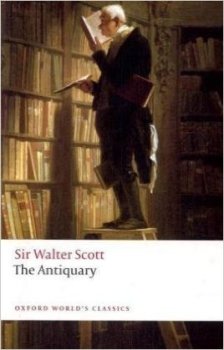
Cover for The AntiquaryThe Antiquary was considered Scott’s gothic novel, but I felt it was more a romance, in the old-fashioned sense of the word. The only gothic elements involve trickery and a ruined abbey. This novel was Scott’s favorite, as well. It is not mine, but it does have a good deal of humor.

The antiquary is Mr. Oldbuck, loquacious to a fault, a man who likes to lecture others on the history of every object that he sees and every subject in conversation. He befriends a young man he meets on a journey, Mr. Lovel, who arrives in the area on undisclosed business.

Mr. Oldbuck has a friend, Sir Arthur Wardour. Sir Arthur handles his money poorly and is in the thrall of a German conman, Herr Dousterswivel, who is trying to further deplete him. Mr. Lovel has formerly met Miss Wardour and proposed to her, but she has turned him down because of his lack of birth.

There are several plot lines in The Antiquary—the machinations of the German, the state of Mr. Lovel’s romance, and a terrible secret of the house of Glenallen that begins to emerge upon the death of the countess.

The dialogue for this novel is in Scottish dialect except for the well-born characters, and there is a good deal of humor around the characters of Mr. Oldbuck and of the rustics.  A beggar named Edie Ochiltree acts as a deux ex machina so often that I began to think the novel should have been called The Beggar. I enjoyed this novel, just not as much as I  have some others of Scott’s.

Related Posts

Guy Mannering

Waverly

The Castle of Wolfenbach

If I Gave the Award

Cover for An Officer and a SpyI’m continuing my tradition of commenting on the award projects I have taken on by giving my opinion about whether the judges got it right. Yesterday, with An Officer and a SpyI finished reviewing the short listed books for the 2014 Walter Scott Prize for Historical FictionAn Officer and a Spy was the winner for that year.

I have to say that there were some excellent historical novels on the list for that year. Life After Life by Kate Atkinson was my best book for one year, and since I read it during a different year, The Luminaries was my best book for another year. I also loved Fair HelenIn fact, I enjoyed all of the nominees for 2014. Of the three named above, Life After Life and The Luminaries are most inventive in structure.

Cover for Life After LifeSo, for this article, I was forced to consider the idea of giving a historical fiction prize. I think that the prize must partly depend upon how successfully the novel depicts the feel of the period or the historical events being described. Here, The Luminaries is not as strong as some of the others in its sense of time and place. An Officer and a Spy may not be as inventive in structure, but it tells a strong historical story. So, too, though, does Life After Life. So, because it combines an inventive structure with a strong historical background, I pick Life After Life, with the caveat that all of the nominees for this year were good ones.

Day 1008: An Officer and a Spy

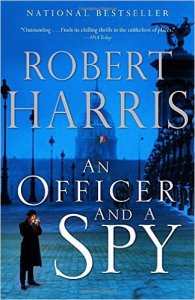
Cover for An Officer and a SpyAn Officer and a Spy is about the Dreyfus Affair. Of course, we know how the Dreyfus affair turned out, but in writing about it, Robert Harris has managed to infuse the story with suspense. He accomplishes this by concentrating not on what happens to Dreyfus himself but on the man who exposed the sham.

At the beginning of the novel, Georges Picquart is only peripherally involved in the Dreyfus affair, but the generals in charge see him as helpful and he is rewarded by being put in charge of the Statistical Section, the army’s intelligence department. Picquart does not want the post, but he soon finds he is good at his job.

His staff seems distrustful of him, while he believes that some of their methods are sloppy. He receives intelligence that indicates that there is still a traitor in the French army, and it is not long before he figures out that the army has found Dreyfus guilty for crimes committed by a Major Esterhazy.

When Picquart notifies his superiors of what he believes is a mistake, his investigation is shut down. Soon, he is sent on a mission out of the country and begins to believe that his own staff is working to discredit him. It becomes clear to him that Dreyfus was actually framed for Esterhazy’s crimes in a climate of antisemitism.

Soon, Picquart is striving to save his own career and reputation. But he also refuses to give up on his campaign to right a wrong.

This novel is deeply involving and at times truly exciting. I have not read Harris before, but picked this up because of my project to read finalists for the Walter Scott prize and since I have read it, have read most of Harris’s Cicero trilogy. This novel is a masterful historical novel that is full of suspense.

Related Posts

Murder on the Eiffel Tower

The Bones of Paris

The Night Inspector


Literary Wives! Day 1005: Mrs. Hemingway

Cover for Mrs. HemingwayToday is another review for the Literary Wives blogging club, in which we discuss the depiction of wives in modern fiction. If you have read the book, please participate by leaving comments on any of our blogs. Be sure to read the reviews and comments of the other wives!

Ariel of One Little Library
Emily of The Bookshelf of Emily J.
Kate of Kate Rae Davis
Lynn of Smoke and Mirrors
Naomi of Consumed By Ink

My Review

Although I liked Mrs. Hemingway better than many of the books we’ve read for Literary Wives, I still wasn’t that fond of it. Perhaps my reaction has more to do with my dislike of Hemingway.

Mrs. Hemingway purports to be about each of Ernest Hemingway’s four wives, particularly about the periods when each of them split from Hemingway (or in the case of Mary, when Hemingway died). As it is such a short book, it can’t really deal with their relationships in depth. And, I used the word “purports” advisedly, because this novel shows more insight into Hemingway than into his wives.

In fact, none of the wives seem like a distinctive character except Martha Gellhorn, and she, interestingly, is depicted with the least sympathy. She alone seems serious about her own writing career, even though two of the other wives are also writers, and she alone breaks with Hemingway.

Not that Hemingway actually breaks with anyone. Instead, he manipulates his wives and mistresses into impossible situations without making a decision, until something gives.

This novel did nothing to change my opinion of Hemingway as a loud, macho bully, so overtly masculine as to perhaps reflect an unsureness about his own sexuality. But I’m over-analyzing. An alcoholic, and a person who alternates charming and brutish behavior. In other words, a jerk.

What does this book say about wives or the experience of being a wife?

Literary Wives logoIt says, don’t marry Ernest Hemingway. But seriously, I don’t think we see enough of these marriages to understand them. We start out at the end of each one, with flashbacks. But it’s hard to understand what draws these women in. I didn’t really feel the charm as described. What I saw was manipulation, cruelty, and a combination of self-regard and self-hatred. Clearly, Hadley thinks he is unbelievably handsome, which he was when he was young. The others are to a certain extent attracted by his fame.

If we are to believe this book, these marriages consist of swimming, fishing, hunting, and drunken parties. We don’t really see the characters in a day-by-day existence. Maybe we see more with Mary, Hemingway’s last wife, but she is dealing with depression and madness along with the alcoholism. Still, we don’t learn very much about what makes any of these characters tick.

The most we can say is that a wife of Hemingway’s can’t rely on him to be faithful, even when he seems at his most tender. Also, that marriage is a one-way street. Everything is for the benefit of Mr. Hemingway.

Related Posts

Under the Wide and Starry Sky

Circling the Sun

The Last Wife of Henry VIII

Day 1004: Half-Blood Blues

Cover for Half-Blood BluesIn 1939 Paris after the German occupation, Sid Griffiths and the members of the Hot Time Swinger’s American Band have just finished cutting a record when Hiero Falk, German but black, is picked up by the Gestapo and never seen again. In 1992, Falk, now considered a jazz legend on the basis of that one recording of the “Half-Blood Blues,” is being honored with the opening of a documentary in Berlin. Sid quit playing years ago, but Chip Jones, another member of the band, talks him into attending.

Chip has been Sid’s frenemy since childhood. He’s a great musician, but he’s also a liar. When he and Sid get up at the opening to talk about Hiero, Chip blindsides Sid with terrible lies about him and Hiero to the audience. The problem is, Sid did do something shameful to Hiero, just not what Chip accuses him of.

After the presentation, Chip talks the reluctant Sid into traveling to Poland. He has found out Hiero is alive and has even corresponded with him. As the two travel by bus into Poland, Sid thinks back to the events of 1939.

This novel is written in African-American vernacular that sounds fairly modern, even for the part from World War II. It takes a little getting used to, although I am not sure if it is accurate for the time. Certainly, the novel effective re-creates the feeling of the time and place, and the precarious existence of these young musicians.

This novel was on both my Walter Scott Prize and Man Booker Prize lists. It was another book that I may not have chosen on my own but that I enjoyed reading.

Related Posts

Suite Française

In the Garden of the Beasts

The Good Lord Bird


Day 999: Beloved

Cover for BelovedOn some occasions after reading a novel, I find my thoughts about it are not clear. Did I enjoy it? Did I completely understand it? Did I think it was powerful or overpowering? This doesn’t happen very often, but these are my thoughts after reading Beloved.

The novel, when looked at straightforwardly, is a ghost story. Sethe escaped from slavery with her children, although the plan went wrong. Most of the other escaping slaves were killed or captured, including her husband, and Sethe had to come later, giving birth to her daughter Denver on the way.

These events happened 16 years ago, but shortly after Sethe made it across the Ohio River, Schoolteacher, the despotic overseer, came after her. To keep her children from being dragged back into slavery, Sethe decided to kill them. She was stopped, but not before she slit the throat of her daughter, Beloved. (Her name isn’t really Beloved, but that’s what’s on her tombstone; we don’t know her name.)

Sixteen years later, Sethe’s house in Cincinnati, referred to as 124, is haunted. Sethe lives there with Denver, her mother-in-law having died and her sons having left. Denver is a sulky, needy young woman who craves her mother’s attention, but that is all for the ghost of her baby.

The action begins when Paul D. arrives. Paul D. had been one of the young male slaves at Sweet Home, where Sethe was a slave. He has been wandering since the war. When he realizes the house is haunted, he drives the ghost out and lives with Sethe as her lover.

But Beloved comes back, now embodied as a girl the age she would have been if she’d lived. Denver and then Sethe become enslaved to her.

But is Beloved a ghost or just a young girl damaged by slavery? Someone in the text makes a reference to a lost girl enslaved since a child, and I think that’s who Beloved is meant to be. Denver and Sethe have just mistaken her from their own needs. There is only one chapter where we see things from Beloved’s point of view, and it is incoherent.

That is what I think, but I was confused because everyone else seems to take the novel as a straight ghost story and of course, an indictment of slavery. I finally ran across a reference to an article by an academic who believes the same thing, but I never found the original paper.

In any case, Beloved is an unusual work. It uses an unusual combination of storytelling techniques, some of which I enjoyed and some I did not. It is powerful, depicting emotions and events that we can barely comprehend. Did I like it? I don’t know. Does it make me think? Yes. Do I understand it? Not completely.

Related Posts

The Known World

The Good Lord Bird

I Know Why the Caged Bird Sings

Day 995: The Promise

Cover for The PromiseSeveral years ago, I read Erik Larson’s Isaac’s Storm, a nonfiction account of the terrible Galveston hurricane and flood of 1900. So, when one of the books on my Walter Scott Prize list turned out to be set in that time and place, I really wanted to read it. It did not disappoint.

Catherine Wainwright has behaved badly, and the result is a scandal that has resulted in her ostracism from her home town of Dayton, Ohio, and cost her livelihood as a performing pianist. In desperation, she writes to an old friend, Oscar Williams, who is a dairy farmer on Galveston Island. Although she has always considered herself his social superior, years ago he proposed to her. She did not accept him, but he is now a widower with a young son. He proposes again and she accepts. She has barely enough money to get to Galveston.

Nan Ogden is a much less sophisticated woman. She was the best friend of Bernadette, Oscar’s wife, and promised her she would take care of Andre, Oscar and Bernadette’s son. Truth be told, she has her own feelings for Oscar. Until Catherine appears, she has hopes that some day she might be Oscar’s wife. Instead, she finds herself a housekeeper for a woman who can barely boil an egg.

We don’t like Catherine at first, but she quickly grows on us as she develops more empathy for other people. As Catherine, Oscar, Andre, and Nan try to sort out their various feelings and relationships, the tension in the novel builds toward the storm. Then the novel becomes truly riveting.

The Promise is especially strong in its sense of place. I’ve been to Galveston when it was so hot I wondered how anyone could live there before air conditioning, let alone wearing corsets and tight clothes. Weisgarber really makes you feel the heat and stickiness.

Related Posts

The Tilted World

The Son

The Johnstown Flood

Day 994: The Lovers of Yvonne

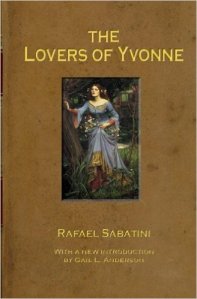
Cover for Lovers of YvonneThe Sieur Gaston de Luynes is a soldier of fortune whose fortunes haven’t worked out so well at the beginning of The Lovers of Yvonne. Almost destitute, he was lucky enough to be hired by Cardinal Mazarin to teach his nephew Andrea de Mancini arms. But in the first chapter of the novel, the Cardinal fires Luynes after Andrea becomes drunk, blaming Luynes for his nephew’s behavior.

More dangerously, Andrea, who is a very young man, has been challenged to a duel. The Cardinal orders Luynes to make sure the duel doesn’t occur. The only way Luynes can see to honorably do that is to injure the other combatant, Eugène de Canaples, first. So, he duly insults Canaples and then handily beats him in a duel, making sure to wound him.

However, this fight attracts a mob, which chases Luynes with the object of hurting him. He is only able to escape by jumping into the carriage of a woman passing by. He falls madly in love with this woman, who unfortunately is Yvonne Canaples, the sister of his victim.

If this weren’t bad enough, the Cardinal informs him that he has arranged a marriage between Yvonne and Andrea. He tells him he will see him hanged if he finds him anywhere near Choisy, where the de Canaples live. But Luynes likes Andrea, so when invited to go along with him, he does. It’s a good thing, too, because several other suitors are on the way there, most notably the Marquis de St. Auban.

This novel is Sabatini’s first, and it is full of intrigue, sword fights, and kidnappings. Sabatini had only lived in England ten years before writing it, but the English is impeccable, his sixth language. Although Sabatini was himself disappointed in this novel, it is entertaining.

Related Posts

La Reine Margot

The Black Tulip

Merivel: A Man of His Time

Day 991: The Angry Tide

angry-tideAt the beginning of The Angry Tide, the seventh novel in the Poldark saga, Ross Poldark is taking his place for his first term in Parliament. George Warleggan is so jealous about what he sees as having his seat stolen that he is buying property so that he can represent a pocket borough, a borough with few or no inhabitants. What is more serious to Ross, though, is that the Warleggans are again plotting to bring down Pascoe’s bank.

When the threat comes to Pascoes, Demelza is left to deal with it, as Ross is away in London. She does what she thinks Ross would do, which is to try to support Ross’s friend Pascoe.

While the Poldark’s marriage is still shadowed by Ross’s knowledge that Demelza was unfaithful to him, the Warleggans are getting along better. George has finally accepted the idea that Valentine is his own child.

Poor Morwenna Whitworth feels herself to be close to losing her mind. Although her husband Ossie has been told that having another child could kill Morwenna, he begins insisting on his marital rights again. But twice a week isn’t enough for him, so he begins a dangerous liaison. Soon, he gets what he deserves.

This novel is another worthy continuation of the Poldark series. Although I don’t always like the directions Graham takes, the story is always interesting.

Related Facts

Warleggan

The Four Swans

The Black Moon