Day 888: Tinkers

Cover for TinkersGeorge Crosby lies dying. He is an old man who retired and then became a clock repairman for 30 years. As he dies, he remembers the life of his father, who was a tinker—a traveling salesman of household items in the rural wilds of Maine—and an epileptic. In a way, of course, George also tinkers, with clocks.

This novel’s writing is truly astounding. Harding has a way of examining ideas and objects down to the bone. At other times, musings seem almost hallucinogenic. I wasn’t sure I understood the point of view, though. If all of the novel is from the point of view of George, as most reviews of the book seem to imply, how does he know what happened to Howard, his father—or is he imagining a life for his father?

To me, the novel seems to be about both men, in particular, about the circumstances that led to George being raised without his father. In the hard primitive life of backwoods Maine, George’s mother is resentful and cold. It is his father who is more considering and thoughtful, but a poor provider who might stop to weave pallets of grass instead of selling his goods. After a particularly bad epileptic attack, the only one witnessed by the Crosby children, George’s mother decides to have their father committed.

This novel was difficult for me to read, because I was so interested in some aspects of the plot that I glanced over some of the gorgeous prose or couldn’t concentrate on it (not my usual approach). The prose is the point of this book, however, and the meditations it evokes.

I believe this book is related to another book that also bought. I can’t remember if it is the sequel to the other book, or the other book is a sequel to it. I’ll be interested to see if reading both books enlightens me more.

Related Posts

The Quickening Maze

Mrs. Dalloway

Olive Kitteridge

Day 887: Fair Helen

Cover for Fair HelenBest Book of the Week!
I was completely entranced by Fair Helen from the first moments of reading it. It’s based on a 16th century ballad, “Fair Helen of Kirkconnel Lea.” Since one of my interests (although sadly not pursued for years) is early ballads of Great Britain, Ireland, and Appalachia, this is a good fit for me.

Harry Langdon is a city man, a scrivener from Edinburgh, the son of a craftsman, so the Borderlands seem wild to him when he answers the summons of his good friend Adam Fleming. Adam feels he needs his friend’s support. He fears his stepfather, his father’s brother, might be trying to kill him. And Harry is surprised to find Adam’s stepfather in the role of Heidsman instead of Adam after the recent death of Adam’s father. (If this sounds familiar, it’s supposed to.)

But Adam is more concerned about the disposition of his love affair. He has fallen madly in love with Helen Irvine, a beautiful and vivacious girl. But the Irvines and the Flemings have been feuding for years. (If this sounds familiar in a different way, it’s supposed to.) Helen’s parents want her to marry Robert Bell, a man with more prospects than a member of an unmade family.

We know from the beginning of the novel that none of this will end well, for we have the text of the ballad before us. And Harry in his old age is telling this story of the most important event in his life and the two people he loved most. For Helen is his cousin, and the two of them were very close as children.

The situation is complicated by the politics of the Borderlands. Harry finds himself summoned by Walter Scott of Buccleuch, a lord who frankly terrifies him (a very different Wat Scott of Buccleuch than the one depicted by Dorothy Dunnet), and is forced to spy on his friends. It becomes clear to him that there have been attempts at murder, if not of Adam, but who is behind them and why?

The novel is written in a mix of Scots and English, with a glossary provided. It is a strong style that goes well with its subject matter. At first, I was thrown off by the footnotes, which are all in the wrong places. I didn’t realize what was going on and thought they were simply non sequiturs. When I figured it out, I spent a lot of time flipping pages, trying to match them up. I honestly wasn’t sure if it was a printing error until I ran across the following passage:

I had aimed to set down plainly only what I witnessed concerning the events at Kirkconnel, to correct the folk haivers and bring some understanding. Yet already I find footnotes, asides and addenda have begun to run wild down the margins and among the lines. I like to think of them as bright wildflowers that border and run through the acres of turnip and kale by which we feed ourselves.

So, Greig is having some fun with us and in more ways than one, although this is in general not a light-hearted novel. It is lovely, though, full of yearning and regret, with a backbone of history for those who are interested.

In my recurring theme of quality printing, I have to say that this is the first modern book with properly bound signatures that I’ve seen in a long while, as opposed to the signatures being hacked off and glued. That’s great, and it means my book will stay together longer. However, the end papers were pasted down carelessly. They have creases, and some of the pages of the book stick out beyond the cover. So, Quercus Books, one big step forward and a few small ones back.

Related Posts

The Candlemass Road

The Disorderly Knights

Turn of the Tide

Day 875: The River of No Return

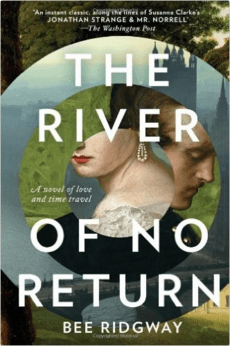
Cover for The River of No ReturnThe River of No Return was popular a few years ago, but I didn’t get around to reading it until now. The plot combining time travel and romance reminded me of The Time-Traveler’s Wife, which I loved. I found Ridgway’s book not nearly as interesting, though.

Nick Davenport appears to be a wealthy dilettante dabbling in cheese making in 2013, but in 1810, he was Nicholas Falcott, Marquess of Blackdown. While fighting in the Peninsular Wars, he was suddenly thrust forward in time to 2003. There he was picked up by a society of time travelers called the Guild, trained to live in modern times, and given a potload of money to live on. Now, the Guild wants him to travel backward to 1815, something he didn’t even know could be done, and resume his earlier life to carry out a mission for them.

Back in 1815, Julia Percy’s grandfather has just died, leaving her at the mercy of an unknown cousin. Since she was a child, Julia has watched her grandfather play little tricks with time. She is just beginning to realize that she can do it, too. Then her cousin Eamon arrives and begins looking for something, a talisman. Julia eventually realizes that she herself is the talisman.

When Nick arrives back in time, he learns he is to find a representative of a rival time-travel society called the Ofan and kill that person. The Guild has learned that the time period within which they can go forward is moving backward in time, and they think the activities of the Ofan have affected the river of time. The Guild thinks this Ofan member lives in a house neighboring Nick’s, the home of Julia Percy.  But Nick has no intention of killing anyone.

A portion of this novel is more romance novelish than I like, a fairly standard romantic plot with unlikely (for the time) sex scenes. Since I am not a fan of the standard romance novel, this was not a plus for me.

Worse, though, is the theory of time travel and its link with human emotions and monetary exchange, which is scientifically absurd. Audrey Niffenegger’s genetic abnormality is at least faintly believable.

All in all, my reaction was fairly meh. The novel is well written, but I wasn’t particularly interested in most of the characters. I thought Nick was incredibly naive about the Guild and went along with it far too long. An alternate explanation of the moving time horizon seemed immediately obvious to me, although it is not addressed in this novel. Because this novel is clearly designed for a sequel, only the romance plot is resolved.

Related Posts

The Bone Clocks

The Shining Girls

1Q84

Day 871: The Summer Before the War

Cover for The Summer before the WarBest Book of the Week!
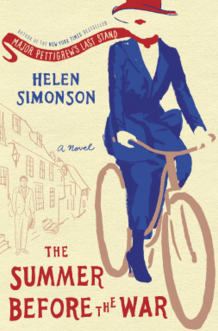
I, for one, have been waiting for Helen Simonson’s second novel ever since I read the first one. And here it is!

Hugh Grange is preparing to pick up the new schoolteacher from the station at the beginning of The Summer Before the War. His Aunt Agatha has been instrumental in the school board’s controversial decision to hire a woman as the school’s new Latin mistress. Agatha has supported the hire because the woman was the most qualified applicant, but she is aware that her position as well as the teacher’s is precarious and that the mayor’s wife, Bettina Fothergill, is up to something.

So, Beatrice Nash arrives to take the position unaware that it is already threatened. She has been eager to leave the home of her father’s relatives, where she has lived since her father’s death. She soon finds that he has bargained away her freedom by agreeing to put her money into trust in return for being allowed to return home to his estranged family. Beatrice’s trustees start right out by assuming that she is mishandling her money.

Hugh is a medical student who is working under Dr. Ramsey, a well-known Harley Street physician. Hugh is a careful person whose future is neatly charted out. He will qualify in a year and then marry Dr. Ramsey’s daughter and join his practice. But the Great War breaks out, and Dr. Ramsey pressures him to accompany him to the front. Hugh wants to finish qualifying first, but Lucy Ramsey threatens to give him a white feather if he doesn’t join up.

Hugh’s cousin Daniel is a poet, and he plans to open a journal in London with his good friend Craigmore, Lord North’s son. But after Lord North sees Daniel and Craigmore together at the local hops festival, he makes Craigmore join the air corps. Daniel joins the Artists’ Rifles in reaction.

link to NetgalleyThis description doesn’t do much justice to the novel, which is about how all the characters’ lives are affected by the war. Aside from the same kind of class and town politics featured in Simonson’s delightful Major Pettigrew’s Last Stand, we meet a handful of characters who are genuinely likable and we get very involved in several subplots.

Simonson evokes a bustling town of Rye in 1917, with it occupants becoming involved in their various war activities. Belgian refugees arrive, and the town begins to experience the first horrors of war. This novel makes an absorbing second effort that is at times very touching.

Related Posts

Major Pettigrew’s Last Stand

The Daughters of Mars

Goodbye to All That

Day 870: Jane Steele

Cover for Jane SteeleBest Book of the Week!
Fans of Lyndsay Faye’s Timothy Wilde trilogy (I am one) have undoubtedly been looking forward to Jane Steele, which she describes as a riff on Jane Eyre. In this novel, which Faye dedicates to “Miss Eyre and Mr. Nickleby,” Jane Steele describes her life as one very similar to Jane Eyre’s, only with an important difference—Jane Steele is a serial killer.

At the beginning of the novel, Jane is nine or ten years old, living in a cottage with her mother on the grounds of Highgate House. Although her mother has told her Highgate House belongs to her, it is occupied by her Aunt Patience Barbary and her cousin Edwin. Mrs. Barbary hates Jane and her mother, and after her mother’s death from an overdose of some opiate, Mrs. Barbary wastes no time in preparing to ship Jane off to Lowan Bridge School, run by Mr. Vesalius Munt. But before that can happen, Edwin tries to rape Jane, who pushes him off a cliff to his death. Terrified by the perspicacious Constable Quillfeather, Jane goes meekly to school.

It is difficult to know how much to reveal in this review, but suffice it to say that almost every action in Jane Eyre is echoed in some way in Jane Steele, but always with a twist. Mr. Munt is, if anything, a worse sadist and hypocrite than the headmaster of Lowood School. Jane Steele has a dear friend in the school, Rebecca Clarke, who comes close to dying, but when Mr. Munt offers Jane a choice between further starving Clarke or agreeing to be sent to an asylum, Jane instead chooses to stab him with a letter opener. Jane being sixteen by then, she and Clarke run off to London.

link to NetgalleyEventually, Jane meets her Mr. Rochester when she forges credentials as a governess to go work at Highgate House. There she hopes to search for proof of her mother’s claim that the house belongs to her. She finds herself in an unusual environment. The house belongs to Mr. Charles Thornfield, a nephew of Patience Barbary. Her charge is a little Sikh girl named Sahjara, and the entire household is Sikh. This household has its own secrets, to do with the betrayal of the Khaba, the Sikh military, by its own leaders.

This novel is a romping good read, full of adventure. It features a missing treasure, secret identities, several oily villains, and the resurrection of the heroine’s self-esteem. Yes, Jane kills five men. Do we still like her? Absolutely. I think you’re going to love this book.

Related Posts

Dust and Shadow

The Gods of Gotham

Seven for a Secret

Day 868: Flight of Dreams

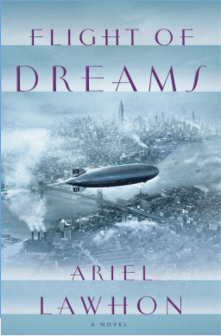
Cover for Flight of DreamsI liked Ariel Lawhon’s first book only moderately but enough so that I was willing to give her second book a try. Since the ending of the first book redeemed what I initially considered a mediocre novel, I was trying to hold out for the ending of this one. That being said, after more than 160 pages, I gave up on Flight of Dreams.

The novel is about the flight of the Hindenburg on its way from Germany to the U. S. on the trip that ends with its explosion. The novel has a large cast of characters, passengers and crew. Many of the characters have secrets, including a couple on some sort of mission, a thief who has deeper motives, and a Jewish woman attempting to leave Germany.

In what Lawhon was attempting, this novel reminded me of Dead Wake, Erik Larson’s nonfiction book about the sinking of the Lusitania. Frankly, Dead Wake built up a lot more suspense. The pace of this novel truly drags. At more than 400 pages, we follow practically every second of four days. By page 168, where I stopped, the book had only reached breakfast on the second day. Since the Hindenburg departed in the evening, I knew I was in trouble.

Perhaps there are too many characters in the novel. We see the actions from five points of view, but there is no distinct voice that differentiates them one from the other. Each narrative point of view sounds the same. Further distance is created by the chapter names, which continue to refer to the characters by their roles (the American, the Stewardess) even after we know their names.

What I’m trying to say is that I didn’t care about Max and Emilie’s romance or what was going on with the Adelts or what the American was up to. I keep making this complaint, but it seems as though some authors don’t know that part of their job is to get readers to care about what happens, not just put characters through their paces. The most notable novels I have read in recent years (or maybe ever) have all shared one trait—they have all had a distinctive voice.

link to NetgalleyFinally, some of the scenes between people play like TV melodrama. I’m thinking of the fight between the Adelts over Gertrud going to the bar and a scene where Emilie kisses a man she doesn’t care for in front of Max. These scenes seem like simply (hackneyed) devices to move the plot, not as if they are originating from the realistic behavior of a character. As far as I was concerned, the Hindenburg could have blown up 300 pages earlier.

Related Posts

The Wife, the Maid, and the Mistress

Dead Wake

Midnight in Europe

Day 865: Arctic Summer

Cover for Arctic SummerFrom its description, I thought that Arctic Summer might be one of the most interesting books I’m reading from the Walter Scott Prize list. It is described as a fictional biography of E. M. Forster, particularly leading up to his publication of A Passage to India.

That is certainly the time period the novel covers, and A Passage to India is one of its preoccupations. But the novel spends most of its time on Forster’s obsession with his homosexuality and his desire for sexual experience. As I’m not all that interested in reading about anyone’s obsession with sexuality, this novel was not the best fit for me.

The novel begins in 1912 on Forster’s first trip to India. While he is there, he will visit a good friend, Masood, and he has hopes that his life will open up, particularly in regard to sex. At the age of 33, he is still a virgin, his fear of disgrace holding him back from expressing his sexuality at home. Perhaps in India he will have an experience, maybe with Masood, whom he loves.

Unfortunately, Forster, who goes by Morgan, has a tendency to fall in love with heterosexual men and prefers men from a lower class, so nothing quite works out the way he wishes. Even when he finally has some encounters, years later, what he is actually looking for is love, which he never finds. The novel follows him during the long gestation of his novel about India, back to England, to Alexandria during World War I, and back to India again. During this time, his most significant relationships are with two friends who do not return his feelings.

The novel is extremely well written, and Galgut deeply characterizes Morgan, if not the other characters. It did make me wonder if any person could be so relentlessly focused on sex, although of course he is also lonely. It also made me wonder how, if he really felt this unrelenting focus, he ever got anything written. Certainly this novel makes you feel for Forster—he was a sad man.

Related Posts

The Master

Under the Wide and Starry Sky

Studio Saint-Ex


Day 862: The Remains of the Day

Cover for The Remains of the DayBest Book of the Week!
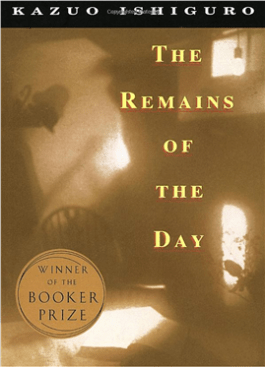
Having seen the movie The Remains of the Day years ago, I think it is just as well I waited so long to read it. Even so, some of the book’s scenes made me envision the movie, though I had forgotten most of it.

Stevens is the butler for Darlington House in the 1950’s. Lord Darlington, whom he served for 30 years, is gone, and now Stevens works for Mr. Farraday, an American. At Mr. Farraday’s suggestion, he has decided to take a holiday to visit the former Miss Keaton, who used to be the housekeeper in Darlington House. He surmises that her marriage is not altogether happy. She has split from her husband, and Stevens hopes she will agree to return to Darlington House as housekeeper. As he travels, he keeps a diary reflecting his thoughts on the journey.

To Stevens, his professional capabilities are the most important areas of his life. He reflects a great deal on such concepts as what dignity consists of. He has removed himself emotionally from the events of his own life, so much so that when his father is dying in the house, he won’t leave the dinner party he is serving. Stevens’ dedication is taken to such an extreme that when he sees in Mr. Farraday a disposition to banter with him, he, who has no sense of humor, begins to practice witticisms.

The Remains of the Day is the striking portrait of a unique individual as he comes to consider some of his life’s decisions. He has devoted his life to the service of Lord Darlington, whose political decisions before World War II left him a ruined man. Stevens thought he was helping Lord Darlington do important work, but later he had to re-evaluate that idea. In the meantime, Stevens ignored a possible other life for himself with Miss Keaton.

This novel tells a sad, sad story. Stevens is not always a reliable narrator for us, as his perceptions are as limited as his point of view. This is a novel of depth and brilliance, intricate as a puzzle box, as we delve the depth of Stevens’ psyche.

Related Posts

The Buried Giant

Life After Life

A God in Ruins

Day 856: A God in Every Stone

Cover for A God in Every StoneA God in Every Stone is a novel that seems to be trying to convey some profound truths. The trouble is, I couldn’t figure out what they were.

It begins in pre-World War I Turkey, where young Vivian Rose Spencer is on an archaeological dig. She is entranced by the thought of the history of artifacts, particularly by a story told her by Tahsin Bey, a friend of her father. He tells her of a circlet worn by the 5th century explorer Scylax, which he believes may be found in Peshawar, where the Persian King Darius sent him to explore the Indus. Viv’s visit is cut short by the start of the war, but by then she has promised herself to Tahsin Bey, who says he will fetch her in London after the war.

Viv begins the war nursing, but after a while she is unable to take the stress. Her mother agrees to allow her to journey to Peshawar as an archaeologist, but first she is drawn by patriotism and naiveté into a betrayal.

Qayyam Gul is a proud Pushtun soldier whose regiment is practically wiped out at Auber’s Ridge. He loses an eye, but it is his experience of being an Indian soldier in England that makes him begin rethinking his loyalties.

In Peshawar, Viv befriends a young Pathan boy, Najeeb, who becomes fascinated by the objects in the museum. She begins giving him lessons in the classics, but when his mother finds out, she makes him stop. Najeeb is Qayyam’s brother, and Qayyam accompanies Najeeb to Viv’s house to return her books. Not much later, Viv is forced to return to London.

Fourteen years later, Viv is enticed back to Peshawar by Najeeb’s letters. He is now employed by the Peshawar Museum and wants her to excavate the site that she hoped to explore years before. Qayyam has in the meantime become involved in the Congress, which wants to separate India from England. Viv arrives, but after violence has already begun.

Although I was interested in the characters and wanted to know what happened to them, I felt that Shamsie presents us with threads of different stories, all unexplored. We don’t learn very much about Qayyam’s experience at Auber’s Ridge or Viv’s nursing experiences, for example, or what’s going on in the Congress. We never find out what happened to Scylax’s circlet. It is almost a McGuffin. The best parts of the novel are her depictions of Peshawar. But even there, the readers’ experience seems fragmentary. In a dramatic portion of the end of the novel, a girl is introduced as an apparent partner for Najeeb, only to be killed within a few pages. The author’s intentions seem confused, as if she started with too many stories to tell and couldn’t decide between them.

Related Posts

An Atlas of Impossible Longing

The Lives of Others

The Daughters of Mars

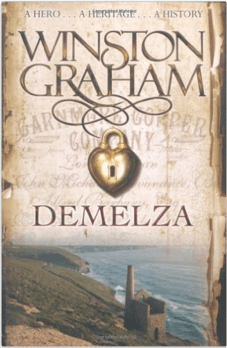
Day 854: Demelza

Cover for DemelzaAgain I had difficulty separating this novel from the Masterpiece series televised a few months ago, which covered the first two of the Poldark novels. The focus of this novel is Demelza Poldark, the kitchen maid whom Ross Poldark married at the end of the first novel.

At the beginning of the novel, Demelza is in labor with the couple’s daughter Julia. Ross has engaged Dr. Choake, who takes the situation more casually than Ross would like. The doctor checks Demelza and goes away, saying she won’t deliver until the next afternoon. But Julia arrives before the doctor does, and Ross makes yet another enemy of his own class.

Demelza has come to believe that Ross’s gentle cousin Verity should have been allowed to marry Captain Blamey. She sees Verity’s sadness and feels she has aged ten years in only a few. So, without Ross’s knowledge, she begins plotting to draw them together.

Ross is striving to avoid the Warleggans’ financial takeover of the whole district. He is pressured to take the lead in forming a business to purchase and smelt copper in an effort to bring up the price of copper for the mine owners, as smelters are bidding low to keep the profit in their own pockets. Since several of the business partners are in debt to the Warleggans, they are concerned to keep their participation secret. However, the secret comes out, in a way that destroys Ross’s relationship with his cousin Francis.

Since the Masterpiece series so closely follows the books, it will not be until I read the third book that I will be able to tell how well the book series stands on its own. However, it seems well grounded historically and is particularly interesting when dealing with the problems of ordinary people of the time, when poverty was threatening many. I also like Ross and Demelza and feel sympathy with their struggles.

Related Posts

Ross Poldark

Harvest

Castle Dor