Day 637: The Quick

Cover for The QuickAt first, The Quick seems like a straightforward historical novel about a young writer in 19th century London. But it has a twist. To be honest, if I’d known what the twist was beforehand, I probably wouldn’t have chosen this novel to read, because frankly, I’m tired of this subject. That said, I’m glad I read the book, because it is absorbing, well written, and quite suspenseful.

James and Charlotte Norbury grow up neglected in a rambling house in Yorkshire. Their father rarely comes near them after their mother dies and seems to forget they might need attention or tutors or governesses. So, while the two children run wild, it is the older Charlotte who takes care of James and teaches him to read.

After their father’s death, James goes away to school while Charlotte stays in the care of Mrs. Chickering, an elderly relative. James eventually moves to London to try being a writer, but he is not wealthy and has difficulties finding acceptable lodgings he can afford. An acquaintance introduces him to Christopher Paige, a young aristocrat looking for someone to share his rooms. Although the more austere and shy James does not envy Paige’s life of frivolity, he slowly begins to realize that Paige is his first friend—then that he is more than a friend.

One night, though, a terrible event takes place. Christopher Paige is killed and James disappears. When James does not appear at Mrs. Chickering’s funeral, Charlotte travels to London to find him.

In London, Charlotte’s inquiries attract the attention of the members of a powerful and mysterious club, the Aegolius. There has been an unexpected event at the club, and other people are looking for James. Soon, Charlotte finds herself involved with a secret substrata of the city.

Owen depicts a wonderfully atmospheric London. Although I was at first disappointed with the direction the story took, I still was unable to put this book down.

Day 635: The Secret Life of William Shakespeare

Cover for The Secret Life of William ShakespeareAs I am interested in Shakespeare and recently enjoyed a Regency romance by Jude Morgan, I wanted to enjoy this novel a lot more than I did. There is of course a risk in making a historical figure a main character in a novel, and that is that no author truly knows the mind of the real person. The truly successful novel of this type bravely forges a persona. Morgan’s solution, however, is to make Shakespeare, about whom little is known, truly amorphous in character.

The novel centers mostly on the relationship between Shakespeare and his wife, Anne Hathaway, an interesting choice, since we know they lived apart for much of their marriage. Morgan explains the marriage between Shakespeare and his bride, almost ten years older, as a love match, which is perhaps more unlikely than many different explanations for it (although of course not impossible). He has Anne reluctantly agree to Will’s eventual decision to join a group of players only on the condition that he is never unfaithful to her. Anne does not understand Will’s fascination with the theatre and views it with jealousy.

To go along with the amorphous nature of Will’s character, the details of his London life are murky. Morgan hardly ever shows him at his work or refers to any of the events of his life. Instead, he has him in conversation with various players and writers, particularly Christopher Marlowe and Ben Jonson. The introduction of Jonson into the novel is particularly confusing, as often we side track to examine his life and career as a playwright. In fact, he is a much more definite character than Shakespeare is.

It felt to me as though, in being perhaps reluctant to misinterpret Shakespeare’s personality, Morgan just doesn’t interpret it at all. Wife and friends find him equally unknowable. I had a hard time reconciling my knowledge of the plays with this reticent character. In particular, it seemed as though a man who was so fascinated with language would play with it more in his speech, as he does in Anthony Burgess’s much more adventuresome book Nothing Like the Sun. I did not buy Morgan’s idea of Shakespeare’s personality at all.

Day 632: The All-True Travels and Adventures of Lidie Newton

Cover for The All-True Travels and Adventures of Lidie NewtonBest Book of the Week!
Just by coincidence, it seems, I have read several books in the last few years dealing with the wars in Kansas over whether it would be a free state or not. Bleeding Kansas by Sara Paretsky was the first book I read on the subject and the least well done, not providing much background for readers who don’t know a lot about the subject. The next book I read was Gilead by Marilynne Robinson, much more poetic but concerned mostly with a son’s reaction to his minister father’s participation in the bloodshed. The Good Lord Bird provides more of a comic flavor to the time, but it concentrates on a portrait of John Brown. I just finished Jane Smiley’s The All-True Travels and Adventures of Lidie Newton, which provides the most background to the issues and a more vivid picture of the times.

Lidie Harkness is a tall, plain young woman who has spent most of her time avoiding her traditional duties and instead rides, hunts, and swims with her 12-year-old cousin Frank near their home in Quincy, Illinois. She is the only child of her very old father’s second wife, and her sisters are much older. When her father dies, she knows her sisters are at a loss for what to do with her and eager to get her off their hands.

She meets Thomas Newton, a New England abolitionist on his way to join friends in Lawrence, Kansas. He seems struck by the stories Frank tells him of Lidie’s outdoor abilities, and it is not long before they are married and on their way down the Mississippi.

Flyers are plastered all over Lidie’s brother-in-law’s store promising a settled paradise in Kansas, but the reality is much more frantic and primitive. Lidie and Thomas find themselvs in a bustling but rustic town and are soon trying to build a homestead from a rough 12 x 12 cabin. Of concern, though, are all the rumors about the political situation and the outbursts of violence against the mostly free-state settlers by groups of pro-slavery Missourians who are trying to force them out.

In this tempestuous climate, Lidie tries to get to know her husband and also to understand just how committed she is to the fight against slavery. The novel depicts its time and location vividly. Lidie’s is an interesting portrait of a young woman attempting to find her own place in the world and decide what she believes about marriage and the issues of her time.

Day 630: Amherst

Cover for AmherstAmherst combines the tale of two love stories, one actual and one fictional. The historical actual affair was between Emily Dickinson’s brother Austin and the much younger Mabel Loomis Todd. The modern fictional affair is between Alice Dickinson, working on a screenplay about the affair, and Nick Crocker, an older academic who gives her a place to stay in Amherst while she does her research. All of these people are married to others except Alice.

Emily Dickinson herself is a minor character in the 19th century story. Her brother and Todd used her house for their trysts—a known fact—and there is some debate about how much exposure Emily herself had to sex. Nicholson theorizes a woman listening at doors and a sort of free love attitude by everyone except Sue, Austin’s wife. I found it all a little sordid and probably unlikely.

All of this might be interesting to a reader of literature if Nicholson had spent any time with these characters before thrusting them into their love affairs. We don’t know any of them, so we don’t care about them (alas, too often my complaint lately).

Worse, to me, are the liberties or omissions at the end of the novel. Nicholson gives Todd full credit for her efforts to publish Dickinson’s poetry after her death, even having her spend hours convincing Thomas Wentworth Higginson of the value of Emily’s work. He doesn’t mention that Higginson was already very familiar with Dickinson’s poetry, having been in correspondence with her for 20 years before her death, as related in the excellent biography White Heat. (Although on the surface Nicholson seems unfamiliar with or ignores some of the content of the biography, he interestingly uses the phrase “white heat” to refer to the affair between Todd and Austin Dickinson.) Higginson was already convinced of the worth of Dickinson’s poetry—he just had doubts about how publishable it was. In fact, he almost certainly met Dickinson, which Todd never did.

The other historical fact Nicholson completely glosses over is the one the world of literature finds most shocking—that Todd and Higginson edited Dickinson’s poetry, changing capitalization and spelling but even rewriting some of the passages.

http://www.netgalley.comThe lovers are not really likable, in fact or fiction. Austin Dickinson actually consummated his affair with Todd while his wife was grieving the recent death of their young son. Mabel comes off everywhere as self-centered, and she fought with the Dickinson’s over Emily’s legacy as much as she ensured it.

The two modern lovers are just not interesting, really more of a footnote to the historical section, and I found Nick to be extremely manipulative. The novel also employs that overused trope of having Alice find out immediately in a way that is too crass to be believable that Nick has a reputation as a seducer. Note to minor characters: these warnings never work.

It’s hard to tell whether Nicholson meant these stories to be romantic, although he states in an interview that he is interested in exploring love. I did not find the stories romantic, either one of them. I also did not feel they particularly explored the theme of love. I was not at all drawn in by this novel, neither by the historical nor by the modern story.

Day 626: River Thieves

Cover for River ThievesReading River Thieves did not leave me with the same impression of wild originality as did Galore, the other Michael Crummey novel I read. Still, it is an interesting historical novel about the interactions between Europeans and the Beothuk Indians in early 19th century Newfoundland.

This novel is based on a true incident. It concerns an investigation into the killing of a Beothuk man by trappers after they went looking for redress for some thefts. This expedition brought back a Beothuk woman, later called Mary, who is captured at the beginning of the novel. But the narration of this story is far from straightforward, and we do not learn exactly what happened until the end of the novel.

Further, the characters’ actions are affected by a long history of their personal interactions. John Peyton is a young man at the beginning of the novel. He is in love with Cassie, his tutor and his father’s housekeeper, but she is somewhat mysterious and keeps aloof from him. John Sr. hired Cassie thinking that she and John Peyton might marry, but a misunderstanding interferes.

Lieutenant David Buchan encounters most of those figuring in the incident when he makes an earlier attempt to establish more cordial relations with the Beothuk than the violent ones currently existing. This expedition, which includes John Peyton, John Sr., and some of John Sr.’s employees, ends in disaster. It is the seemingly upright Buchan, later a captain, who is put in charge of the subsequent investigation.

This story is told at a remove from the characters. Although we learn the thoughts of several of them, Crummey never reveals everything, forcing us to view his characters more as an ensemble rather than to consider one a central character. In Galore, Crummey used this technique to depict the occupants of an entire village. Here, it is not quite as satisfying.

Day 624: Men Against the Sea

Cover for Men Against the SeaMen Against the Sea is the sequel to Mutiny on the Bounty, and it accomplishes an interesting feat. While Mutiny on the Bounty depicts Captain Bligh as an enraged and irrational task-master, Men Against the Sea shows him as a consummate navigator and an able leader.

The novel takes up where the mutineers put the more loyal men adrift in a small boat. They have very little food and water and only a small tool box and a few weapons. Nineteen men are crowded into the 23-foot-long open launch.

Although the men make their way at first to one of the nearby Friendly Islands (present-day Tonga), they come close to being killed there by hostile natives. In fact, one of their number is murdered while they make their escape. They realize they will have to travel 3600 miles to the nearest European-occupied territory, in the Dutch East Indies (Indonesia).

Narrated by Thomas Ledward, the ship’s surgeon, the novel tells the story of this incredible journey. The men fend off hostile natives, battle storms, and survive on scanty rations and little fresh water, lead on by Captain Bligh.

This novel is well written and engrossing, although it lacks the suspense of the trial in Mutiny on the Bounty. I am looking forward to the final book in the series.


Day 621: Smith, The Story of a Pickpocket

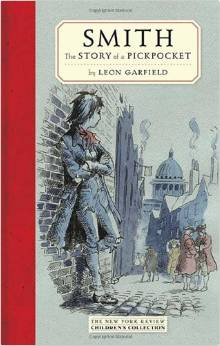
Cover for SmithI did not understand from the reviews I read for this book that it was a children’s book until I noticed its sprightly and simple tone. (My copy did not have this cover.) However, it is not suitable for just any child, because it begins with a murder and includes other violent acts. When I read in the introduction that Garfield wanted to write books full of adventure, like those by Robert Louis Stevenson, that made sense to me. The book is also described as Dickensian, but whereas some of Dickens’ and Stevenson’s books appeal to both adults and children, Smith does not have as much to offer adults.

Smith shares some plot elements with Oliver Twist, if the hero of the latter had been the Artful Dodger instead of the more innocent Oliver. For Smith is a twelve-year-old pickpocket. His adventures start when he picks the pocket of an old gentleman. Right after he does that, he sees the man murdered by two men dressed in brown. These men chase after Smith, but he eludes them.

Smith finds that all he has stolen is a paper that he can’t read. He is smart enough, though, to figure out that the paper must be important, since the men in brown are looking for him. Soon he finds he must leave the cellar where he lives with his two sisters and flee for his life. He goes looking for someone to teach him to read.

Smith’s adventures lead him to meet lots of characters who are vaguely Dickensian but somehow not as fully drawn as Dickens’ own. He finds shelter with a kindly blind man and his gruff daughter, is friends with a boastful highwayman, and meets an untrustworthy lawyer.

I found Smith only mildly entertaining but think that a child of the right age could be fascinated with this book—both by the life of a Victorian street urchin and by Smith’s adventures.

Day 620: Literary Wives! The Shoemaker’s Wife

Cover for The Shoemaker's WifeToday is another meeting of Literary Wives, where a group of bloggers get together and review a book about being a wife. If you have read this month’s book and would like to participate, leave comments on any of our blogs. Be sure to read the reviews and comments of the other wives!

One thing I can say about The Shoemaker’s Wife. It provoked discussion in our household. After reading the novel’s first two paragraphs to my husband, I asked, “Does this qualify as purple prose?” and he answered, “It’s at least very mauve.” In any case, the novel is packed with labored metaphors, some of which leave us readers with very odd mental images—for example, a comparison of the Alps to silver daggers.

The novel is based on the story of Trigiani’s grandparents, a couple who met as teenagers in the Italian Alps and then were separated by circumstances for years. I haven’t read any of Trigiani’s other books, but along with many other writers these days, she doesn’t seem to understand in this novel that making things happen to her characters doesn’t automatically make readers care what happens to them. Her characters have traits, but they don’t have any emotional depth, so we don’t care about them.

A specific example of this comes early in the book, when the girl Enza’s little sister dies. Abstractly, the death of a child is sad, but since we barely know Enza and we just met Stella a few paragraphs before she died, we don’t feel much about it. If we had a sense of the child or the older sister, we would care more.

I was unable to finish this book, so I can’t answer the usual Literary Wives questions about it. Realizing I was not enjoying it at all, I decided to read a quarter of it and if I still felt like I was wasting my time, to stop. It is a very long book, so I read about 120 pages, and Ciro and Enza had just met by then, with Ciro banished to America immediately after. When I quit reading, Ciro was on the ship to New York. So, no answers to questions about how wives are depicted in this book, not even about the main character’s mothers. Ciro’s mother abandons her sons at a convent at the beginning of the book because she can’t support them and is never seen again, and Enza’s mother is a vaguely drawn figure who simply works hard.

All novels aren’t character driven, but for me there has to be something that makes a novel interesting besides the plot. Sometimes it’s the voice of a compelling character, sometimes a puzzle, sometimes a fascination with the subject or world view being described, but it has to be something.

Literary Wives logoWhile I’m writing this, I’m thinking of examples, about how Agatha Christie could create a distinct character in a few sentences, not a nuanced one, but a distinct one nevertheless. I’m thinking how in The Secret Garden we immediately recognize Mary as an unlikable child, but we can see how the fear of waking to find everyone gone from her home in India has made her more demanding, and we sympathize. I’m thinking of how hard I cried when Beth died in Little Women. And I’m thinking how fascinated I was by 18th century Japan in The Thousand Autumns of Jacob De Zoet.

Read along with us in February, when we will be reading and commenting on The Last Wife of Henry VIII by Caroly Erickson.

Day 618: Giants in the Earth

Cover for Giants in the EarthI don’t usually read introductions until after I read a book, but I began to read the one for Giants in the Earth because I was curious about the book’s origins. I had always assumed it was an American book because it is about settlers in the Dakota territory. But in fact it was originally written in Norwegian and published in Norway in 1925 and 1926 and then translated to English in 1927, for Rölvaag came to the States in 1896 as a young man of 20.

The reason I mention the introduction by Lincoln Colcord, who translated the book with Rölvaag, is that it gives away a key plot point of the novel in the second paragraph. I couldn’t believe this, as it certainly affected how I read the novel, and it is especially egregious in that the event referred to does not happen until the very end of the book. If part of your enjoyment of a novel comes from not knowing what to expect, as mine does, do not read the introduction.

Per Hansa and his family have lost their way crossing the featureless prairies at the start of the novel. They had been travelling out with a group of Norwegians and Norwegian-Americans, but Per Hansa had difficulties with his wagon and the others went on ahead, even his best friend Hans Olsa. Then Per Hansa’s little group got lost in the fog for awhile, and now Per Hansa is afraid he might have missed the others and gone past them.

Per Hansa is an ebullient, sociable, hard-working man, and when he and his family finally arrive at the group of homesteads by Spring Creek, he is delighted with the land Hans Olsa has already marked out for him. He finds the prairie beautiful and is confident that he is going to make a wonderful life there for his family.

His wife Beret feels otherwise, and it is around her reaction that much of the novel centers. She is appalled by the prairie, this vast expanse that has not a single tree to hide behind. She soon begins to view the land as if it is some sort of godless and primitive monster, while Per Hansa sees only that it is rich and fertile.

The novel is set in the 1870’s and early 80’s and details the hardships of life so far away from any amenities. The men have to travel days for firewood in one direction and for supplies in another. Still, more immigrants keep arriving until there is a little settlement by the creek.

This is a fascinating novel about the Norwegian contribution to the settlement of the country. It is a realistic novel, not romanticized, with no big feats of heroism or villainy, just details of the life these people have chosen and its effects on them.

Day 616: The Rathbones

Cover for The RathbonesBest Book of the Week!
The Rathbones is a strange and wonderful novel, part gothic mystery, part magical realism, about a whaling family in the 18th and 19th centuries. Mercy Rathbone is a girl, the last of a mysterious family. She lives in a massive house only partially built that used to house dozens of people. Now only her aloof mother lives there with her and her cousin Mordecai—who stays in the attic and acts as her tutor—and a few servants.

Mercy has vague memories of a brother that her mother and cousin tell her never existed. She has not seen her father for more than ten years, although packages from him occasionally arrive. She is curious about the family portraits in a gallery, all with the names removed. She knows the names of her mother and father but has no idea who her grandparents were, or how they related to Moses, the patriarch of the family.

One night Mercy is attracted by the sound of a boy singing and ventures into a part of the house where she is not allowed, the widow’s walk where  her mother goes every night. There she witnesses her mother being embraced by a strange man, and that man chases her through the house. She finds refuge with Mordecai, and the two decide to go to sea to find her father. They flee in a little dory, pursued by the strange man.

So begins a wonderous adventure, where they encounter an island occupied only by old ladies; an island of rich, eccentric cousins with a massive collection of furniture and art; an island of birds occupied by a woman who only speaks bird language. At each stop Mercy learns more about the odd and sometimes grotesque history of her family, many of whom have a magical affinity for the sea.

I do not usually enjoy magical realism, but with this novel I loved never knowing where the story would go. It is an odd one, certainly, and probably not for everyone, but it is imaginative and unusual.