Day 614: The Bridge of San Luis Rey

Cover for The Bridge of San Luis ReyThe Bridge of San Luis Rey is a moral fable that explores whether there is a purpose in life beyond that of a person’s own will. This theme is not one that interests me, nor do I usually enjoy fables, but I did enjoy Wilder’s rich characterizations in this short novel.

The novel begins in 1714 in Peru, when the bridge of San Luis Rey collapses, killing five people. A monk, Brother Juniper, believes that this event may be his opportunity for scientific proof of the will of God. So, for six years he collects information about the lives of each victim.

What follows is a chapter about each of the lives of the victims, in all their humanness and contradictions. The Marquesa de Montemayor is an ugly, rich old woman who is despised by many for her eccentricity. She obsessively loves her daughter, who has moved to Spain to get away from her, and she writes her rambling but marvelous letters that only her son-in-law reads. With her dies her young maid Pepita.

Esteban is a twin whose brother Manuel recently died. Esteban and Manuel were inseparable until Manuel fell in love with the actress Perichole, who used him to write her love letters. Ever since Manuel’s death, Esteban has been inconsolable.

Uncle Pio was a wanderer who eventually settled down to mentor Perichole, whom he raised from a young barroom singer to become a great actress. But Perichole begins to have ambitions beyond the theatre and eventually throws off Uncle Pio. Uncle Pio has devoted himself only to her, though, and promises to educate her son Jaime.

This novel is beautifully written and touching in its acceptance of the foibles of humanity.
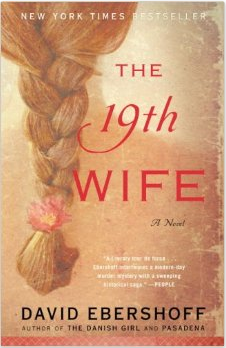
 

Day 612: The 19th Wife

Cover for The 19th WifeBest Book of the Week!
The 19th Wife is actually two interleaved novels, one as interesting as the other. The novel that begins the book is a modern mystery. The novel that dominates the book, however, is historical, about Ann Elizabeth Young, Brigham Young’s 19th wife, whose lectures after she left the Latter-Day Saints were partially responsible for ending the authorized practice of polygamy within the church.

In the modern story, Jordan Scott is a young man who grew up with the Firsts, a fundamentalist Mormon group that still practices polygamy. At the age of 14, Jordan was booted out on his own because he held his stepsister Queenie’s hand. Jordan’s intentions were not amorous, because he is gay, but he realizes that the young men are ejected from the group so that the old men can keep the young girls for themselves.

Jordan is living in California when he reads that his father has been murdered and his mother, Becky Lynn, arrested for it. As his mother is a complete believer who actually dumped him out on the highway herself those years ago, he does not believe she murdered his father. The evidence against her is that another wife saw her coming from their husband’s room looking upset. Jordan’s father was texting someone just before he was killed and remarked that his 19th wife was at the door. That wife is Becky Lynn.

While Jordan tries to find out what happened that night, we read the story of Ann Elizabeth Young, a woman born into the Church of Latter Day Saints but who has always been clear on the evils of the practice of polygamy. This story is told through fictional excerpts from her autobiography, newspaper clippings, statements by Brigham Young, and other documents.

Ann Elizabeth begins with the story of how her own parents, once devoted to each other, were forced into polygamy by Brigham Young, and what pain it caused her mother every time her husband took another wife. This pain was amplified by the hypocritical ruling that the first wife had to accept all future wives into the household before further marriages could take place. Ann Elizabeth’s own first marriage is also marred by threats of polygamy, which her husband uses to manipulate her despite having promised before marriage not to practice it.

Well written and convincingly characterized, this novel is absolutely engrossing. Although I found the modern mystery interesting in its insights into fundamentalist Mormonism as currently practiced, I found the story of Ann Elizabeth’s life even more compelling. Ever since reading Jon Krakauer’s Under the Banner of Heaven, I have been fascinated by this subject.

Day 608: The Convenient Marriage

Cover for The Convenient MarriageThe Winwood sisters are in turmoil. Miss Winwood has gained a spectacular suitor in the Earl of Rule, who has finally decided to marry. He is wealthy, and his generous settlement will save the family from ruin. The only problem is that Miss Winwood is in love with Edward Heron, a mere army lieutenant and a second son with no fortune.

Young Horatia Winwood, not yet out of the schoolroom, thinks she has the solution. Rule wants to marry a Winwood, and it should not matter to him which one. So, she goes to his house and proposes herself as an alternative. She forthrightly points out her unfortunate eyebrows and her stammer and hopes that Rule won’t mind them. Rule is enchanted.

So, Horry gets married without realizing she has made a love match. Since Rule is afraid he may be too old for her, he treats her with a little too much care. She has told him she won’t interfere with him, so she says nothing when she learns about his mistress, Caroline Massey.

Rule has broken with Massey, though, who is jealous and angry. Crosby Drelincourt, Rule’s foppish heir, is eager to make trouble, as is Rule’s enemy, Robert Lethbridge.

Horry soon finds herself very popular. But her efforts to make Rule jealous and the plots of Rule’s enemies land her in trouble, and her scapegrace brother Pelham’s schemes to get her out of it only make things worse.

In Horry, Heyer has created another engaging and feisty heroine. Heyer is an expert on the Regency period, as well as the master of warm and funny romantic escapades, and The Convenient Marriage is one of her best.

Day 597: Neverhome

Cover for NeverhomeBest Book of the Week!
After some personal tragedies, Ash Thompson leaves the farm in Indiana to join the Union army and fight in the Civil War. Although the truth about Ash is not immediately apparent, I feel little hesitation in revealing that Ash is a woman, because the publicity for this novel makes that clear. Why she has chosen to leave her husband Bartholomew and go off to war is another matter.

Ash, who is tall and strong, shows herself to be a brave and obedient soldier, resourceful and a good shot. No one knows her for what she really is except a few women she sees in passing and her colonel.

This story is told by Ash herself in a very understated way. In fact, it is the voice of this novel, so distinctive, that makes it stand out. It is not until the end of the novel that we learn that Ash is not always a reliable narrator.

http://www.netgalley.comThis novel is beautifully spare and compelling, a wonderful portrait of a person who is more disturbed by violence and her personal tragedies than she appears to be.

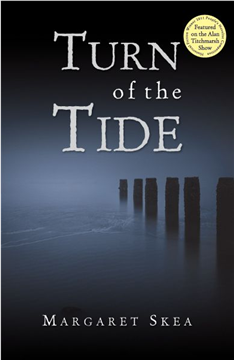
Day 595: Turn of the Tide

Cover for Turn of the TideTurn of the Tide is a historical novel set in the 16th century that centers around a long-running feud between two Scottish families, the Cunninghames and the Montgomeries. The feud and some of the events are factual, although the main character and his family are not.

The novel begins when the Cunninghames summon Munro. Not a Cunninghame himself, he is a minor laird who owes them allegiance. But he is not happy when he finds the plan is to massacre a bunch of Montgomeries on their way to meet with the king.

Although Munro’s wife Kate is angry when she finds he took part, she is even more angry when she finds out later that he has befriended some of the Montgomeries. This apparent change of loyalties could cause even more problems for their small family. King James has forced the two families to make peace, but it is an awkward one, with both families jockeying for position in court.

Munro is most wary of his uneasy relationship with William Cunninghame, the Earl of Glencairn’s heir and a brute. As Munro becomes closer to the Montgomeries and William’s eye alights on Sybilla Boyd, the fiancée of Munro’s brother Archie, the relationship between Munro and William becomes dangerous.

This novel never quite gets off the ground for me. Although I don’t demand action from every book, this one has very little going on for much of the time. Skea does so little to differentiate some of the characters that I kept getting confused about who they were. The novel begins with the massacre and ends with some action that is not really satisfactory. In between it concerns itself with grown men literally jostling for position with King James, the form of which seems silly, although probably exactly what went on.

The novel is also about Munro’s family life, mildly interesting but not compelling. It is nicely written with some Scots dialect. It just isn’t very tightly plotted.

Day 587: Harvest

Cover for HarvestBest Book of the Week!
Harvest seems to be concerned with exploring the dark side of human nature. Set in an unspecified time in the past, it focuses on unusual events in a small, remote village.

The villagers are celebrating the harvest. They are so busy drinking and eating that they forget to appoint their harvest queen. Groggily awakening the next morning, they spot two fires. One is green wood burning in the distance, a signal that some new family is establishing itself. The other is the master’s resented dovecote and the stables. Someone has set fire to the dovecote, and the fire has spread.

The novel’s narrator, Walter, noticed three young men return the night before with a load of hallucinogenic mushrooms and a dried puffball. He knows there is no use for the puffball except to spread a fire. Still, he decides to say nothing.

After the fire is out, Walter notices how the men he believes guilty behave over-helpfully to Master Kent and insist that the newcomers must have set it. So, the master and some of the villagers go off to see them.

Walter has injured his hand in the fire, so he stays home. But he soon hears how the villagers caved in the roof of the hovel so that it injured the young woman inside and how the master sentenced her two companions to a week in the stocks.

For some reason I felt dread from the onset of this novel, and this feeling was not wrong. Although the villagers have already started trouble by not confessing their actions, much worse is to come. For kind Master Kent has lost his property through an entailment to his wife’s cousin, a ruthless and cruel young man who is only interested in enclosing the common land and putting it to sheep. Now that he is master, it is up to him to mete out justice when the next incident happens.

Although Walt’s main fault is inaction, he soon finds himself being treated like a stranger again, for he came to the village long ago as a servant to Master Kent. Soon the village he loved is unrecognizable.

This novel is masterfully written, about how greed and ignorance can destroy a community. It is a dark and twisty tale.

Day 579: The Daughters of Mars

Cover for The Daughters of MarsNaomi and Sally Durance are sisters and Australian nurses in 1914. They are divided by old grudges and a new crime. The older Naomi deserted their home in the bush for a career in Sydney, leaving Sally stuck there with their parents. More recently, their mother was struck down with cervical cancer and suffered terribly. Sally stole enough morphine from her own hospital to help her mother die, but one day after Naomi arrived, Sally found their mother dead and the drugs gone. Sally feels guilt at her part of the crime and resentment that Naomi could do what she could not.

There is a fervor in Australia for the war, so both women decide independently to volunteer as nurses. They set out by ship for Egypt, then to serve on a hospital ship off Gallipoli, and finally to France.

This novel shows extensive research into the conditions of World War I for nurses, and of their treatment. Although by and large they receive respect, that is not always the case. In an incident based on a true event, their hospital ship Archimedes is employed for one mission as a troop carrier, its red crosses blacked out. It is torpedoed and the survivors, including Sally and Naomi, wait in the water clinging to a raft for hours for rescue. During this traumatic wait, one soldier after another simply lets go.

After the nurses are rescued, they are put to work in a hospital on Lemnos, where the officer in charge sees no use for them and lets the orderlies treat them with disrespect. All their possessions lost, they are given local peasant dresses to wear instead of uniforms. Eventually, an orderly rapes one of the nurses and after a perfunctory investigation, gets off lightly.

The adventures of the sisters and their friends are indeed interesting and provide a different view of the war. With the few of Keneally’s books that I have read, Schindler’s List being the most well known, I have felt a certain distance from events and characters. This book is no exception, but at the same time I wanted to see what would happen.

Although told in a straightforward limited third-person narrative that moves between the point of view of the two women, Keneally offers up an alternate ending. It is not one we can choose between, but one where he tells us what might have happened and then tells us what did happen. The ending brought tears to my eyes but also seemed a little like a trick.


Day 577: Red Sorghum

Cover for Red SorghumRed Sorghum is absolutely brutal. It tells the story of a Chinese family during the time of the Second Sino-Japanese War. Most of the action of the book takes place in 1939 and a few years thereafter, although there are glimpses of years before and later. I say book, because it is described in some places as a series of novellas and in other places as a novel.

The two main characters are Yu Zhan’ao, the narrator’s grandfather, also known as Commander Yu, and Dai, his grandmother. The narrator’s father Douquan is a less important character. The narrator himself only makes an appearance in the last two pages.

The book begins with an ambush of the Japanese near Black Water River. But nothing here is related in a straightforward manner. The narration moves back and forth in time as Commander Yu’s preparations for the battle alternate with the story of Uncle Arhat’s kidnapping as slave labor for the Japanese and the story of how Yu Zhan’ao meets Dai. There is plenty of violence in all of these stories, and we are not spared any details of guts falling out, decapitated heads, or anything involving bodily functions.

The Chinese are at war through most of the book, of course, but various factions of Chinese fight and kill each other just as viciously. Although Commander Yu wins the battle of Black Water River, almost all of his men are killed when his ally, Detachment Leader Pocky Leng, fails to turn up at the ambush, then steals all of the captured armament.

Earlier in time but later in the book, Grandfather Yu meets Dai on her way to marry a rich man’s son. Her father’s greed has betrothed her to a leper. Yu seduces her on her way back to visit her parents after three days of marriage and then goes off to murder her husband and father-in-law, leaving her a rich widow.

Sometimes the violence in this book is so extreme it is almost funny. People behave grotesquely—they are crude, barbaric, disgusting, venal, and revengeful. Commander Yu is almost more eager to kill Pocky Leng than he is the vicious Japanese, who are nearly cartoonish in their evil.

In between scenes of almost unbelievable brutality are beautiful descriptions of nature, with a strong emphasis on color. Red is consistently a symbol of life and goodness while green is its opposite. Sometimes blood is green instead of red and too the sun can be green. This use of color comes to a focus in the last pages of the novel, where Mo Yan laments the disappearance of the wonderful red sorghum (a major presence in the novel) and excoriates its green hybrid replacement.

I found very little to like in this book. I read it all, but I basically had to force myself to finish it (and beautiful descriptions or not, I got tired of reading about sorghum). I know the book has received a lot of admiration, and I do not exactly agree with the criticism that it glorifies violence, but there is a lot of very graphic violence in the novel.

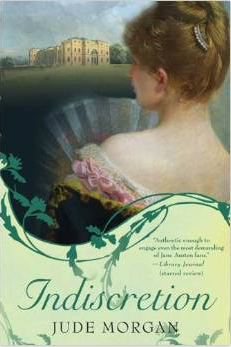
Day 576: Indiscretion

Cover for IndiscretionIn Regency London, Caroline Fortune and her ex-soldier father have been surviving at the edge of poverty for a long time. When her father reports that he has lost all his money in a bad investment, Caroline decides to look for work as a governess.

Soon, her father tells her he has found her a better situation, as companion to Mrs. Catling, the widow of her father’s former colonel. In his ebulliant way, he assumes Caroline could easily be left Mrs. Catling’s fortune. Caroline is not pleased with the situation, nor does she have any hopes of Mrs. Catling’s generosity, but seeing no other option, she takes the position. With no relatives other than her father to fall back on, as her mother’s relatives disowned her mother after her marriage, Caroline moves to Brighton to wait on Mrs. Catling.

Caroline soon learns that Mrs. Catling is demanding and petulant. She treats her servants harshly. When Mrs. Catling’s niece and nephew, the Downings, come to call, Caroline witnesses how her employer manipulates Matthew Downing with the promise of her fortune. Still, Caroline manages to get along with the Downings and Mrs. Catling fairly well, even receiving unwanted confidences from Matthew. However, her dependent position unexpectedly leaves her open to an insult from an unscrupulous man.

Re-opened contact with her relatives eventually removes her to an entirely new neighborhood and life, and she makes some new friends. After awhile, though, her experiences in Brighton return to haunt her.

I don’t often read romance novels and tend to stick to the older authors I love when I do. I have found no writer who can surpass Georgette Heyer in Regency romances. But a friend recommended this novel to me, and I found it quite entertaining. It does not seem simply a copy of Heyer as some other Regency novels have. The dialogue is witty. Once Caroline leaves Brighton she meets some endearing characters, and the plot is both complex and interesting. Caroline is an intelligent and engaging heroine. For some light, escapist reading, I recommend Indiscretion.

Day 575: All the Light We Cannot See

Cover for All the Light We Cannot SeeI felt a bit of distance while I was reading All the Light We Cannot See, but by the end I was brought under its spell. It is about a German boy and a French girl who meet briefly during World War II.

Werner is growing up in an orphanage in Germany. He has always been fascinated by how things work, particularly electronics, and he is far advanced of his teachers in math. One day he discovers a broken radio set in the trash and is able to make it work. He and his sister Jutta discover a children’s broadcast from France in which a man explains science topics and plays music. This station delights them for years until it becomes dangerous to listen to under the Nazi regime.

With all his gifts, Werner is slated to work in the mines when he is old enough. He gets an opportunity, though, to attend a technical school. Against Jutta’s advice, as Werner has avoided being pulled into the orbit of Nazi politics, he takes his chance.

Marie-Laure’s father is a locksmith employed by a Paris geological museum. At the age of five she becomes blind. Her father teaches her to find her way in their neighborhood by making a model of it, which she learns by feeling her way. She loves spending time at the museum, learning about all its treasures and handling the shells. She also loves reading adventure stories in Braille.

When the Nazis are due to invade Paris, the museum gives four stones to four employees to keep safe. One of them is the museum’s most precious possession, a fabled diamond with a curse attached; the others are fakes. Marie-Laure’s father receives one of them, and the two leave the city, eventually arriving in St. Malo, where Marie-Laure’s great-uncle lives.

The diamond acts as sort of a MacGuffin in this novel. Of course, we are sure who has the real stone.

The stories of Marie-Laure and Werner’s pasts alternate with the bombing of St. Malo in 1944 by the Americans. Werner is trapped with some German soldiers in the basement of a hotel, while Marie-Laure is hiding in her great-uncle’s house from a German officer searching for the diamond.

This novel is beautifully written and shows the hardships of war from both sides of the conflict. Werner struggles with his desire to do what is expected vs. what is the right thing. Marie-Laure tries to resist the chaos of war in other ways. I felt for a long time that the novel would end predictably, but I was pleasantly surprised and delighted by how the ending opened up from a claustrophobic setting to a more universal feeling.