Day 512: Troubles

Cover for TroublesBest Book of the Week!
It is the summer of 1919. Major Brendan Archer has just left the hospital after his experiences in the trenches of France. When on leave in 1916, he met Angela Spencer. Although he has no recollection of having asked her to marry him, she has ever since then written him exhaustive letters signed “Your loving fiancée.” Determined to find out if he is engaged, the Major travels to the Majestic, Angela’s family hotel in County Wicklow, Ireland.

Troubles is about the decline of the once powerful Anglo-Irish aristocracy. Nothing symbolizes this decline quite as effectively as the state of the Majestic. Once a grand resort hotel, the Majestic is now the crumbling permanent home for a handful of old ladies who knew it from their heyday.

The Palm Court is so overgrown that it gets more and more difficult to find the chairs. No staff is visible when Archer checks in, and he is finally vaguely shown around by Ripon, Angela’s brother, who urges him to pick a room. When Archer retires, he finds his bed has no sheets, and his investigation of a sickly smell leads to the discovery of a sheep’s head in a pot in his room. Most frustrating, though, is that he can find no opportunity to speak to Angela, who shortly after his arrival shuts herself up in her room.

Major Archer soon finds himself drawn into the activities and personalities of the household. Angela’s father Edward seems unconcerned about the increasing decrepitude of the house. He occupies himself with projects such as raising piglets in the squash court or conducting bizarre experiments in “biological research.” He is most concerned with preventing Ripon from marrying the daughter of a merchant, whom Ripon has made pregnant. Edward’s objection? She is Catholic.

It is the time leading up to the partition of Ireland, with events that 40 years later will result in The Troubles. To Edward’s way of thinking, along with most of his class, those who want independence from Britain are nothing but hooligans. He refuses to recognize that his impoverished and desperate tenants have legitimate grievances.

The growing sense of dissolution both in Ireland and—periodically interjected by newspaper articles—in other parts of the British Empire keeps the novel from being simply a comedy such as Cold Comfort Farm. That, and Farrell’s writing style of cool and precise satire. As poor Major Archer bumbles in a well-meaning way through the political briars and Edward becomes more detached from reality, the Majestic slides perceptibly into ruin.

This is another book from my Classics Club list.
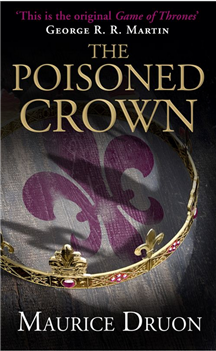
Day 502: The Poisoned Crown

The PoCover for The Poisoned Crownisoned Crown begins with the beautiful and devout Clémence of Hungary on her way into a pit of vipers, the court of Louis X of France, and marriage with the king. Louis has managed to rid himself of his inconvenient first wife. His attention span is short, however, so by the time Clémence arrives after a horrendous journey he is more involved with an ill-conceived siege against the Count of Flanders than with arrangements for the wedding. Still, the new queen is soon esteemed for her gentleness and generosity, even by her horrible husband.

During Louis’ short reign, France has already descended from relative prosperity to famine, and the progressive steps taken by his father have all been rescinded. Robert of Artois, always trying to cause trouble for his aunt Mahaut, has provoked her barons to rise up against her in Artois. The cardinals have still not settled on a new pope. In short, France is in chaos. Louis’ younger brother Philip of Poitiers has striven to dissuade his brother from his poorer decisions, but Louis sends him off to the papal conclave.

Another character who has served in previous books as almost comic relief will soon become more important. This is Guccio Baglioni, the very young nephew of a rich Lombardi merchant. He has fallen in love with the daughter of impoverished nobility, Marie Cressay, and hopes to marry her, without understanding how much beneath them her family considers him. He has just helped escort Clémence of Hungary to France when he is badly injured.

The curse against the Capet kings of France continues in this third book of Druon’s excellent series The Accursed Kings. Those who are following it will not be surprised to learn how short Louis X’s reign will be.

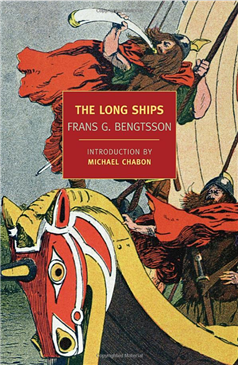
Day 496: My First Classics Club Review! The Long Ships

Cover for The Long ShipsBest Book of the Week!
Today I’m posting my first review for The Classics Club, the one chosen for me by the Classics Club Spin #5!  The Long Ships is a great start to the Classics Club for me. I found it to be a rousing adventure story full of deadpan humor.

This book is the result of Bengtsson’s desire to write a realistic novel about the Vikings. A poet, Bengtsson also wrote essays and a biography of Charles XII, but he became more widely known for The Long Ships.

His protagonist Orm Tostesson is only a boy when the novel begins. Orm is eager to go a-viking to Ireland with his father and older brother, but his mother tends to be protective of him, so he stays home. Shortly after the men leave, he attempts to stop some sheep stealing on the part of a group of Vikings from Lister and is kidnapped by them. The Vikings soon find him an able and intelligent companion, so he becomes part of their crew rather than being kept a slave.

In the course of their adventures down the western coast of Europe, they are initially successful but eventually are captured and sold as galley slaves. In return for a service they performed for a Jew from Córdoba, they are freed to serve as bodyguards for lord Almansur, the regent and imprisoner of the young Caliph of Córdoba. There they serve for years until circumstances force them to flee for home.

This voyage is the first of three related in the novel, during which “Red” Orm meets his bride to be, loses her when his best friend Toke steals her father’s concubine, goes a-viking to England to try to retrieve her from English priests, and many years later travels down the Dnieper to bring back a stash of hidden gold. Even when he is settled at home, he is involved in tiffs with his neighbors, attempts to murder him on the orders of the evil King Sven, visits from unusual acquaintances, rowdy celebrations, and a Thing, a convocation of various groups of Vikings for settling their differences.

There is plenty of action in this novel, but what I find most charming are its air of insouciance and its ongoing (although somewhat grisly) humor. It has a sense of playfulness, especially about the differences between the Norsemen’s old religion, Christianity, and Islam, to which Orm and his fellows are temporarily forced to convert. Take, for example, this passage from the prologue, about the arrival of the shaven men, or priests, in Skania:

They had many strange tales to relate, and at first people were curious and listened to them eagerly, and women found it pleasant to be baptized by these foreigners and to be presented with a white shift. Before long, however, the foreigners began to run short of the shifts, and people wearied of their sermons, finding them tedious and their matter doubtful . . . . So then there was something of a decline in conversions, and the shaven men, who talked incessantly of peace and were above all very violent in their denunciation of the gods, were one by one seized by devout persons and were hung up on sacred ash trees and shot at with arrows, and offered to the birds of Odin.

To give you another idea of the humor in this novel, a Viking tells a story of a wedding that broke up into a fight. When the bride sees the groom’s friends beating up one of her relatives, she hits the groom with a torch, which starts his hair on fire, beginning another fire in which 11 people are killed. Everyone agrees that it was the best wedding they ever attended.

The story of Red Orm is told in a detached manner but by a truly talented storyteller. It is full of sly humor and observations of human folly. I really enjoyed it.

Day 490: The Glass Palace

Cover for The Glass PalaceBest Book of the Week!
In the late 19th century, the kingdom of Burma was one of the wealthiest in southeast Asia. Its people were all literate, and no one in the country went hungry. Hundreds of thousands of Indians and people from other nearby countries traveled there to work on the waterways or the teak plantations.

In 1885, the Burmese government imposed a fine on a British trading company for avoiding taxes by under-reporting the amount of teak it was exporting. The British government used this incident as a pretext for invading the country and taking the royal family captive. King Thebaw and Queen Supalayat and their children, along with a few servants, were deported to India, where they were kept captive for the rest of the king’s life in a crumbling, poorly maintained house. Their personal possessions, including the king’s valuable jewelry collection, were confiscated and returned to England.

It is around this shameful incident that the beginning of The Glass Palace is constructed, an ambitious novel that tells the recent history of India and Burma/Myanmar through the stories of several related families. Rajkumar is a 10-year-old Indian orphan whose mother died in their attempt to reach Burma, and he is working at a small cooking stall near the palace when it is breached. He witnesses the removal of the queen and the princesses, and is struck by the beauty of Dolly, their young servant. Dolly is the only one of the lady’s maids who chooses to follow the royal family into exile.

Rajkumar goes to work for a Malayan businessman named Saya John Martins. With Saya John’s help and advice, Rajkumar eventually makes his fortune in the teak industry and finally travels to India to look for Dolly. She accepts his proposal and returns to Burma with her friend Uma, the recent widow of the first Indian Collector, the official in charge of the Burmese royal family.

These are just the bare bones of a dual story rich in characters and detail, on the one hand that of Rajkumar’s efforts to better himself, on the other hand that of the lives of Dolly and the royal family in exile. But this novel is not a love story, and that is just the beginning of this novel, which continues until the present. The novel follows the fates of Rajkumar and Dolly’s children and grandchildren and those of Uma’s nieces and nephews in India and Burma as the families intermarry with each other and with Saya John’s children. As we follow the fortunes of some family members in Burma and Malaya, other family members get involved in the Indian movement for independence from the British empire.

During the Japanese invasion and bombings of Burma and Malaya during World War II, various family members struggle to survive, one an Indian soldier in the British army, one a rubber plantation owner, one a photographer who disappears in Malaya. Rajkumar and Dolly and their daughter-in-law and grandchild are forced with thousands of other Indians to make the thousand-mile trek back to India.

Ghosh is interested in telling a complex story of culture and  history, so he keeps us at a remove from his characters, but that does not make the novel any less moving. The novel does an amazing job of exploring the roots of problems in Myanmar and India through its exposition of events and the varying points of view of its characters. This is a captivating and ambitious novel.

Day 487: The Book Thief

Cover for The Book ThiefLiesel Meminger is nine years old when she arrives at a house in a poor street near Munich. Her mother has given her and her brother up to a foster family because she cannot support them, but her little brother died on the train on the way there. She is dirty and illiterate, and when she arrives at the house of Hans and Rosa Hubermann, she has to be coaxed to come inside.

Although the Hubermanns prove to be loving parents and Hans eventually teaches Liesel to read, it is 1939 in Nazi Germany. Slowly, the difficulties of living in the Third Reich and the hardships of war will affect everyone she knows.

Liesel has already stolen her first book, when a grave digger dropped it the night her brother died. She steals her second book from a fire on the night of a book burning, for small and even large acts of defiance have become a part of her nature.

Zusak depicts a vivid life within Liesel’s little community. The boy that becomes her best friend, Rudy Steiner, has already distinguished himself before they meet by covering himself with soot and pretending to be Jesse Owens during the 1936 Olympics. Hans Hubermann is a failing painter and virtuoso accordion player who is ultimately too kind for his own good. His gruff wife Rosa shows her inner kindness by forcing people to eat her dreadful soup.

The novel is told by Death, which acts as an omniscient narrator, sometimes telling the back story, sometimes giving a glimpse of the future. At the beginning of the book, I thought I was going to find this irritating. By the middle of the book, I was wondering if it added anything that a traditional narrator wouldn’t provide. By the end, I thought it was effective. One little quirk of style that bothered me a little, though, was that Zusak occasionally creates his own words when perfectly good ones that are very similar already exist, like lovelily instead of lovely. I think this is an affectation that adds little to the novel.

The Book Thief accomplishes an unusual goal—to show that there were decent Germans during World War II. One of the kind and dangerous things that Hans Hubermann does is shelter a Jew, Max Vandenburg, in his basement for months. Liesel’s relationship with Max forms a core part of the story.

This novel is involving and affecting. It does have a few difficult scenes, but I think that it is a very readable experience for tweens, teens, and older readers. It has been wildly popular, so obviously readers are enjoying it.

Day 486: Empress of the Night

Cover of Empress of the NightIn early November 1796, Catherine the Great of Russia suffered a stroke and lay on her deathbed for 36 hours before she finally succumbed. Eva Stachniak’s second novel about Catherine imagines her spontaneous flashbacks of her life, interrupted by moments of fleeting awareness, as she lies there helplessly.

Empress of the Night covers some of the same ground as Stachniak’s The Winter Palace, only the previous novel is told from the point of view of Varvara Nikoleyeva, Catherine’s spy turned confidante, and concentrates mostly on the time before Catherine was Russia’s ruler. Varvara is only a fleeting presence in Empress of the Night, and I wonder if readers who had not read The Winter Palace would be confused by references to her.

Stachniak’s deathbed approach for this novel by definition causes it to be disjointed in narrative style and sometimes difficult to follow chronologically. The novel portrays Catherine as a figure more sympathetic than otherwise, but other characters are left relatively undeveloped.

Catherine’s memories go all the way back to her arrival in Russia as Sophie von Anhalt-Zerbst-Dornburg, a prospective bride for the Empress Elizabeth’s spoiled and childish heir Peter. We follow her struggles to be accepted as a future wife, to conceive, and to maintain some kind of standing in Elizabeth’s court, although that subject is covered more thoroughly in the first novel. The narrative carries us through the coup against her husband after Elizabeth’s death and the most important events of Catherine’s reign, ending with her attempts to marry her granddaughter Alexandrine to the king of Sweden and to leave her office to her grandson Alexander instead of her foolish and tyrannical son Paul.

Although this novel is interesting, I was not as drawn in as I was by the first book. The parts of the novel dealing with Catherine’s stroke and its aftermath interrupt the flow of the narrative too often. I was also taken aback by the preponderance of attention given in the novel to Catherine’s favorites, especially to the annoying Zubov, versus the actual events of her rule. The emphasis seems to lie with her personal attachments, which I frankly think is unlikely for a world ruler. I also find it hard to believe that Catherine had so much patience with some of her relatives and lovers, most of whom are characterized as being annoyingly selfish.

Since I have read a fair amount about Catherine’s life, I was able to follow the references to important events with little difficulty, but I am left wondering how easy it would be for someone who is unfamiliar to form a good understanding of what is going on. Still, I think this novel draws an appealing portrait of a complex and difficult person.

http://www.netgalley.comMy original understanding of The Winter Palace was that it was the first in a trilogy about Catherine the Great. I am left wondering if I was mistaken, because this novel does not seem to leave anywhere for the writer to go in a third novel. Empress of the Night is ultimately much less satisfying than The Winter Palace in the depth it applies to its subject, which makes me wonder if Stachniak simply lost interest.

Day 483: Reread: The Strangled Queen

Cover for The Strangled QueenThis article is a repeat review of the second book in Maurice Druon’s excellent Accursed Kings series. I wrote my initial reviews years after I read the books, from memory. This review is from a recent reread in preparation for my first review of the third book in the series.

The name of Philip the Fair would glow down the centuries only by the flicker of the faggots he had lighted beneath his enemies and the glitter of gold he had seized. It would be quickly forgotten that he had curbed the powerful, maintained peace in so far as it was possible, reformed the law, constructed fortresses that the land might be cultivated in their shelter, united provinces, convoked assemblies of the middle class so that it might speak its mind, and watched unremittingly over the independence of France.

So says Druon in his prologue to The Strangled Queen about Philip IV of France (Philip the Fair), whose death in 1314 begins the action of the novel.

Marguerite of Burgundy has not heard of Philip’s death. She and her sister-in-law Blanche, Philip’s daughters-in-law, are imprisoned in the Château-Gaillard for adultery, and she does not know that her husband has become the king of France, Louis X. When her cousin Robert of Artois comes to tell her, she naïvely believes he wants to help her, unaware how he has assisted in her downfall. What he actually wants is for her to agree to an annulment, as now she poses a big problem to the succession.

But Marguerite doubts when she should not. Although she would gladly exchange her harsh prison for a convent, she is afraid that once she signs, those in charge of her will leave her where she is. She also does not want to declare her daughter a bastard, the other requirement of her release.

Louis X soon sets his sights on marrying Cleménce of Hungary. To do so, he must get a pope installed who will agree to give him an annulment. However, the cardinals have been arguing ever since the death of Pope Clement V, who with Philip the Fair was a victim of the curse of the Grand Master of the Knights Templar (whose death by burning at the stake is referred to in the quote at the beginning of this review).

The weak and stupid Louis is faced with a battle between the forces of order and progress, represented by Enguerrand Marigny, his father’s coadjutor, and the old ways of feudalism, represented by his uncle, Charles of Valois. Whoever can get Louis a pope or his marriage with Cleménce will ultimately win, but in the meantime he begins stripping away all of the governmental reforms instituted by his father.

Bitingly told, about a fascinating period of French history, these novels introduce us to a world of complicated alliances, treachery, and politics, as well as murder and mayhem. Lately the novels are being marketed as the original Game of Thrones. There are certainly strong similarities.

Day 482: The Map of Love

Cover for The Map of LoveBest Book of the Week!
The Map of Love is an absorbing novel to read now, just after the Arab Spring and during the troubled times that have continued on. It is a love story certainly, its title tells you that, but it also explores the roots of the political turmoil in present-day Egypt and some of the other countries that used to be a part of the Ottoman Empire.

The novel follows the course of two cross-cultural love affairs 90 years apart. In 1900 Anna Winterbourne travels to Egypt in an attempt to overcome her grief. She is the widow of a man who recently served in the Soudan, and even though their marriage was not a happy one, she is sorrowful that she could not help him overcome his despair at participating in an unjust war. Almost accidentally, she meets Sharif al-Barroudi, a Cairo lawyer and activist, and falls in love with him.

Anna’s diary and letters are discovered by her great-granddaughter, Isabel Cabot. Isabel herself has fallen in love with ‘Omar al-Ghamwari, a famous Egyptian-American orchestra conductor who is rumored to work with the Palestinians. ‘Omar feels that their age difference is too great for a relationship, but he suggests that Isabel take her find to his sister Aman in Cairo so that she might help Isabel translate some of the materials.

Aman becomes absorbed in reading Anna’s diaries and letters and realizes very soon that she and Isabel are related, for Anna’s beloved sister-in-law Layla is Aman’s own grandmother. With Layla’s diaries of the same time period, she begins to reconstruct Anna’s story and that of Egypt’s history during a turbulent period. Aman has returned from life abroad to live in Cairo in another turbulent time.

Anna’s courtship is fraught with difficulties, but once she and Sharif are married, she is caught up in his work for Egyptian independence from the Ottoman Empire and from British oversight. As the years go by, his efforts extend to attempts to keep Palestinian land, once owned by his family and by his neighbors and occupied by hundreds of thousands of Muslims, from being bought up by Zionists who would expel them.

The blurb for this novel stresses the similarities between the two love stories, and there are many points of similarity, but the focus of the story in the current time is more with Aman than with Isabel and ‘Omar. Aman is at first at loose ends in Cairo, but she becomes involved with trying to help the fellaheen who occupy her family’s land, as they are treated unjustly by a corrupt and paranoid government. I was frankly more interested in Aman and in Anna and Sharif than I was in Isabel and ‘Omar, who are much less present in the novel.

For me, not very politically aware in regard to problems in this part of the world, this was a fascinating and revealing reading experience. It points up the complex history of the area from a point of view we westerners seldom hear. It is affectingly told in the context of a great love affair between two lovingly created characters. The characters of the two sisters, Layla and Aman, are also vivid. This novel is beautifully written and evokes for us a vibrant culture.

Day 478: Mr. Timothy

Cover for Mr. TimothyAlthough not typical holiday fare, Mr. Timothy picks up some of Dickens’ characters about 20 years after A Christmas Carol and has the added similarity of being set at Christmas time. The main character is Timothy Cratchitt, familiar to us as Tiny Tim.

Timothy is depressed and aimless. The patronage of Ebenezer Scrooge, or Uncle N as he is known in this novel, has had the unfortunate effect of making Timothy dissatisfied with his roots while not fitting him for much else. Most of his family has died or moved away, and he is depressed about the death of his father six months before. In despair, he has left his usual haunts and gone to live in a brothel, where he teaches the owner, Mrs. Sharpe, how to read. Although he has some desire to make his own way, he lacks purpose and initiative, still accepting an allowance from Uncle N. He seems to be on his way down in life.

Timothy goes out dragging the river for bodies one night with his friend Captain Gully, and they pull out a young girl. She has an odd brand on her back, like a G with eyes. Timothy realizes he has seen this brand before, on another girl the police were examining as he went by, who was found dead in an alley.

Timothy has several times spotted another young girl around the city and tried to approach her, but she has always run away. With the help of a street urchin named Colin, he finally tracks her down. Philomela is Italian and has had something traumatic happen to her of which she will not speak. When Timothy tries to take her home to safety, two different parties attempt to remove her from his custody on the street. A charity worker insists she will take Philomela to a home, and a mysterious man in a coach tries to kidnap her. Philomela and Timothy get away, but now Timothy is determined to find out what is going on.

This novel is a slow starter and fairly depressing at the beginning. Although it is feasible to theorize that Scrooge’s help could result in such unhappiness (ala Great Expectations), I wasn’t sure I wanted to think of the original story in these terms. However, the novel successfully invokes a Dickensian atmosphere, including the comic characters and character names, and it picks up its pace as Timothy gets involved in the mystery. After the first 50 pages or so, I was involved and trying to figure out the mystery, which is as entangled as any Dickens effort.

Day 476: The House of Special Purpose

Cover for The House of Special PurposeThe House of Special Purpose is an alternative history novel that looks at the end of the Russian monarchy with just a slightly different twist. It’s a familiar one, though, that Grand Duchess Anastasia escaped the execution of the royal family. Why is it always Anastasia, I wonder? This information is not a spoiler, for it is evident early on.

Most alternative histories start with the change to history and show how things would be different. This one is the portrait of Anastasia’s relationship with the main character, Georgy Danilovich Jachmenev. In fact, history isn’t changed in this novel except for that of a couple of people.

Unfortunately for my enjoyment of this novel, I could not suspend my disbelief for two of the foundations of the plot. The first is that the Tsar would appoint a peasant’s son, Georgy, to guard the Tsarevich Alexei on the basis of one incident, misunderstood as bravery. The second, even more vitally, is that Anastasia would give a boy with this background, and presumably no education (although oddly well spoken), the time of day. That she would throw herself into a love affair with him almost at first sight is utterly unbelievable. It is unlikely that he would even have been allowed to talk to her.

I’m not sure why Boyne had to stretch our disbelief so far. He could have made our hero a minor member of nobility or even a middle class boy and I would have bought it. Think me elitist if you will, but I don’t believe Boyne has any idea what life was like in the Russian peasantry.

With this problem always in mind, it was difficult for me to enjoy the novel, which, except for journeys back to the past, is about a fairly complex marriage. But again, it doesn’t deal with, for example, any difficulties Anastasia—or Zoya as she is called through most of the novel—might have had coping with the problems of a normal, even impoverished life. We skim over things like that, as well as how effortlessly Georgy seems to adjust to life in the Winter Palace. Or whether in post-revolutionary Russia, any couple could just jump on a train and travel to Paris without identity papers.

So, on the one hand I was absorbed by the novel at times, on the other it seemed too unrealistic. It is well written, and Georgy and Zoya are appealing characters, but it does not, in the end, constitute a convincing story.