Day 397: Sylvester, or the Wicked Uncle

Cover for SylvesterOn occasion, I reread a few of Georgette Heyer’s Regency romances, which have been some of my favorite reading for many years. Just recently, I reread Sylvester, which in some editions is titled Sylvester, or the Wicked Uncle.

The extremely eligible bachelor Sylvester, Duke of Salford, has decided to take a wife. His only difficulty is in deciding which of five eligible girls to marry. When his beloved mama mentions that she and her best friend made a plan for their children to marry many years before, he decides to go inspect the girl, his godmother’s granddaughter, to see if he might like her. Although he is warm and thoughtful to those he cares for, since his twin brother’s death, he has been aloof to others and comes off as haughty.

Sylvester’s visit is disguised as a hunting party, but Phoebe Marlow is informed by her detestable stepmother that the duke is coming to make her an offer. Unfortunately, Phoebe has already met Sylvester and took such a dislike to him that she used him as the villain in a novel she wrote. That novel is going to be published, despite all expectation. Normally, she would not expect him to recognize himself in a silly gothic romance that pokes fun at various society figures, but for the mention of Sylvester’s very distinctive eyebrows.

Fearful of her stepmother’s pressure and not understanding that Sylvester has no intention of proposing, Phoebe talks her childhood friend Tom into escorting her to her grandmother’s house. However, an accident and a snowstorm strand her and Tom with Sylvester in a small country inn.

After Phoebe gets to know and like Sylvester, she is horrified to find out that he has a nephew, since in her silly romance his character is a wicked uncle who wants to steal his nephew’s fortune. Another horror lurks, because Phoebe’s book proves to be a smashing success, much read by society members, who are all trying to identify their friends. Since Phoebe has never brought herself to admit to Sylvester that she wrote a book, she soon fears that people will find out she is the author.

Heyer creates delightful, engaging characters and puts them into silly and unbelievable situations, which is part of the pleasure of reading her novels. They are very well written, with entertaining and sparkling dialogue and a complete understanding of the customs, dress, and speech of the period. If you decide to read Sylvester, get ready for some fun. Many of Heyer’s novels have been re-released in the past few years, so they should not be hard to find.
Day 394: The Fountain of St. James Court or, Portrait of the Artist as an Old Woman

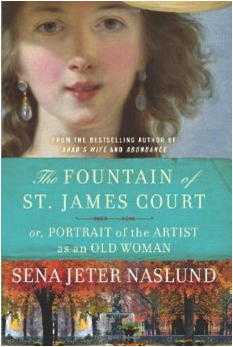
Cover for The Fountain of St. James CourtI received this book in a First Reads giveaway from Goodreads. I haven’t read Naslund before, so I am not sure whether she adapted her writing style for this novel, but it took me awhile to accustom myself to it. She follows the activities of two artists, one Kathryn Callaghan, a fictional older writer in the current time, and the other a once-living person, Élisabeth Vigée-Le Brun, a painter known especially for her portraits of Marie Antoinette.

The modern-day story begins at midnight next to a fountain of Venus in a neighborhood of Louisville, Kentucky. Kathryn, or Ryn, is taking her newly finished manuscript to her friend Leslie’s door because she can’t wait to deliver it.

The novel’s structure is a book within a book. Chapters following one day in Ryn’s life are interleaved with chapters covering the whole of Vigée-Le Brun’s life, which are from Ryn’s book. Both stories are about the theme of what it means to be an artist and what you must give up of your personal life to pursue your profession. The novel is said to be a deliberate variation on Joyce’s Portrait of an Artist as a Young Man, but it has been so long since I’ve read it that I cannot comment on that.

This novel is contemplative, especially in the modern-day narrative, but the interleaving of stories in such short chapters slows down the pace too much. It literally takes until page 34 for Ryn to walk across the street and deliver the manuscript. Even with some chapters from the 18th century interleaved, the pace is frustrating. I found myself thinking, when is this woman going to make it across the street?

I found the story of Vigée-Le Brun’s life more compelling than the modern-day story, during which we follow Ryn’s every thought. She is an excitable, emotional woman who contemplates everything she looks at and repeatedly broods over the same things. We read about the russet and yellow fall colors or the appearance of the fountain many times. Nothing much happens all day until a late-night confrontation that seems artificially created to provide some tension.

I did not feel, however, that the two women, Ryn and Vigée-Le Brun, were two different people–they seemed to be the same person in different time periods. Vigée-Le Brun is slightly less emotionally excitable than Ryn, but their observations of the world around them, their attention to color and the details of design and structure, are very similar. Vigée-Le Brun’s narrative style, in first person where Ryn’s is in third person, is a little more formal as befitting an earlier age, but conversations in this story often sound stilted, and her first conversation with Marie Antoinette is positively sycophantic.

Naslund’s writing style, although sometimes vibrant and lyrical, often seems affected, particularly in the modern-day story. The copy I read was an advanced reader’s edition and it had quite a few typos, which I assume will be corrected. I was not quite as sure of some self-consciously unusual phrases, whether they were stylistic choices rather than errors. Naslund’s writing style tends to the unusual, to be sure, but I stumbled over some of these phrases. The only one I wrote down was an instance where some characters “made quick chat.”

I wanted to like this novel more than I did. I think the theme of women and art is worth exploring, although I’m not sure how much this novel actually explored this issue, despite its obvious intentions. I am actually curious about the alleged feminist leanings of Naslund and their effect on this book. Vigée-Le Brun has to put up with her father and then husband appropriating all her money and, in her husband’s case, only giving her a bit of it back as an allowance. When they divorce, he gets almost everything. Yet, she is determined not to let it bother her. I am not sure whether that is a feminist viewpoint or not.

However, the characters in this novel certainly reflect the “gift for pleasure” noted in reviews of Ahab’s Wife (which I am currently reading). The women go on pursuing their lives and dreams without much heed to their menfolk, they have cordial relations with those around them, they delight in color and the fineness of life. Their regrets and sorrows mostly focus on their children.

One thing that surprised me about the historical story was that Vigée-Le Brun hardly seemed to notice the causes of the French revolution or the revolution itself. There is one scene where a woman confronts her on the street and another where she grieves for the fate of so many. That’s about it.

Conversely, it is hard to believe that she would be shocked to the core by seeing a model of internal organs, as artists had been studying the body for hundreds of years. I do not know how much of this novel actually reflects Vigée-Le Brun’s true thinking and feeling. The danger when portraying a historical person is that you are imagining who the person really is–you don’t know–and you have no idea if you are doing them justice or injustice.

Day 383: The Hamlet

Cover for The HamletWhen I got into The Hamlet a bit, I realized that a bastardized version of it had been released as a movie years ago called The Long, Hot Summer. But Paul Newman’s charming rascal is not at all the same animal as his original, Flem Snopes, a despicable man who rises in life using chicanery, cheating, and blackmail to wrest what he can from the poorest of the poor.

The Hamlet is part of a trilogy of novels about the history of the fictional Yoknapatawpha County, Mississippi, beginning shortly after Reconstruction. In particular, it is about the rise of Snopes, the son of an impoverished sharecropper. It begins when Jody Varner, the son of Frenchman’s Bend’s most powerful citizen, Will Varner, leases a property to Snopes’s father Ab, suspected of being a barn-burner. Jody thinks he’ll be able to cheat Snopes out of his yearly crop by alluding to his alleged crimes at the appropriate time. But soon he is more inclined to fear that Snopes will burn him out, so he offers Snopes’s son Flem a job as clerk in the Varner store as insurance.

Soon Jody has lost his own position as manager of the store to Flem Snopes and Snopes has apparently taken over Jody’s standing with his own father. Somehow Snopes begins accruing valuable property and gives away many of the jobs in the village, over which Will Varner has control, to Snopes cousins, whether they are capable of doing them or not. Eventually, he makes a deal to marry Will Varner’s young daughter, the voluptuous Eula.

Life among the Frenchman’s Creek sharecroppers is grim, and the story of the rise of this gray, tight-lipped, cold man is told through a limited third-person narration that moves from person to person. This narrative style creates a sort of plural viewpoint of all the village folk and is combined with the intelligent observations of itinerant sewing-machine salesman V.K. Ratliff, who alertly follows Snopes’s maneuvers and understands all his cheats–or so he thinks.

This novel is created from a series of tales, and it is really about how the tales of an area form its history. It is elegantly written, reflecting a formidable intelligence and education, and is sometimes grimly comic. It comments on the decay of the South in the aftermath of the American Civil War and the Reconstruction, as Frenchman’s Bend is a run-down little village built on the ruins of a once-stately plantation. The legend of gold supposedly buried on the grounds of the plantation plays a pivotal part in the story.

Day 378: Cascade

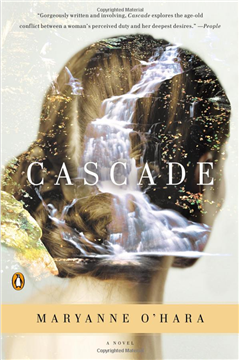
Cover for CascadeIt would be nice to know how much O’Hara expects us to like Desdemona Hart Spaulding, the heroine of Cascade. Unfortunately, I think we may be thrust too abruptly into Dez’s troubles to get to like her.

A promising artist who has studied in Boston and Paris, Dez has already been forced to leave that life when we meet her. The Great Depression cost her father his fortune, and he had to close down the famous theater he founded in the resort town of Cascade and sell his treasured First Folio of Shakespeare. Dez was forced to withdraw from art school and hastily married her childhood friend Asa Spaulding so that she and her father would have somewhere to live. Her father dies soon after, and she is taken aback to find he has left the theater to Asa.

Still, considering she married a man with little interest in or understanding of her drive to create art, Asa has set aside a bright room in their house for her studio, and she paints for several hours on most days. Asa wants a child, though, and Dez fears that her precious painting time would be taken up with child rearing. She is secretly doing what she can to prevent conception.

Two things soon make her dissatisfied with her life. Her art school friend Abby stops by on her way to a new life in New York, and suddenly everything in the depressed town looks shabby, even the beloved playhouse. Dez has also formed a friendship with a Jewish man named Jacob Solomon, who has taken over his father’s peddlar’s route. Jacob, though, is a gifted artist who plans to sell his father’s inventory and move to New York, hoping for a job with the Works Progress Administration. He meets Dez once a week to discuss art, but after a dispute, Asa asks her to stop meeting Jacob.

Asa is concerned because the town is under threat. Cascade is one of two possible towns that may be flooded to create a reservoir that will supply water to Boston. Asa wants to mobilize an effort to save Cascade, and Dez has the idea to paint a series of postcards showing Cascade in the past and present in an attempt to garner public support for the town. She is able to sell this idea to a prominent national magazine. All the while, however, she is secretly hoping the town will lose and she will have an excuse to move to a large city. The agreement she makes with the magazine and other disastrous decisions cause her to betray her husband, her town, and finally even Jacob.

I think O’Hara wants us to sympathize with Dez in her growing ambition to go to New York and take up a career in art. But some of her actions don’t just show poor judgment; they are despicable. As the plot advances, I feel less and less sympathy for her.

A review from the Boston Globe calls Dez complex and says she doesn’t always make the right choices. I think it’s worse than that; the trouble is really with where she places her priorities. The town is in danger of dying, in the horrible economy many people’s welfares are at risk, but Dez puts her future as an artist first and barely gives the other townspeople a thought, in fact, seems to feel superior to them. She supposedly yearns to reopen her father’s playhouse but doesn’t seem to give it much attention when it is threatened, although she eventually makes a deal that saves it. She has married for selfish reasons and is all too ready to give up on her marriage.

Of course, the principal theme of the novel is how much to give up for art, but in this case, it is not Dez who does the sacrificing. I wish I had liked this novel better. I think that if we’d had a longer time with Dez in her art student life and gotten to know her before she began a series of lies, deceptions, and betrayals, I could have felt more sympathy with her struggle.

Day 374: A Plague of Lies

Cover for A Plague of LiesA Plague of Lies is the third in the mystery series set in 17th century France and featuring Charles du Luc, a master of rhetoric at the Louis le Grand school in Paris.

Charles is dismayed when he is summoned to escort Père Jouvancy to the court at Versailles to present Madame de Maintenon with the gift of a holy relic. Madame is angry with the Jesuits because the King’s confessor, Père la Chaise, convinced the King not to give her the title of Queen, so the gift is an attempt to regain favor. Although Charles disapproves of what he sees as the Sun King’s constant self-glorification, he must escort Père Jouvancy, an old man who is just recovering from an illness that is raging through Paris.

On their way to Versailles, Charles and Jouvancy encounter Lieutenant-Général de la Reynie, head of the Paris police, whom Charles has assisted on occasion. La Reynie asks Charles to keep an eye on the Prince of Conti while he is there and to listen to what is said about him.

Once at court, though, Père Jouvancy has a relapse, and Charles comes close to witnessing the death of a much-disliked man, the Comte de Fleury. Apparently, he too was ill and running for the latrine when he slipped on the wet floor and fell down the stairs. The rumor is that he was writing a scandalous memoir, and poison is immediately mentioned. When the other members of Charles’ party fall ill, there are more rumors of poison, but all the men seem to just have food poisoning.

De Fleury does appear to have been poisoned, however, and Charles observes several people going in and out of his room, including the Duc du Maine, son of the King. Charles finds himself getting embroiled in the problems of the Duc’s sister, Mademoiselle de Rouen, who is soon to be engaged to the son of the King of Poland and is not happy about it. Charles also observes Conti behaving suspiciously. Next, a gardener is found drowned.

The novel presents us with a convoluted plot but also with a fascinating portrait of the court at Versailles. Rock’s knowledge of the period, even of how the places she describes would have appeared at that time, seems convincingly complete. Her novels are always absorbing.

Day 366: The Pale Blue Eye

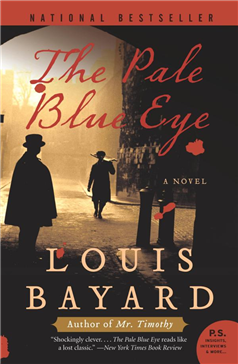
Cover for The Pale Blue EyeGus Landor, a retired New York police detective, is dying, and he writes the account of his last case in The Pale Blue Eye. Gus is a lonely widower who earlier moved up to the mountains near the Hudson Valley with his wife and daughter to help improve his lungs. But his wife died within a year, and his daughter left him soon after. So, Gus lives as a veritable hermit.

On an October morning in 1830, an officer from West Point fetches him. The body of a cadet named Fry was found hanged the night before, presumably a suicide, but during the night his body was stolen and later he was found with his heart removed. Superintendent Thayer and Commander Hitchcock wish to hire Landor to find who stole the heart. Landor is quick to figure out that Fry did not commit suicide but was murdered. A mysterious message clutched in his hand seems to indicate an assignation.

Landor soon realizes that his investigations on the reservation will be sorely hampered without the assistance of an inside man. So, he asks for the help of an unusual cadet he has met who is not in good favor with the academy–Cadet Edgar Allan Poe.

This is a clever novel with a macabre mystery that would have been completely to Poe’s taste. Just when we think everything is figured out, Bayard presents us with a twist. His portrait of the young Poe, bombastic, ridiculously romantic, and fearfully intelligent, is a great pleasure.

I would only fault the novel for a slow-paced middle section, and only because Landor doesn’t seem to be doing anything. Most of the plot is driven forward by Poe’s reports, which begin to dwell on his infatuation with a lovely young woman, Lea, the daughter of the post doctor, who unfortunately suffers from the “falling sickness,” or epilepsy.

Of course, Landor is doing something–he’s deciphering Fry’s diary–but since he doesn’t relate its revelations, his investigation seems to flag, and he barely seems to look into a second death, with a second missing heart. Otherwise, the novel is well written, with well-developed and interesting characters and a surprising ending.

Day 363: The Captive Crown

Cover for The Stewart TrilogyAt the beginning of this novel, the third in Tranter’s Stewart Trilogy, Jamie Douglas has fled to the highlands after being declared an outlaw following the disastrous battle of Homildon. That no Scot who fought in the battle would so call him is no concern to Robert Stewart, Duke of Albany and the Governor of Scotland.

Jamie is living with his family on the estate of Alexander Stewart of Badenoch, acting Justicaire of the Highlands. Although King Robert III is still alive, he has handed over the government to his brother Robert of Albany. His young son James, heir to the throne, has been captured by the English on his way to France, where his father sent him for safety after the death of his older son, David, at the time in Robert of Albany’s custody.

Jamie, who has always believed that the Duke of Albany plotted the murder of his chief, the Earl of Douglas, also believes that David Stewart was starved to death at Albany’s order. Jamie is content to stay away from the Lowlands and serve with Alexander.

The plot of this novel is a lot more difficult to describe than that of the other two, as it covers the significant events of several years in Alexander Stewart’s life, including battling the invasions of Donald of the Isles, forming an embassy to the British to treat for the release of King James after Robert III’s death, privateering against the British, and so on. This is a fault with the novel, constrained as it is by actual historical events to seem disjointed. It is definitely the weakest of the trilogy and does not make a satisfying ending for the series.

Day 358: People of the Book

Cover for People of the BookBest Book of the Week!

I read People of the Book several years ago and remembered that it was good, but when re-reading it for my book club, I enjoyed it even more. The novel is based on the history of a Hebrew codex known as the Sarajevo Haggadah. Part of the novel is envisioned based on what is known of the book’s history, while the rest is invented.

In the immediate aftermath of the Bosnian war, Hanna Heath, an expert in the restoration of old books, is asked to restore the priceless Sarajevo Haggadah, a famous book believed twice to have been destroyed by war that was both times rescued by Moslem museum curators. The book is especially important because of its beautiful illustrations, as before it was discovered, scholars believed that old Hebrew books did not contain such illuminations.

While Hanna is working on the book, she makes observations and collects artifacts that will help trace its history. She notes that the book once had clasps that are now missing, collects an insect wing, and scrapes residue from staining.

Hanna also becomes involved with the man who rescued the book, Ozren Karaman, whose wife was killed during the war and whose baby son is in the hospital with a brain injury. As Hanna was raised by an aloof and competitive mother, though, she is poor at forming attachments.

When Hanna finishes restoring the book, she follows up with research into the clasp and the artifacts she collected. As she finds out about each item, the novel goes farther back in time, explaining what happened to the book and telling the stories of the people involved with it, until the creation of the book in 15th century Spain.

A poor Jewish girl named Lola works for the partisans in the forest outside Sarajevo during World War II after the Jews are expelled from the city by the Nazis and her family is shipped off to camps. Later she is helped to safety by the Moslem curator of the museum, who also has a book to hide. A 19th century Viennese bookbinder who is dying from syphilis steals the beautiful silver clasps from the book to exchange with his doctor for treatment. In 1609 Venice, a priest working for the Inquisition saves the book from burning but confiscates it from its owner. A young girl saves the book as the Jews are expelled from Spain in 1492.

These are just the bones of some of the absorbing stories that draw you along as Brooks imagines the history of the book. Each tale is vividly imagined and skillfully told, and they are all held together by Hanna’s experiences. People of the Book is a gracefully written and imaginative novel that emphasizes the contributions of multiple cultures and religions to the book’s creation and safety.

Day 353: Friday’s Child

Cover for Friday's ChildFriday’s Child is one of Georgette Heyer’s funniest Regency romances. Although some of her novels are a bit closer to being “serious” romances (that is, with the emphasis on the romance, but always with witty dialogue), this novel is endearing in its plethora of foolish characters.

Anthony Verelst, the Viscount Sheringham, is a wild young man who is extravagantly wasting his inheritance on gambling and women, but his estate is left so that he cannot touch the principal unless he marries. He has fancied himself in love with the current reigning beauty, Isabella Milbourne, but he is not tempted to matrimony until he becomes fed up with his mother and her brother, one of his trustees, whom he believes is milking his estate. He proposes to Isabella, plainly expecting an answer in the positive, but piqued by his lack of ceremony, she rebukes him for his dissipated lifestyle. In a rage, he storms off, vowing to marry the first female he meets.

As he is returning to London from his mother’s house in the country, he meets Hero Wantage, a very young lady who is an impoverished orphan and a neighbor. He thinks of her as a little sister, so he has no hesitation in relating the tale of his misfortunes. When he tells her of his vow, she answers, “Silly, that’s me!” So, the heedless viscount throws her up into his curricle and drives her off to London to get married. Since she has long worshipped the Viscount, or Sherry, as he is known to his friends, and has been mistreated by her Bagshot relatives, she is happy to go.

The couple is naturally headed for trouble, for Hero is completely naïve and badly brought up, with no idea of how to behave in society. The heedless Sherry seems to feel that he can go on about his business as always without paying much attention to her, so she begins befriending the wrong people and otherwise falling into scrapes.

This novel features an outstanding cast of secondary characters, especially Sherry’s close friends–Gil Ringwood, a thoughtful young man who vaguely feels there is something wrong with the way Sherry neglects his wife; Ferdy Fakenham, a silly but warm-hearted dunderhead reminiscent of Bertie Wooster; and George, Lord Wrotham, a hot-tempered gentleman who constantly challenges other men to duels and is madly in love with Isabella. As a side comment, I think it is a hallmark of a good Heyer novel that the characters who would be the heroine and hero in a typical romance novel (that is, Isabella and George) provide some of the humor in her own novels, especially the devastatingly handsome George, with his exaggeratedly romantic behavior.

Heyer is one of my favorites for light reading, and Friday’s Child makes me laugh out loud, particularly when Ferdy gets it into his head that he and Gil are being pursued by “that dashed Greek we learned about at Cambridge. Kept lurking about in corners,” in other words, Nemesis. The characters are funny, the dialogue is witty, and the plot is full of twists and turns.

Day 351: The Fixer

Cover for The FixerBest Book of the Week!

In 1911 Russia, Yakov Bok is tired of his difficult life in the shtetl. So, after his wife leaves him for another man, Yakov travels to Kiev in hopes of making a better living. When he helps a drunken man who is passed out in the snow, Yakov is offered a job supervising a brick yard. However, in order to take this job, Yakov must live in a part of the city forbidden to Jews.

It is this circumstance followed by a series of mishaps that ends up with Yakov being accused of murdering a boy he chased away from the brick yard. As the case continues, it becomes clear that the murder is being used by authorities an an excuse to trump up charges of ritual murder against the Jewish community.

The novel becomes more and more difficult to read as literally everything that happens to Yakov makes things worse for him. The gentiles he knows in Kiev tell lies about him. Once he is in prison, the jailers do everything they can to incriminate him, including trying to entrap him into breaking the rules or admitting his guilt.

Yakov goes into jail a nonpolitical, irreligious, naive man who hopes for justice, and the novel is partially about his development into an angry man who refuses to be beaten. Although almost nothing in the way of plot or action happens from the time he goes to jail, I was absolutely compelled to finish reading.

Written in a storytelling fashion that I associate with the tales of Sholem Aleichem or Isaac Bashevis Singer, this novel is more grim than most of the stories I’ve read by these other writers. However, both The Fixer and The Bloody Hoax, by Aleichem, are based on a true event from 1911 Kiev, called the Beiliss blood libel case.