Day 105: This Side of the Sky

Cover for This Side of the SkyThis Side of the Sky is Elyse Singleton’s novel about the friendship between two African-American women. It begins when the two are growing up in a small town in Mississippi during the 1930’s. Myraleen is a light-skinned beauty but sarcastic and stubborn, who sometimes tries to pass for white. Lilian is dark, more educated, quiet and hard-working.

The two girls become close friends, even though Lilian’s mother looks down on Myraleen. Eventually, they move away to Philadelphia where they get menial jobs. There they find more freedom but segregation that is more hidden. With still more ambition, they join the Women’s Army Corps towards the end of World War II, eventually ending up posted in London and then Paris.

Although the plot of this novel is sometimes interesting, the characters never seem to be real people. Each of them has only a few characteristics. Nor does the period setting seem particularly convincing except for the details of small town life in a poor, rural area. London during the war is not very well depicted, and Paris is barely depicted at all, as if the author has never been to either city. A few chapters from the point of view of Kellner, a German prisoner of war who is involved with Lilian, seem particularly unconvincing.

Overall, I felt this story should have been very interesting, but it was ultimately lacking in the kind of detail that would make it believable.

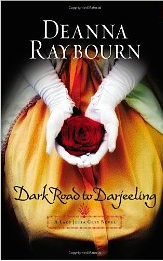
Day 103: Dark Road to Darjeeling

Cover for Dark Road to DarjeelingMy interest in the Lady Julia Grey series by Deanna Raybourn waxes and wanes. Although it is unusual for me to like books that mix mystery and romance, I usually enjoy reading this series, but I enjoy some books more than others. The books have followed the relationship of Lady Julia Grey and Nicolas Brisbane–who solves crimes for a living and whose breeding makes him an unsuitable mate for Julia–since they first met when her husband was murdered. Now, after several books following the ups and downs of their relationship as they solve crimes and get each other into and out of danger, they are married.

In Dark Road to Darjeeling, Lady Julia and Brisbane have been persuaded to interrupt their honeymoon in the Mediterranean by Julia’s sister Portia, who is worried about her friend Jane. In a previous novel, Jane left Portia to be married, and she is now a widow on a tea plantation near Darjeeling. Portia has asked Julia and Brisbane to investigate the possible murder of Jane’s husband. Jane herself is obsessed by her own pregnancy and the mysterious death of her husband Freddy, who may have been murdered for his inheritance.

The Brisbanes take along part of her eccentric family, Portia and brother Plum. Upon arriving at the plantation, they get to know the potential suspects, including Freddie’s aunt, his cousin Harry, several neighboring families, and the mysterious White Rajah.

I was unable to guess the murderer but figured out which family the murderer belonged to. Although this series sometimes resorts to the typical conflict between romantic co-investigators about the danger of the job, a conflict that I find extremely tedious, the dynamic between Julia and Brisbane still holds my attention. If you are interested in this series, I recommend that you start with the first book, Silent in the Grave.

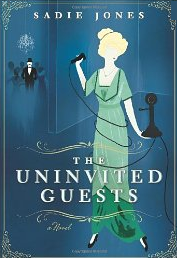
Day 101: The Uninvited Guests

Cover for The Uninvited GuestsThe Uninvited Guests is a delightfully original novel. At first it seems to be an Edwardian family social comedy that reminds me of the light, eccentric novels written by Stella Gibbons or Dodie Smith, but then it takes a turn toward the bizarre.

The Torrington-Swifts live in a large, ramshackle house that is at risk because they can’t afford it. The grown children, Emerald and Clovis, make a show of resenting Edward, their kind, patient, one-armed stepfather. Clovis is sulky and irritable, while Emerald is more likeable. Charlotte, their mother, is selfish and used to being cossetted. Smudge, the youngest girl, is used to being ignored.

It is Emerald’s 20th birthday, and the family is preparing for guests and a party, but Edward must miss the party because he has to travel to Manchester to try to borrow money to save the house. The guests are settling in and a storm is building when other people begin to arrive. A horrendous train accident has occurred a few miles away, and the railroad has sent the passengers to the house for shelter. Among them is an odd character in a red waistcoat who insists upon inserting himself into the birthday party.

Here is where the story begins its strange turn as the party gets odder and odder.

The novel is extremely well written and completely captivating, with a touch of the bizarre.

Day 100: Appaloosa

Cover for AppaloosaWoohoo! One hundred days of blogging! I hope you’re enjoying it. And now, on to the review.

I do not usually read Westerns but looked for Appaloosa after seeing the excellent movie starring Ed Harris (also the director) and Viggo Mortenson. I was surprised to find the book was written by Robert B. Parker, who I only know from the Spencer and Jesse Stone mysteries.

Virgil Cole and Everett Hitch clean up towns. The businessmen of Appaloosa hire them after the sheriff is murdered at Randall Bragg’s ranch when he goes out to arrest some of the hands. Bragg’s hands have been flagrantly breaking the law and terrorizing the town–taking merchandise without paying, assaulting women, and murdering men.

Cole works from a strict sense of law and duty, although he does it his way. He sets the laws in his towns and others must follow them or suffer the consequences. Hitch loyally backs up Cole.

Hitch and Cole get the town under control quickly, but the only witness to the sheriff’s murder, Deputy Whitfield, ran away after the shooting. However, under Cole and Hitch, the town feels safe enough for Whitfield to volunteer to testify against Bragg. Now Cole and Hitch must arrest Bragg and at the same time keep their witness safe.

In the meantime, an attractive widow named Mrs. French arrives in town and latches onto Cole, who is a bit naive when it comes to women. Hitch is skeptical of her, but after awhile, it looks like Cole may be planning to settle down.

The novel is full of action, but it stands out because of the friendship between Cole and Hitch and Parker’s ability to create distinctive characters using laconic dialogue and a bare minimum of description. And Parker has not omitted a twinkle of humor, such as when Cole marvels that Mrs. French takes a bath every single day. Although Appaloosa sounds like a traditional Western, it is unusual, especially in its denoument. I found it to be a quick, appealing read.

Day 96: The Forgotten Garden

Cover for The Forgotten GardenKate Morton’s The Forgotten Garden was one of my big discoveries two years ago. I absolutely love this book.

A four-year-old girl walks off a ship in Australia in 1913 with a little white suitcase. No one meets her. She won’t say who she is or where she came from. The harbor master takes her home, calls her Nell, and adopts her, and she forgets her previous life. When she is 21 and on the verge of marriage, he tells her about it. This information is so shocking to Nell that she breaks with her fiancé and her family and isolates herself, feeling that she has been living a lie.

In 1975, Nell’s irresponsible daughter drops her own teenage daughter, Cassandra, at Nell’s house and drives away, never to return. Nell has other plans, but puts them aside to take care of her granddaughter.

In 2005, Cassandra is mourning Nell’s death. She has inherited Nell’s property but is only vaguely aware of her history. When she looks through Nell’s things, she finds a white suitcase with a book of fairy tales in it. She also finds that Nell never stopped looking for her real family. Continuing Nell’s search, Cassandra ends up in a small Cornish village where she learns she has inherited a small cottage on the Mountrachet estate.

Cassandra finds an entrance into a walled garden, and another one from there to the estate. Eventually, she also discovers the history of her grandmother’s parentage.

The book traces Nell’s history by alternating among these times. The modern story is one of investigating one’s roots, but the older tale is more gothic. Ultimately, it is the story of two cousins, the wealthy Rose Mountrachet and the slum-born Eliza Makepeace, who comes to live with her and be her companion.

A mystery about family secrets, the story is complex and enthralling. Some readers may be daunted by its length, but once you begin reading, you will not be able to stop.

Day 91: Mortal Love

Cover for Mortal LoveMortal Love is Elizabeth Hand’s extremely unusual and strange novel about artistic inspiration and its relationship to obsession. It is narrated in two parallel stories, one taking place in the present and the other in the Victorian age.

In the story from the past, an American painter named Radborne Comstock meets Evienne Upstone, a model who has inspired the work of members of the Pre-Raphaelites and who has supposedly driven one painter insane. He finds this woman irresistable but she may be insane herself. Evienne has a close associate, a maid, who has blue fingers. Comstock experiences weird hallucinations when he is near Evienne, but is not sure whether they are hallucinations or he is going insane.

In the present time Daniel Rowlands, an American writer visiting in London, meets Larkin Meade, who seems to be the same woman as Evienne Upstone. She becomes his lover and leaves him physically and emotionally deranged.

In the meantime, a young man, Comstock’s grandson, who has been raised by a man with blue fingers and has fought insanity all his life, has become obsessed with his grandfather’s paintings of Evienne and decides to visit London.

This book is a wild, fantastic tale linking Celtic folklore, the Pre-Raphaelite art movement, and ancient mythologies. It is at times bewildering but also makes compelling reading.

Day 88: The Iron King

Cover for The Iron KingBest Book of the Week!

The Iron King is the first of seven books in the “Accursed Kings” series by the French novelist Maurice Druon. Unlike many historical novels, this series does not follow a fictional hero or heroine but is an interpretation of actual events in French history with all historical figures. This series was popular in its time (it was written in the 1950’s), but may be difficult to find now. If you are lucky, your local library may have it.

It is 1307 in France. The kingdom is broke, and King Philippe IV, known as the Iron King, is looking for sources of money. The Knights Templar, one of the wealthiest organizations in the world, seems like a good place to get it, but they refuse France a loan. Some charges of heresy, obscene rituals, and other abominations have been laid against them by a defrocked knight. Everyone knows they are false, but with the collusion of Pope Clement, who fears the knights’ power, Philippe orders the members to be arrested all on the same night, and seizes their assets.

In the meantime, Robert of Artois has been cheated out of his inheritance by his aunt, Mahaut.  He decides to get his revenge by bringing down her daughters, who are married to the King’s sons.

Druon’s writing is elegant and ironic, his novels thoroughly researched. He doesn’t over-explain; instead, the novel is compelled forward solely by the events in the plot. Few of the characters are sympathetic; nevertheless, it is a fascinating series. I have often read opinions that Druon is one of the best historical novelists ever.

Day 84: Bring Up the Bodies

Cover for Bring Up the BodiesBest Book of the Week! Year!

If Wolf Hall was a wonderful historical novel, Bring Up the Bodies is masterly. In this second of a trilogy, Hilary Mantel continues the story of Thomas Cromwell. Bring Up the Bodies is more focused than the last book, because it deals with a much shorter time period and defined subject–the downfall of Anne Boleyn.

The writing is elegant and impeccable. I have read a few comments that Wolf Hall was sometimes difficult to follow because the readers could not always tell who was meant by “him” or “he.” Mantel has written both books using a strict third person limited point of view, from that of Cromwell, and people don’t think of themselves by their first names. Hence, the difficulty, which I did not notice as a problem in Bring Up the Bodies. This technique is very difficult to employ successfully–we are much more used to a third person that changes from character to character or even to third person omniscient. But Mantel uses it effortlessly to create a memorable character in Cromwell–kind but implacable, one who fosters the growth of others but does not forget the crimes and indignities committed against Cardinal Wolsey, whom he loved as as a father.

Henry VIII has already decided he wants to rid himself of Anne Boleyn and marry Jane Seymour, but Anne has one more chance. She is carrying a child, and if it is born alive and is a boy, she is safe. Henry must have an heir, and he has decided that if he hasn’t been given one, God must have found some fault with his marriage to Anne just as there was one for his marriage to Katherine of Aragon. Thomas Cromwell must find him some way out of his difficulties.

Of course, Cromwell helped Anne to her position in the first place, but the Boleyns have made many enemies in their enjoyment of power, and they have treated him with disdain. More importantly, Anne Boleyn destroyed the Cardinal, and her brother mocked him in his downfall.

From the moment you begin reading, you find yourself plunged into the Tudor world of shifting politics and intrigue. Of course, we know what happens to Anne Boleyn, yet the novel maintains its suspense. The Boleyn and Howard families are going to suffer a huge defeat, but they will go down fighting.

Day 82: Cotillion

Cover for CotillionOne of my favorite authors if I want the lightest of reading material and a good laugh is Georgette Heyer. Although I am not a romance reader, for her meticulously researched and comic Regency romances I have to make an exception. Her period pieces are absolutely convincing, as she was an expert on Regency dress, deportment, and speech. In fact, she became such an expert on the period’s idioms that she once was able to successfully sue a plagiarizer by proving that the expression the other writer copied appeared only in some records to which she had been granted private access.

But Heyer was also an expert at creating charming comic characters and situations. Cotillion is one of my favorites of her books, and one of the silliest.

Kitty Charing is an impoverished orphan who has been raised in discomfort by her miserly old guardian, “Uncle” Matthew Penicuik. A great one for manipulating his putative heirs, Uncle Matthew announces that he will leave his entire fortune to Kitty, but only if she marries one of his four grandnephews. Then he invites them all to come calling. Priggish Reverend Hugh Rattney and doltish Lord Dolphinton arrive, and the married Lord Biddenden comes to represent his rakish brother Captain Claud Rattney, but dashing Captain Jack Westruther, whom Kitty has grown up hero-worshipping, does not make an appearance, as he is unwilling to be manipulated.

Kitty is furious that Jack doesn’t appear, but even more furious at being put in this position. She soundly rebukes all of her “cousins,” except Lord Dolphinton, who is too stupid to be responsible for his actions and has been compelled to come by his mama. But then Uncle Matthew announces that if Kitty refuses to marry one of her cousins, he will leave her with nothing. What is a spunky Heyer heroine to do but run off into a snowstorm with only a few possessions and an impractical plan to get a job as a house maid?

She arrives at the local inn to find her cousin Freddy Standen, who has absolutely no idea why he has been summoned. Freddy, not the brightest of bulbs but a kind-hearted young man, is perfectly wealthy in his own right and has no intention of getting married. When he meets Kitty at the inn, she talks him into pretending an engagement with her and inviting her to go up to London so she can acquire some “town polish,” buy some nice clothes, and (she hopes but doesn’t tell Freddy) enchant Jack into a proposal.

Freddy, an expert in deportment and fashion who can always be relied upon to accompany a young married woman to a dance or concert, is not really a lady’s man. When he and Kitty arrive in London to find his harassed mother attempting to care for a house full of children with mumps, he is dismayed to find he is left responsible for a naïve girl who tends to fall into difficulties and odd friendships.

The novel is crammed with comic characters, such as Kitty’s foolish governess “Fish,” who has a turn for quoting romantic poetry; Freddy’s frippery married sister Meg, who wears color combinations that shock him to the core and spends her time trying to avoid her mama-in-law; Camille, Kitty’s real French cousin, who is impersonating a lord; Lord Dolphinton, who is terrified of his mother but strictly charged by her to get Kitty to dump Freddy and marry him; and the silly doe-eyed Olivia, whom Kitty befriends but Jack is pursuing to be his mistress.

Day 81: A Whistling Woman

Cover for A Whistling WomanI may have been less bemused by A Whistling Woman if I had known that it was the fourth in a series by A.S. Byatt, of which I have only read Babel Tower, and that long ago. Instead, I kept having the feeling that there was something I just wasn’t understanding. My impression was that it was about too many things, so I was relieved to find a review in The Guardian that criticizes it for having “too many ideas” and being an “over-ambitious jumble.” The intent of the series, says The Guardian, is to depict the social and imaginative life of Britain in the 1950’s and 60’s. Well, that is quite a job.

The title refers to a story published by a peripheral character about people on a perilous journey. On the way they meet creatures who are half woman and half bird and whose whistling cries are unbearable. The prince in the story has learned many languages and finds he can understand the creatures, so they tell him their tale. I don’t want to go into it further, but it is clearly a statement about feminism, which is logical since A Whistling Woman is set in 1968 and features several women who are struggling with their place in society.

The action focuses (if focuses is the word) around Frederica Potter, the host of a fashionable TV talk show; a protest movement against a university; a conference on body and mind; and the growth of a cult. Frederica is planning a show around the conference, where the scientists’ rationalism is pitted against the results of their experiments, which show that the brain is not built for reason but to make the body work. At an alternative therapy clinic, the psychoanalyst Elvet Gander is falling under the influence of his patient Joshua Ramsden, a schizophreniac, around whom a messianic cult is forming. Ramsden’s essential goodness is being muddied by his increasing psychotic episodes. Some outsiders are encouraging the students at the university to form an Anti-University, the sole purpose of which is apparently to protest.

In addition to being almost confusingly full of ideas and plots going in every direction, the book does not really echo my own experience of the times. Surely student demonstrations, at least in the States, were more meaningful and actually about something. Most of the ones I remember were about the war in Vietnam.

The book includes deep discussions of science and religion. It is interesting while offering almost too much to think about.