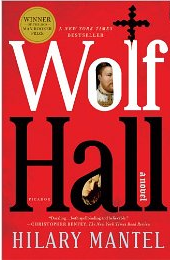
Day 77: Wolf Hall

Cover for Wolf HallBest Book of Week 16!

This is a good time to write about Wolf Hall, because I was thrilled to learn that Hilary Mantel’s sequel to it has just come out. My copy is arriving soon. Mantel is always an interesting writer whose work does not occupy any one genre, although her last few books have been historical fiction. Wolf Hall won the Man Booker Prize and was one the best books I read in 2010.

The novel looks at the political and religious machinations of Henry VIII through the eyes of Thomas Cromwell, who rose from low origins to become Henry’s chief minister. Although Cromwell has traditionally been viewed as Henry’s “heavy,” recent historians have looked at his career more kindly, showing that his work as chief minister brought England into more modern statehood and that his changes created more order for government functions that were less controlled by the whims of nobility.

Mantel depicts Cromwell as a loyal man who cares for his dependents and works to reform England. He builds up a great household as he moves from the position of secretary to Cardinal Wolsey to work for the king. Later, after the Cardinal’s downfall, he slowly, almost imperceptibly, works to bring down those who furthered their own interests by destroying the Cardinal, including the rapacious Boleyns.

Cromwell is loving to his family and friends, completely faithful to the Cardinal and then to Henry, intelligent, able in many spheres of work, and decent. Mantel paints a charming pictures of his home life. In contrast, she turns the tables on Thomas More, venerated for centuries, showing him as a sadistic torturer of Protestants who is in love with his own martyrdom.

Cromwell meets Jane Seymour when she is a young, lonely lady’s maid to the queen, teased and neglected by the rest of the court, and feels pity for her. Later, after he is long widowed, he falls in love with her. The title of the book is the name of her ancestral home, Wolf Hall.

Mantel’s approach is understated, leaving the reader sometimes to connect the ideas. The details in this novel seem completely authentic, and Mantel handles the period brilliantly. She somehow manages to generate tension and suspense even about things we know all about, like what will happen to Anne Boleyn.
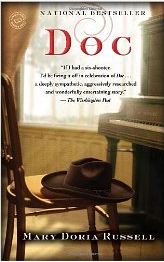
Day 75: Doc

Cover for DocThanks go to my friend K.C. for recommending this book. Writing a very interesting tale of a tragic life, Mary Doria Russell does a good job of staying true to the facts while fictionalizing what she can’t know in Doc, the story of Dr. John Henry (Doc) Holliday.

Russell begins with Holliday as a young boy, delicate, raised as a Southern gentleman and educated by his mother. Although he is frail, he shows much promise for his intelligence, grace, and wit, but his chances are hurt first by the Civil War, which ruins his wealthy family, then by the tragedy of his mother’s death caused by sickness and starving, and finally by tuberculosis.

Already by the time he sets off in his early 20’s for Dallas to work in a dentistry practice, he is ill. Shortly after he arrives, a major collapse in the world economy causes him to lose his job and casts him adrift to live as best he can. Gambling and the hope of starting his own practice bring him to Dodge City, and the Earps bring him to Tombstone for the famous gunfight.

Russell does a great job of depicting Doc: a soft-spoken gentleman with a wicked tongue, generous to his friends, profligate with his money, a fine pianist, and patient with his rapacious prostitute mistress Kate, who also fell far from a proud background.

Russell also fills out the characters of the Earps, especially happy, kind Morgan and the rather thick-headed, upright Wyatt. Bat Masterson appears as self-aggrandizing, responsible for falsely depicting Doc in the media as a hardened killer.

Russell’s approach is a little disorienting. She periodically changes her narrative style to sound more like an old codger telling a yarn and at other times sounds like she is writing a nonfiction biography. It is hard to tell whether she makes these style shifts purposely or has trouble removing herself from her source material. Although most of the book is chronological, she occasionally plays with time by going back to tell about a character’s earlier life.

Overall, Doc is a sympathetic, involving effort.

Day 66: The Lacuna

Cover for The LacunaBest Book of Week 14!

My experience with reading Barbara Kingsolver has been uneven. Her first books were interesting and heartwarming, but some of her later work is more political and sometimes degenerates to lecturing on certain causes. However, The Lacuna is an absolutely enthralling historical novel.

Harrison Shepherd is a young man, half Mexican and half American, who survives an upbringing by a feckless mother and a cold father and finally begins making his own way in 1930’s Mexico. He finds a job working in Diego Rivera’s kitchen and ends up as the cook and plaster mixer in Rivera’s household with Frida Kahlo. Later, when they give Leon Trotsky a home, Shepherd works for Trotsky as a secretary and translator, and finally he returns to the United States to write Aztec historical potboilers.

The novel covers major historical events in a turbulent period, including the Communist Worker’s Movement, Trotsky’s assassination, FDR’s terms in Washington, World War II, and the House Unamerican Activities Committee. Although Shepherd’s life is extraordinary by any standards, Kingsolver was able to make it feel absolutely persuasive. While I usually dislike historical novels where ordinary people keep running into famous people, I completely accepted every sentence of this book.

Told by diary entries, newspaper articles, and letters, the novel gets going a little slowly, but eventually enthralls. Kingsolver does a great job of creating colorful and believable characters from the lives of real, historic people, something that is not simple, and completely involves readers in the events of their lives.

Day 63: An Atlas of Impossible Longing

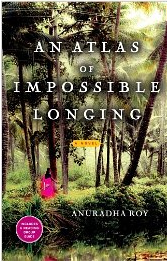
Cover for An Atlas of Impossible LongingIn An Atlas of Impossible Longing by Anuradha Roy, a family in turn of the (20th) century Bengal lives in a small remote village where the husband has moved for business. He, Amulya Babu, neglects his wife Kananbala for work, but he supports a boy in the local orphanage named Mukunda. Amulya and Kananbala have two grown sons, Kamal and Nirmal. Nirmal marries Shanti and is happy with her. But after she dies at her father’s house in childbirth, he deserts his family. His daughter Bakul is brought up in his father’s house by Kamal and his wife and by Kananbala, who is soon widowed.

On one of Nirmal’s visits after his father’s death, he goes to the orphanage to see who his father has been supporting for years and brings back Mukunda, who is casteless because no one knows his parentage. Mukunda and Bakul are raised together and allowed to run wild as each other’s only friends and companions.

The story eventually becomes about the relationship between Mukunda and Bakul and in the last section is narrated by Mukunda.

I had an ambivalent reaction to the book. I felt that the glimpses of Indian life were interesting and so was the historical context, even though momentous events are touched upon lightly. The book spans about thirty or forty years and three generations, ending in the 1940’s or 50’s. For a novel of such scope, however, it seemed too short to adequately develop the material. In the multigeneration story and the themes of the book, I was reminded of two other recent books, The God of Small Things by Arundhati Roy and The House of Blue Mangoes by David Davidar. But both of these books were much more satisfying.

I felt little connection to any of the characters, who seemed sketchily depicted. The love story that the book focuses on in the final part of the book is the least interesting part of the story because Roy has not made me care about either of the lovers. I was curious about what would happen but at the same time did not care very much about which way things would go.

Day 61: The Game of Kings

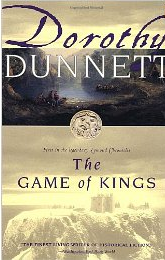
Cover for Game of KingsBest Book of Week 13!

If you love an authentic, well-researched, exciting historical novel that makes you almost feel like you are in the period, then I can’t recommend a better author than Dorothy Dunnett.  I have been trying to get people to read her for years with the caveat that her books are challenging, not for the reader of light romantic history.

Lady Dunnett is described on her Wikipedia page as a “leading light in the Scottish arts world and a renaissance woman.” Her books are loaded with detail about medieval customs, dress, politics, religion, food, and literature, and have labyrinthine plots full of action. She is most renowned for two series, the Lymond Chronicles, written in the 1960’s and 70’s and set in 16th Century Europe and Africa, and the House of Niccolò, written in the 1980’s and 90’s and set in 15th Century Europe, Asia, and Africa. Dunnett died shortly after finishing the last book in this series.

Game of Kings is the first book in my favorite series, the Lymond Chronicles. Francis Crawford of Lymond makes a rollicking and disruptive re-entrance into his home country of Scotland despite the charge of treason hanging over his head. He forms a band of outlaws and begins roaming around the countryside, sneaking across the border to play tricks on the British and harassing his own family. For quite some time, you don’t know whether he is a hero or a villain. He never explains himself, so it is left up to the reader (and the other characters) to figure out his motives for sometimes seemingly wrongful acts. His enemies think he is responsible for the explosion that killed his sister and is trying to murder his older brother Richard so he can inherit the estate. His friends are absolutely devoted to him but suffer doubts when he misbehaves, as he often does. His brother doesn’t know what to think, and his mother, Sybilla, is silent.

Francis is a mimic and a rogue, a musician and a polyglot, a poet and a swordsman, as swashbuckling a character as you will ever meet with in a novel. In among the action of cattle raids, impersonations, intrigues, duels, and archery contests, you actually learn a lot about Scottish history and politics.

Game of Kings is Dunnett’s first book, and my only criticism of it is that Lymond is a bit too fond of quoting poetry in antique languages. Most of it is incomprehensible unless you are a medieval scholar, but skipping over it does not hurt your understanding of the novel. Dunnett does this much less in the other books in the series. If you read this book and continue with the series, by the second book you won’t be able to stop.

Day 51: With Fire and Sword

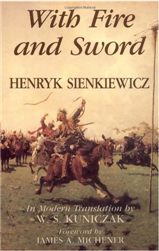
Cover for With Fire and SwordBest Book of Week 11!

Two years ago I read an exciting trilogy of Polish novels written in the 19th Century by Henryk Sienkiewicz, a Nobel prize winner for lifetime achievement in writing epic literature. The books were wildly popular for about 50 years, and Polish friends of mine tell me that they were their childhood reading. My review of the trilogy was published on Nancy Pearl’s blog (the librarian who has her own action figure), and I wrote to her awhile back asking if I could republish it here. She did not respond, so without further ado, I am going to write another review of the first book, With Fire and Sword. I will of course crib from my original review. The three books are stand-alone but with recurring characters, so you can read just one without missing important plot points.

It is 1647, and the Polish-Lithuanian Commonwealth is having some trouble—there are rumblings of rebellion among the Cossacks, who are a major force in the Polish army. Yan Skshetuski is a young Polish officer in the hussars of the Ukrainian Prince Yeremi Vishnovyetski. Prince Yeremi sends him on a mission as an emissary to Bohdan Hmyelnitzki, the leader of the Cossack rebellion. Yan has just become engaged to the beautiful Helen, but duty calls, so he makes his way through down the river to where the Cossacks are gathering.

Yan has been sent too late, though, for the rebellion has already started when he arrives, and he is made a prisoner. He escapes with difficulty and makes his way through the war-torn landscape, all the time worrying about Helen.

The political situation in Poland is very unstable, so no one comes to Prince Yeremi’s aid as he is attacked by hoards of Cossacks from the southeast. Even though Helen has been kidnapped by the wild Cossack Bohun, Yan cannot take time to look for her because he is embroiled in another mission for the Prince. So, his friends, the fat buffoon Pan Zagloba, the lovelorn knight and master swordsman Michal Volodyovski, and the gentle Lithuanian giant Longinus Podbipyenta decide to help Yan by rescuing Helen themselves.

This novel is all adventure and romance, and it is truly exciting. Along the way, you learn something about 17th century Polish history.

If you are interested in reading the book, you may have  a hard time finding it (although I see it is available in a print-on-demand basis). It is also available in several translations, about which there is some debate. The original translation by Curtin is said to be truer to the book, but I took a look at it, and it is also fairly badly written. The translation that I read by Kuniczak takes some liberties with the structure of the novel, but is eminently readable, if you can find it. The cover picture at the beginning of the article is from the edition that I read.

Day 38: The Winter Palace

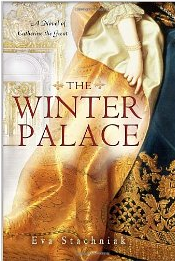
Cover for The Winter PalaceBest Book of Week 8!

The Winter Palace by Eva Stachniak is an excellent, absorbing historical novel that captures the rise of Catherine the Great.

Barbara (Varvara) Nikoleyeva is the daughter of a Polish bookbinder who takes his family to St. Petersburg hoping for opportunity. It is the years of the reign of Empress Elizabeth, the daugher of Peter the Great, who has wrested the empire from her nephew, the rightful heir, Ivan, and placed him in prison. Years ago, Varvara’s father had bound a badly damaged book owned by Elizabeth, and Varvara’s mother, an artistocrat who has married beneath her, urges him to draw himself to the Empress’s attention. The family’s move is a success until both Varvara’s parents die, and as a young woman she begs a place at court from Elizabeth.

The court is full of secret passages and peepholes. Nothing is private, and many people are paid to listen, poke through others’ belongings, and inform. Varvara finds herself employed as a spy, or nose, for the Chancellor Bestuchev. She does not wish for this position but finds it a way to keep favor, as in the volatile atmosphere of the court, one needs to keep in with the right people. Even the position of princes and princesses can be precarious, and Varvara has no social status.

Varvara is new to court when the Empress imports Sophia Anhalt-Zerst to consider her as a possible bride for her heir, the childish Peter Fyodorovich. Varvara’s sympathies are caught immediately as she watches Sophia navigate the treacherous shoals of the temperamental Empress, Sophia’s own selfish and conniving mother, and the foolish Peter. Despite her mother’s plotting, which almost gets her thrown out of the country, Sophia converts to Russian orthodoxy, taking the name of Catherine, and eventually marries Peter.

Varbara becomes close to Catherine and supports her even as she is ignored and then cruelly treated by her husband and loses her status with the Empress and the court when, because of Peter’s impotence, she fails to conceive.

The life of the Russian court is vividly depicted in this enthralling novel, where Catherine’s rise to power is paralleled by the building of the magnificent Winter Palace.

Day 34: Your Presence Is Requested at Suvanto

Cover to Your Presence is Requested at SuvantoYour Presence Is Requested at Suvanto by Maile Chapman is an unusual and disturbing novel about the events at a hospital in Finland at the turn of the century. Sunny Taylor is an American who begins a new job as a nurse for a ward of mostly American women. These women, the wives of men in the timber industry, come regularly for treatment even though most of them are probably not really ill. The atmosphere of the ward is more one of pampering than of being treated for serious illness.

While telling of seemingly innocuous everyday incidents, the book develops a feeling of darkness and uneasiness, increased by the bleak setting of the isolated hospital.

A new doctor, Peter Weber, takes over the hospital with a plan to change the ward to a maternity ward for local women. An older, troublesome woman named Julia Dey is in his sights. Sunny begins to understand that Dr. Weber wants to teach the Finnish doctors a new uterine stitch for birth problems by having them practice on the older women who are receiving hysterectomies.

Something happens, and although Sunny thinks she remembers the day of the events, she somehow doubts her memory of what happened or who might have been involved.

The novel is an attempt at a sort of Victorian Gothic. It is certainly atmospheric, but some readers may find it rather slow-going, as it takes awhile for anything definite to happen.

Day 29: The Winter Sea

Cover for The Winter SeaLet me start out by saying that this is not my kind of book. There are carefully researched and plausible historical novels that make you feel like you understand the time and place and that may or may not include a romance. Then there are romance novels that just happen to be placed in a historical time but otherwise read as if the writer did not bother looking up a single fact. And there are all ranges in between. Despite the notes from Susanna Kearsley about her research, I would locate The Winter Sea closer to the latter end of this range.

Carrie is a writer working on a novel about one of the Jacobite rebellions. She has been living in France where all the intrigue went on, but she isn’t getting into her novel. On a visit to her agent in Scotland, she is attracted to a ruined castle. When she hears that part of the rebellion was based there, she decides to move to the nearby village, and on a suggestion by her agent, make her main character a woman. She arbitrarily picks Sophia Paterson, her own ancestor.

She begins to imagine vivid scenes, which interleave the modern story. But when she checks the facts surrounding these scenes, she finds the details are actually correct. After awhile she decides the explanation must be that she carries her ancestor’s genetic memory in her DNA, an explanation so absurd that it dumbfounded me.

The modern author’s romance with her landlord’s son is interspersed with the story she is writing about Sophia’s romance with a young Jacobite. Although the story reflects some historical research, the focus is on the romance. The dialogue in the historical section is awful, as if the writer thought all she had to do to make it authentic was stick the word “did” in constantly. (“I did arrive from Edinburgh last month.”) I almost quit reading because I could barely stand to read the dialogue. I would rather have the writer use modern English than patently fake and unconvincing archaic English.

Had the author based the writer’s insights on some form of second sight–they are in Scotland after all–I would have found that explanation more acceptable than the pseudo-scientific claptrap. Avoid this one unless you absolutely don’t care about any historical or scientific authenticity.

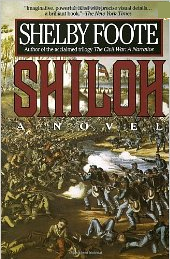
Day 25: Shiloh

Cover to ShilohIn Shiloh, the historian and novelist Shelby Foote has written an interesting fictional account that describes the battle from the points of view of several different narrators, some on the Union side and some on the Confederate. Each narrator has his own chapter. In these brief narratives you get a sense of the character while being able to trace the larger movements of the battle.

Foote manages to work into the narratives the major events, such as the death of General Johnston; the surviving Confederate leadership’s failure to follow Forrest’s recommendation of attacking again at night, which probably would have ended in victory for the Confederates; the 10,000 Union “shirkers” who hid along the riverbank after they became dispirited from having to pull back time after time; and the river crossing by Buell’s troops, which turned the tables in the Union’s favor.

Lieutenant Palmer Metcalfe is marching with the Confederate army under Johnston as it prepares for a surprise attack on the Union troops. He thinks back with satisfaction to the complicated plan he helped draft, as he is a staff officer under Johnson. The noisy troops may have lost the element of surprise, but Johnston insists upon attacking.

Captain Walter Fountain is a Union soldier writing a letter to his wife Martha during a Tennessee evening when the Confederate troops burst out of the woods and charge the Union army.

Private Luther Dade is wounded in battle and is sent to a triage area to wait for a doctor. After hours pass and no doctor shows up, Dade begins to show signs of infection. He stumbles around across a large swathe of the battle area and finds himself witnessing the death of the Confederate commander Johnston.

So the novel proceeds in short chapters that culminate with a return to Lieutenant Metcalfe as he reviews the results of the battle. The characters are briefly drawn but have distinct personalities. Through following the peregrinations of the various characters and with the assistance of the maps in the book, you can get a good understanding of the complex battle and why the initially successful attack ultimately failed.