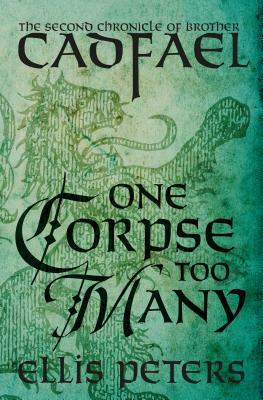
Review 2602: One Corpse Too Many

It’s 1138 during the war between King Stephen and Queen Maud, which became known as the Anarchy. King Stephen is besieging Shrewsbury, which is soon to fall. FitzAlan and Adenay, the castle defenders, wait until the last minute to flee with their men, but rumor has it that Adenay’s daughter and FitzAlan’s fortune are still inside the castle.

In the monastery, Cadfael is assigned a new helper, a boy named Godrik, who is a hard worker. It doesn’t take Cadfael long to figure out Godrik is a girl, Adenay’s daughter Godith, whom Stephen is searching for to use as leverage.

Stephen has the remaining defenders of the castle executed after he takes it, and Cadfael takes charge of identifying and burying the bodies. However, he finds there is one corpse too many. In looking more carefully at the corpses, he sees that one man has been garroted. So, he reports to the king the information that someone has tried to hide a murder by mixing the body with the executed and is given permission to try to identify the body.

A young lady of the town, Aline, identifies the body as Nicholas Faintree, a squire of FitzAlan. She has recently also identified one of the executed men as her brother.

Meanwhile, Godrik, whom Cadfael has sent reaping to escape the attentions of a mysterious man, Hugh Beringer, who has been following him, finds a wounded man. It turns out that the wounded man Godith finds is Torond Blunt. He was sent off with Nicholas Faintree to carry FitzAlan’s fortune into Wales. However, they were ambushed at night. Briefly separated, Torond returned to find Nicholas dead and then someone attacked him from behind, but he managed to get away and hide the fortune.

Now Cadfael is hiding Godith and Torond and trying to make arrangements to get them both to Wales along with the fortune. Meanwhile, it’s clear that Beringer is dogging his steps ever since he visited Godith’s old nurse to tell her she is safe. Incidentally, Beringer is engaged to Godith, although they haven’t seen each other for years. And she has fallen in love on sight with Torond.

Beringer seems to be playing a game with Cadfael, so he decides to play back. But is Beringer a friend or foe?

Although this mystery doesn’t really give clues to the murderer’s identity until the end, it does a good job of misdirection. This book is the second of the Cadfael series, which I would describe as Medieval cozy. It has likable characters and seems to be well grounded in its time period.

Related Posts

A Morbid Taste for Bones

A Murderous Procession

Grave Goods

Review 2592: Death Comes As the End

I have been trying to pick off Agatha Christie’s books I haven’t read without looking to see what they are about. So, I was surprised by this one. At first, I thought maybe the ancient Egyptian setting was the introduction to a more modern mystery, but then I realized it wasn’t.

Renisenb has returned with her young daughter to her father’s house on the lower Nile, her husband having died. At first, it seems as if everything is the same. Her father, Imhotep, a property owner and priest, is still watchful of his own authority and eager to have control of everything. Her oldest brother, Yahmose, is still dutiful and careful of Imhotep’s interests—his wife Satipy thinks too much so and nags him to be more assertive. Satipy argues with her sister-in-law Kait over precedence one moment, and they giggle together the next. Kait’s husband Sobek, the younger brother, is still full of big ideas and wasteful of his father’s money. Renisenb’s orphaned nephew Ipy is still young but disrespectful and spoiled by Imhotep. Esa, the grandmother, is frail but sharp.

Renisenb still cannot bring herself to like Henet, the servile but sneaking servant, and she still feels comfortable with Hori, her father’s main scribe. However, when she tells Hori that everything is still the same, he warns her that it is not.

Imhotep goes off on a business trip, and when he comes back he has brought two people—a young concubine named Nofret and a secondary scribe named Kamini, who claims some relationship to the family. It becomes clear that Nofret is malicious and means to make trouble. Almost immediately, she has problems with the two sisters-in-law. Renisenb tries to be friendly to her but feels she dislikes her.

Nofret begins to succeed in dividing Imhotep from his two sons. Imhotep, angry about an incident, threatens to send the sons and their families away. The next thing they know, Nofret is dead, having fallen from the cliff path that goes to the tomb Imhotep is responsible for keeping.

The two sisters-in-law suddenly change behavior. Satipy, formerly shrewish, becomes timid and withdrawn. Kait becomes more forceful. Renisenb and Hori wonder if Nofret’s death was an accident.

The next event seems clearly not an accident. The two brothers are poisoned after drinking some wine. Sobek, having drunk more, dies.

Renisenb, Esa, and Hori get together to try to figure out who the murderer is, but there are more evil events to come.

Christie doesn’t offer many hints to figure out the murderer, and I didn’t guess the solution. However, I also didn’t find this novel as interesting as some of the others. Perhaps Christie was trying a change of pace or just wanting to write something that reflected what she learned on her archaeological digs. Still, it worked almost wholly on an understanding of the characters rather than any real clues.

Related Posts

Death on the Nile

Alexandria

Cleopatra: A Life

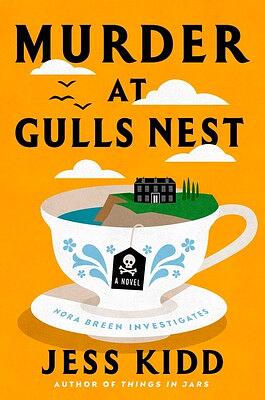
Review 2581: Murder at Gulls Nest

I messed up a bit with this book. What happened was that as soon as I heard about it, I pre-ordered it because I love Jess Kidd’s books. Then a few months later, although I am no longer active on NetGalley, I received an email from a publicist asking if I would like a review copy. I answered, as I have for other books, that I would love to if I could get a paperback rather than an ebook.

As usual when I make this request, I got no reply, so I dismissed it from my mind. Then, when I received a copy quite a bit later, I assumed it was my pre-order, not even noticing that it was a review copy. I put it at the top of my pile, which I have been ignoring while I try to finish A Century of Books (now complete!). I apologize to that publicist, because I have missed the dates. It wasn’t until my pre-order arrived that I realized my mistake, but then I read it immediately. So, here’s my review—better late than never.

It’s the 1950s. Nora Breen, looking disheveled, arrives in a seaside town in winter. She is a middle-aged ex-nun who has renounced her vows, and she has arrived because her friend Frieda, sent from the monastery for her health, has stopped writing. That is unlike Frieda, and Nora is worried about her.

Nora has taken a room at Gulls Nest, a sad rooming house, where she finds she is to occupy Frieda’s room. She learns that Frieda just disappeared one evening, no one apparently being surprised by it.

The occupants of the house are a mixed crew. Helena Wills, a widow, is the owner, but she spends almost all her time in bed and lets Irene Rawlings, the grim housekeeper who has lots of rules, run it. Helena also has a young daughter Dinah, who is all but feral. As she arrives, Nora watches a young couple from afar, Teddy and Stella Atkins, and notices them appearing to quarrel. She also sees another lodger, Karel Ježek, stomp on Teddy’s hat. Other lodgers are Bill Carter, an ex-Navy cook who works as a bartender, and Professor Poppy, an old Punch and Judy puppeteer who is rumored to be an aristocrat.

Although Nora goes immediately to the police, Inspector Rideout thinks there’s nothing unusual about someone who was living at Gulls Nest disappearing without warning. Nora has decided not to reveal to anyone else her friendship with Frieda, hoping she will learn more if no one is aware of it. However, she is feeling frustrated when Teddy is found dead in Poppy’s workshop behind the house, poisoned with cyanide in his coffee. Teddy often had coffee with Poppy before work. Inspector Rideout is thinking suicide, but Stella says not. She has just told him she is pregnant. So, did Teddy commit suicide or was he murdered? If he was murdered, was he the intended victim or was Poppy? Finally, is Teddy’s death related to Frieda’s disappearance?

Like Kidd’s other books, this one has some eccentric characters, although it is perhaps not as unexpected as her others. Still, it has some likable characters and some twists, as Nora begins to blossom out into this new world. A secret about the relationship between two characters was one I guessed fairly quickly, but I was unable to figure out a motive for what turns out to be not just one murder.

Fun stuff!

I received this book from the publisher in exchange for a free and fair review.

Related Posts

The Night Ship

The Hoarder

Things in Jars

Review 2573: The Name of the Rose

Adso of Melk, an elderly monk, feeling he is nearing his death, leaves this manuscript that tells, for the first time, the events of 1327 in an Italian abbey.

It’s been a long time since I read this book, so I remembered more vividly the movie version, which concentrates on the mystery aspects of the novel. But the novel is more about the religious and political upheavals of the time.

As a Benedictine novice, Adso travels into Italy with a learned Franciscan monk, William of Baskerville from Hibernia. William has been asked to mediate an important meeting between two factions of monks—the Franciscans and other Minorite sects who believe in the vow of poverty and are aligned with the French King, and other sects who think the vow is heretical and follow the Pope in Avignon.

Once they arrive at the magnificent abbey high on a mountaintop, the Abbott, Abo, asks William to look into another issue that has recently occurred. Adelmo of Otranto, an illuminator from the scriptorium, has been found dead on the slope below the abbey’s Aedificium, a fortified building that contains the kitchen, the scriptorium above it, and the library above that. It’s not clear whether Adelmo jumped or had help, and Abo wants William to figure out what happened, preferably before others arrive for the meeting. William quickly ascertains that Adelmo must have fallen from the library, but he learns that only the librarian is allowed in the library, a man named Malachy.

Although William has been denied access to the library by Abo, he soon figures out that there is a way to get into it besides the locked entrance. After a visit to the scriptorium, where William and Adso inspect Adelmo’s work area and meet some of the monks, another monk is found dead, Venantius, a Greek scholar. This makes William surer that the deaths have something to do with the library.

He and Adso sneak into the library at night. It is a labyrinth. Moreover, they disturb someone who runs away and are almost poisoned by the air in one of the rooms.

More monks associated with the library die, and William becomes convinced that they are dying because of a secret book. He and Adso must learn the secrets of the library, and William comes to believe that the murders are related to the history of the monastery.

I have concentrated on the mystery, too, but there’s a lot more going on in this book. It is concerned with the conflict between Louis of France and the illegitimate Holy Roman Emperor, between two popes, and the then recent history of the Inquisition against certain heretical religious groups. It has several learned debates, in which the monks disagree about what seem, to the modern eye, to be obscure and trivial issues. And it fully shows the superstitions of even the most learned of men (except William) and the pit of fear that was life in this monastery.

Although the novel seems straightforward, there is a lot more going on. To me, Eco seems to be mocking the beliefs of the church at times—some of the learned disputes make such ridiculous statements (believed at the time) that I couldn’t help laughing. And I couldn’t help noticing that at least two of the characters’ names, William of Baskerville and Adelmo of Otranto, hearken back to previous mystery and gothic fiction.

A New York Times reviewer from 1980 asserts that the entire novel refers to the time when it was written (the 1970s, I assume), so obviously he also found second meanings and playfulness in the novel.

The novel moves you along despite several learned discourses. The medieval mind also seems to like lists, and I have to admit skipping through several of those. This is at once a challenging and compelling read.

Related Posts

Mistress of the Art of Death

Dissolution

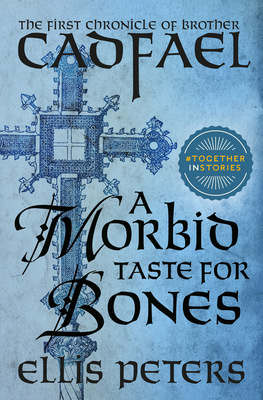
A Morbid Taste for Bones

Review 2539: A Morbid Taste for Bones

I didn’t really like the Cadfael series on TV, and I thought I had read at least one book long ago and decided not to pursue it. However, I saw that the first book filled a hole in my A Century of Books project, so I thought I’d give it another try. Now, I’m not sure I ever read any, because this book is pretty good!

In 1137, Brother Cadfael is a Welsh monk in a Benedictine order in Shrewsbury. He has led an exciting life, but now a quiet one taking care of the monastery garden suits him. He has two young assistants. Brother Columbanus is from a family of high Norman blood who seems almost too devout and eager to please. Brother John is practical and full of mischief.

Brother Columbanus is stricken with something that seems like epilepsy, so Prior Robert, an ambitious, proud man, suggests sending him to the Shrine of Saint Winifred in nearby Wales. When Brother Columbanus is miraculously cured, Prior Robert suggests that what the order needs are some relics, and Saint Winfred’s bones may answer the case.

Although Prior Robert wouldn’t normally include Cadfael in his expedition to get the bones, he needs him as a translator. Brother Columbanus is allowed to go as the subject of the miraculous healing, and Brother John offers to take care of the livestock. After getting permission from the Welsh authorities to remove the bones, the party encounters opposition from Rhisiart, the major landowner in the area, and thus from the rest of the locals.

Prior Robert meets with Rhisiart to try to talk him around, but he mishandles this discussion badly by trying to bribe him. They schedule a second meeting, but Rhisiart never arrives. Once they learn he left home for the meeting and never returned, everyone goes out to look for him. They find him shot in the chest with an arrow that belongs to Engelard, a Saxon boy who wants to marry Sioned, Rhisiart’s only child and his heir.

Suspicion immediately focuses on Engelard, but to Cadfael that doesn’t make sense. Even though Rhisiart opposed the marriage, he has treated Engelard like a son since he arrived, in a country where you usually must belong to a family to get work.

Does the murder have to do with the marriage? with Sioned? a love triangle? the monk’s expedition?

I enjoyed this mystery. It seems well-researched and is written with a wry sense of humor. Although I did guess the murderer, Peters tricked me enough to move my guess to two other people before I returned to my original suspect just about the time Cadfael did.

Related Posts

A Murderous Procession

Grave Goods

The Serpent’s Tale

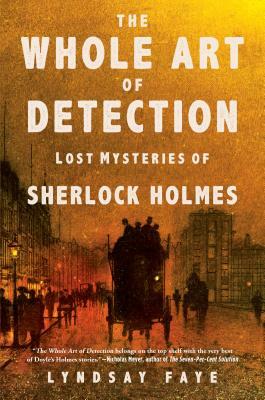
Review 2527: The Whole Art of Detection: Lost Mysteries of Sherlock Holmes

I knew this book might not be a good fit for me, because I usually feel that mystery short stories are too short to do much but pose puzzles, but more importantly, because I usually think it is unsuccessful when an author continues another author’s work. However, I have generally enjoyed Lyndsay Faye’s books, so I tried this one.

Purporting to be lost stories, notes, and diary entries, most by Dr. Watson but some by Holmes, this book’s 15 stories span the time from before the two met until 1902.

I am not going to run through a description of each story. Instead, I’ll comment on how authentic Faye’s stories seemed as stories about Holmes, keeping in mind that I haven’t read a Holmes story in years.

First, how much like the originals are Faye’s Holmes and Watson? Faye clearly is very familiar with the books (this applies to pretty much all the things I’ll look at, not just this one) because she makes lots of references to other cases and certainly has down Holmes’s characteristics. However, it seemed to me that her Holmes is more of a Benedict Cumberbatch Holmes than an Arthur Conan Doyle one. For one thing, he is much more expressive of emotions, more so even than Cumberbatch, especially as the book goes on. Watson seems himself, only even more flowery of description, but smarter. Also, like in the B. C. version mentioned above, his war service is stressed a lot more.

What about the mysteries? Well, you’re reading the words of a person who never once guessed the solution of a Sherlock Holmes story—until now. On the one hand, Faye’s stories are not nearly as ridiculously overcomplicated and unlikely as Doyle’s (spoilers for ACD!)—teach a snake to crawl down a rope? while dying, say “the speckled band” instead of “a snake bit me”? On the other hand, it seemed ridiculously easy to guess at least portions of the solution for most of the stories (unlike in Faye’s other mysteries—this is what I mean by mystery short stories—they’re either totally opaque or too easy). For instance, in “The Case of Colonel Warburton’s Madness,” I guessed immediately that (spoilers) gaslighting was involved and who was doing it. I just didn’t know how. Later in a story about identical twins, I knew immediately that the twins had switched.

Faye writes well and keeps up the interest. I just wish she’d write more of her own stuff.

Related Posts

Seven for a Secret

Back to the Garden

The Edinburgh Mystery and Other Tales of Scottish Crime

Review 2312: Bright Young Women

Bright Young Women is a novel centering around the true story of a famous serial killer, whose last killings took place in a sorority at Florida State University in Tallahassee in 1978. Apparently, Knoll believes as I do that men commit such acts at least partially for the attention so she calls the killer The Defendant throughout the book instead of his name. So will I.

The novel is narrated by two different people in three different time frames. In 1978, Pamela is the president of a sorority and is about to become an important witness. In 2021, she is still trying to track down evidence that will lead to the body of one of his earlier victims.

That victim is Ruth, the second narrator, who in 1975 had the misfortune to meet The Defendant at the beach in Issaquah, Washington.

This novel doesn’t want to focus on The Defendant so much as on the girls he was after. The novel sticks with Pamela from the day before the crime through the days after she sees a strange man fleeing the sorority house, but it focuses on Pamela’s self-development afterwards. At the beginning, she is living an expected life as head of the sorority with the brightest girls on campus, engaged to Brian and planning to attend law school, only an inferior school even though she was accepted to Columbia because Brian couldn’t get in. Pamela is obviously in shock after the event because she doesn’t realize for hours that two of the girls are dead. But she clearly tells the sheriff that although she at first thought the man she saw was Roger, her best friend Denise’s boyfriend, she realized the man was a stranger. Nevertheless, the sheriff focuses on Roger, and this is only one instance of the incompetence of the law enforcement work on the case. Pamela is disregarded and patronized time and again in this novel.

One of Knoll’s themes is her idea that The Defendant, having performed poorly at college and not having been accepted into law school, was picking out successful, attractive women to kill. Then the media fed into his own view of himself by depicting him as smarter and more handsome than he was, despite his ridiculous performance when he eventually defended himself. Basically, they admired the killer while denigrating his victims.

Ruth’s self-evolution takes her from a lesbian woman dominated by an unloving mother who doesn’t want the neighbors to know her “shame” to a confident, lovely girl who has found a place for herself, largely because of the help of her friend Tina. It is Tina who later comes to Pamela and tells her she thinks The Defendant murdered Ruth as well as the sorority girls. Although Tina is right about everything, law enforcement disregards her and warns Pamela against her.

Knoll’s late 1970s certainly sound more like the 60s to me. In Michigan, I didn’t know any girls who were interested in sororities or still used hair spray or dressed as described in the novel anymore. Then again, it was Florida.

I found this a fascinating novel with a strong feminist message. I am looking forward to what Knoll does next.

Related Posts

The Shining Girls

The Broken Girls

Killingly

Review 2297: Killingly

Killingly is loosely based on the true story of a student’s disappearance from Mount Holyoke College in 1847.

Bertha Mallish has vanished, but the readers realize that her best friend Agnes Sullivan seems to know something about it. The river has been dragged, but no trace of Bertha can be found.

Bertha and Agnes are the campus misfits. They are hard workers who don’t socialize and are from poor families. However, the last few months they have become very close.

Dr. Hammond, who had been courting Bertha, has arrived at the college with Reverend Mallish, Bertha’s elderly grandfather, and Florence, her much older sister. Florence and Agnes don’t like Dr. Hammond, who quickly develops an obsession about the case, hires a private detective, and behaves as though he’s in charge of the investigation. He becomes suspicious of Agnes.

Beutner is very skillful in how she slowly unfolds the story and reveals what happened to Bertha. She draws you in to a story that is sometimes affecting, sometimes suspenseful. The novel is involving, and I look forward to reading more by Beutner.

Related Posts

Alias Grace

Stone’s Fall

The Shape of Darkness

Review 2263: The Shadows of London

Cat Lovell and her partner Brennan have a commission to build a new almshouse and some houses where the old almshouse burnt down in 1666. However, workmen find a body in a rubbish pile on the site. Not only does the body need to be identified because it has no face, but a magistrate named Rush closes down the entire site until the inquest. This is unnecessary, but Cat’s employer Mr. Hadgraft, says that Rush originally was a partner in the undertaking and pulled out, so he is trying to get back at Hadgraft. For Cat and Brennan, the situation is urgent, because they only have a few months before winter closes the work down.

Cat’s friend James Marwood now works entirely for Lord Arlington, who assigns him the task of discovering the corpse’s identity. He finds there are two missing men who might be the victims. One is John Ireton, a civil servant who has disappeared. The other is a Frenchman, Monsieur Pharamond (a pseudonym). Both were involved in fleecing a young French lady-in-waiting in Dieppe.

This novel also tells the true story of that lady-in-waiting, Louise de Keroualle, who has attracted the attention of Charles II. Both Lord Arlington and the King of France see a benefit in having a young French, Catholic girl in the King’s bed. But Louise herself is hoping for a way out.

Marwood’s investigations indicate that his and Cat’s old nemesis, Roger Durrell, a tough for Buckingham, might have killed the dead man. Another issue is that James has become infatuated with Hadgraft’s daughter, and Hadgraft seems unexpectedly eager for the marriage. Cat finds herself surprisingly jealous.

This is an excellent series, and another exciting entry in it. I especially liked the ending.

Related Posts

The Royal Secret

The Last Protector

The King’s Evil

Review 2169: The House on Half Moon Street

In Victorian London, Leo Stanhope is leading a difficult existence as a clerk for a hospital mortuary. His only extravagance is a weekly trip to the whorehouse, where he meets Maria, with whom he is madly in love. She is one of only a few people who knows his secret—that he was born a girl but has always believed he’s a boy. At 15, he left a comfortable home to live as a man.

One day the body of a murdered woman arrives at the mortuary. It is Maria, who did not turn up for the date they had for Saturday. Leo is soon brought in for questioning, but he is let go, and he becomes obsessed with trying to find Maria’s killer. He believes that her death may be related to that of another corpse brought in a few days before.

Of course, Leo finds that almost nothing Maria told him about herself was true, and that leads me to the first general discomfort I had with this novel even before Maria’s body turned up. That is, I really hate the trope of a young man being obsessed with a woman who is leading him on, especially one who exhibits stalker behaviors. If that wasn’t bad enough, Reeve puts Leo through so much physical and mental torment before he’s through that it made me very uncomfortable.

I think the mystery was complex and interesting, but Leo, who is self-obsessed and humorless, reminded me a lot of C. J. Sansom’s depressing hero, Matthew Shardlake. At one point, another character tries to point out that he is not only jeopardizing his own life but hers, but he thinks only of himself and continues to go on the same way.

Related Posts

Special Assignments: The Further Adventures of Erast Fandorin

The Gods of Gotham

Rustication