Day 1079: Murder in the Dark

Cover for Murder in the DarkOne of our pleasant discoveries since moving is to find that the local PBS station schedules lots more murder mysteries than Austin did, including our favorite, “Midsomer Murders.” On another channel, we also discovered the “Miss Fisher Mysteries,” based on the Phryne Fisher series by Kerry Greenwood being reissued by Poison Pen Press. When I saw that Netgalley was listing three of the series, I promptly requested them.

Phryne Fisher is a sort of flapper detective in this Australian series set in 1920’s Melbourne. Murder in the Dark is the 16th in the series. For those of you who have been watching the TV series, I have to warn you that this novel bears very little resemblance to the episode of the same name.

Christmas is nearing when Phryne begins to receive threats related to the Last Best Party, a house party given by siblings Gerald and Isabella Templar. Someone does not want Phryne to attend and even sends her a Christmas present of a poisonous snake. Of course, this makes Phyrne determined to attend.

When she speaks to Gerald about it, he admits that someone has sent him death threats. Soon after she arrives at the house, Gerald’s adopted son, Tarquin, disappears, as Isabella’s adopted daughter, Marigold, has already done. Although they thought Marigold had run away, Tarquin seems devoted to Gerald. Phryne also begins a sort of scavenger hunt, as she receives clues, supposedly from the murderer, that each lead to the next.

Phyrne soon finds out from her sources that someone has hired a hit man. Unfortunately, the description of the man is so vague that it could apply to most people.

In the sybaritic atmosphere of the party, Phryne tries to find the clues and locate the hit man before he kills someone. Since the guests include members of the upper classes, polo players, musicians, hashish smokers, the acolytes of the hosts, and even a goat lady, there are a lot of characters roaming about.

This novel was a pleasant enough light reading experience. The culprit wasn’t readily guessable because there was so little information about the plethora of characters. And indeed Greenwood cheats a bit by having, count ’em, three different culprits. I did glancingly guess the identity of the person who hired the hit man but dismissed the idea because it didn’t seem to make sense.

link to NetgalleyOne character who doesn’t appear in the TV series (oops! not until after I wrote this) is Phryne’s lover, an elegant Chinese man named Lin Chung. In this book, at least, he seemed to be completely unnecessary, perhaps only around to make Phryne’s behavior at the party seem more scandalous. But maybe he is more important in some of the other books. In any case, the TV show centers around a flirtation between Phryne and the police inspector, Jack Robinson, that does not seem to be present in the novels. Or maybe I’m talking from too little exposure to Phryne’s world.

Normally, I would avoid mysteries like this that go into great lengths to describe Phryne’s clothes and are too detailed about her love affairs. I have two more to read, so we’ll see how well I can stand it. In any case, these novels are like popcorn, light and fluffy.

Related Posts

Girl Waits with Gun

Dandy Gilver and a Bothersome Number of Corpses

Birds of a Feather

Day 1045: Sovereign

Cover for SovereignI am working my way through C. J. Sansom’s Matthew Shardlake series so that I can cross his fifth novel off my Walter Scott prize list. Sovereign is Sansom’s third, set in 1541.

Henry VIII is now married to Catherine Howard, and he is already engaged in a progress through the north when the novel begins. Archbishop Cranmer asks Matthew to meet the progress in York and help handle and judge the legal petitions that will be presented to the king. In addition, he asks Shardlake to see to the welfare of the state prisoner and make sure he stays alive until he gets to the Tower of London.

Once Matthew and his assistant Jack Barak arrive, things get complicated. His fellow lawyer in charge of petitions, Wrenne, seems like a nice man, but Matthew does not like Fulke Radwinter, the jailer for the prisoner Broderick. And there are complications. Shortly after arriving, Matthew finds the body of a glazier, Oldroyd, who has fallen into a cart of glass. The man in charge of the investigation, Sir William Maleverer, is up to his ears in corrupt land deals with Matthew’s great enemy, Sir Richard Rich.

When Matthew and Barak search Oldroyd’s house, they find a locked box in a hidden compartment. They take the box to a safe place in their lodgings, where Barak opens it, but as he is glancing through the papers inside, someone knocks him out and steals them.

After that incident, someone begins trying to kill Matthew. But are the murder attempts connected with the prisoner and his treason, the stolen papers, or Matthew’s law case against Richard Rich?

As usual, I found this novel full of period detail and knowledge of Tudor history. In the background of the novel is the story of Catherine Howard’s downfall. Shardlake, who became disillusioned with Thomas Cromwell and the Reformation in the first novels, now begins to view his monarch with distaste. The series is an interesting one, and I’m happy to continue reading it.

Related Posts

Dark Fire

Dissolution

The Tudor Secret

Day 1027: In the Month of the Midnight Sun

Cover for In the Month of the Midnight SunI enjoyed Cecilia Ekbäck’s first novel, Wolf Winter, very much, so I was delighted to hear that her second was out and ordered it right away. This novel is also set in the Lapland area of Sweden, near the fictional Blackåsen Mountain, but it takes place about 75 years later, in 1856.

Magnus Stille is an administrator at the Bergskollegium, the Swedish Board of Mines. His father-in-law, who is also the state minister of justice, asks him to travel north to investigate a situation that has developed. Three men have been murdered, apparently by a Lapp. The minister wants to make sure the murder is not related to a Lapp uprising, which could put a huge mining agreement in jeopardy.

At the last minute before Magnus leaves, the minister asks him to take along his sister-in-law, Louisa. Louisa has gotten into some kind of trouble, and her father is apparently throwing her out of the house.

These two characters act as narrators of the novel, along with Büjá, an older Lapp woman who is grieving for her husband. Also speaking at times is Nila, Büjá’s dead husband.

Magnus has not been asked to go all the way to Blackåsen Mountain, but when he meets the Lapp, he is not sure he believes he is the murderer. So, he decides to walk all the way to the remote village. Once he gets there, he feels there is something terribly wrong at the foot of the mountain.

Like Wolf Winter, In the Month of the Midnight Sun features tension between the native ways of the Lapp and the settlers’ Christianity. It also has a supernatural element to it. The unusual setting makes these novels really interesting, as does Ekbäck’s talent for depicting her characters.

Related Posts

Wolf Winter

The Winter Thief

Rustication

Day 1008: An Officer and a Spy

Cover for An Officer and a SpyAn Officer and a Spy is about the Dreyfus Affair. Of course, we know how the Dreyfus affair turned out, but in writing about it, Robert Harris has managed to infuse the story with suspense. He accomplishes this by concentrating not on what happens to Dreyfus himself but on the man who exposed the sham.

At the beginning of the novel, Georges Picquart is only peripherally involved in the Dreyfus affair, but the generals in charge see him as helpful and he is rewarded by being put in charge of the Statistical Section, the army’s intelligence department. Picquart does not want the post, but he soon finds he is good at his job.

His staff seems distrustful of him, while he believes that some of their methods are sloppy. He receives intelligence that indicates that there is still a traitor in the French army, and it is not long before he figures out that the army has found Dreyfus guilty for crimes committed by a Major Esterhazy.

When Picquart notifies his superiors of what he believes is a mistake, his investigation is shut down. Soon, he is sent on a mission out of the country and begins to believe that his own staff is working to discredit him. It becomes clear to him that Dreyfus was actually framed for Esterhazy’s crimes in a climate of antisemitism.

Soon, Picquart is striving to save his own career and reputation. But he also refuses to give up on his campaign to right a wrong.

This novel is deeply involving and at times truly exciting. I have not read Harris before, but picked this up because of my project to read finalists for the Walter Scott prize and since I have read it, have read most of Harris’s Cicero trilogy. This novel is a masterful historical novel that is full of suspense.

Related Posts

Murder on the Eiffel Tower

The Bones of Paris

The Night Inspector


Day 974: Thrice the Brinded Cat Hath Mew’d

Cover for Thrice the Brindled Cat Hath Mew'dI wasn’t sure whether I wanted to continue with Alan Bradley’s Flavia de Luce mystery series, because it seemed to be going a bit off-kilter with the turn toward espionage. Still, at the end of the last novel, Flavia was sent home from school, and I thought I would continue with the return to Bishop’s Lacey.

Now 12 years old, Flavia returns near Christmas time happy to be home, but her expectations of being greeted by the family aren’t met. Instead, only Dogger comes to the station, reporting that Flavia’s father is in the hospital with pneumonia.

Flavia isn’t allowed to visit him, so she distracts herself by going out to see friends. The vicar’s wife, Cynthia Richardson, is also ill and sends Flavia on an errand to take a message to Mr. Sambridge, the church wood-carver. At Sambridge’s she finds the man dead, hanging from a frame on the back of his bedroom door.

One clue Flavia picks up is a curious link to Oliver Inchbald, the author of children’s poetry who has been dead for some years. Mr. Sambridge has a collection of his books, including one owned by a local girl, Carla Sherrinford-Cameron. When Flavia looks into this connection, she finds that Inchbald died in odd circumstances, apparently pecked to death by seagulls on a small island. The woman who identified the body died shortly thereafter in an aqualung accident.

Were all these deaths suspicious? As Flavia investigates, she turns up some odd connections.

link to NetgalleyThis Flavia novel lacks the snap and humor of the first few books. As Flavia ages, she’s becoming more thoughtful, but she is not nearly as entertaining. There are still some flashes of that wonderful combination of book knowledge and naivete that made the first novels so good, though. And I confess, I did not figure out the solution to the mystery, although I felt that one secret was obvious. On the other hand, I’m not happy with what is happening in Flavia’s personal life.

Related Posts

Speaking From Among the Bones

As Chimney Sweepers Come to Dust

The Dead in Their Vaulted Arches

Day 968: Lost Among the Living

Cover for Lost Among the LivingIt is three years after World War I. Jo Manders is working as a paid companion to her husband’s aunt, Dottie Forsyth, after her husband Alex disappeared during the war. Jo has been in a limbo of grief and practical concerns. Although he is assumed dead, Alex has not been declared dead, so Jo cannot receive a pension. Penniless, she was forced to take the job with Dottie, who is often unpleasant or rude.

Jo has been traveling with Dottie through Europe buying art from newly impoverished nobility. But now they are on their way to Dottie’s home, Wych Elm House, which has been closed for some time. Dottie’s son Martin is returning home from a hospital where he’s been treated since the war, and Dottie has summoned home her husband with the plan of finding Martin a wife.

On the first day at the house, Jo walks into a room and sees a young girl in gray and pearls. It takes her some time to realize she’s seen a ghost—Dottie’s mentally ill daughter Franny who died during the war by falling off the roof. Franny had hallucinations and claimed that a demon dog named Princer protected her. In the village, Jo hears that children claimed to have met Franny and Princer in the woods. On the same day that Franny died, the body of a man was found in the woods, torn to pieces.

As Franny keeps appearing to Jo, sometimes leaving things for her to find, Jo begins to believe that Franny was murdered. She also wonders about one of Dottie’s clients, a  mysterious Colonel Mabry, who seems to know something about Alex.

St. James just keeps getting better and better at her chosen combination of suspense, the supernatural, and romance. In this case, a little of the mystery was lessened because there was only one plausible romantic partner for Jo, but still, this is a very suspenseful, eerie novel.

Related Posts

The Haunting of Maddy Clare

An Inquiry into Love and Death

Silence for the Dead

Day 960: Silence for the Dead

Cover for Silence for the DeadKitty Weekes has been living a catch-as-catch-can life ever since she fled from her abusive father four years before. To support herself and hide from her father, she has taken on several different identities the past years. Now she has forged credentials as a nurse to get herself a job at Portis House, an asylum on the coast of England.

When Kitty arrives at the isolated mansion, separated from the village by a bridge, Matron sees through her right away. But the hospital is understaffed, so Matron keeps Kitty on probation. The mansion was once beautiful but now it is forbidding, with sealed off areas that are crumbling. The patients are all ex-servicemen suffering from shell shock, depression, and other conditions related to the war. The routines of the place seem unnecessarily severe and the budget too limited. Then there is the mysterious Patient 16, whom only a few people are allowed to see.

Kitty soon finds herself working harder and longer hours than she was contracted for. But she also feels something is wrong. There are certain places around the house that don’t feel right. One night she sees a bare-chested man walking around when all the patients are accounted for. Another time when she is outside the house, she sees a unknown woman and when she goes to investigate, is knocked down.

Then she meets Patient 16 and is shocked to find he is Jack Yates, a hero of the war. Some information she gains from a previous nurse makes her wonder what happened to the family that owned the house, who simply vanished. When she and Jack begin exchanging information, they realize something strange is going on.

Silence for the Dead is another supernatural suspense novel from Simone St. James. It is quite good at developing an atmosphere of foreboding. Kitty is a plucky heroine, and this is another enjoyable light read from St. James.

Related Posts

The Haunting of Maddy Clare

The Other Side of Midnight

An Inquiry into Love and Death

Day 920: Sidney Chambers and the Dangers of Temptation

Cover for Sidney Chambers and the Dangers of TemptationSidney Chambers and the Dangers of Temptation is the fifth book in the series known as the Grantchester Mysteries, even though Sidney no longer lives in Grantchester. I have only previously read the first book, and much has changed in Sidney’s life since then. It is 13 years later, Sidney is married to Hildegard and has a four-year-old daughter Anna, and he is an archdeacon.

Like the first book, this Sidney Chambers book is also presented as a set of short stories, but this is a bit of a misnomer. The mysteries are contained within a story, and many of them are very slight, but the back story and the other events continue through the book as if it were a novel. Consequently, the focus has moved from solving mysteries to the discussions of various spiritual issues. I believe the Father Brown mysteries touched lightly on similar issues, but Runcie is much more heavy-handed.

In “The Dangers of Temptation,” Sidney is drawn back to Grantchester by a former parishioner, Mrs. Wilkinson. Sidney both does not like her and is attracted to her. She has asked him to do what he can to extract her teenage son Danny from a commune run by Fraser Pascoe. Sidney is unsuccessful, but then Pascoe is murdered.

In “Grantchester Meadows,” young Olivia Randall loses a valuable family necklace while she is fooling around in a meadow during a drunken party for May Week. At the same time, there is a general panic because a young man across the field is nearly trampled by cows.

Sidney’s good friend Amanda’s marital troubles come to the fore when her husband’s first wife is murdered. The murder is secondary to the plot about what will happen with Amanda’s marriage.

link to NetgalleyIn other stories, Sidney and his family travel to East Germany to vacation with Hildegard’s family, and an arson and blackmail force Sidney’s ex-curate Leonard to consider his sexuality. “The Return” has a plot suspiciously similar to a Father Brown story.

For the most part, these stories devolve into discussions of a spiritual nature. In fact, the mysteries started to seem like excuses to springboard these musings. I, for one, did not find it interesting. Further, I prefer the 50’s setting of the older mysteries to the 60’s setting.

Related Posts

Sidney Chambers and the Shadow of Death

The Tuesday Club Murders

Dandy Gilver and a Bothersome Number of Corpses


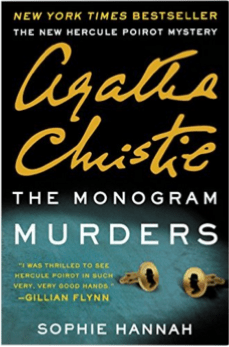
Day 900: The Monogram Murders

Cover for The Monogram MurdersThe Monogram Murders is the first Hercule Poirot mystery written since Agatha Christie’s death that was approved by her estate. It is written by the British thriller writer Sophie Hannah, whose books I have enjoyed. I was curious to see how authentic the novel seemed as a Christie mystery.

Hercule Poirot visits Pleasant’s Coffee House every Thursday night because he finds that its delicious coffee activates the little grey cells and he likes the astute observations of a waitress named Fee. One evening a regular patron comes in disturbed, behaving as if she fears for her life. When Poirot tries to convince her to confide in him or go to the police, she runs away. All Poirot can find out about her is that she works in some large house across town and her name is Jennie.

Hercule returns to his rooming house to confide in his fellow lodger, Mr. Catchpole, who works for Scotland Yard, but Catchpole is disturbed by having just attended the scene of a murder. Three people have been found dead at the exclusive Bloxham Hotel, and each had a monogrammed cufflink in his or her mouth.

Investigation soon finds that the two women victims, Harriet Sippel and Ida Gransbury, both lived in the small town of Great Holling. They traveled up separately to London and had rooms on different floors, but they both had tea with the third victim, Richard Negus, at 7:15 PM. They were all found dead in their rooms after 8 PM.

It soon becomes clear that the deaths have something to do with a tragedy years before in Great Holling, when lying rumors about the town’s vicar resulted in the loss of his reputation and the subsequent suicides of his wife and himself. The three dead were the couple’s biggest traducers, and a servant named Jennie Hobbs told the original lie. But who is the murderer? Some pieces don’t fit.

So, how does The Monogram Murders stack up against other Christie mysteries? It is certainly as complex as any other Poirot mystery and as difficult a puzzle. Hercule Poirot is very much himself. Catchpole is a suitably dense sidekick, a bit reminiscent of Mr. Watson in another series. The novel is engaging and interesting. The one distinctive characteristic of Christie’s novels that it lacks are her deft characterizations, her way of making readers be able to visualize them with just a few sentences. Still, this novel makes a fairly worthy entry into the series.

Related Posts

At Bertram’s Hotel

Death on the Nile

The Truth-Teller’s Lie

Day 891: Girl Waits with Gun

Cover to Girl Waits with GunConstance, Norma, and Fleurette Kopp are driving their carriage into Paterson, New Jersey, one day when they are broadsided by an automobile driven by a wealthy man accompanied by a bunch of thugs. The men try to drive away but are stopped by the townspeople. The man turns out to be Henry Kaufman of Kaufman Silk Dying Company.

When Constance tries to collect $50 from him for repairs to their buggy, she and her family find themselves the victims of harassment. They receive threatening letters, bricks are thrown through the windows of their farmhouse at night, and men invade their property. Constance’s trip to the police gets no help from the prosecutor’s office, but Sheriff Heath teaches Constance and Norma how to shoot and sends deputies out to patrol the house.

The threats don’t stop, though. Instead, the attacks escalate and the women receive kidnapping threats against Fleurette, who is only 16.

In the meantime, Constance has met Lucy, a young dyer, who says she had a child by Kaufman. She said she sent the baby away with other children during a recent strike, and he is the only one who didn’t come back. She is sure Kaufman kidnapped him.

This novel is fun, exciting, and well written, with interesting characters, placed during a period when there was a lot of labor unrest in the Northeast. Constance is an engaging heroine. Although the plot involving Lucy is made up, the rest is based on a true case of the time, taken from newspaper articles from 1914. This novel makes truly enjoyable reading.

Related Posts

Empire Girls

Birds of a Feather

Dandy Gilver and a Bothersome Number of Corpses