Day 741: Seven for a Secret

Cover for Seven for a SecretSeven for a Secret is the second fantastic Timothy Wilde historical mystery by Lyndsay Faye. The series is set in 1840’s New York City. Wilde is a member of the newly formed copper stars, the city’s first police force.

It is Valentine’s Day, and Timothy and his colleague Jakob Priest are celebrating having solved an art theft when a beautiful woman of color comes looking for him at the station house. She is Lucy Adams, and she has just returned home from her job at a flower shop to find her son and sister missing. She knows exactly what happened to them. “Blackbirders” have snatched them to sell down south as escaped slaves, even though they are free.

Timothy asks his brother Valentine to go with him to get them back. Although Valentine is a corrupt Democratic party boss and a drug addict, he’s a good man in a fight. Timothy, his African-American friend Julius, and Valentine retrieve the three from the slavers, Varker and Coles, but not without a fight. The two women and little boy need somewhere safe to stay until Lucy’s husband returns, so Valentine offers them the use of his apartment.

Something is going on that is more complex than he understands, for when Timothy goes searching for Lucy’s husband, he finds that Lucy isn’t married to Charles Adams, a white salesman, as she thinks she is. She may or may not be married, but her “husband” is a Democratic senator for New York state.

Coming to see Lucy and her family a couple of days later, Timothy finds Lucy strangled and the room disrupted. Timothy is an honest police officer but he knows a frame job when he sees one. He has just finished removing the body and cleaning up when an enemy, Sean Mulquean, another copper star, arrives to investigate a reported disturbance. Timothy also soon learns that Varker and Coles have kidnapped Julius, so he must hurry to court to try to free him before he can look for Lucy’s sister Delia and son Jonas.

Faye’s historical setting of gritty 1846 New York is absolutely convincing. We like Timothy more the more we see him, and Faye is beginning to build a solid cast of supporting characters. This is a well-written, swift-moving, suspenseful series. At almost 500 pages, the novel is long for a mystery, but it didn’t seem like it for a second. Unfortunately, I have just learned that there is only to be one more in the series, and that one is waiting in my pile to be read.

Related Posts

The Gods of Gotham

Dust and Shadow

The Pale Blue Eye


Day 734: The Sun Is God

Cover for The Sun Is GodI have just become aware of the work of Adrian McKinty, said to be one of the best Irish crime novelists. The Sun Is God is set in New Guinea in 1906 and is based on an unsolved true crime.

Will Prior is a failing plantation owner in German New Guinea when his friend Lieutenant Kessler comes to request his assistance. Will is a former British military police officer who left the service after a massacre of rioting prisoners in South Africa. Kessler has come to ask him to help investigate a possible murder on a nearby island.

The island is occupied by a cult of mostly German nudists who call themselves Cocovores. They eat only coconuts and bananas and are sun worshippers. The pilot who brought Max Lutzow’s body back to Herbertshöhe, the regional capital, was told Lutzow died of malaria. But an autopsy reveals that he drowned.

Prior and Kessler are dismayed to find that they are expected to take a woman along with them on the investigation, Bessy Pullen-Burry, a travel writer. She is coming as a representative for Queen Emma.

The investigation seems to go nowhere almost immediately. Although the autopsy indicates otherwise, all the Cocovores tell the same story of malaria. The only discrepancy is whether Ann Schwab was with Lutzow right until he died. Yes, the investigators are surprised to find three women among the nudists, whom they had understood were all men.

Even though the investigation seems to stall, hampered by the islanders’ consumption of high-grade Bayer heroin, which they believe to be nonaddictive, Will grows worried about his party’s safety. They are not finding any evidence, but something is wrong, and they only have one opportunity a day to leave the island.

This novel is very well written and compelling, although it suffers from the feeling that no investigation is going on. So many men are on the island that I had difficulty keeping track of them and didn’t get much of a sense of their personalities. Still, the setting and situation are atmospheric and there’s a surprising shift of point of view at the end.

Related Posts

The Luminaries

The Bone People

Arcadia

Day 710: The Kept

Cover for The KeptBest Book of the Week!
The Kept is a mysterious and darkly moody novel that I found compelling from the first sentences. Elspeth Howell arrives home on a snowy winter day in upstate New York near the turn of the 19th century. She has been away for months working as a midwife. But when she reaches home, she finds that her husband and all of her children that live in the house have been murdered. Only her 12-year-old son Caleb, who has taken to living in the barn, is alive, but he has been hiding in the pantry for days, and when she opens the pantry door, he shoots her in terror.

Caleb spends the next few days alternately trying to take care of his mother and dispose of the bodies of the rest of his family. He cannot bury them in the frozen earth, but in his attempt to burn them, he accidentally burns down the house. He ends up caring for his mother in the barn.

The Howell’s home is isolated and difficult to find. As a young girl, Espeth was driven from her home for having spoken to Jorah, the man she later married, because he was Native American. But there are other reasons for the family’s isolation. In any case, Elspeth thinks the murderers must have sought for their house.

When Elspeth is barely healed, she and Caleb set forth to find the three men who murdered their family, men whom Caleb watched from the barn. They stay briefly with an old couple who have been terrorized by the same three men and who point them in the direction of a town on Lake Erie with a terrible reputation. There, with Elspeth disguised as a man, they go to search for the men.

Beginning as a straightforward revenge novel, the book goes on to explore deeper themes. One of them is that of unintended consequences, as Caleb finds that their troubles result from Elspeth’s own actions years before.

This novel is well written and packed with atmosphere. It is vivid and brutal and beautiful.

Related Topics

Seven Locks

True Grit

Neverhome

Day 699: Rustication

Cover for RusticationBest Book of the Week!
I was captured by this dark, twisty novel from the moment I started reading it. I only feared it may eventually disappoint, but it does not.

In winter 1863, Richard Shenstone, 17, appears without warning at his mother’s new home, a large dilapidated house on the southern coast of England. He has been rusticated, sent down from Cambridge for reasons not immediately explained.

Having received word of his father’s death too late for the funeral, he is surprised to find his mother and sister living in apparent poverty. Furthermore, although he doesn’t at first tell them he’s been sent down, his arrival is met by a surprising lack of welcome, indeed hostility on the part of his sister Effie.

There is some mystery about his father’s death, that is clear. His father’s pension has been denied to the family, and Richard’s mother is suing for her father’s estate as well. Effie is also up to something, for he twice sees her out accompanied only by a tall man, not proper behavior for a lady.

Richard is not a pleasant person, obsessed as he is by desire for every girl or young woman he meets and also addicted to opium. The novel is told as excerpts from his journal, interrupted by copies of a series of hateful letters that soon begin arriving at the homes of various people in the district. It is also clear from the beginning that some crime has been committed and the journal is a look back into the past. It is not clear to readers, however, how reliable a narrator Richard is or what’s going on when he roams the countryside at night in his opiated state. Soon the letter writer begins leaving corpses of mutilated sheep behind him.

This novel is atmospheric in the extreme and completely absorbing. As Richard begins trying to figure out who the letter writer is, he finds the finger pointed toward himself. He takes unwarranted leaps of logic that cause him to make many mistakes and ignores some clues that he has. Still, exasperating and unlikable as the main character is, you are urged along to the end of the novel.

Related Posts

Stone’s Fall

The Séance

The Darkest Room

Day 692: The Devil in the Marshalsea

Cover for The Devil in the MarshalseaTom Hawkins has been leading a dissolute life ever since his ordination ceremony was sabotaged by his stepbrother’s reports of his behavior at school. In a desperate attempt to save himself from debtor’s prison, he goes out gambling with his disapproving friend Charles and manages to win enough money to save himself. But on the way home, he is attacked and robbed of everything. Soon, he is on his way to the Marshalsea.

In 1727, the Marshalsea is not the place Dickens described in Little Dorrit. Although Dickens’ prison was a place of lost hope, in the early 18th century, the Marshalsea is a hell-hole run by a venal and vicious governor, Mr. Acton. Hawkins is astounded to find that it costs more to live in the Marshalsea than it does outside, and if you can’t pay your lodging you will be banished to the horrors of the Common Side, from which bodies are brought out daily. Hawkins has no money at all except what he gets for pawning his mother’s cross and a bit of money from Charles.

To support himself, Hawkins takes on the job of investigating the death of another debtor, Captain Roberts. Although Roberts’ death was deemed a suicide, it was almost certainly a murder, and his ghost is reported as roaming the prison.

Hawkins has taken Roberts’ room, so his roommate is Samuel Fleet, whom all of the prison inhabitants fear. Fleet claims to have been asleep when Roberts’ body was dragged from the room that night. But Hawkins soon observes that Fleet never sleeps.

This novel is terrific. It is thoroughly researched and richly imagined so that both the setting and characters come to life. Hodgson explains at the back of the book that many of the characters are based on actual historical figures. This is Hodgson’s first book, and I’ll be looking for more.

Related Posts

Jack Maggs

Great Expectations

The Solitary House

Day 667: Alias Grace

Cover for Alias GraceBest Book of the Week!
Most of what I have read by Margaret Atwood has been futuristic and dystopian, so I was quite surprised to find that Alias Grace is an apparently straightforward historical novel. But then, nothing with Atwood is exactly straightforward.

The novel is based on a notorious Canadian murder, in which two servants were found guilty of murdering their master and his paramour housekeeper. The man was hanged, but there continued to be debate about the extent of the guilt of the woman, Grace Marks.

The novel begins some years after the event, when Dr. Simon Jordan, studying new discoveries in the field of mental illness, is hired by a group trying to gain Grace a pardon. Grace has always claimed she cannot remember the crimes, and he hopes to revive her memory. He begins in a way meant to slyly nudge a modern sense of humor, by bringing her an apple followed by a series of root vegetables he hopes will remind her of a cellar, where the bodies were discovered.

Grace, who was very young at the time of the crime, eventually tells him what she can remember, beginning with her early life. She relates her story in a simple way, conveying the persona of a proper young girl.

Dr. Jordan appears as if he is going to be the hero of this novel, but he has his own obsessions and difficulties.

As Grace tells her story, we are drawn slowly in, waiting to learn what really happened. This novel is rich in detail and beautifully written, but it is also slyly humorous and dark.

Related Posts

Stone Mattress

Corrag

Burial Rites


Day 584: The Shining Girls

Cover for The Shining GirlsBest Book of the Week!
The Shining Girls is a clever, clever novel, a hybrid of a fantasy novel and a crime thriller. I read rave reviews of it, and it deserves them.

Harper has just killed a man in a Chicago Hooverville in 1931. He is being pursued in the freezing cold when he murders a blind woman for her coat. Inside the pocket he finds a house key, and somehow he knows the way to the house. It is a boarded up old wreck on the outside, but inside it is warm and comfortable, even prosperous looking. When Harper goes into an upstairs room, he finds souvenirs and girls’ names written on the wall. He understands that the house wants him to kill these girls. When he goes back outside, he finds himself in another time.

In 1993, Kirby Mazrachi interviews for an internship at the Chicago Sun-Times. She has asked to work with Dan Velasquez, a former crime writer who now covers sports. Her goal is to find the man who attacked her and nearly killed her in 1989. She believes he is a serial killer, and she is planning to use the paper’s resources to find more of his murders.

As Kirby continues her investigation, finding evidence that doesn’t make sense, Harper tracks down his shining girls one by one, visiting them when they are young and then going back for them as adults, over a time period of 60 years. He takes something from each one and gives it to the next.

This novel is completely absorbing, well written, and suspenseful. It is also haunting and unusual, with everything cleverly linked up. In the larger context, it explores the issues of fate and free will, but as entertainment, it keeps you pinned to your seat.


Day 545: Twelfth Night

Cover for Twelfth NightFans of the Lady Julia Grey mystery series will probably enjoy this novella, which seems as if it was written for Christmas even though published in June. It is a simple little holiday story, a bagatelle.

The Marches, Lady Julia’s family, have gathered together during the holidays to celebrate Twelfth Night. Every decade the family itself performs the Revels, which are attended by the countryside around. During the rehearsals, an abandoned baby is found in the stables.

Lady Julia’s father asks her husband Brisbane to try to find the mother, but Brisbane’s initial inquiries turn up nothing. Lady Julia has heard her young niece and nephew buzzing about a witch living in an abandoned cottage, and then Lady Julia catches her niece Perdita sneaking out at night to see the witch.

http://www.netgalley.comThis short piece doesn’t involve much of a mystery, but it is always enjoyable to spend time with Julia and Brisbane.

Day 478: Mr. Timothy

Cover for Mr. TimothyAlthough not typical holiday fare, Mr. Timothy picks up some of Dickens’ characters about 20 years after A Christmas Carol and has the added similarity of being set at Christmas time. The main character is Timothy Cratchitt, familiar to us as Tiny Tim.

Timothy is depressed and aimless. The patronage of Ebenezer Scrooge, or Uncle N as he is known in this novel, has had the unfortunate effect of making Timothy dissatisfied with his roots while not fitting him for much else. Most of his family has died or moved away, and he is depressed about the death of his father six months before. In despair, he has left his usual haunts and gone to live in a brothel, where he teaches the owner, Mrs. Sharpe, how to read. Although he has some desire to make his own way, he lacks purpose and initiative, still accepting an allowance from Uncle N. He seems to be on his way down in life.

Timothy goes out dragging the river for bodies one night with his friend Captain Gully, and they pull out a young girl. She has an odd brand on her back, like a G with eyes. Timothy realizes he has seen this brand before, on another girl the police were examining as he went by, who was found dead in an alley.

Timothy has several times spotted another young girl around the city and tried to approach her, but she has always run away. With the help of a street urchin named Colin, he finally tracks her down. Philomela is Italian and has had something traumatic happen to her of which she will not speak. When Timothy tries to take her home to safety, two different parties attempt to remove her from his custody on the street. A charity worker insists she will take Philomela to a home, and a mysterious man in a coach tries to kidnap her. Philomela and Timothy get away, but now Timothy is determined to find out what is going on.

This novel is a slow starter and fairly depressing at the beginning. Although it is feasible to theorize that Scrooge’s help could result in such unhappiness (ala Great Expectations), I wasn’t sure I wanted to think of the original story in these terms. However, the novel successfully invokes a Dickensian atmosphere, including the comic characters and character names, and it picks up its pace as Timothy gets involved in the mystery. After the first 50 pages or so, I was involved and trying to figure out the mystery, which is as entangled as any Dickens effort.

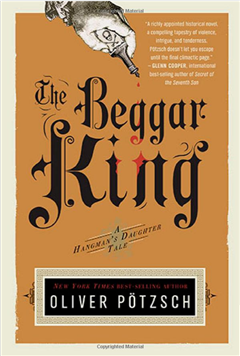
Day 475: The Beggar King

Cover for The Beggar KingBehavior is a problem in The Beggar King, the third of Oliver Pötzsch’s Hangman’s Daughter series, but the first I have read. Characters who are in peril of their lives stop running away from their pursuers to have arguments; characters who are fighting for their lives start flashing back to their pasts instead of concentrating on not being killed. To be very clear about this problem, the characters do what the plot requires. When the plot requires the three main characters to be apart, for example, Pötzsch has them begin arguing or just has someone walk off instead of finding a plausible reason for separating them.

The novel begins in 1662, when the Schongau hangman, Jakob Kuisl, gets a letter from his sister in Regensburg saying she is very ill. When he arrives at the bathhouse her husband owns, he finds her and her husband brutally slain. Immediately afterwards, the authorities rush in and arrest him. Now it is up to the Regensburg hangman to torture him into a confession.

In the meantime, back in Schongau Magdalena Kuisl and her lover Simon Fronwieser have run into trouble. As the hangman’s daughter, Magdalena is considered to be among the lowest rungs of society, and she is not allowed to marry Simon, a member of the middle class. A series of encounters with a group of bullies finally ends in the Kuisls’ house being set on fire. Instead of helping her mother and her eight-year-old twin siblings (who by the way behave more like four or five than eight) as might be expected, Magdalena and Simon decide to run off to Regensburg to start a new life.

I have been to Regensburg, which is a beautiful medieval city with an interesting history. We learn a bit about this history, and that is probably the most interesting part of this novel. The city is mostly described to us in terms of its mud and filth, however, not in terms of its lovely pastel stucco buildings decorated with beautiful medieval-era murals or winding cobblestone streets.

However unlikely, our three main characters have stumbled into two plots, one of revenge against Jakob for events during the Thirty Years’ War, the other involving an imminent threat to the Reichstag. Soon, all three protagonists are wanted by the authorities, Magdalena and Simon for arson after someone burns down the bathhouse with them in it, Jakob because he has escaped. Nevertheless, they chase all over the city without anyone noticing them unless Pötzsch needs them to be noticed. In the meantime, they unfailingly trust the wrong people and assault the ones who are trying to help them.

This novel is certainly full of frantic activity. Whether it is plausible at all is the question. I was particularly irked by the last 50 to 75 pages, in which all three characters are in peril in separate locations. Just as one scene reaches a climax, Pötzsch switches the action to another location. This tactic might foster suspense if done once, but Pötzsch uses this technique repeatedly over 50 pages simply to spin things out. I found this tactic so irritating that I almost quit reading at the end of the book!

Although the novel is written moderately well, the characters are one-dimensional and their behavior is driven by plot. The plot itself is ridiculous.