Review 2335: Silence

I was interested in this novel because of its setting in 17th century Japan. However, although it is considered the author’s masterpiece, it is almost completely about religious faith, Roman Catholic faith, in fact, although the particular religion doesn’t affect my lack of interest in that subject.

Although the Japanese originally welcomed the Portuguese and allowed missionaries and conversions, by 1627 when the novel begins, the shogun has closed the country’s borders and outlawed Christianity. Word comes back that Christóvão Ferreira of the Society of Jesuits is apostate in Japan.

Three of his former students cannot believe this of their beloved leader. So, Francisco Garrpe, Juan de Santa Maria, and Sebastian Rodrigues get permission to journey to Japan in hopes of finding Ferreira.

After a long and difficult journey, Garrpe and Rodrigues arrive in Japan, Santa Maria being too ill to leave Macao. In Japan, they immediately take up a life of hiding, the situation being perilous, while they wonder if they have the inner strength to be martyred. They have come from Macao with the only Japanese man they could find there, a shifty man named Kichijiro, who says he is not a Christian. However, when they reach Japan, he takes them to a village of Christians who say he is one.

Several times Rodrigues has to witness Japanese being tortured or killed for being Christians, and he begins to wonder why God remains silent while Christians suffer. His battles with doubt become the focus of the novel.

Although the novel is historically interesting, the continual mental thrashing is not, at least not to me, nor are the religious arguments between him and Japanese authorities after he is caught. However, someone interested in religion may find them so. I also found distasteful the fascination with becoming a martyr.

Related Posts

The Thousand Autumns of Jacob de Zoet

The Silk Roads: A New History of the World

Zealot: The Life and Times of Jesus of Nazareth

Review 2167: Weir of Hermiston. Some Unfinished Stories

I wasn’t aware when I picked up Weir of Hermiston that it was Robert Louis Stevenson’s last and unfinished novel. But unlike The Mystery of Edwin Drood, only nine chapters of it exist. It has been packaged in the slim volume I found, dated 1925, with several other unfinished novels or stories, but of the others only one or two chapters or partial chapters exist. Between most of the fragments is a note from the editor containing what is known about the fragment and Stevenson’s intentions.

Weir of Hermiston tells the story of Archie Weir, whose mother brought him up to fear and distrust his father, the Lord Justice-Clerk. As a young man, Archie reacts in a disgraceful way, possibly treasonous, to a hanging, so his father sends him to his estate in Hermiston to learn to run it. Archie is ashamed and is not socially adept, so he becomes a bit of a recluse. However, he meets Christina, a cousin, and begins to fall in love with her. He is joined by Frank, a financially embarrassed friend, who decides to give him some competition for Christina. Things aren’t looking good when the fragment ends.

The next fragment is Heathercat, about a young boy whose mother keeps disobeying the law in regard to religion—I didn’t really understand the details—to the point where his father is being ruined by fines. She is using her son, whose nickname is Heathercat, to run illegal errands and keep guard on illegal services of worship. The notes explain that this novel was going to be based on a true story about a young boy who was married to an older girl to prevent her being forced to marry someone else.

Other stories are about a beautiful wife of a wine seller who falls in love with an aristocratic customer, a prince, presumably Prince Charlie, who tires of waiting around and decides to act; a man who takes over the household of a friend who has fled the country; and so on. The fragments are set in Scotland, England, or France during the 15th to 17th centuries, except Weir of Hermiston, which is set in the 19th.

I forgot to add that my copy begins with a description of Stevenson’s death and funeral, written by his stepson, Lloyd Osbourne, who was apparently very fond of him.

I found a book composed of fragments to be frustrating, but it made me want to read more of Stevenson’s adult novels.

Related Posts

Kidnapped

Treasure Island

Travels with a Donkey in Cévennes

Review 2110: Classic Club Spin Result! The Saga of Gösta Berling

The Saga of Gösta Berling begins with the story of a young minister. He has been so depressed by his difficult job and his gloomy house in a remote region of Sweden that he has begun drinking, going so far as to miss some Sunday services. His parishioners have complained, so the bishop and other senior clergymen have come to his parish to attend Sunday service and dismiss him. However, that morning he is sober and gives a passionate and inspiring sermon. The clergymen question the parishioners and they suddenly have no complaints. So, the clergymen give the minister a talking-to and depart. The young minister is Gösta Berling, and now he resolves to reform, to stop drinking and dedicate his life to others. But then one of his old drinking buddies, who drove away with the clergymen, tells him they won’t bother him again. He has given them a terrifying sleigh ride to the station and then threatened them. Gösta knows they won’t believe he didn’t have a hand in it. So, off he goes to become a defrocked priest, a vagrant wandering in the wilderness.

This bit is typical of what we find in this episodic novel, situations apparently resolved for the good, only to end in some ironic twist. It is an unusual novel, and the only thing I can think of that it reminds me of is Peer Gynt, except that Peer Gynt didn’t seem to have good intentions.

Years later, we find Gösta at Ekeby, the home of the majoress. She has a sad past but for years now has ruled Ekeby and its iron mines and farms through having married the major. She has given free room and board, indeed a wing of her house, to 12 cavaliers, who are required to do nothing except enjoy themselves and raise hell. The only catch is that each year, one of them dies. Gösta is one of the cavaliers.

On Christmas Eve, a “black gentleman” emerges from the chimney during the cavaliers’ party and convinces them that everything wrong with their lives is the fault of the majoress, that she has made a pact with the devil to get power. He particularly convinces Gösta even though the majoress rescued him from poverty. They make a pact with him to have control of Ekeby for one year, and if one of them acts unlike a cavalier in that time, he will have all their souls. So, on Christmas Day the cavaliers drive the majoress out of her house to wander the countryside.

This event is only two or three chapters into the book, but by this time there had already been several episodes in which Gösta proved himself charismatic but mercurial and unreliable. I was getting disgusted with him and took a break from the novel.

But coming back to it, I began to appreciate Lagerlöf’s extravagant prose style and vivid descriptions. It’s clear that she loves the Värmland area of Sweden, which was her home and the setting of the novel. Plus, I got more involved in the action of the novel, which has the feel of stories of the past being told around a fire.

Still, I found Lagerlöf’s idea of a fitting ending as well as the religious overtones fairly off-putting. So, a so-so for Gösta. I read this novel for my Classics Club list.

Related Posts

Wolf Winter

The Long Ships

The Prisoner of Zenda

Review 1797: The Historians

Like her previous two novels, Cecilia Ekbäck has set The Historians partially on the fictional Blackåsen Mountain, a stand-in for the Kirina Mine in far northern Sweden. This novel is set during World War II.

In Lapland, a Sami girl goes missing. She is not the only one. Near Blackåsen, a miner decides to find out what is going on in the secret mine, the one that is supposedly out of bounds. He hopes to find members of the Norwegian resistance there, so that he can help them against the Germans, Sweden being neutral. Later, he is found dead.

In Stockholm, Laura Dahlgren is approached by her best friend Britta’s Sami friend Andreas. He tells her Britta has disappeared, and he is worried. Britta and Laura were part of a group of special history students studying with Professor Lindahl at Uppsala University. After the others took up careers, Britta remained, working on her thesis. Laura thought Britta wanted to tell her something the last time she saw her, but she did not. Now not only is Britta missing, but so is her thesis.

Jens Regnell, the secretary of a government minister, is perplexed when the ministry archivist, Daniel Jonsson, asks about some phone calls to the Danish and Norwegian foreign ministers that were not logged. In fact, he doesn’t know how one could circumvent the logging. When he tries to find out about the calls, he is shut down and then Daniel is replaced, reported to be ill. Next thing he knows, Daniel is dead, a supposed suicide. Oh, and Jens receives in the mail a thesis by a student named Britta Hallberg.

This novel is genuinely thrilling, as Laura reconvenes the friends in her study group to find out what happened to Britta and what was in her thesis. I started out reading this novel when I had to take a break from reading another novel on my iPad because it needed a charge, but I ended up putting that one aside completely, even after my iPad charged, until I finished this one.

In the Month of the Midnight Sun

Wolf Winter

Warlight

Review 1696: V2

Just a note first: The description of V2 on Goodreads made me wonder if the publicist actually read the book. It describes one of the main characters, Kay Caton-Walsh, as an ex-actress when she is actually an ex-university student, and it says she becomes a spy. I always assume these descriptions come from the book jacket, but in this case the jacket is more truthful. I just happened to notice this, so I went over and looked at the description on Amazon, and it is the same as the one on Goodreads. Hmm.

_______________________

Kay Caton-Walsh, a WAAF, is having a liaison with her married lover, who is also the air commodore, when the area is hit by a Nazi V2 rocket. Her lover is dispatched to the hospital while she returns to work, disturbed by his refusal to let her accompany him to the hospital. A photo interpreter in Intelligence, she and her sector are attempting to locate the V2 launch site in the Netherlands. When the commodore treats her dismissively afterwards, she decides to volunteer for a position with a group of WAAFs in Belgium who will be trying to locate the launch sites by computing the rocket’s parabola.

Dr. Rudi Graf is a rocket engineer who has worked with Werner von Braun since he was 16. He has tried to concentrate on the mechanics of the rockets, but he is becoming disillusioned about the conduct of the war and sickened by the behavior of the Nazis. The novel alternately follows these two characters as they work on the same project from the two sides.

Although I am a devoted Harris fan, I don’t think this is one of his best. For one thing, it doesn’t build suspense as most of Harris’s books do. For another, I am dismayed by this trend I’ve noticed of depicting sympathetic German soldiers from World War II. Although I realize they were not all actively engaged in horrible acts, Graf really is. His dream of space flight has been converted into flinging rockets at civilians. Luckily, the program wasn’t that successful. Still, it killed hundreds of people on the British side and enslaved many more on the other side of the Channel.

Related Posts

Munich

An Officer and a Spy

The Second Sleep

Review 1587: Captain Paul

Quite a few years ago now, I bought the collected works of several 19th century writers in ebook form from Delphi Classics and resolved to read them all, starting from the earliest works. I didn’t get very far—read one or two novels by each—before life got in the way of my project and I forgot it. But recently, I thought I would occasionally interject one of those novels into my regular reading, and the first one is Captain Paul by Alexandre Dumas, his second novel.

Now, this novel is quiet peculiar, for Dumas was inspired for it by James Fennimore Cooper’s The Pilot, which is about John Paul Jones. I haven’t read The Pilot, but it seems that Dumas has taken some liberties with Jones’s life if not with Cooper’s book. In particular, while naming his character Paul Jones, as Cooper apparently does in his book, and using some actual episodes from John Paul Jones’s life, he makes him a Frenchman (he was, of course, Scottish-American), and he gives him an entirely fictional but romantic lineage as the illegitimate son of a French count (although JPJ was born on an estate, the son of a gardener, so maybe Dumas was making some sort of assertion about his birth).

In the novel, Captain Paul, unaccountably donning two disguises in the first few pages, takes onboard his ship a prisoner of France that he is supposed to deliver to the prison island of Cayenne. The crew is not supposed to speak to the prisoner, but his conduct during a battle with an English ship leads Captain Paul to ask for the story of the prisoner, Hector de Lusignan.

Six months later, Captain Paul visits Count Emmanuel d’Auray, who originally delivered Lusignan to the ship, to tell him he knows he imprisoned Lusignan unlawfully. Lusignan’s crime was to fall in love, without fortune, with d’Auray’s sister, Marguerite, and have a child with her. While d’Auray got rid of Lusignan, his mother, the Marchioness, removed Marguerite’s child. Now, they are trying to force her to marry a fop who has promised d’Auray a commission. Captain Paul announces his intention to get Lusignan a pardon and remove Marguerite’s child from wherever it is hidden. But when he learns Marguerite still loves Lusignan, he decides to help the lovers.

There are more secrets to come, including Captain Paul’s own identity.

This is a short, fast-moving novel once you get over your bemusement about poor John Paul Jones. It is entertaining, but after all the action is over, Dumas couldn’t resist adding an Epilogue, which tells us how everyone ended up and also contains more of Jones’s real (maybe) exploits. The Epilogue, therefore, is about as long as two or three of the chapters, and everything bogs down tremendously. This is the addition of an inexperienced writer, and we all know he improved.

By the way, I believe that the figure depicted on the cover above (which is not the edition I read) is actually supposed to be Alexandre Dumas’s father, who was a famous general.

Related Posts

La Reine Margot

The Black Tulip

Acté

Review 1554: The Vanishing Futurist

Right before the start of World War I, Gerty Freely goes to Moscow to be a governess for the Kobelev family. There she falls in love with one of Pasha Kobelev’s friends, Nikita Slavkin, a brilliant, idealistic scientist and revolutionary. Although Gerty is not political, she eagerly embraces the life of a communard in a commune Slavkin founds in the Kobelev’s house after the revolution. With them are Pasha and his sister Sonya and a few other young people.

Slavkin’s mission becomes to invent a machine that will change people’s cellular structure making them perfect Communists. Eventually, he comes to believe that he can make a machine that will transport a person into another dimension where perfect Communism is possible. Certainly, it doesn’t seem possible in the present one.

Hobson’s novel skillfully depicts the idealist euphoria and immense creativity of the early days of the Russian revolution as well as the hardships, the inevitable disintegration of communal life, and the craziness of those days as the revolution begins to turn in on itself. It makes really interesting reading and seems to much more authentically depict the time than any of the recent novels I’ve read about it.

I read this book for my Walter Scott Prize project and really enjoyed it.

Related Posts

The Revolution of Marina M.

A Gentleman in Moscow

Memories: From Moscow to the Black Sea

Review 1484: The Sealwoman’s Gift

With one foot in the world of myth and saga and the other based in a true historic event, The Sealwoman’s Gift should have been a great book. Sadly, it is not quite so good as I expected. It has an interesting beginning and a touching end but tends to drag sometimes in the middle.

One morning in 1627, Oddrún comes to Ásta, saying she’s had a vision of men crossing their island to attack them. However, Oddrún thinks she’s a sealwoman and only one of her visions has been known to come true, so no one pays attention. Shortly thereafter, their small Westman Island, part of Iceland, is attacked by Barbary pirates. Almost everyone is killed or enslaved.

This is Sally Magnusson’s imagining of a true event the remains one of the most significant in Icelandic history. Out of a population of about 40,000, many were killed and 400 taken. Among those taken are Ásta and her husband, the minister Ólafur, and all but one of their children. Ásta, hugely pregnant, begins giving birth on the ship, and one of my complaints is that, with all the flashbacks and background information, it takes from chapter one until the end of chapter five before she actually has the baby. I have to say that this seemed interminable, and Magnusson could have figured out a better way to handle the background information. Finally, they arrive in Algiers.

Ásta and Ólafur and two of their children are bought by a powerful trader named Cilleby, while their oldest son Egill, is purchased by the Pasha and never heard from again. Ólafur is surprised to be given no duties, but after a few months Cilleby dispatches him with a safe passage back to Denmark to try to obtain ransom for Denmark’s Icelandic citizens.

Ásta, who has been a dreamy woman with a love of Icelandic sagas, remains as a seamstress, trying to bring up her remaining two children and listening to the stories told in the evening by members of the harem.

During this period, Magnusson might have tried to more fully imagine life in Algiers, but this world is not fully realized. Or, she could have stuck with Ólafur on his journey back to Denmark and in his years of fund raising to free the captives. But she is more interested in Ásta and has her develop a relationship with Cilleby. I found this the least likely and least interesting part of the book.

Still, I was glad I finished the book, because the story eventually ends in Iceland, which Magnusson depicts more convincingly. The ending was touching and redeemed the novel quite a bit.

Related Posts

Iceland’s Bell

Burial Rites

The Greenlanders

Review 1420: The Talisman Ring

Having greatly enjoyed a play based on The Talisman Ring, I thought it was about time I reread the original. So, I pulled out my old, tattered paperback copy (copyrighted 1964) and read it again.

Sylvester Lavenham is dying and wishes to assure that his granddaughter is taken care of. So, he proposes a marriage to his nephew, Sir Tristram Shield. The granddaughter, Eustacie de Vauban, is young, French, and volatile. She agrees to marry Sir Tristram, but having romantic tendencies, she is taken aback by his matter-of-face nature. Changing her mind, she decides to steal away at dead of night to London with the aim of becoming a governess.

Unfortunately, she is taken by smugglers who are trying to escape some excisemen. To her delight, she finds that the leader is her cousin Ludovic Lavenham, famously wanted for murdering a man who refused to return his talisman ring, which he pledged while gaming. During their escape, Ludovic is shot, and Eustacie takes him to a local inn for help.

Here’s the poster from the play.

Of course, Ludovic is not guilty of murder and several characters join forces to prove his innocence. But if you think Ludovic and Eustacie are the romantic lead characters of this novel, you don’t know Heyer. For at the inn, they encounter Sarah Thane, an older young woman with a quick sense of humor.

The Talisman Ring is a typical Heyer romantic comedy, with a complicated, ridiculous plot, one brave but foolhardy hero, a vivacious heroine, and a likable older couple to anchor the romance. It’s lots of fun, as Heyer’s novels usually are.

Related Posts

Sylvester, or the Wicked Uncle

Cotillion

Friday’s Child


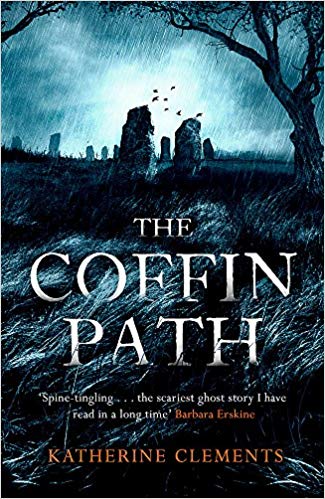
Review 1326: The Coffin Path

Cover for The Coffin PathIt’s 1674, and Mercy Booth helps her aging father work a sheep farm in remote northern England. She feels that at 28, she is beyond marriage, but she really only cares about the farm.

In early spring, she is out on the moor when she feels that someone is watching her with enmity. After that, strange things begin happening in the house. Three old coins disappear from her father’s drawer. She hears noises upstairs when no one seems to be there. She catches glimpses of a pale face. The home is believed to be cursed after the three prior inhabitants were all murdered, their mouths covered with those missing coins.

Early in spring the head shepherd hired Ellis Ferreby, a wandering shepherd. The novel is narrated by him in alternate chapters as he observes what is going on. He, too, has seen and heard strange things.

Also key to the story is Sam, the young son of Ambrose, the head shepherd, who lately lost his twin brother after a fall. He is a favorite of the house but begins to behave strangely.

This novel is truly atmospheric, and although I had glimpses of its secrets, I could not figure everything out. I found myself interested in the characters and involved in what was happening to them. This is a real page-turner.

Related Posts

Corrag

The Haunting of Maddy Clare

All the Birds, Singing