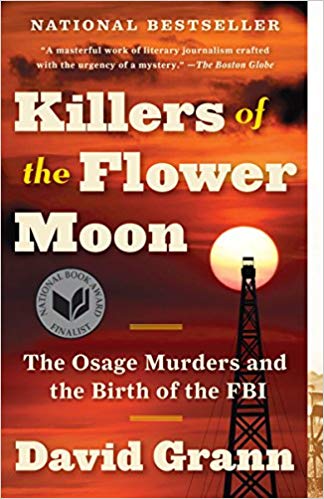
Review 1335: Killers of the Flower Moon: The Osage Murders and the Birth of the FBI

Cover for Killers of the Flower MoonDavid Grann’s book Killers of the Flower Moon details a past that was once infamous but now almost forgotten except in Osage country. In the 1920’s, the Osage nation in Oklahoma was the richest population per capita in the United States. This phenomena was a result of wise decisions by the tribal leaders during the 19th century land grab by the whites. They voluntarily moved from their homelands, purchasing land in Oklahoma that they thought white men would deem worthless. Then oil was discovered on their property. Because the nation had purchased the property, it couldn’t be taken back.

However, the federal government, in its infinite wisdom, deemed the Osage unfit to handle their own money. So, they appointed white guardians for them. As you can imagine, there were many eager to cheat these people out of their headrights, as were called their shares of the tribal fortune.

The Osage began dying. Grann centers much of his book on Mollie Burkhart, the Osage wife of Ernest Burkhart. One by one, her family started dying. First, her sister, Annie, was found shot in the head. Then her mother, Lizzie, died of a mysterious illness, believed by many to be poison. When her sister Rita’s husband, Bill Smith, tried to investigate, he and his wife and servant girl were killed one night when their house exploded. Other Osage were dying, too, and investigators either came up with nothing or were themselves murdered.

As the FBI was in its infancy and trying to figure out its own jurisdictional powers, new director J. Edgar Hoover decided that the Osage murders, which were becoming infamous as indicators of failure and corruption, would be good ones to solve. So, he sent out a former Texas Ranger, Tom White, to investigate.

Grann follows their investigation, and it is a fascinating one. This is a shameful period in our history that should not be forgotten. Grann goes further than the FBI, though, by looking into other deaths that were not investigated.

This book tells a mesmerizing story about a shocking time not so far in the past.

Related Posts

The Lost City of Z: A Tale of Deadly Obsession in the Amazon

The Midnight Assassin: Panic, Scandal, and the Hunt for America’s First Serial Killer

The Wicked Boy: The Mystery of a Victorian Child Murderer

Review 1321: Samuel Pepys: The Unequalled Self

Cover for Samuel PepysYears ago, I attempted to read Samuel Pepys’s diary, but I didn’t make much headway. However, I was reading it without any context. Now that I’ve read Claire Tomalin’s excellent biography of Pepys, I am interested in trying it again.

For one thing, I was not aware that Pepys worked his way up, by his great energy and organizational skills, from a poor beginning to an eminent position in the British admiralty. He was responsible for setting up many of the procedures used today. In the diary’s beginning, he is just a lowly clerk who seems to go out drinking a lot.

But Tomalin’s admiration is for Pepys’s unstinting truthfulness, even when it makes him look bad, as well as the literary and historical value of the diary. In short, he was a marvelous writer who documented significant events in a tumultuous period of British history.

Tomalin’s talent as a biographer is in giving her readers a true feeling for the personality of her subject. Pepys was a pleasure seeker, a womanizer, and not always an honest man, but he was curious, cultured, highly intelligent, dedicated, and faithful to his patrons. Although he had a poor opinion of both Charles II and James II, he served them faithfully, even when it was against his best interests. Pepys turns out to be a very interesting person.

Related Posts

Thomas Hardy

Jane Austen: A Life

The Journal of Mrs. Pepys

Day 1097: Alexander Hamilton

Cover for Alexander HamiltonBest Book of the Week!
I don’t think it’s ever taken me so long to read a book as it did Alexander Hamilton, despite it being a fascinating biography. Although it did not seem as if it went into too much detail, as some biographies do, it is certainly long.

Thanks to the Broadway show, which is based on this book, people have become a little more conscious of the accomplishments of Hamilton. Unfortunately, he was such a controversial figure that his enemies managed to blacken his legacy for many, many years.

A man of astounding intelligence, Alexander Hamilton sprang from a difficult heritage as an illegitimate son of a man who was a failure at business and deserted his common-law wife and their children. From this beginning, Hamilton expended his own formidable efforts, eventually to become one of the most powerful men in the new United States.

Hamilton was apparently not at all tactful and earned himself many enemies through speaking truth to power. He and Washington had a close and affectionate relationship that began when he was Washington’s aide during the Revolutionary War, but he counted among his enemies James Monroe, Thomas Jefferson, the New York Clinton family, Aaron Burr, and to a lesser extent, James Madison. John Adams hated him. None of these men emerge from this book looking well, although Hamilton certainly had his faults.

I think almost anyone interested in history will find this book fascinating, even if, like me, you are not particularly interested in the Revolutionary period. Alexander Hamilton was an amazing man who has been largely robbed of his proper legacy.

Related Posts

Valiant Ambition: George Washington, Benedict Arnold and the Fate of the American Revolution

Lafayette in the Somewhat United States

Seven Locks

Day 1075: At Home: A Short History of Private Life

One of the most enjoyable features of Bill Bryson’s travel books is his curiosity about everything and his willingness to go off on wild tangents. At Home is his attempt to inform himself and us about the objects of ordinary life, using his own home as a base for his explorations. But really, it’s his excuse to go off on tangent after tangent.

For example, his chapter on the cellar—he organizes his book by the rooms of the house—takes us to the building of the Erie Canal which takes us to the development of hydraulic cement then to the use of building materials in the United States versus England, a short history of Sir John Nash’s career, and so on. In fact, the contents of this particular chapter seem to have little to do with the actual room, except for the cement.

In reference to other rooms he discusses the history of various foodstuffs, the use of certain pieces of furniture, cemeteries, the history of how human mortality is treated, and even the history of gynecology. As always with Bryson, his comments can be amusing and the observations enthralling. If you like learning interesting little facts, this is the book for you. My edition was the illustrated one, which is full of fascinating photos and other pictures.

Related Posts

The Road to Little Dribbling

A Walk in the Woods

The Life and Times of the Thunderbolt Kid

Day 1049: Lafayette in the Somewhat United States

Cover for Lafayette in the Somewhat United StatesIt was interesting to contrast Lafayette in the Somewhat United States with the other book about the American revolution I read recently, Nathaniel Philbrick’s Valiant Ambition. While Valiant Ambition concentrated on what made Benedict Arnold a traitor, this book focuses on the French contribution to the war, embodied particularly by the Marquis de Lafayette.

The Marquis himself
The Marquis himself

In some ways, both books cover the same ground, particularly the woeful state of the Continental army. Several times, infusions of cash from the French saved it from utter ruin. But the writing style and the intent of these books are different. Vowell’s book is written in an informal, sprightly style with many references to current popular culture. Also, Lafayette’s impetuous, affectionate character comes through strongly.

This book is a slightly quirky homage to Lafayette’s contribution to our country, featuring side-trips to various battlefields and landmarks as well as a cogent, irreverent discussion of the events. It is a fun read.

Related Posts

Valiant Ambition: George Washington, Benedict Arnold, and the Fate of the American Revolution

Abigail Adams

Ross Poldark

Day 1028: Empty Mansions: The Mysterious Life of Huguette Clark and the Spending of a Great American Fortune

Cover for Empty MansionsI’ve been sitting here trying to understand what makes Empty Mansions such an interesting book and what drew me to the topic in the first place. I’m still wondering about that, although the topic was interesting enough to make Bill Dedman’s NBC investigative series popular. (I did not see it.) Perhaps the fascination is with abundant wealth, perhaps one with eccentric personalities. Perhaps it is a sort of voyeurism.

Huguette Clark was the youngest daughter of W. A. Clark, the Copper King, a man who for Samuel Clemens, fairly or unfairly, represented the Gilded Age. Although W. A. Clark’s name is not familiar to us like that of John D. Rockefeller or Andrew Carnegie, he was right up there in terms of wealth.

This book tells the story of his life along with that of his daughter, Huguette. An artistic woman but shy, she gradually removed herself from the public eye. Although she owned several beautiful and palatial homes and apartments, she first became almost a shut-away in her New York apartment and then lived in a small hospital room for the last years of her life. Of further interest is the charge that some of Huguette’s caregivers and employees took advantage of her dependence on them to drain her estate. Her estate is currently involved in a suit between the legatees of her will and 19 of her relatives.

The book, written by Dedman and Paul Clark Newell, Jr., a cousin who corresponded with Huguette, does a pretty good job of remaining impartial on this point. In any case, I found the story of Huguette’s unusual life to be fascinating.

Related Posts

The Fall of the House of Walworth: A Tale of Madness and Murder in Gilded Age America

The Secret Rooms

The Invisible Woman: The Story of Charles Dickens and Nelly Ternan

Day 1017: The Midnight Assassin: Panic, Scandal, and the Hunt for America’s First Serial Killer

Cover for Midnight AssassinI lived in Austin, Texas, for more than 20 years (not anymore, yay!), so I already know that Austin had a serial killer before Jack the Ripper. That didn’t make this book any less interesting, though.

Journalist Skip Hollandsworth was very surprised when he learned about it. In fact, he says he didn’t at first believe that, starting in 1884, Austin suffered a series of brutal attacks on women that ultimately culminated in several murders.

At that time, serving women usually lived in little shacks at the backs of their employers’ homes. Most of the victims were dragged out of these homes—other occupants either hit over the head or merely threatened—and then brutally attacked somewhere nearby. Most of the first victims were black, so of course (it being Texas and the 19th century), the authorities looked to African-American men for the perpetrator. Then they decided it was a gang of them. The idea of a serial killer seemed inconceivable to them.

Hollandsworth’s strength in this book is in bringing 1880’s Austin to life. He does a great job of setting the stage. I also enjoyed all of the photos of Austin from that time. This is an interesting story, one that many Austinites are unaware of. Of course, it doesn’t have a solution as the killer was never caught. We may never know who this murderer was or why he stopped. Hollandsworth follows up some interesting leads, though.

If you are interested in this topic, Steven Saylor has written a fictional account of it, using O. Henry as a character. His solution is a bit far-fetched and easy to predict, though.

Related Posts

The Invention of Murder: How the Victorians Revelled in Death and Detection and Created Modern Crime

Dust and Shadow

The Yard

Day 982: 84, Charing Cross Road

Cover for 84, Charing Cross RoadIt’s taken me some time to read 84, Charing Cross Road, but I’m glad I did. This very short book, a collection of letters, has been a classic for some time.

The books spans 20 years, beginning in 1949. Helene Hanff, a freelance writer living in New York, writes a letter to Marks & Co., antiquarian booksellers at 84, Charing Cross Road. She has become weary of the shoddy books she is able to afford in New York and asks the booksellers to send her inexpensive secondhand copies of several works. She is duly answered by Frank Doel.

This correspondence moves from formal to friendly. Hanff knows that England is still under postwar austerity measures, so she sends the store employees packages of eggs and meat and other goodies. Soon the correspondence is joined by letters from Frank’s wife and other store employees.

This is a delightful book about friendship between people who have never met. Many of the letters are funny, and the book is particularly appropriate for book lovers.

Related Posts

White Heat: The Friendship of Emily Dickinson and Thomas Wentworth Higginson

History of the Rain

Dracula

Day 976: The Wicked Boy: The Mystery of a Victorian Child Murderer

Cover for The Wicked BoyDuring a scorching 1895 July in East London, Robert Coombes murdered his mother while she was sleeping. He and his younger brother Nattie continued to live in the house for ten days with their mother locked in her bedroom, decaying. They hocked items from the house for money and attended a cricket game and a play. They told neighbors and relatives their mother had gone to Liverpool to visit her sister. They invited a laborer named John Fox to live with them, and they all slept downstairs in the parlor. Their father was away at sea at the time.

When the boys’ Aunt Emily forced her way into the house and found the body, Robert told her that his mother had beaten Nattie and that Nattie had asked Robert to kill her when he gave the signal. This story later seemed to have been forgotten, and Nattie testified against Robert in trial.

This crime was shocking to the Victorians, and there were many theories about it, from the morally debilitating effects of the penny dreadfuls Robert loved to ideas about children’s innate base instincts that must be covered over by civilizing influences. No one really knows why Robert killed his mother, but journalist and writer Kate Summerscale has her ideas.

link to NetgalleySummerscale was able to follow Robert’s movements to Broadmoor Asylum after his committal and traced his career in World War I as an instrumentalist and stretcher bearer. At first I wondered where the epilogue was going but figured it was connected with the opening of the novel, about a fleeing boy.

I found this book very interesting. Although most of it focuses on the crime and trial, I found this story of a murderer’s redemption satisfying.

Related Posts

The Invention of Murder: How Victorians Reveled in Death and Detection and Created Modern Crime

The Fall of the House of Walworth: A Tale of Madness and Murder in Gilded Age America

The Secret Rooms

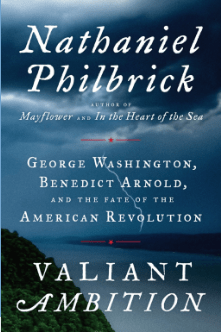
Day 936: Valiant Ambition: George Washington, Benedict Arnold, and the Fate of the American Revolution

Cover for Valiant AmbitionAlthough he has written on other subjects, Nathaniel Philbrick has made a specialty of writing about events and industries that affected New England, including the Revolutionary War. His latest book concentrates on the forces and personality flaws that resulted in Benedict Arnold’s betrayal of his country.

I haven’t read much about Benedict Arnold, only one novel, Rabble in Arms by Kenneth Roberts. That novel painted him in surprisingly sympathetic colors, blaming his treachery largely on the rapacious demands for money of his wife Peggy. Philbrick’s view is more nuanced.

Certainly, at the beginning of the war you can sympathize with Washington and with Arnold. For his part, Washington was hamstrung by the ineffectiveness and bickering of the Continental Congress. He had very little power over such decisions as which of his officers would receive promotion, which lead to the initial difficulties with Arnold.

A key to the British strategy of cutting off New England from the rest of the country was the chain of lakes leading down from Canada to the Hudson. So, Fort Ticonderoga was an important target. Benedict Arnold and a rag-tag collection of boats prevented the British from approaching the fort in the fall of 1776, before the lakes could freeze up to keep the British out.

As the hero of this engagement and the senior Brigadier General in the Continental Army, Arnold expected a promotion. But the Congress devised an idiotic scheme that awarded the promotions not on merit but according to what state the person was from. Since Connecticut already had two Major Generals, Congress awarded the promotions to other Brigadier Generals who were junior to Arnold, some of whom were only mediocre in ability. Washington protested this decision, to no avail. Even after he got his promotion, Arnold was forced to defer to these men who were promoted before him.

link to NetgalleyIt was this kind of bickering about states’ rights and even local rights versus the rights of a national government that hampered the Congress. In addition, there were plenty of people out for what they could get. I was shocked to read that while no one was interested in supporting the Continental Army, to the point where they were starving and dressed in rags, the rest of the country was doing very well financially. Arnold joined into this self-enrichment when he was made military governor of Philadelphia after it was captured back from the British. He was actively engaged in all kinds of corruption.

Philbrick’s book is really interesting and sometimes quite exciting as it revisits key scenes from the war and leads up to Arnold’s big betrayal. His conclusions about the results of the betrayal are startling.

Related Posts

Away Off Shore: Nantucket Island and Its People, 1602-1890

Mayflower

Abigail Adams