Day 861: The Witches: Salem, 1692

Cover for The WitchesIn The Witches, Pulitzer-winning nonfiction writer Stacy Schiff takes another look at 1692 Salem and its witch hunt. She explores the climate of New England at the time, particularly its paranoia and excessive religiosity, and why it was open to such an over-reaction. The book also explores the ramifications for the region for years to come.

Schiff quickly points out that much of what is “known” about the witch trials is apocryphal. There was no black slave, for example, but an Indian servant. Schiff reconstructs the events from what she can find, many of the official documents having been destroyed at later times, and the accounts, even of the official note takers, varying considerably from one another and interjecting opinion and descriptive wording that should not have been permitted.

The incident began with one household, where some of the children were subject to screams and contortions. This household was that of Samuel Parris, the minister of Salem Village. The girls were a niece, daughters, and a servant, all teens or pre-teens. Schiff is fairly charitable in ascribing the state of these children to a condition that was later diagnosed as hysteria (a condition itself fraught with controversy), which generally affected young women leading restricted lives with little hope of change. Later, we hear of another householder who handled a similar condition severely and eliminated it. But Parris soon established it as witchcraft, and an even larger group of girls and other people who became afraid of being accused themselves were on their way to a lot of attention. As one of them put it (whose remark was ignored), “We must have some sport.”

They had their sport all right. By the end, 19 people and 2 dogs were hanged for witchcraft. Some of the girls would have gone on from there, but the colony finally declared there would be no more prosecutions and the behavior eventually stopped.

This is a fascinating book that explores such topics as permissible evidence, assumption of guilt, the treatment of people who protested their innocence versus that of those who admitted guilt, and the behavior of certain of the principal leaders of society. It finds parallels to other events much more recently in our past.

Related Posts

Cleopatra, A Life

Véra (Mrs. Vladimir Nabokov)

Mayflower: A Story of Courage, Community, and War


Day 815: No Ordinary Time

Cover for No Ordinary TimeNo Ordinary Time tells of the contributions of Franklin and Eleanor Roosevelt to the conduct of the United States before and during its participation in World War II. The book relates how Franklin Roosevelt exercised his acute political awareness of public opinion to nudge the U.S. out of isolationism during the war, foreseeing as he did how the world would be changed if Germany succeeded and how assisting England against the Axis powers allowed the U.S. to ramp up for war. While Roosevelt was concentrating on the war, Eleanor remained his social conscience, attempting to hold on to the social advances of the New Deal, taking up the causes of women and their right to work and of African-Americans and their right to equal treatment.

The book also treats of the relationship between Franklin and Eleanor. Although they were always friends and companions, Eleanor had been devastated much earlier in their marriage to find out that Franklin had been having an affair with her own secretary, Lucy Mercer. This discovery ended certain aspects of their marital relationship. Eleanor’s relationship with her mother-in-law was difficult, too. In many ways, Eleanor was never at home in her own house. When she had to find a way to be of use as First Lady, since the traditional role of hostess didn’t suit her, she began to make a life for herself as Franklin’s eyes and ears around the country. So successful was she at this that when Franklin wanted to rekindle their relationship later in life and asked her to stay home more, she didn’t want to give up her active life.

These were two remarkable people, although they had their faults. At times, Eleanor’s zeal for a cause made her oblivious to Franklin’s need at the end of the day for relaxation. She found it difficult to unbend, always wanting to be active. Franklin, although charming and seemingly affectionate, was occasionally selfish and seemed sometimes to have no care for people who had given him unstinting care and friendship.

Reading this book made me feel as if I really knew these people, a feeling I seldom get from nonfiction. This is a fascinating story, sometimes thrilling, sometimes sad, about an important period in our history.

Related Posts

The Bully Pulpit: Theodore Roosevelt, William Howard Taft, and the Golden Age of Journalism

Team of Rivals: The Political Genius of Abraham Lincoln

Unbroken: A World War II Story of Survival, Resilience, and Redemption

Day 809: The Warmth of Other Suns: The Epic Story of America’s Great Migration

Cover for The Warmth of Other SunsBest Book of the Week!
The Warmth of Other Suns is Pulitzer Prize-winning journalist Isabel Wilkerson’s remarkable book about the migration of nearly 6 million rural African-American southerners to northern and western cities from 1915 to 1970. Wilkerson began her research because of her perceptions that the migration was largely unrecognized and that when recognized was misunderstood.

What makes this book so remarkable is how she manages to humanize it. Although she presents us with facts and figures and results of studies as well as examples of experiences taken from newspapers and the like, the bulk of the book is taken up with three representative case histories. She identified and interviewed three people who ended up in three of the cities usually targeted for migration. Their stories are both representative and extraordinarily interesting.

Ida Mae Brandon Gladney was the wife of George Gladney, a sharecropper in Mississippi. The state of sharecroppers was deplorable. After a solid year of work, the sharecropper would hand over half the crop to his landlord and then settle up accounts, the plantation owner subtracting the cost of the seed and supplies from the sharecropper’s share. The records were the landlord’s, and even if the sharecropper kept his own books, he didn’t dare oppose his landlord. Many of the plantation owners routinely added extra goods onto their tenants’ accounts and otherwise cheated them. George’s plantation owner was considered a good one simply because George ended up with a couple of bucks for the year instead of breaking even or ending up in the red.

Still, it was not because of the unrewarding grind of sharecropping that George decided to leave but because his cousin was beaten nearly to death for stealing turkeys that had just gone to roost some way away. Though George felt safe enough to tell the plantation owner he was leaving, he and Ida Mae still had to sneak away from home, taking the train to Chicago in 1937.

George Starling also had to sneak away from his job picking oranges in Florida but because he was in peril for his life. During World War II, oranges were at a premium and so many laborers had gone north already that the growers had difficulty finding pickers. Still, they wanted to pay the pre-war wage of 10 cents a basket to the pickers. George and two of his friends who had worked briefly in Detroit talked the pickers into letting him bargain for them and got their pay more than doubled. But some of the pickers were terrified and informed the growers what was going on. George heard that he and his friends were going to be lynched, so he had to smuggle himself out of his home county before he could take the train to Harlem in 1945.

Robert Foster was a surgeon from Louisiana in 1953 with a need to succeed. He had married Alice Clement, the daughter of a prominent African-American family in Atlanta. The Clements made it clear that they thought Foster was inferior and did their best to control Alice during the early years of their marriage. After serving as a surgeon in the army, Foster found he couldn’t get admitting privileges to any southern hospitals unless he accepted his father-in-law’s help and settled in Atlanta. Knowing that his family would always be under Clement’s domination, he decided to go to California, where he had always wanted to live. He set off for Los Angeles in 1953, driving in his car.

Wilkinson’s contention is that the causes and the results of the migration have been misunderstood. For example, some studies posited that mechanization in the cotton industry was a major cause. But Wilkinson shows that the industry was forced to mechanize as a result of losing the bulk of its laborers, not the other way around.

Similarly, she shows that contrary to belief, the families who migrated were in general better educated than white emigrants, less likely to divorce, and more likely to have a work ethic than African Americans born in the north, putting to shame the idea that the migrating families ruined their host cities. In fact, many of those who failed did so because of the conditions that already existed in their new home cities.

This history is an amazing book that will keep your interest from beginning until end. I became totally involved in the stories of these three people and wanted to know if they would succeed.

Related Posts

All Aunt Hagar’s Children

This Side of the Sky

The Tilted World

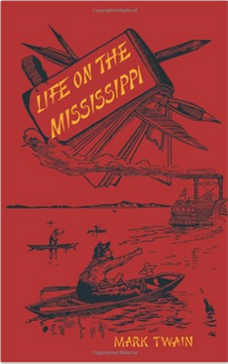
Day 807: Life on the Mississippi

Cover for Life on the MississippiLife on the Mississippi is Mark Twain’s nonfiction book about the Mississippi River. Sort of. Although part history, part memoir, part travel account, it also includes a chapter from The Adventures of Huckleberry Finn, some folk tales, and many tall tales. So, it’s not just nonfiction. And not the best of Twain.

Twain begins with a few chapters about the history of the river’s discovery and exploration by Europeans. These first chapters are followed by reminiscences of Twain’s life as a boy along the river (including the excerpt about Huck) and his career as a riverboat pilot, including a description of what is involved in learning to navigate the river. This section takes up about half the book, by far the best half.

From there, the book loses focus, and if the kitchen sink had anything to do with the Mississippi, it would be in there. The last half of the book is supposedly centered around a trip Twain takes down the river to New Orleans and all the way back up to Minnesota. It describes the people he encounters and the towns he visits during his journey, 20 years after his time as a pilot. But it also goes off an every manner of digression and tells many anecdotes, some of which are frankly corny and a few of which are offensive these days. I don’t want to make too much of this because it is judging a book unfairly by the standards of another time, but some of the pictures especially, reprints of those that appeared in the 1883 version, are insulting to African-Americans.

Finally, my edition, a replica by Dover, was loaded with typos, especially in the last half. I can only hope that the errors weren’t really in the originally published edition.

Related Posts

The Tilted World

The All-True Travels and Adventures of Lidie Newton

Once Upon a River


Day 776: Patrick Leigh Fermor: An Adventure

Cover for Patrick Leigh FermorWhile reading Patrick Leigh Fermor’s retrospective trilogy about the journey he made in his teens, walking from Holland to Istanbul and then Greece, I was struck by the references to what seemed to be an exciting and unusual subsequent life. So, I soon looked for a biography and found this one, by British writer Artemis Cooper, the granddaughter of Leigh Fermor’s good friends and a woman who knew him from when she was a child.

Cooper goes into a little more detail than Leigh Fermor (known by his friends as Paddy) about his childhood, making clear there was a split between his parents and a good deal of neglect from both. Still, he had a happy childhood growing up in a rural setting, and his problems only began with the regimentation of school. Having failed in an academic setting and with the army, Paddy got the idea to go on his fabled walk.

Cooper summarizes the route of this walk, only she reveals the true names of the people he met (he used pseudonyms) and tells us when the stories are invented or conflated. When I read the trilogy I wasn’t aware that any events were invented or conflated, but I should have known that the level of scholarship reflected in the writing was not that of an eighteen-year-old. (Well, I did know, but he wrote the books much later in his life.)

picture of Princess Balasha
Princess Balasha

After his journey, Paddy settled in Athens and then Rumania with Princess Balasha Cantacuzene, a fascinating older woman separated from her husband. However, after World War II broke out, he hurried back to England, not realizing how long it would be until he saw her again.

Paddy spent most of the war in Crete working with the resistance. He is famous for kidnapping a German general and removing him to Egypt, an act meant to improve Cretan morale. (A movie, Ill Met by Moonlight starring Dirk Bogarde as Paddy, was made about this feat, but Paddy was unhappy with how far it drifted from the facts.) For the rest of his life, despite the unfortunate political differences that evolved between England and Greece after the war, Paddy was beloved in Crete.

picture of Joan Fermor
Joan

After the war, Paddy lived a gadabout life with many famous friends, only settling down in Greece with his wife Joan in his late middle age. He and Joan had been together 27 years before they married and for many of those years, had an open relationship.

Paddy chose the profession of writer and wrote several books about his travels and adventures. He was a raconteur who demonstrated an impressive range of knowledge and was interested in everything. Apparently very charming and loved by many people, he was not always sensitive to the feelings of others.

This biography is a well written, fascinating, and occasionally funny portrait of a remarkable man. At times, the sheer number of people mentioned made me unsure of who they all were, and there was certainly an assumption that readers would know who was meant. I didn’t always, which made the book a little more difficult to follow, but that was only on occasion.

Related Posts

A Time of Gifts: On Foot to Constantinople: From the Hook of Holland to the Middle Danube

Between the Woods and the Water: On Foot to Constantinople: From the Middle Danube to the Iron Gates

The Broken Road: From the Iron Gates to Mount Athos

Day 752: The Ascent of Man

Cover for The Ascent of ManThe book The Ascent of Man is a companion piece to the 1970’s era TV series. The introduction to the book states that the series was an answer to Kenneth Clarke’s famous Civilisation, which left out the accomplishments of science. Author Jacob Bronowski was a well-known mathematician, biologist, and science historian.

Bronowski begins this book with our ape relatives and a discussion of evolution, but he really gets into his subject after man has moved from a nomadic to an agrarian lifestyle. His contention is that nomads do not have the time or energy to innovate.

The book takes us through a series of the most important discoveries for the improvement of human life and understanding. These include the combination of copper and tin to make bronze, mathematical discoveries, the Copernican system, the Scientific Revolution, and so on up to the double helix.

As the book is so obviously the script of a program, there are some frustrating times when it refers to an image that certainly appeared on TV but not in the book. On the other hand, the illustrations in the book are many and beautiful.

Of course, since the book was written in the 70’s, it is a little dated. One example is that Bronowski frequently comments on how slowly animals evolve, but I believe this idea has been reconsidered.

Because the discussion of the concepts is very brief, there were times when I felt Bronowski was implying a lot more than he described. That is, his greater understanding of the topic interferes a bit in his simple explanations. So, even though I watch a lot of science programs and usually have no trouble understanding them, I felt sometimes as if the explanations of the more difficult subjects have too much left out. Still, for someone who wants to learn basic information about important scientific discoveries up to the middle of the 20th century or is interested in the history of science, this is a good place to start.

Related Posts

Salt: A World History

Death by Black Hole and Other Quandaries

A History of the World in 12 Maps

Day 740: Richard III: England’s Black Legend

Cover for Richard IIIHistorian Desmond Seward explains in the introduction of Richard III that there are two views of Richard. He calls them the black legend—the traditional view—and the white legend—the notion that Richard’s reputation was blackened by the Tudors after Bosworth Field. This theory was first put forward by Horace Walpole in the 18th century and is famously supported by Josephine Tey’s The Daughter of Time. The Richard III Society has even claimed that Richard was not a hunchback, which claim was proved false by the recent discovery of his bones.

Seward’s view is that of the black legend, that Richard was a ruthless man who committed many dark deeds, including killing the princes in the Tower. Richard III is an interesting biography of Richard, based on what is known of his life. There are few of his own writings to base it on, unfortunately, because Richard was not much of a writer, a situation common to nobility of his time.

Of course, Richard’s entire life was lived during the turbulent period of the Wars of the Roses. England experienced little peace during this period, and what little there was occurred during the reign of Edward IV, Richard’s older brother. This peace was marred mostly by the rapacious behavior of the Woodvilles, Edward’s in-laws, and that of the Duke of Clarence, his erratic brother. However, that peace was destroyed by Edward’s early death, which plunged the country into another succession crisis because the prince was only 12 or 13 years old. The last time a young prince had become king, Henry VI, was disastrous for the country.

My own impression from reading this book is that Seward invariably looks at the darkest interpretation of events. I guess you could call me of the dark gray school. Certainly, the murders of the princes in the Tower was a shocking event, viewed with horror during its time and since, and there seems little doubt that Richard ordered the murders. Still, the situation for Richard was difficult. In doing his duty by his nephew, he faced the prospect of at least six years of an unstable regime with continual battles for power with the Woodvilles. This is not to excuse his actions, but it is possible to view them as an attempt to maintain stability in the realm, and that’s probably how he explained them to himself. Instead, the result was to almost completely exterminate the Plantagenet family.

Related Posts

The Wars of the Roses

Mary Boleyn

A Folly of Princes

Day 729: The Great Texas Wind Rush

Cover for The Great Texas Wind RushThe Great Texas Wind Rush is a history of the wind energy business written by Kate Galbraith and Asher Price, a couple of reporters. It begins with the building of wind turbines to pump water and then covers a few pioneers who tried to use turbines to produce electricity, with mixed results.

Finally, it follows the various attempts to do this as a business and the legislation that made it possible to make wind farming a serious business. These efforts finally culminated in the 2000’s with the establishment of many successful wind farms across Texas.

I have nothing against wind power. In fact, I am for green energy. But the book at times seems to be biased both for Texas and for wind power. I live in Texas, so I am used to the ridiculous pro-Texas bias that creeps into everything, but I felt that the cons of wind power were glossed over. The problems of migratory birds are mentioned, for example, several times, but there are no facts or figures even estimating the number of birds killed. This is disturbing, especially in discussions about wind farms off the coast, where there are many bird sanctuaries, including for the whooping crane, which already almost went extinct. And the admiring tone the book occasionally takes is not good journalism.

Books about business do not fall within my interests, and the only reason I read this one was because it was chosen for my book club. At first I found it more interesting than I expected, but eventually it seemed to become just one story after another about one company after another. I kept falling asleep. Unless you are really interested in wind power or business history, the book, although clearly written for a general audience, has limited appeal.

Related Posts

The Big Short: Inside the Doomsday Machine

The Information: A History, A Theory, A Flood

Annals of the Former World: Rising from the Plains

Day 702: Dead Wake: The Last Crossing of the Lusitania

Cover for Dead WakeIn Dead Wake, Erik Larson has written another fascinating history—the story of the last voyage of the Lusitania. As he sometimes does, Larson goes after the story with a two-pronged approach: on the one hand following preparations for the voyage and the actual trip, on the other hand following the progress of the U-20, the German U-boat that sank it. In this book, the story has a third, weaker prong—the romance of President Woodrow Wilson with Edith Bolling Galt, who would become his second wife.

Even though everyone reading the book knows what will happen to the Lusitania, a passenger ship en route to England from the United States during World War I, Larson manages to create a fair amount of suspense. He tells us about a number of the passengers, and we want to know who survives, of course. I think this ability of Larson’s to create suspense even from a story where we know the outcome is quite a talent.

Aside from learning about the ship, the voyage, and the results of the attack, we also learn about things that are more surprising. In particular, Larson leads us to wonder whether the British admiralty was incompetent or whether the hope that some event like this would force the Americans into the war made them negligent. There were several actions the admiralty could have taken to keep the ship safer.

I recently read an article about the man who bought the wreckage of the Lusitania, who believes that the ship secretly carried armament meant for England. It is true that there was an unexplained second explosion after the U-boat’s torpedo hit the ship, but if the theory turns out to be correct, that makes the British admiralty’s conduct even more perplexing.

Related Posts

In the Garden of the Beasts: Love, Terror, and an American Family in Hitler’s Berlin

The Daughters of Mars

Midnight in Europe

Day 661: The Bully Pulpit: Theodore Roosevelt, William Howard Taft, and the Golden Age of Journalism

Cover for The Bully PulpitNoted historian Doris Kearns Goodwin approaches her subject of the relationship between Theodore Roosevelt and William Howard Taft from several insightful angles. Although her book examines their careers separately, it is focused on the differences in their personalities and approaches that finally led to the serious rift in their friendship of many years. This rift also led to Roosevelt’s third run for president, which split the Republican ticket.

One of the major differences that Goodwin identifies is their relationships to and use of the press. The journalists particularly close to Roosevelt and involved in the fortunes of both presidents all worked for McClure’s magazine and make up an impressive list of names in journalism: Ida Tarbell, Ray Stannard Baker, William Allen White, and Lincoln Steffens.

I wanted to read more by Goodwin after I read Team of Rivals, the great history of Lincoln’s career that inspired the movie Lincoln. Although I also have her book about FDR and Eleanor Roosevelt in my queue, I was interested in this one because I know only a little bit about Teddy Roosevelt and almost nothing about Taft, just the broad outlines of their careers.

Without going into detail about the careers and personalities of either man, although I developed respect for both, after reading this book, I confess to having a lot of sympathy for Taft over their split. The fact is that Roosevelt regretted his decision not to run for a third term and so looked for excuses to find fault with Taft’s presidency. After Roosevelt’s return from Africa, he criticized Taft’s record of progressive legislation even though it was actually better than Roosevelt’s own. Taft later acknowledged that he wasn’t as good as Roosevelt in publicizing his accomplishments or explaining his policies to the press.

This book is thoroughly interesting and revealing of the characters of both men. It is carefully researched, and it is also very well written. Although quite hefty at 750 pages, it moves along at a good pace and does not get bogged down with extraneous details.

Related Posts

Team of Rivals: The Political Genius of Abraham Lincoln

The River of Doubt: Theodore Roosevelt’s Darkest Journey

The Gods of Gotham