Day 437: A History of the World in 12 Maps

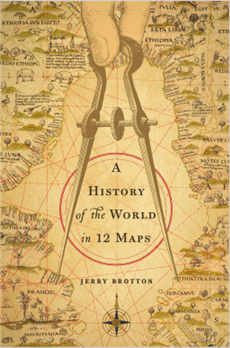
Cover for A History of the World in 12 MapsA History of the World in 12 Maps is an interesting look at the evolution of efforts to map the world, showing how each map is a reflection of the outlook of the culture that made it. The book is written by Jerry Brotton, a professor of Renaissance Studies at Queen Mary University and an expert in cartography.

Brotton begins by showing us a Babylonian map from the fifth century BC. Although crude and hardly recognizable to the modern eye as a map, it locates the major towns in this “known world” and the rivers. It places Babylon, divided by the Euphrates, in the direct center of the map. Clearly, Babylon was the center of the universe, or at least of the world.

Brotton takes us linearly through time, showing us such examples as the first world map using a projection, as described by Ptolemy; the Hereford Mappa Mundi from the 14th century, which places Jerusalem at the center of the world and locates the principal stories of the Bible; the Cassini maps, an attempt of the Age of Enlightenment to exactly map the entirety of France; and on to the ramifications of Google Earth. He discusses different types of map projections and why mapping an ovoid Earth on a flat surface will always involve distortions.

http://www.netgalley.comThis book is a serious effort rather than popular science, well documented and scholarly, but it is written in a clear and cogent style that should appeal to any reader, including interesting details about the different cartographers’ lives and work. The illustrations are beautiful, and the ideas thought-provoking. Brotton’s main point is that it will never be possible to create a world map that is completely accurate and unfreighted with the assumptions and attitudes of the people who created it.

Day 392: The Invention of Murder: How the Victorians Revelled in Death and Detection and Created Modern Crime

Cover for The Invention of MurderJudith Flanders, a British journalist and history writer specializing in Victorian times, has written an entertaining and exhaustive book showing how the Victorian fascination with murder grew and forced improvements in policing. In addition, it resulted in the evolution of the detective novel. Flanders begins this discussion with the interest in a few major crimes from before the Victorian era, explaining how public response changed during the Victorian age.

One theme of the book is class. Flanders effectively shows that the public interest in murder was for crimes that involved the middle or upper classes, with a tendency of the newspapers and popular songs and legends to elevate in class the murderers who were from the lower classes. Newspapers flagrantly made up “facts” about accused murderers that sensationalized their backgrounds or their crimes, including changing their social class. Even as late as the Jack the Ripper murders, interest was probably only taken by the public (since the victims were lower-class prostitutes) because of the number and viciousness of the crimes.

Flanders tells us about a series of panics that took place as a result of a growing audience for this kind of subject matter. Once a tax was removed from newspapers in 1855 that had kept the price high enough to restrict their circulation to the middle and upper classes (although the poor shared newspapers or picked them up in coffee houses), circulation greatly expanded and the papers found a new audience for sensationalism.

Even though there had only ever been a very few cases of murder by poisoning, in the early and mid-nineteenth century a poisoning panic resulted from a highly publicized murder case. In the ensuing rash of accusations, people were brought to “justice” when there was no actual proof that anyone had been poisoned let alone any proof that the accused was guilty of any wrongdoing. Unqualified persons were allowed to testify on the “scientific” evidence, including one Alfred Swaine Taylor, who for years testified to the presence of arsenic using a test that actually introduced arsenic into the sample through copper gauze. Even worse, the lower class “poisoners,” who usually had little or no legal representation, were invariably hanged, while the middle and upper class accused often got off completely or with lighter punishment, even if there was more real evidence against them.

Eventually, with improvements in the science of criminology and the rise of public indignation about some obvious miscarriages of justice, the police force was compelled to become more professional and the law to pass more stringent rules of evidence.

Frankly, our lurid interest in crime hasn’t changed, as shown by the prevalence of true crime shows on TV. A large part of the fascination and entertainment value of this history has to do with the details of the crimes as well as the plots of the many plays, novels, and penny dreadfuls that derived from them. Flanders has written an entertaining and lively history for anyone interested in true crime, the evolution of the mystery novel, or the history of advancements in criminology.

Day 367: Between the Woods and the Water: On Foot to Constantinople: From the Middle Danube to the Iron Gates

Cover for Between the Woods and the WaterBest Book of the Week!

In December 1933, 19-year-old Patrick Leigh Fermor set out to walk from Amsterdam to Constantinople. He wrote about the first leg of this journey years later in A Time of Gifts, ending the book as he crossed a bridge from Czechoslovakia into Hungary. In 1986, he finished this memoir of the second leg of the journey, which begins on that same bridge in Esztergom the evening of Easter Sunday and ends in the early autumn of 1934.

In the second part of the journey, Leigh Fermor breaks his rule of making the entire trip by foot and also spends much of the time in more luxurious surroundings than he did in the first part. As he makes his way through Hungary and the Romanian border, as it was then, into Transylvania, he is passed by his growing list of acquaintances and friends from one kastély to another, spending days with a learned professor discussing languages and history, borrowing a marvelous horse from a count for part of the journey across the Hungarian plain, staying for weeks with a new friend named István in Romania, and dallying with a young married woman on a motor trip with István to Prague.

Leigh Fermor does not spend all his time in such exalted circles, though. He happily camps out with gypsies, spends the night outside a shepherd’s cottage, is hosted by a Jewish family after an afternoon spent discussing the Hebrew language, sleeps in a cave, and camps on an island in the Danube near a village inhabited by resettled Turks. On his way, he describes the scenery in lyrical terms, explains the ancient history of each area he passes through, and tells us about the people he meets and the sights he sees. His chronicle is supported by the notebooks he kept and a nearly photographic memory of a remarkable journey. In addition, he tells us that he revisited some of the areas 20 years later.

This memoir is beautifully written. Although relatively unacquainted with formal learning, having abandoned military school at that early age, Leigh Fermor has an astonishing range of interests, and he tells us all about them. He is constantly plunging into dusty tomes in his hosts’ libraries but is just as ready to dance and drink the night away. This is a delightful series of books, still full of the youthful joy and enthusiasm Leigh Fermor must have felt when he was 19 and 20 years old.

In the Appendix to this book, Leigh Fermor reflects on how many of the sights he writes about in this book are now under water, for the Danube valley that he traversed and the torrents and currents that once rushed along it as well as the Iron Gates themselves have been subsumed by a huge concrete dam and hydro-electric power plant. And of course there have been other causes of destruction since 1934.

Unfortunately, The Broken Road, the unfinished manuscript of the final portion of the journey, is being republished but is not available from Amazon until March of next year! (It may be available used from some other site.) I am so disappointed to find the book never gets us all the way to Turkey but stops in Greece.

Day 354: Worldly Goods: A New History of the Renaissance

Cover for Worldly GoodsWorldly Goods promises a new look at the European Renaissance from a different point of view. Lisa Jardine, a professor of English at the University of London, proposes an interpretation of the period in terms of the growth of commerce and a new consumerism and multiculturalism.

However, the information offered does not seem new. Rulers and wealthy men have always been conspicuous consumers. Jardine attempts, for example, to turn around our view of the flowering of art as merely a series of demonstrations of the wealth of patrons who commissioned the works, a sort of competition to show who is most wealthy or powerful. But simply providing examples of patrons who specified expensive materials or the inclusion of their goods in pictures doesn’t prove this point.

Jardine does a better job of showing how the development of printing made the exchange of ideas easier, thus affecting the advances in many different fields, including the arts and the sciences. However, her argument that the policy decisions of the period were all driven by the dictates of commerce is taking things too far, I think.

The book is well written and lively. It does not back up its assertions with footnotes or a bibliography, however, indicating that it is written for the general public but frustrating those who would like to look further. At some point, I felt that the examples were becoming too repetitive and no new points were being made. For example, Chapter Three is about the proliferation of books and printing, but Jardine continues to make the same points about printing and the sharing of scientific and technical information repeatedly throughout the rest of the book.

Although the history provides an interesting discussion of commerce during the Renaissance, it is oversold as a complete history of the period.

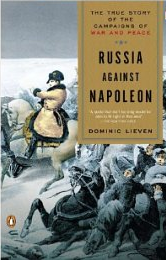
Day 292: Russia Against Napoleon: The True Story of the Campaigns of War and Peace

Cover for Russia Against NapoleonDominic Lieven explains in the introduction to Russia Against Napoleon that the popular conception of Russia’s role in the battles with Napoleon in 1812-14 is mostly derived from Tolstoy’s War and Peace. Tolstoy posited that the fate of Napoleon’s army was mostly a result of luck on the part of the Russians and the brutality of the Russian winter. Lieven also explains the reasons why most scholarship on this subject has been done from French, German, Austrian, or British records.

However, Lieven is able to convincingly show that the Russian victories, although of course partially due to luck, were mostly because of the understanding of Russia’s Emperor Alexander I and his field marshall, Mikhail Barclay de Tolly, of the kind of war Napoleon was good at and their refusal to give it to him. That is, Alexander and Barclay de Tolly planned from the beginning for a long, drawn-out war that would lure Napoleon deep into Russia, to be followed by a second campaign in Germany and France.

Lieven is a professor of history with the London School of Economics and an acknowledged expert on Russian history. Interestingly, he is also the descendent of three of the generals at the Battle of Leipzig.

Lieven’s book explains in the clearest terms the details of every campaign in those three years, taken from the Russian letters, diaries, and records that have not been readily available until recent years, as well as from the records of British observers and others of the combatants. He provides insight into the political jealousy and maneuverings and even to the details of staffing and provisioning the armies and maintaining the long supply lines needed when the Russian army entered western Europe.

Lieven’s analysis of war is comprehensive, and even though it is very detailed, it never seems to get bogged down in minutia. It introduces us to some colorful characters and vividly and suspensefully describes the battles.

The book’s only weakness for me was that it assumed a little more knowledge of the events immediately preceding these years than I had and knowledge also of the functions of the vast numbers of different types of troops. However, that lack of knowledge on my part did not really impede my understanding or detract from this very interesting history.

Day 283: My Alsace

Cover for My AlsaceDuring a visit to Alsace several years ago, I was fascinated by this book, especially by the pictures, but I could only find it in French. Then, awhile back, I found it on Amazon in English.

My Alsace was written by Hansi (Jean-Jacques Waltz), a beloved Alsatian poster and children’s book artist who grew up in the late 19th century under German occupation. In the 19th and early 20th centuries, the region of Alsace, which identifies itself as French, changed hands between Germany and France four times. In the German school at Colmar as a boy, Hansi only learned about the great Prussian victories and the defeat of Alsace in his history classes. He deemed this period the worst in his life and wanted Alsatian children to know that Alsace has a prouder history.

My Alsace is a selection from the history he wrote in 1912 and some writings from after World War I. The latter section of the book goes on to tell about the trouble he got into with the German authorities during World War I because of his jokes about Germans in the earlier book. He was originally fined and later he was given a year’s prison sentence for insulting a German officer. He published the latter part of the book in 1919 to celebrate the region’s liberation from the Germans.

Hansi’s drawings are wonderful. He was well known for his pictures of Alsatian villages, people in traditional costumes, and celebrations of Alsatian life from an earlier time. The text is amusing, although it is full of anti-German satire. Written for children about eight years old, it is also entertaining for adults.

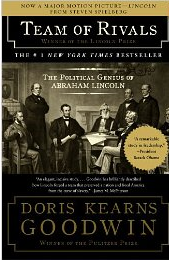
Day 260: Team of Rivals: The Political Genius of Abraham Lincoln

Cover for Team of RivalsBest Book of the Week!

Doris Kearns Goodwin begins her examination of Lincoln’s administration by remarking that because so much has been written about him, everything might be thought to have been said. However, by examining his career in terms of the team he put together to run the country, she found much more to write about.

This team consisted of his rivals in politics. Edwin Stanton, who treated Lincoln with contempt on their first meeting and who Lincoln made Secretary of War, was griefstricken at Lincoln’s death. Salmon P. Chase, eternally Lincoln’s rival for the presidency and a frequent undercutter, was an extremely competent Secretary of the Treasury. William H. Seward, the favorite for the Republican presidential nomination that Lincoln won, was at first inclined to underestimate Lincoln but became his closest friend and advisor as Secretary of State. Edward Bates, the Attorney General, was a homebody who was not sure he wanted a public life and at first looked upon Lincoln as well-meaning but incompetent, but ended up thinking he was very nearly perfect.

Team of Rivals begins on the day of the Republican convention of 1860, in which, of the rivals who had some expectation of winning the nomination of the party, Lincoln would seem to have the least. Seward was the odds-on favorite, but he had made many enemies in the party. Chase’s overwhelming ambition for the presidency lead him on several occasions to ignore the warning signs that he would not be the nominee. Bates was willing to act if nominated but made no extraordinary efforts because he preferred his home life.

Goodwin’s narrative then turns farther into the past to trace the men’s respective careers. In this examination she shows how Lincoln cleverly set himself up to be everyone’s second choice for the Republican nomination.

The book follows Lincoln’s nomination, campaign, and stunning victory, but the bulk of it concerns the compelling story of how he put together a cabinet containing these men, who were not only rivals for the office but who were from different regions of the country and who had different views on the important issues of the day. He then managed to work with these men and run the country during one of its most difficult times. It was frequently rumored that Seward actually held the power, but Goodwin shows us that Lincoln was always in charge.

Through an examination of the diaries of the men, letters, and other sources, Goodwin provides us with the fascinating details of political machinations, the conduct of the war, the fights among the generals, the alliances and friendships, and the story of how several men, who began with no esteem of Lincoln at all, grew to respect and love him.

Goodwin’s book is one of the most absorbing history books I have read. Although it is long and takes awhile to read, it explains each issue in completely lucid terms and interesting detail. The most important thing I got from the book was a fuller understanding of Lincoln’s greatness, his humor, kindness, and magnanimity–and what a disaster for the country his death was.

Day 245: Unbroken: A World War II Story of Survival, Resilience, and Redemption

Cover for UnbrokenUnbroken is the incredible story of Louis Zamperini, an Olympic runner whose plane went down in the Pacific during World War II. He and his pilot Phil (Russell Allen Phillips) survived many days on a small raft only to be captured by the Japanese and interred in a series of brutal POW camps.

The book begins with Zamperini’s childhood in California as an almost feral creature who was always in trouble for stealing and other mischief. His unconquerable spirit served him well through his travails in adulthood but caused problems for his parents and himself when he was a child. His unruly years were ended, or at least subdued, by his brother Pete’s interest in training him as a runner, as he had always been the kid who ran away from his pranks the fastest. Once Louie began to take the sport seriously, he became a very fast runner and began winning medals. Although he only finished 8th at the 1936 Olympics, he ran his last lap in 56 seconds, and his dream was to return to the Olympics and medal.

After Pearl Harbor Louie became a bombadier and made many flights in dangerous and ill-equipped planes until his B-24, known as a lemon, went down during a search for another missing plane. I was particularly surprised at how unsafe the planes were and how ill-equipped the men were when their plane went down. Their raft contained only some chocolate and a few flares, and its repair kit pieces were ruined because they weren’t kept in a waterproof envelope. The three men who survived the crash had no equipment to make drinking water from sea water and were reduced to attempting to catch rain water. They had no food except the chocolate (which one of the men ate the first night). Braving strafing by a Japanese plane, shark attacks, dehydration, starvation, and a typhoon, Louie and Phil survived more than 40 days at sea. The other man died.

Their raft landed on an atoll in the Marshall Islands, where they were immediately captured by the Japanese. At first treated kindly, once they were transferred to POW camps, they encountered unbelievable brutality. Aside from being routinely starved–while Red Cross shipments intended for them were stolen by the Japanese–they were forced into hard labor and regularly beaten. Louie in particular because of his ungovernable nature became the scapegoat of an insane, brutal guard named Mutsuhiro Watanabe.

About half of this book is devoted to the men’s experiences in the camps, with the focus on Louie after he and Phil were separated. Eventually, though, the men were saved with the end of the war. The rest of the book related Louie’s trials with PTSD and alcoholism and how he overcame those problems to live a productive life. The book ends with his accomplishments even in an active old age, including carrying the torch at the 1988 Olympics in Nagano on his 81st birthday.

Overall, this is an interesting book, but I found the descriptions of the brutality at the camps overwhelming. Although I am not squeamish by any means, I kept reading a few sentences only to have to put the book down. I read it for a book club, and the other members reported having the same difficulty, even skipping over complete sections. The writing was excellent–Laura Hillenbrand’s Seabiscuit is a favorite–and the story compelling, but the details difficult to absorb.

Day 222: The Hare with Amber Eyes: A Hidden Inheritance

Cover for The Hare with Amber EyesBest Book of the Week!

In 1994, the world-class ceramics artist Edmund de Waal inherited a collection of 264 netsuke from his great uncle Ignace (Iggie). De Waal decided to trace the history of the netsuke from the time they came into his family, and in doing so, to trace the history of the family itself and the times they lived in. The result is a fascinating combination of memoir, history, art history, and collection of musings on related topics, The Hare with Amber Eyes.

Charles Ephrussi originally purchased the netsuke in Paris during the second half of the nineteenth century. The Ephrussis were at that time a wealthy family of bankers, originally from Odessa, who in previous generations had expanded their offices to Vienna and from there to Paris. Charles Ephrussi was not a banker but a noted art collector and critic, friend of Impressionists such as Degas and Manet, and one of the two models Proust used for his character Charles Swann.

De Waal attempts to understand Charles through an examination of his writings and possessions and through events in his time, particularly the effect of the Dreyfuss case on antisemitism in France. Charles’s work in art was an important part of his life, and in this section of the book I was struck by the connection de Waal makes between Japonisme–the interest in and collection of Japanese artifacts, with their focus on nature and everyday life–and the rise of Impressionism, which was considered revolutionary partly because of its focus on nature and everyday life instead of “noble” subject matter such as historical scenes or stories from the Bible or mythology.

In 1899, Charles sent the netsuke to Vienna as a wedding present for his younger cousin Viktor Ephrussi, de Waal’s great grandfather and eventual head of the Ephrussi bank in Vienna. De Waal traced what he could of the life of Viktor and his family, this story culminating shortly after the dual terrors of the Anschluss and Kristalnacht. During this time, everything that this branch of the family owned was confiscated by the Gestapo. In these pages of the book, de Waal does a better job of conveying the fears and anxieties of those times than any of the recent books I have read.

De Waal’s grandmother Elisabeth recovered the netsuke after the war. How they returned to the family is an incredible story that I will not reveal. Shortly after she returned to England with them, where some of the family had made their home, they traveled to post-war Japan with de Waal’s great uncle Iggie.

I have just supplied the barest outline of the fate of the netsuke, which provides a focus for de Waal’s investigations and musings, but the family’s story and the story of their times is fascinating and imaginatively reconstructed. The book is at once a meditation on and enthralling depiction of the life and times of an extraordinary family.

Day 197: The Adventure of English: The Biography of a Language

Cover for The Adventure of EnglishThe Adventure of English: The Biography of a Language is a history of the English language written for the general public. The author, writer and television personality Melvyn Bragg, has been responsible for some acclaimed television shows on the subject in England.

The book takes us from the introduction of English (or rather, the languages that would become English) into Britain with the invasions of the Angles and Jutes up to modern times and the versions of English spoken around the world. Bragg explains how English pushed other languages, liked Celtic, to the brink of extinction, and how numerous times the language has been threated by extinction itself, most particularly with the Norman invasion. The Normans spoke French among themselves and enforced its use at court and for all matters of legal business, a condition that lasted for centuries and posed a real threat for the survival of English. However, eventually the Norman kings began thinking of themselves more as Englishmen than Frenchmen and using English for business, starting with Henry V.

The book provides many interesting factoids, such as, that of all languages, Old English was most closely related to Frisian, still spoken by some people in the Low Countries. The explanation of how the British developed such extremely varied regional dialects (much more distinct from each other than American dialects) from the settlement and isolation of different peoples and tribes in different regions is interesting, especially the tale of how a man from rural Cumberland was able to communicate with Icelanders during World War II because of it.

However, the book contains some real irritants. One is the relentless personification of the language as a metaphor throughout the book. English is always gobbling up other languages or fighting them off. Another is the spin put on some of the information. For example, when the Catholic Church insisted on exclusive use of Latin and made translation of the Bible into other languages a heresy, it wasn’t seeking explicitly to destroy English but was rather protecting its priestly prerogatives. If priests weren’t needed to translate and interpret the Bible to their flocks, what would be their purpose? Of course, Bragg explains this, but he implies that the decision was a purposeful attempt to destroy English.

The lack of authority for some of Bragg’s statements is certainly a weakness throughout the book. There were times when I, with my little knowledge, thought he may have misrepresented or put a spin on some facts, but until I finished the book, I was assuming Bragg was a linguist, so I just thought that I was wrong. Now I’m not so sure.

Finally, although the TV series was probably very good, the book’s roots in television show too clearly in the shallowness of the approach. Some chapters, for example, are almost nothing but lists of words with a few paragraphs in between. Overall, although I learned a few interesting facts, I was disappointed.