Day 174: Pauline Bonaparte: Venus of Empire

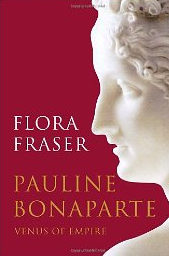
Cover for Pauline BonaparteI didn’t know anything about Pauline Bonaparte before I read Pauline Bonaparte: Venus of Empire. I picked it up because it was by Flora Fraser, a noted biographer who specializes in 19th century women. (She is also the daughter of Antonia Fraser, the famous biographer.)

Pauline Bonaparte was Napoleon Bonaparte’s youngest sister, renowned for her beauty. She lived a colorful life and is immortalized by a life-sized, nude statue by Antonio Canova that resides in the Villa Borghese in Rome.

The connection with the Borghese family is not one that they cherish. Pauline’s second husband was Prince Camillo Borghese. During their long marriage, they lived mostly apart, and Pauline entertained herself with numerous flagrant affairs.

In fact, Pauline’s reputation was dreadful. Napoleon’s enemies spread numerous rumors about her, even stooping to claim that her relations with her brother were incestuous. Not only did she not care, she encouraged that particular rumor to show how powerful she was.

Although she could be very charming, she spent most of her career manipulating infatuated men and intimidated women. Stories abound of her using generals as footstools, turning people our of their own houses, and so on. A particularly odd one was that when she was visiting an officer of the church, she made him cut a hole in the ceiling of his bathroom over the tub so that someone could stand on the floor above her and shower her with milk.

Although extremely jealous of the prerogatives granted her sisters (as they were of hers) and generally hateful to the Empress Josephine (she and her sisters held onto Josephine’s train during her coronation so that she could not move forward), Pauline’s most positive trait was her loyalty to her family. She was devoted, although not faithful, to her first husband, General Victor Emmanual Leclerc. When Napoleon fell out of power, she was persistent in trying to improve his living conditions and tried to get permission from the British to share his exile.

Fraser’s biography is interesting and well written. I found Pauline to be a fascinating subject, although not an admirable person.
Day 168: Cod: A Biography of the Fish That Changed the World

Cover for CodCod is the best known of Mark Kurlansky’s interesting micro-histories. If you are not familiar with the term, a micro-history is a short book that details the history of a specific and focused subject. Cod explores the importance of cod and the history of cod fishing beginning in the early days when the Vikings and Basques dominated the industry.

It was interesting to learn that Vikings and Basques going after cod were probably the first Europeans to “discover” America. They had been fishing off the coast for years before Columbus traveled to the Americas, keeping their fishing grounds secret.

Later, the eastern seaboard provinces of Canada and the New England states dominated the industry because of their location. The abundance and importance of cod provided many years of prosperity for these areas, but the later dearth of cod has had the opposite effect. Iceland, whose economy was almost solely dependent upon cod until recent years, has been severely impacted.

Of course, there is an ecological aspect to the history of cod. During the height of the fishing industry, the fish were so plentiful that it was said a person could walk across their backs. In the present, the fisheries are in danger of dying and many families with long histories in the industry are being forced to find other work. Kurlansky shows how the fishermen’s warnings about cod disappearing were routinely ignored by scientists and governments for years.

There is some overlap with Kurlansky’s book Salt, as he explains the importance that being able to salt the cod had to the success of the fishing industry. Before salting was begun, the cod had to be dried and a lot of it spoiled onboard. The chapters about battles over international waters are also fascinating.

As always with Kurlansky, the book is interesting and well written. It employs his usual format of mixing in recipes for preparing cod with the historical information.

Day 162: Religion and the Decline of Magic

Cover for Religion and the Decline of MagicKeith Thomas’s Religion and the Decline of Magic, first published in 1971, is not for the faint-hearted. Thomas is a British historian, and this book is considered an important work because of its then revolutionary combination of research in the fields of history and anthropology.

With that kind of background, you might expect the book to be academic in writing style. It is not, but in fact is actually very accessible and well written. I say it is not for the faint-hearted because of its length and the numerous examples of every point, expected for an academic text but a little rough on the casual reader. These examples are mostly interesting; it is the number of them illustrating every point that threatens to become tedious. The book is 800-900 pages long, depending upon the edition, and nearly half of it is devoted to notes, additional explanations, and references. And truth be told, I was reading the electronic version so could not judge my progress, but it felt like I was reading a lot more than, say, 500 pages. (I did not read the back matter.)

Thomas concentrates upon the history of magic in England from roughly 1500 to 1700, tracing the changes in how the different types of “magic” are viewed and treated by the common people, the judicial and governmental authorities, and the religious ones. His definition of magic is rather broad, including alchemy–which at the time was considered a science and is now generally regarded as the forerunner to modern science–and astrology–which again was considered a science at the time. I believe his inclusion of these disciplines was because at some time they were also considered magic, at least by the church.

Thomas shows that the Catholic church actually encouraged a belief in magic in some ways–linking the connection between prayer and incantations, for example, and fostering a belief in the efficacy of exorcism–consciously building on pagan beliefs to encourage conversion just as it did when it adopted a slew of pagan holidays and modified them to its own purposes.

The ways in which religious leaders and common folk viewed magic, then, changed radically with the Protestant Reformation. Protestant clerics were actually less likely to, for example, attempt to prosecute witches even though the laws defining witchcraft and the penalties against it were prone to fluctuate between more strict or more lenient over time. On the other hand, prosecutions of witches that originated with demands by the common people–who initially were not inclined to fear witchcraft but had to be taught to do it–became more common and more hysterical as the Protestants increased their preaching against it.

Thomas’s premise is that the ultimate decline in witchcraft as a concern of the public and the powers of justice was a result of the Enlightenment–the increasing number of truly scientific studies and the assumption that everything can be understood in terms of science–and ultimately the increase in technology that eventually became the industrial revolution.

This book can be an absorbing study for those who are interested in the subject. I made a good-faith effort to finish it but found that I eventually was unable to cope with the myriad of examples of every point. I skipped maybe 50-100 pages to the conclusions, but when I found the same technique employed there too, I finally gave myself permission to quit. I found the writing style interesting and even dryly witty, but overall the intent of the work was too scholarly for my total enjoyment as a more casual reader.

Day 155: In the Garden of Beasts: Love, Terror, and an American Family in Hitler’s Berlin

Cover for In the Garden of BeastsBest Book of the Week!

In the Garden of Beasts is the latest of Erik Larson’s extremely interesting histories. In a couple of his books, he takes the approach of  juxtaposing two seemingly different subjects and showing how they are related, for example, in Thunderstruck, where he tells the story of Marconi and the invention of radio and how that affected the capture of the famous British murderer, Crippen. In other books, though, he has managed to make historical events more personal by relating them from the point of view or one or two people. Such is the case with In the Garden of Beasts, which follows William E. Dodd’s years as the American ambassador to Germany during the build-up of Nazi power before World War II (1933-1937).

The book is about the experiences of Dodd and his family as they witnessed the events of those times. It focuses mostly on Dodd and his daughter Martha, based upon their letters and memoirs.

Dodd was in many ways an uncomfortable fit for the position of ambassador. He was an academic–a historian whose previous position was chairman of the history department at the University of Chicago. He had worked his way up from extreme poverty and believed that he had not risen as far as he would have if he had come from a more privileged background.

Dodd was a personal acquaintance of Franklin D. Roosevelt, and he requested a position as an ambassador of a small country from FDR, hoping both to add to his prestige and to be able to devote more time to writing his history of the South. In an ironic twist, though, he was offered Berlin, a much more demanding situation than he wanted and no sinecure, after several other candidates turned it down.

He saw his role as that of a reformer. He intended to live modestly on his salary and provide the other employees in the diplomatic service with an example of good stewardship of public funds, never understanding that his frugality was more likely to be misunderstood by his colleagues from more privileged backgrounds, who were the more usual occupants of such a position and who viewed him with disdain. In fact, some of them circulated a malicious and untrue rumor that FDR had made a mistake with the phone book and offered the job to the wrong Dodd.

The family was at first inclined to believe that the stories of attacks on foreigners and Jews by the SA (German Stormtroopers) were exaggerated. Frankly, they were also somewhat anti-Semitic. Martha admired the vigorous blond young men who were excited by the rise of Hitler, and she socialized with men in the Nazi leadership. In fact, she was quite the party girl, in every sense of the term. Dodd naively thought that he would have more impact on German policies if he maintained friendly relations with the country’s leaders, no matter what he thought of them personally.

It took Dodd an inordinately long time to recognize the truth about the kind of people he was dealing with, especially considering all his sources of information. However, when he did, he was at times heroically unflinching about standing up to the Nazi high command.

The genius of this book is that it relates history from the point of view of naive onlookers whose understanding of the situation and sense of danger grow slowly, rather than from complete hindsight. The book brilliantly conveys the feel of the time and place as the Dodds slowly realize the extent of the Nazi atrocities and begin to understand the growing terror of the German citizens. Dodd is an interesting character, a man who is sneered at by his staff and the Germans for his fuddy-duddy qualities, such as leaving state balls at 11 to go to bed, but who startles them several times by having the courage to stand up to Nazi leaders.

Day 145: Mayflower: A Story of Courage, Community, and War

Cover for MayflowerMayflower: A Story of Courage, Community, and War is an eye-opening history of the Pilgrims, starting with their journey to America in 1620 and ending roughly 50 years later with King Philip’s War. King Philip’s War began as a small local conflict between the Plymouth Colony and King Philip, the sachem of the Pokanokets, and ended as a regional war that killed, author Nathaniel Philbrick reveals, a higher percentage of the population than any other American war.

What makes Mayflower most interesting is how Philbrick takes on the old myths–Plymouth Rock (if a rock was used, it wasn’t that one), the first Thanksgiving (actually begun by Abraham Lincoln, although there was a feast in early fall), Squanto (not such a nice guy), the courtship of Miles Standish–and provides new ways of looking at what happened.

Although the book touches on many aspects of the Pilgrims’ lives, a major theme is their relationship with the native people. The very bonds formed when Massasoit and the Pokanokets saved the original settlers from starvation and illness, when broken by the Pilgrims’ sons, are those that resulted in the destabilization of the entire New England region for years to come.

The book provides fascinating insights into these people, who had a mission for their own lives but little tolerance for others, who bravely founded a successful colony but fathered offspring whose greed, rigidity, and racism almost destroyed the results of those efforts. With his focus on relations with Native Americans, Philbrick skims over some other important elements, for example, the Pilgrims’ dissident faith, the expulsion of Roger Williams, the relationship between Plymouth and the colonies founded by Puritans and others. However, the book is focused on a topic that is interesting to a 21st century audience and has not had much discussion.

Day 139: Abigail Adams

Cover for Abigail AdamsI think Abigail Adams suffered from the fact that I had recently read David McCullough’s biography of John Adams, and Woody Holton’s book covers a lot of the same ground. This fact made me ponder a bit about how much a woman’s history is often treated as an echo of her famous husband’s. I am sure that not as much information is available about Abigail as there is about John, especially before they married, but I felt like these two books didn’t need to cover so much of the same territory.

The picture that emerges of Abigail Adams is of a well-meaning but bossy woman of strong views. Her feistiness had two sides. I know that people are captivated by the thought that she spoke her mind during a time when many women didn’t and behaved as if she had rights that she did not, but I had the distinct impression that on numerous occasions she would have driven a lot of people crazy, particularly in her attempts to manage her relatives. When, for example, Abigail interfered in John Quincy’s posting to Russia, he must have been very patient, or very angry.

On the other hand, Holton shows that Abigail was an expert manager of the couple’s property and fortune, actually more astute than John. She took upon herself rights that were not hers legally, from principle, and she stood up for what she believed.

I am not sure I understand the expectation at the time, but I was also struck by the fact that she made very little effort to move into or even visit the White House. I know that it was only partially built at the time and was more like a rustic men’s boarding house than the building we know today, but it seemed that John Adams spent a lot more time without his wife than was necessary, as Abigail also did not accompany him on all of his diplomatic trips. Perhaps this arrangement suited the two of them, but I had the impression that it suited her much more than it did him.

These comments are not a criticism of the biography as such, but here is one. Like many biographers do, I feel that Holton occasionally draws conclusions and makes generalizations based on too little evidence. Perhaps he is trying to avoid the problem of scholarly presentations that provide too much evidence to keep the material interesting, but if so, he goes too far the other way at times. I found myself thinking several times that he had not proven his point of view. At other times, he buries his themes in too much biographical detail. I think he was having difficulty keeping that vital balance between too much information and too little. However, Holton does usually manage to preserve a tone that is light and interesting, and Abigail Adams is certainly a compelling figure in history.

Day 135: The Sun King

Cover for The Sun KingThe Sun King is an interesting biography of Louis XIV and a history of his court, although it occasionally assumes a level of knowledge about French history that I do not have. It is also not terribly revealing of the personality of Louis XIV, who was apparently a very guarded person. For example, the book contains no revealing quotes from personal letters or anything similar.

I was interested to read that Nancy Mitford originally envisaged the book as a description and discussion of the architecture and gardens of Versailles rather than a biography, which perhaps partially explains the focus.

The book starts with the beginning of Louis’s reign, so there is no information about his early life. Chapters are organized around incidents during his reign rather than periods of history. The book describes the opulent court and details intrigues and power struggles within it. The chapter about poisoning was shocking. It is easy to see why the French court of the time had such a reputation for decadence.

The edition that I read (not the one pictured) is full of beautiful pictures of Versailles as well as sketches of the architects, artists, and gardeners responsible for creating the palace. However, there are no good pictures of Louis, presumably because none exist. He is always depicted as a tiny figure in large historical paintings of some event, so it was hard to see what he actually looked like.

Of course, the book is well written and witty. Although Mitford is best known for her humorous novels of sharp social commentary, she also wrote several well-received and thoroughly researched biographies.

Day 106: The Information: A History, A Theory, A Flood

Cover for The InformationRight up front I must admit that The Information is not my kind of reading. I persisted through this extremely long book but quit reading about 100 pages from the end. One review says the book is better if it is savored, which is exactly what I was not inclined to do.

Science writer James Gleick’s book is a comprehensive history of information and information theory. His thesis has to do with how people’s relationship to information has changed the nature of human consciousness.

Some of the book is very interesting, especially at the beginning when the ideas people are investigating seem more concrete, but it more often deals with subjects that are too obscure to interest me. On at least one occasion, he clearly misunderstands a concept or at least explains it carelessly, and the New York Times review points out another occasion. (Unfortunately, when writing up the notes for this review, before I started this blog, I did not specify to myself which concept.)

Another criticism is that Gleick does not appear to have decided who he is writing for. At some points he does a masterful job of explaining complex ideas, seeming to address an audience of ordinary people like me, while at other times he presents ideas without really explaining them or alleges concepts to be truths without showing that they are, as if he were addressing a more knowledgeable audience. A review by Nicholas Carr, although much more positive than mine, also points this out, saying that Gleick’s powers of explanation break down the closer he gets to the present, particularly in his explanations of quantum mechanics. This is precisely where he lost me.

But really, my problem boils down to a personal dislike of philosophy and abstruse theory. I couldn’t at times stop myself from wondering why anyone would spend time thinking about some of the things Gleick explained. They are too esoteric to interest me. Or perhaps it is the fault of the presentation, since I have enjoyed books before on topics that I would normally assume held no inherent interest for me, Fermat’s Enigma by Simon Singh being an example.

However, if this topic sounds interesting, you may find you enjoy the book much more than I did.

Day 102: Who Murdered Chaucer? A Medieval Mystery

Cover to Who Murdered ChaucerIt is an accepted interpretation of history that Richard II was a weak, dissolute ruler who was hated by the English people. But Who Murdered Chaucer? A Medieval Mystery makes a plausible case for the truth having been rewritten by the victors after Richard was deposed.

The version of events that has been accepted for centuries is that Henry IV saved the English kingdom by overthrowing the corrupt Richard II at the urging of the populace. Authors Terry Jones, Robert Yeager, Alan Fletcher, Juliette Dor, and Terry Dolan provide plausible evidence that Richard was neither unpopular nor weak, but that he was a relatively enlightened monarch–a patron of the arts and an advocate for the new fashion of authors writing in their own languages instead of in Latin–and that he permitted criticism of the church.

However, his rule was periodically threatened by several of the more conservative members of nobility and the church, including especially Thomas Arundel, the younger brother of the Earl of Arundel. Richard eventually had to banish some of them, including Arundel, and others were killed. The end of Richard II’s reign actually came later when he felt secure enough to travel to Ireland.

As the result of a proposed duel, Richard also banished Henry of Bolingbroke, the son of John of Gaunt. Henry was considered the consumate knight and was admired throughout the kingdom. Richard seemed to be fond of him and probably considered him his heir. Henry’s dispute with Thomas de Mowbray resulted in charges of treason, and they were both banished. Henry was banished for 10 years, but Jones et al. find plausible indications that Richard had an agreement to allow Henry back early. One was that Richard initially did not take Henry’s property, as was usual.

But Henry met with Arundel on his European travels, despite strict injunctions not to have dealings with him. The two plotted to overthrow Richard, attacking England when he was away in Ireland with his army. Henry won and became Henry IV, treating Richard shamefully. No one was sure what happened to him, except that he was dead. (Henry’s own son, after he became Henry V, had Richard’s bones brought to Westminster to be buried.)

The book shows that Henry relentlessly rooted out records that were approving of Richard, even implicitly, or that were negative to himself. He assiduously promoted propaganda alleging that Richard was hated, weak, and dissolute. He gave Arundel free reign, as Archbishop of Canterbury, to burn heretics for the first time in England and to set his own criteria for judging heretics. In short, he instituted a reign of terror.

What does this have to do with Chaucer? This shift in power left him very vulnerable. His works under Richard II had criticized the very things about the church that Arundel considered to be heresy. Chaucer disappears from the historical record right around 1400, about a year after Richard was deposed.

The book makes a shakier case that Arundel either caused Chaucer’s death, possibly in imprisonment, or paid to have him killed. There is no evidence of this, of course; the authors’ conclusions are drawn from things that happened to other writers, from some vague accounting records, and from hazy interpretations of some of Chaucer’s work. Although I feel that they have certainly pointed toward some possibilities, even they admit that it is unlikely anyone will know the truth.

The book is easy to follow and amusing at times. It is beautifully illustrated with pictures from illuminated manuscripts. The political and historical theories about Richard’s and Henry’s reigns are very interesting. However, I believe the book falls off a bit at the end when it settles down to examining the story of Chaucer’s end, especially when it resorts to interpreting Chaucer’s poetry.

Day 93: The Johnstown Flood

Cover for The Johnstown FloodOn May 31, 1889, the dam above Johnstown, Pennsylvania, broke, sending a wall of water and debris down the mountain to the bustling steel town. It wiped away small towns on the way down and smashed into Johnstown, destroying the town and killing more than 2,000 people. It was the biggest tragedy in America to that time and became a national scandal.

The Johnstown Flood is David McCullough’s enthralling account of the tragedy, its causes and outcomes. Although the dam was originally well built, it was repaired when the property above Johnstown was purchased by a group of wealthy industrialists, among them Andrew Carnegie and Andrew Mellon, to create a private resort. The repair work was not done by qualified people and several warnings about the state of the dam and the danger for the communities downstream had been ignored by resort managers.

The book related the events leading up to the disaster and tells the personal stories of many of the survivors. It discusses the relief efforts and lawsuits that followed and explains the outcomes for the survivors. The book is extremely well written and guaranteed to keep you riveted.