Day 89: The Wars of the Roses

Cover for The Wars of the RosesThe Wars of the Roses were a series of complex events involving numerous significant figures. As such, when I have previously read about them, I’ve found it confusing to keep track of events and people.

In The Wars of the Roses: Through the Lives of Five Men and Women of the Fifteenth Century, Desmond Seward presents the clearest and most interesting explication I have read. He organizes the material and infuses interest by following the effects of the wars on five people–William Hastings, Edward IV’s best friend and one of the most powerful men in the realm during his (Yorkist) reign; John de Vere, Earl of Oxford, head of an ancient family and a loyal Lancastrian; Lady Margaret Beaufort, Henry Tudor’s mother; Dr. John Morton, a loyal Lancastrian clergyman who turned Yorkist; and Jane Shore, mistress of Edward IV and daughter of a successful London businessman.

A series of battles between rival factions of the Plantagenet family for the throne, the Wars of the Roses lasted 32 years. The roots of the dispute lay in Henry IV’s usurpation of the crown from Richard II years before. Henry IV and his son, Henry V, were strong rulers, but Henry V’s heir, Henry VI, succeeded at the age of 15. He proved a weak and ineffective ruler who was dominated by his favorites and his wife’s rapacious relatives. Henry also managed to lose the portion of France that his father had so arduously and expensively won back, and England’s state of law and order had almost completely broken down.

The shift in government began when Henry VI had a son who replaced Edward Duke of York (later to be Edward IV) as heir to the throne. This made Edward’s position precarious and he had to flee to Europe. His subsequent battles against Henry’s adherents were only the beginning of years of instability that resulted in the end of the Plantagenet dynasty and the beginning of that of the Tudors.

History can be written with too much detail or in a too academic and dry style, or it can be so lightly researched as to seem like fluff. Seward hits the perfect balance with a terrifically interesting book that is wonderfully well written.

Day 64: The River of Doubt: Theodore Roosevelt’s Darkest Journey

Cover for River of DoubtIn 1913, ex-President Theodore Roosevelt departed on a trip up an unknown river in the Amazon with a party that included his son Kermit, Brazil’s most famous explorer Candido Mariano da Silva Rondon, and the naturalist George Cherrie. Because the trip was originally planned to be less challenging and also because it was provisioned (by the leader of a failed arctic expedition) with more of an eye to comfort than practicality, the party soon found itself in dire straits, and by the end of the trip Roosevelt was near death.

In The River of Doubt: Theodore Roosevelt’s Darkest Journey, Candice Millard writes a compelling tale of this dangerous journey to a completely unexplored region, which ended by putting a 1000-mile river on the map of Brazil. In a hostile environment that the explorers found strangely lacking in food, they were at times very close to attack from the Cinta Larga Indians, who had only had a small amount of exposure to Brazilian rubber hunters–and that had been violent. The group also had to deal with boats that were unsuited to the rapids they encountered, disease, dangerous animals, and theft and murder by one of their party.

Whether Millard is explaining the scientific reasons behind the jungle’s apparent lack of food, the geology of the region, or the dramatic events of the trip, she writes with absolute clarity and interest. Although this book reminded me a great deal of The Lost City of Z, which I reviewed earlier and also enjoyed, I thought it was much more interesting and better written.

Day 53: The House of Mitford

Cover for House of MitfordMany of you may be familiar with the famous Mitford sisters from Nancy Mitford’s wonderful books The Pursuit of Love and Love in a Cold Climate, thinly veiled novels about her own eccentric family. Last year, after reading several books by Nancy Mitford and wondering about the kind of family that could have produced such extreme offspring as Nancy the social satirist, Decca the devoted communist, Diana the fascist and wife of Oswald Mosley, and Unity the fanatical worshipper of Hitler, I struggled to find an unbiased book about the Mitfords. I thought I had found one when I located The House of Mitford, which was written up as the “authoritative Mitford biography.” It wasn’t until I was halfway through that I realized the authors, Jonathan and Catherine Guinness, were Diana Mitford’s son and granddaughter. In fact, any books I could locate about the Mitfords were written by the Mitfords, a prolific family indeed.

The book is certainly interesting and often amusing, and it provides a lot of insight into the 1930’s, an especially turbulent time in Great Britain, but it has its faults.

Although the authors deplore both the extreme leftist and rightist views of the family and point out how all believed what they wanted to believe, the book shows certain biases and likes. It is much harder on Decca’s communist sympathies than on Mosley’s Naziism, for example. We are invited to admire Mosley’s ideals and prescience, and yet the book almost ignores the fact that he tolerated his followers’ rabid anti-Semitism.

On the other hand, Decca is made out to be a liar in what she writes in her book Hons and Rebels about the family, while other family members are depicted simply as having selective memories. Yet when I read Hons and Rebels after this book, expecting it to depict the family in a cruel and critical manner, I found it to be more the story of teenage rebellion. Decca (Jessica) left the family at 17 and what she remembers is colored by her feelings when she left.

Nancy, seemingly the most harmless of all the famous sisters, is depicted as two-faced. Great efforts are made to deny that Unity was a sort of groupie for Hitler, when she clearly was one. Unity’s most famous act besides the photos of her at Hitler’s rallies in Nuremburg was to shoot herself in the head on the day that England declared war on Germany.

Nevertheless, the book successfully shows that despite all the family disagreements and bickering, underlying it all was strong family affection and unity. The book didn’t do much, however, to answer my initial questions about how an admittedly eccentric but not very political upbringing could produce such extremes of personalities and beliefs in a single generation.

Day 39: Away Off Shore: Nantucket Island and Its People, 1602-1890

Cover for Away Off ShoreIn Away Off Shore, Nathaniel Philbrick explores the history of Nantucket Island, from the first boat of British people leaving the restrictions of the mainland to the final death throes of the whaling industry.

This book could probably be called a microhistory because it is the history of one small island. I had a feeling when reading it that it might be one of Philbrick’s earlier books, and sure enough it was written in 1994, well before his other books. It was apparently reprinted on the shirttails of his more recent, very successful histories.

Philbrick explains how different Nantucket was from mainland New England even from its beginnings. It was occupied by Wampanoag Indians when the Pilgrims arrived to find the rest of the coast almost empty of Native Americans. These people were first treated well by the new settlers, who even purchased their land from one of the two groups (the wrong one, however), but this relationship slowly changed. The Indians were eventually enslaved to some of the other islanders by incurring debts they could not pay, for which an exorbitant amount of work was demanded in return. The islanders’ isolation from the mainland, their strong Quaker roots, and their eventual success in the whaling industry as the first men to go after sperm whales singled them out from other New Englanders.

Philbrick relates the history of the island largely by focusing on a few colorful individuals and families, and principally on two antagonistic factions. Although that strategy makes the book interesting, I’m not sure it provides a true reflection of the island through time.

I felt that the book makes assumptions about the readers’ knowledge of Nantucket, as if it was written for the inhabitants or at least those who are frequent visitors. He often makes comments like “the house was located where the post office is now.”

This last comment is a minor criticism, but it relates to a more major one, which is the lack of good maps and pictures. The book has two reproductions of old maps, but they are so small and fuzzy as to be unreadable. I am a  map person, so when Philbrick is describing where things are, I want to see them on the map. That was almost always impossible. In addition, most histories of this type contain reproductions of paintings or old photographs so that we can see what some of the people or the old town looked like, but this book has none. Indeed, Philbrick actually compares photographs of two men, but the photos do not appear in the book. It would have been nice if the book contained pictures of some of the people and places.

Philbrick is known as an expert on Nantucket, and the book certainly shows meticulous research. It is very interesting, but also frustrating at times.

Day 33: The Great Game: On Secret Service in High Asia

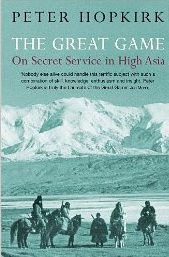
cover for The Great GameThe Great Game by Peter Hopkirk details the history of the 19th century shadow war for supremacy in Central Asia–that is, the spying, territory-grabbing, and general skullduggery accompanying the land grab of the Central Asian states and countries by Tsarist Russia and Victorian Great Britain. A great deal of the activity was centered around Afghanistan, which provides a lot of background about why the situation is so messed up today.

Investigations (exploring and snooping) were first begun in the area because of the British occupation of India. The greatest fear of the British occupiers was that the Russians would come swooping down on them through the Khyber Pass to take away what they had gained in India. So they sent small groups of men into the forbidding, wild regions to investigate the terrain, establish outposts, and try to make pacts with local war lords, khans, and other rulers.

This history is written by a Brit, so the Russians are the tacit bad guys. However, it would seem that often the Russians were more reliable partners to these states and countries than the British, who consistently let down their allies by doing nothing when the Russians invaded their territories. For their part, the Russians seemed often to be more brutal, but not always.

The book contains the enthralling stories of many young officers and civilians who took on dangerous missions into unknown, very wild territory with little or no backup from the British government, some of them simply to explore the areas but others to actively spy. Often these young men received no thanks from the British government for their efforts.

Note that a different edition of this same book is called The Great Game: The Struggle for Empire in Central Asia. I believe these are both the same book but that On Secret Service has been updated, taking into consideration recent events. I am not exactly sure which one I read because my edition was a special one from the Folio Society (just called The Great Game), but was published around the same time as the more recent book.

Day 22: Cleopatra: A Life

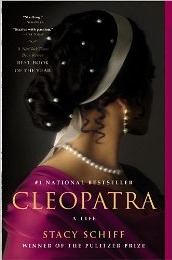
Cover for Cleopatra: A LifeWhen my grandmother traveled to Egypt in the 1960s, she wanted to buy a bust of Cleopatra. She was surprised to find out that the Egyptians consider Cleopatra a traitor. No images of her were available, so Granny Billie came back with a bust of Nefertiti instead.

When you think about Cleopatra, maybe you imagine the beautiful seductress played by Elizabeth Taylor in the movie. Maybe you think about the scheming whore in Antony and Cleopatra. Maybe you even think Cleopatra was Egyptian. (The Ptolemys were Greek.) Stacy Schiff, whose book Cleopatra: A Life was selected by the New York Times for its best books of 2011 list, would point out to you that Cleopatra’s history was written by the victors, her defeaters.

Schiff tells us the engrossing story of what is known of Cleopatra’s true life. Certainly she married her brother. So too did most of the Ptolemaic rulers marry their own siblings. Certainly her brother was executed when he revolted against her. The Ptolemys were noted for lopping off the extra branches of the family tree.

What you may not know is probably more to the point. Schiff shows us a picture of Egypt, the wealthiest country in the ancient world when Cleopatra gained the throne, but already on the wane. And there is its powerful ruler, Cleopatra, not beautiful but cultured and intelligent, reportedly fascinating in conversation, educated. Not the type of woman the patriarchal Romans are used to dealing with.

A clever strategist and negotiator and witness to Rome’s attempt to gobble up the known world, Cleopatra early realized that she needed to carefully pick her allies in Rome’s continuous battles for control of the empire. First she picked Pompey over Julius Caesar—not ultimately the wisest decision, but her family had ties to him, and her brother’s betrayal of him was one of the horror stories of the age. Then she negotiated a partnership with Julius Caesar, but unfortunately he was soon assassinated. Her next choice was not as percipient, but Marc Antony seemed to be the greatest soldier of his time.

There are few unbiased records of Cleopatra’s life, and none that are biased for her, but Schiff does an excellent job of examining the various allegations made in the existing records and judging their likelihood. Rather than the ruthless vixen reviled through the ages, Schiff depicts Cleopatra as a strong woman who was doing her best for her country.

Although some have criticized the book as heavy going (one actually commented that it “lacked dialogue”—I don’t know what source that person thought the dialogue would come from), I didn’t find it so. It was written for the general public but reflects serious scholarship, and Schiff has found an elegant balance between that and entertainment.

Day Seventeen: The Lost City of Z: A Tale of Deadly Obsession in the Amazon

Cover for The Lost City of ZThe Lost City of Z by David Grann tells the story of a famous British explorer, Percy Fawcett, and his obsession with finding the fabled city of El Dorado in the Amazon. He was the last of the great Victorian adventurers and possibly the inspiration for Indiana Jones (and for the explorer in the movie Up).

Fawcett made a career of exploring the Bolivian and Brazilian Amazon, beginning with being hired by the Bolivian government to establish its border in the Amazon. He became convinced that there had been a large city, which he called Z, in the region of the Xingu River. Hundreds of expeditions had been made to find it, beginning in the 16th century, and many of them were never seen again.

In 1925 Fawcett set off on an expedition funded by the Royal Geographical Society with a small party that included his son and son’s best friend. He sent daily dispatches back from the jungle that were published in the newspapers and waited for with anticipation by the general public. Then the dispatches stopped, and he was never seen again.

But the story wasn’t over. Others went into the jungle to try to find out what happened to him, including a famous movie star. Many of them never returned, either.

Grann, a staff writer for The New Yorker, became interested in the subject, which he came upon while working on another project. During his research, he met with members of the Fawcett family and was given access to a some previously unpublished personal papers. He is able to provide insight into the explorer’s character and thought processes, which makes for a fascinating story.

Grann also became consumed with the fate of the Fawcett expedition and found himself deciding to follow in Fawcett’s footsteps. Although his trip through the Amazon in a jeep was no Victorian expedition, he himself is no explorer. He was surprised to find the Amazon almost as wild today as it was 100 years ago.

And maybe he solved the mystery of what happened to Fawcett’s expedition. The story of Fawcett’s adventures makes compelling reading, and the ending is unexpected.

Day Fourteen: Salt: A World History

Cover for SaltNo, this review has nothing to do with the Angelina Jolie.

For those of you who aren’t familiar with micro-histories, they are histories about very limited topics. Micro-histories are usually fairly short because of their focus but can be fascinating and go into great detail on a very specialized subject. The best of these that I have read is Zero: The Biography of a Dangerous Idea by Charles Seife, who writes on math and science topics. However, I read that so long ago that I would not be able to write a good review of it.

Today’s review is of Salt: A World History by Mark Kurlansky, who has specialized in writing micro-histories. The book traces what is known about the collection, processing, and uses of salt from the earliest times and the role it plays in history. He quotes commentators from ancient China, Rome, and Egypt on the qualities of salt. He explains how certain cities became prominent in early times because of salt mines or salt fields on bodies of water and how empires (for example, that of Venice) were built around salt, either making it or trading it. He also discusses its close connection with cod and other things important to world history.

The book is a micro-history full of micro-histories. Kurlansky tells about the mines in Poland that have chandeliers carved from salt and explains that the downfall of the French monarchy was a result of the hated salt tax, which placed a heavier burden on the peasants than it did the aristocracy. He explains that one of the reasons for the success of Napolean’s army was the discovery by Nicolas Appert of how to preserve meat by canning (using salt), allowing the army to have a more reliable source of food than simply pillaging the villages. He explains the reasons for Mahatma Ghandi’s illegal march to the sea to gather salt and why it galvanized resistance to British rule in India. He includes recipes.

Basically, if a subject has anything to do with salt, he writes about it. Salt is an interesting book, although it contains many digressions and seems unfocused at times. To pursue a point, he sometimes goes backward and forward in history, which can be confusing. The recipes were interesting at first, as they come from all times in history and from many different countries, but after awhile I felt that they interrupted the flow, especially as some were more than a page long.

I’m told that Kurlansky’s book Cod is even better, and I have that on my shelf waiting to be read, but he said so much about cod in Salt that I’m wondering what more there is to say!

Despite my caveats, if you want to read an engrossing book that will tell you many interesting things you probably didn’t know, read Salt.