Review 2572: Sarah’s Key

In 1942, Sarah Starzynski is 10 years old, a Jewish child in Paris. There have been rumors of a raid on Jewish homes, but usually the French police take only the men. So, Sarah’s father hides in the basement while Sarah, her mother, and her four-year-old brother go to bed as usual.

But this time, the French police are there to take everyone. They don’t seem to know about her brother, so Sarah locks the little boy in his secret place, thinking she will come back soon and let him out. In the street, her mother has hysterics and screams her father’s name so that he comes out. All of them are taken to the Vélodrome d’Hiver, ultimate destination Auschwitz.

In 2002, Julia Jarmond, an American journalist who lives in Paris, is assigned to write an article about the 60th anniversary of the infamous roundup at Vel’ d’Hiv’, as the velodrome is known. Julia has never heard of it before. Aside from the ultimate destination, the Vel’ d’Hiv’ is known because, like with Hurricane Katrina, thousands of people, mostly women and children, were there for days without food, water, or sanitary facilities.

As part of her research, Julia asks French people if they know about this story. Most of them claim not to, but Julia learns from her father-in-law, Edoard, that the flat her husband Bertrand has been renovating became a possession of the family after the removal of its Jewish family on the night of the Vel’ d’Hiv’. In fact, that family was the Starzynskis.

The novel follows Sarah’s journey for a time, alternating with Julia’s story, as her personal life becomes entwined with her desire to find out what happened to the Starzynskis, particularly Sarah, who was not recorded as having died in Auschwitz. After about half the book, Sarah’s narrative stops.

I know I never read this book before, but some plot points seemed familiar, so perhaps I saw the movie. The plot was compelling enough, but I still had some issues with it, particularly that I couldn’t imagine that after a while a four-year-old child wouldn’t have made enough noise to be found in almost any apartment building.

I had more problems with the writing, though, particularly of Sarah’s sections, and the characterization. I think Sarah’s sections are written in a way to suggest childishness—the sentences are short, most of them in a subject-verb-object order that results in choppiness. Her reactions are naïve, much more so than I can imagine from any Jewish child of ten at that time and place. And ten-year-olds can have as complex thoughts as adults. She seemed, especially at first, more like a much younger child.

The writing is better for Julia’s parts, but there are still inapt word choices and no very strong use of language. It’s mediocre. For example, a glass of limoncello is described as “a beautiful yellow.” Ho-hum.

I felt the novel was interesting enough to finish, but just barely.
Related Posts

The Oppermanns

The Postcard

Suite Française

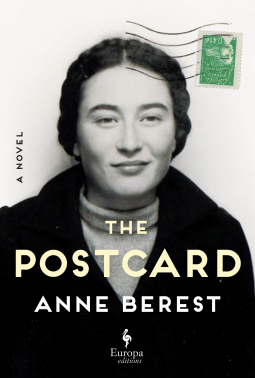
Review 2225: The Postcard

Although sold as fiction, I believe that The Postcard is very much autobiographical and historical, the story of the fates of Berest’s relatives and her own search for an identity.

The search begins with a postcard, one that arrived years before but that Anne’s mother Lélia shows her much later. It is an old postcard containing only the names of Anne’s grandmother’s parents, sister, and brother. All of them died in Auschwitz. The postcard is addressed by another hand to Lélia’s mother Myriam, but at Lélia’s address, where Myriam did not live. It is a mystery. Is it a threat? A reminder?

Myriam has never spoken about their family’s past and now she is dead, so both Lélia and Anne have grown up knowing very little about their family, Ephraïm and Emma Rabinovitch and their children, Noémie and Jacques. Since receiving the postcard, though, Lélia has built up an archive of documents about the history of the family up to when they were deported by the French government. The first part of the novel covers this history.

The further sections of the novel are about Anne’s attempts to discover who sent the postcard and what happened to Myriam. Why was she the only one missed, and what did she do during the war? And finally, how has her family’s experience affected Anne’s own life?

This is a deeply engaging story and an important one, I think. Although the Holocaust is long past, its effects are still reverberating.

Related Posts

Night

The Invisible Bridge

The Zone of Interest

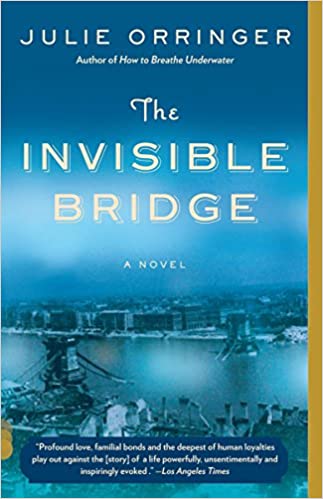
Review 2065: The Invisible Bridge

One of the reasons I learned to love reading was that I got swept up into another time or place or even world. As I got older and more discriminating, this experience happened less often. It happened most recently within a few pages of starting The Invisible Bridge, which I read for my James Tait Black project.

Andras Lévi, a young Hungarian Jew, arrives in Paris in 1937 to study architecture. He has brought with him a letter that an acquaintance asked him to mail once he was in Paris. He mails the letter but notices the address.

Soon he is involved in the technicalities of art school, made more difficult because he almost immediately loses his scholarship, a first act of the anti-Semitisim that is perceptibly increasing, although not as bad in Paris as it was in Budapest. He seeks a job at a theater from Zoltán Novak, a man he met on the train from Hungary. When he begins a friendship there with an older actress, she sends him to lunch with friends at the address on the envelope he mailed, and that’s how he meets Klara, an older woman with whom he falls madly in love.

This novel, which starts out seeming very particular, about a love affair between two people, grows into a novel of great breadth, covering events of World War II, the Hungarian Holocaust, life in work camps, the siege of Budapest. All of it is centered in the importance of family.

I absolutely loved this novel. It is sweeping, wonderfully well written, touching, harrowing. And what a story, based on the lives of Orringer’s grandparents. I can’t recommend this book enough.

Related Posts

Great House

A Town Like Alice

Between the Woods and the Water: On Foot to Constantinople: From the Middle Danube to the Iron Gates

Day 1181: The Zone of Interest

Cover for The Zone of InterestIn Martin Amis’s The Zone of Interest, the Zone is a Nazi factory and concentration camp in Poland. Interestingly, Amis makes this setting a source of some very black humor.

The novel is written from the points of view of several characters, mostly Nazis, but it is mainly from that of Thomsen, an officer in charge of production at the rubber factory. He is a womanizer, but he begins to have feelings for Hannah Doll, the commandant’s wife.

Doll himself is a vile human being. He has his rival for Hannah imprisoned and uses threats against inmates’ relatives to force them to do things.

In fact, most of the characters are vile. And that’s the difficulty with this novel. First, is the Holocaust fodder for humor? I’m not sure it is in general, but it isn’t for me. Also, even though Thomsen is the least criminal of the characters because he’s working subtly against the war effort, these are people busily explaining away their own terrible actions.

Amis’s goal, I think, is to give some insight into the behavior of these people. Whether you want to read a novel on this subject probably depends on whether you’re interested in that insight. It made me a little queasy. This is one of the books I read for my Walter Scott Prize project that I didn’t really enjoy.

Related Posts

Maus I

Great House

The History of Love

Day 841: Night

Cover for NightHere is my review of my Classics Club spin choice for Spin #11!

Night is Elie Wiesel’s spare and harrowing description of his and his father’s time spent in a series of concentration camps during World War II. He begins his story in 1944, where in the town of Sighet, Transylvania, the war did not seem to have touched the Jewish population. They had heard of problems in Budapest, but they knew nothing of the larger Nazi activities aimed at their people.

The first indications came from Moishe the Beadle, a man with whom Elie has been studying the Kabbalah. As a foreign Jew, Moishe was deported to a work camp. But he came back to tell everyone that all of the deportees were driven to Poland where they were forced to dig trenches and then shot. Moishe was wounded but managed to get away and returned to warn them. No one believed him, however. They naively refused to believe the Germans could behave that way. Elie and his family could have gotten a visa out of the country, even at that late date, but they stayed.

Next, all the Jews were rounded up into two ghettos, and not much longer after that, they were shipped out to Auschwitz. Once the women and girls were separated from the men and boys at the camp, Wiesel never saw his mother or sister again. He was 15 and probably only lived because an inmate told him to say he was 18.

At only 120 pages, this is a short but affecting description of his experiences in the camps. It does not dwell overly much on the horrific conditions, but we understand how terrible it was. The book also deals with Wiesel’s spiritual landscape, as he changed from a devout boy to a man who no longer believes.

This book is not a testament to human fortitude, for Wiesel makes it clear that humans under evil conditions behave badly. Instead, it is an important documentation of a black time in human history.

Related Posts

The Narrow Road to the Deep North

Unbroken: A World War II Story of Survival, Resilience, and Redemption

The Book Thief

Day 499: Literary Wives! The Zookeeper’s Wife: A War Story

Cover for The Zookeeper's Wife

Here it is time for another Literary Wives club meeting. Please also see the reviews of my fellow “wives!”

If you have read the book and would like to participate, you can add comments to any of our pages or to the Literary Wives Facebook page.

Let’s get right to the book!

The Zookeeper’s Wife tells the true story of Jan and Antonina Zabiński, the keeper of the Warsaw zoo and his wife during World War II. After the bombardment by the Germans and their invasion, the Zabińskis struggled to keep the zoo animals alive, but they were also responsible for providing temporary shelter in the zoo grounds and in their house to hundreds of Jews. Jan, who was a member of the Polish Underground, found ways of smuggling people out of the ghetto, and he and Antonina kept them at the zoo until they could be placed elsewhere, sometimes for a few days, sometimes for longer periods.

The book is rich with details about life in their unusual household, full of animals and of hidden people who came out cautiously at night. It tells stories of lucky escapes and frightening encounters with the Nazis. It also provides information about life in the ghetto and some of its heroic leaders. I found some of these stories extremely touching, such as that of Henryk Goldzmit, a children’s author who went by Janusz Korczak. He abandoned his literary career to found an orphanage for Jewish children, and when the Nazis decided to ship all the children to Treblinka and almost certain death, went with them so they would not be frightened.

Although some of Ackerman’s many digressions from the main story add interest and color to the book, I unfortunately found others disruptive to the flow. For example, she spends more than a page on Jacques Offenbach simply because Antonina played one of his pieces on the piano to warn the hidden residents when strangers approached. Ackerman, a nature writer, spends another very long paragraph just listing the types of bugs in an insect collection entrusted to the Zabińskis. After awhile, these digressions began to feel like padding.

I also felt that Ackerman’s writing sometimes verges a little too closely on fiction. She is prone to rather florid descriptions of things she can only be imagining, often including inapt or odd metaphorical language. Although she introduces the book by saying she got the dialogue directly from Antonina’s diaries, she fictionalizes other things, such as the thoughts of sculptor Magdalena Gross, that could not have come from her sources. This style of writing for a nonfiction subject makes me uncomfortable. In fact, I read this book when it first came out and remembered it as a work of fiction.

What does the book say about wives or the experience of being a wife?

Literary Wives logoIn what way does this woman define “wife”—or in what way is she defined by “wife?”
It is interesting to me that Jan Zabiński describes Antonina at one time as “just a housewife,” because she is clearly so much more than that. She helps him administer the zoo and take care of the animals even before the war. During the war, she takes care of a household of refugees while Jan is out until late most nights and is gone for some extended periods of time. Although he is described as authoritarian and occasionally harsh, he trusts her implicitly to run things and keep everyone safe, even through scary encounters with Nazi officials and drunk soldiers. Although she would define herself as a wife and her husband as the master of the house, it is clear that the two respect each other and trust each other to handle difficult and dangerous situations. Antonina also defines herself as a mother, with the fierce determination to protect her children and her other charges.


Day 110: Maus I

Cover for MausMaus I is a graphic novel that is both about Art Spiegelman’s relationship with his father, Vladek, and about Vladek’s survival of the Holocaust. The characters are depicted as different types of animals–Jews are mice, Poles are pigs, Germans are cats, Americans are dogs, and Swedes are reindeer. Spiegelman explained in The Comics Journal (according to a reader review on Amazon.com) that his idea for using these animals is not entirely original but is extrapolated and expanded from the names the Germans called Poles and Jews.

In the novel, as Vladek tells Art the story of his experience during World War II, they also argue. The story is compelling, although the relationship between the two is less so. Vladek is difficult and eccentric, but Art seems childish and spoiled, with no patience or understanding for his father. However, the novel makes the point that he, too, was scarred by his father’s experiences.

I am not by any means an expert on graphic novels, having only read one other, which was the beautifully illustrated Britten and Brülightly. However, the art in Maus I is so primitive that I could not tell any of the characters of a single species apart except for their clothes. I suppose, though, that that in itself is a statement. Still, the art shows a strength of line and a simplicity that make it interesting.

Maus I is apparently intended for young adults, and as such, is probably a powerful educational piece. I think it is less successful for adults.

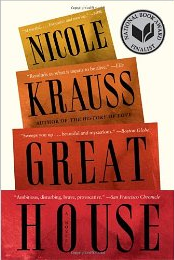
Day 24: Great House

The tale this collection tells is so complex that my book club members asked me to send them an email explaining the sequence of events, once I had figured it out. Great House by Nicole Krauss is written as a series of interleaved stories without regard to sequence, almost as if she wrote the stories in order as a novel and then cut it up into pieces and rearranged it. The effect is interesting, but it is difficult for readers to understand where they are in time as they go from one story to another.

A labyrinthine tangle of people’s stories is written around the migration of a desk from one person to another. Nadia, a writer, tells the story of how she accepted the loan of furniture from Daniel, a Chilean poet, who was soon after murdered by Pinochet’s regime. Years later, a woman comes to her claiming to be Daniel’s daughter and asking for the desk, so Nadia gives it to her.

Arthur, the husband of Lotte, the writer who gave Daniel the desk, finds a secret while he is going through his dying wife’s things. This secret may be the clue to where Lotte got the desk.

Nadia goes looking for the desk to ask for it back because she finds she cannot write without it. She eventually finds herself in Israel. Other characters encounter the desk, are affected by the search, or meet Nadia or each other. We find out that the woman who claimed the desk was not the daughter of Daniel after all, but the daughter of someone who has an even better claim to it, as his family lost it in the holocaust.

Most of the members of my book club were perplexed, and many of them did not like any of the characters. I had a more neutral reaction. The desk eventually comes to represent all of the things that were lost in the holocaust. The stories as a whole are demanding and interesting, and Krauss purposefully leaves you with unanswered questions.