Review 2211: Horse

This novel tells the story of a famous racehorse and the people connected to him evoked through some objects—his own skeleton and three portraits of him. Although the main characters in the novel are fictional, many of the historical characters are not. The horse, Darnley, who is renamed Lexington, is still considered one of the best racehorses of all time, and many of his offspring have been champions.

In 2019 Theo is a Nigerian graduate student of art history at Georgetown. He plucks a painting out of the trash of his neighbor. It is of a horse, and he recognizes that it is well painted, so he decides to write an article about having it cleaned and valued.

Jess is the head of a lab at the Smithsonian that cleans and articulates animal skeletons for display and study. She has recently located the skeleton of the famous race horse Lexington for a scholar studying equine bone structure when Theo brings in his cleaned painting. Jess recognizes it immediately as one of Lexington painted by Thomas J. Scott, a 19th century horse painter.

In 1850, 13-year-old Jarrett is a slave working with horses for Dr. Warfield in Lexington, Kentucky. Jarrett’s father, Harry Lewis, is a well-known horse trainer who has bought his own freedom and is saving to buy Jarrett’s. Jarrett is with Alice Carneal when she gives birth to Darnley, the horse that will be renamed Lexington. After a promise from Warfield to give Darnley to Harry instead of his yearly wage, Jarrett develops a close relationship with the horse.

Thomas J. Scott is a young artist who specializes in painting horses and is hired by Warfield to paint some of his horses. While he is there, he paints a copy of his picture of Darnley and gives it to Jarrett. Later, he returns to paint an older Lexington.

These are the characters whose points of view are used to tell the story of Lexington. Brooks’s story is based on what is known of the real horse and characters with some inventions. It’s an interesting story with vivid descriptions of the races, of 19th century New Orleans, and of the racing industry of the time. It also has strong themes of the effects of slavery, racism, and cruelty to animals.
Related Posts

Horse Heaven

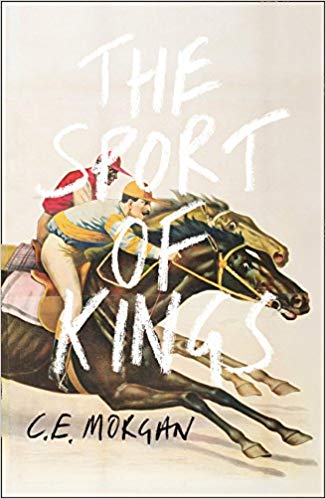
The Sport of Kings

People of the Book

Review 1382: The Sport of Kings

To paraphrase Sophia Brownrigg, a reviewer from The Guardian, The Sport of Kings is about horse racing like Moby Dick is about whales. It is ambitious—attempting to tell the history of Kentucky through that of two families—one white, wealthy, elitist, and bigotted, the other black, poor, and beleagered. It is sometimes magnificent in its prose and sometimes overblown. It is Southern Gothic, focussing on the ramifications of slavery and bigotry.

Henry Forge is the only son of a proud Kentucky family. As a youngster, he was brutalized by his father and lectured about his place in history. We have some sympathy with him until, in his teens, he commits an unforgivable act.

He rebels against his father by turning the family corn plantation into a horse farm, but the nut doesn’t fall far from the tree. When his wife leaves him, his daughter is nine. He takes his daughter out of school and teaches her himself, all his lessons revolving around horses and breeding and including much out-of-date or just plain incorrect information. He is as elitist as his father—and worse.

Henrietta grows up with a talent for working with horses and a keen, cold intelligence. She also likes to pick up men for sex. Then she meets Allmon Shaughnessy, the new African-American groom, fresh from a prison program for working with horses.

Up to that point, the novel seems mostly a multigenerational saga, occasionally discoursing on geology, genetics, or history in the interludes. But after that it becomes wildly overblown at times, reminding me of the characteristics of Moby Dick that I disliked.

Like one other reader on Goodreads, every time I picked up this novel I wanted it to end. It is about deeply unpleasant characters; the least at fault—Allmon—whines his way through the novel. Its long asides are often irritating. It is sometimes beautiful and very dark, but it is often annoying.

Last year I read an essay—I can’t remember who wrote it—complaining about what I call “books only men like,” usually the ones that win awards. (I read this one for my James Tait Black prize project.) This essay commented that because a certain type of book gets attention and wins awards, now some women are beginning to write like men, using All the Birds, Singing as an example. I did not agree with the writer’s example but couldn’t help thinking of this essay while I read this novel.

Related Posts

Mother of Pearl

Wise Blood

Horse Heaven

Day 1188: Horse Heaven

Cover for Horse HeavenFor me, Jane Smiley’s work is a little unpredictable. While I consider her A Thousand Acres to be one of the best books I’ve read, I haven’t liked others as much. To my surprise, though, I really enjoyed Horse Heaven.

In this novel, Smiley attempts a difficult feat—she wants to show all the nooks and crannies of horse racing by depicting quite a number of characters. There are owners, trainers, riders, jockeys, bettors, and veterinarians. There are also horses, a handful of which are important to the plot.

The novel isn’t plot heavy. We’re not headed toward a showdown among the major players at the races. Instead, each character has his or her own plot trajectory. The shifty trainer Buddy will do anything to win a race but suddenly finds Jesus. Elegant owner Rosalind is married to loud and gauche Al and has an affair with her trainer, Dick. Irish trainer Deidre thinks of herself as bitter and brusque but is adored by the people who work for her. Zen horse trainer Farley falls madly in love with rider Joy, who feels most comfortable alone. Elizabeth is an animal psychic who gets tips on the races from a retired racehorse.

I complained in Smiley’s Last Hundred Years trilogy that there were too many characters to get to know. But here, even though you see them in little vignettes, you do begin to care about them.

And I cared even more about some of the horses. Without actually anthropomorphizing them, Smiley gives them discernible characters. I was particularly captured by Justa Bob, an intelligent, reliable horse who begins a downhill slide mostly because of the carelessness of his owners. Smiley does’t focus just on champions. There is Mr. T., the retired horse; Froney’s Sis, a young filly who is timid and a slow learner; and Epic Storm, a horse who is fast but dangerous and mean.

If you like horses, I think you will love this book, but even if you don’t, Smiley shows us a fascinating, complex world. The novel is written in a breezy style with quite a bit of humor.

Related Posts

A Thousand Acres

Some Luck

Early Warning