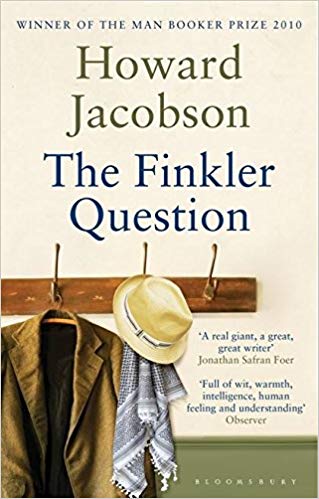
Day 1260: The Finkler Question

Cover for The Finkler QuestionHaving read Howard Jacobson’s J for my Booker Prize project, I was not looking forward to reading The Finkler Question for the same project. Since it won the award in 2010, I was hoping to like it better. I found it, however, very difficult to stay interested in.

Julian Treslove, the main character, is always expecting loss. He imagines himself holding the women he loves as they lie dying. I found him unbelievable and cartoonish.

Treslove has a long friendship with Libor, his former professor, and Finkler, an old school friend. Both of them are Jewish and recent widowers. Treslove, naturally lugubrious, has been hanging out with them while they grieve and argue endlessly about Jewishness and Israel.

I mean endlessly.

Treslove tends to make generalizations about Jewish traits and calls Jews “Finklers.” I ask you, who would do that?

Then one night on the way home from Libor’s house, Treslove gets mugged by a woman who says something to him that might be “You Jew.” After Treslove endlessly examines this event, I mean endlessly, he decides maybe he’s actually Jewish. He hopes he’s Jewish.

It doesn’t help that Jacobson tells this story using the same jokey, ironic tone that drove me crazy in J. I know that there are people who convert, but Treslove is such a ridiculous person I feel he’s there to be ridiculed.

Yet, I briefly became interested in him after he buckles down to become Jewish and meets a woman who seems suited to him. I could not say the same for Finkler, who belongs to ASHamed, Jews who are ashamed of the behavior of Israel.

I assume Jacobson is mocking the different characters and their ideas about Judaism, but no one in this book feels like a real person but Treslove’s girlfriend, Hephzibah. This novel really bugged me. I see it as the type of literary novel honored by the male publishing elite that no one actually likes.

Related Posts

J

The Fixer

The New Sweet Style

Day 1149: J

Cover for JJ is one of the books I read for my Booker Prize project, and I almost didn’t finish it. About one third of the way in, I considered giving it up. Jacobson spent almost half the book hinting around about the underlying secrets of the novel, during which time nothing much seemed to be happening. Finally, I decided to read some reviews to see if they would make me decide to finish it, and they were intriguing enough for me to continue.

This novel is set in a dystopian future, but this dystopia is not quite what we might expect. An event, referred to as WHAT HAPPENED, IF IT HAPPENED seems to color all of society. History is not studied, and reading books is not encouraged. Everything seems too politically correct, with nothing being outlawed but many things—like rock music and most forms of art—eliminated by general consensus. Because this event was precipitated by social media, no one uses computers anymore, and the only phones are landlines that cannot call long distance, called utility phones. Oh, and everyone has a Jewish last name through a program named Call Me Ishmael.

Ailinn Solomons meets Kevern Cohen, and they begin dating. They both feel like outsiders in their coastal village even though Kevern was born there. He is a paranoid person who checks his locks and the position of his rug several times before he leaves his home. Ailinn is an orphan who is new to town.

Ailinn is vaguely aware of being nudged in Kevern’s direction by her housemate, Esme Nussbaum. And Kevern’s paranoia isn’t unfounded as someone is keeping an eye on him, Professor Edward Everett Phineas Zermansky, a colleague of the Benign Arts deparment of Bethesda Academy.

Something is clearly going on, but Jacobson is evasive about it for most of the novel. Zermansky knows about part of it and his diary entries, at first unidentified, punctuate the narrative as do those of another unidentified character. Zermansky’s interjections are more annoying than revelatory, written in an ironic but elliptical style, and we don’t see the point of them for some time.

My main criticism of this novel is that it takes so long to be understandable. In the meantime, we are treated to an uninteresting romance between two characters we don’t care about. It’s not that they’re one-dimensional, they’re no dimensional. For this is a novel about ideas, not people.

The reviews promise a shocking conclusion and stunning deep secrets. Certainly something nasty is going on, but by the time I learned what it is, I didn’t care. There are enough hints along the way that the conclusion is not all that surprising. I’ve seen this novel compared to Never Let Me Go, but that novel made you care about the characters before it sprung its big reveal, and then it stayed with the characters afterward. This novel puts all its eggs into the basket of the big surprise ending, which isn’t that much of a surprise by the time you get to it.

Related Posts

The Prague Cemetery

Brave New World

The Heart Goes Last