Day 243: The Pursuit of Love

Cover for The Pursuit of LoveIt’s always fun to re-read Nancy Mitford’s charming and funny autobiographical novel about her youth and young womanhood. Mitford’s alter ego is Linda, a young woman with terrible taste in men, who throws herself from one extreme to another in pursuit of love.

Mitford’s strength is her portrayal of peculiar but lovable characters, all modeled upon her own eccentric family or on figures in society. The novel is narrated by Fanny, a sensible but lonely girl who spends a lot of time with her cousins, the Radletts. Her terrifying Uncle Matthew (modeled on Mitford’s father) loves to hunt his children instead of foxes, a game the children love. Aunt Sadie is unutterably vague, which she probably has to be to live with Uncle Matthew. Uncle David is a cultured hypochondriac. The Bolter, Fanny’s mother, is supposedly a portrayal of Lady Idina Sackville, a famous society woman who kept leaving her husbands and was a member of Kenya’s famous Happy Valley set.

Mitford starts the novel with childhood–the children are hunted, hang out in the linen cupboard fantasizing about running away, and generally run wild–and follows the older girls into young adulthood. The novel finally centers on the story of how Linda first impetuously marries a stuffy banker who bores her silly, then leaves him for a communist who only thinks about his causes, and finally falls into the arms of Fabrice, a French duke who is a world-class womanizer. Characterized by facetious observations of society life and dialogue brimming with zingers, Mitford’s novel is a joy to read.

Just as an aside because I’ve recently read a few posts about cover design, I originally copied into this post the most recent cover of the book, which shows a romantic black and white photo of a debutant holding a bouquet of flowers with a pink banner for the title. I decided to replace it with this older cover (the one on the copy I have), which I think does a much better job of conveying the type of novel it is, much more of a social commentary than a romantic novel.

Day 239: Lucky Jim

Cover for Lucky JimI hate to use the word “hapless” two days in a row, but here goes. Hapless Jim Dixon is an unhappily employed lecturer in history at a “new university” in England. (I believe even that phrase is supposed to be fraught with meaning, but I am not British, so I don’t know what it might be.) Uncertain of whether he’ll be keeping his job in the coming year, he is forced to listen with an attentive air to the endless prosings of his boss Professor Welch and to take on all the tedious chores he is assigned. He vents his frustration through silly pranks and grotesque grimaces when he thinks no one is looking.

He has also gotten himself entangled with Margaret, a manipulative coworker whom he pities because she recently attempted suicide when her fiancé left her.

During a stultifying weekend of amateur theatrics and madrigal singing at the Welch’s, Jim meets the beautiful Christine, the girlfriend of the horrible Bertrand, Welch’s pretentious and belligerant son. Jim is startled to find that perhaps Christine returns his interest.

Amis’ amusing skewering of academic life comes to a climax at Jim’s well-attended lecture on Merrie England. Amis’ novel is known both for being the first “campus novel,” one that takes the point of view of a lecturer rather than a student, and for its down-to-earth, witty writing style, an approach that was unusual at the time. Although it was published in 1954, it holds up pretty well in modern times.

Day 231: I Am Half-Sick of Shadows

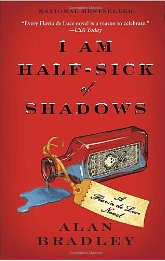
Cover for I Am Half-Sick of ShadowsAnother comic mystery starring the eleven-year-old sleuth Flavia de Luce, I Am Half-Sick of Shadows is the usual fun, even though the clues don’t add up until after the murderer is revealed.

Flavia’s father has rented out the house for Christmas to a film company in an effort to save the estate, since the family is so badly in debt. On Christmas Eve, the lead actors, Phyllis Wyvern and Desmond Duncan, perform a small benefit concert for the village of Bishop’s Lacey, after which everyone is snowed in by a blizzard. During the night, Wyvern is murdered, strangled to death with a length of film. This situation leaves the entire film crew and population of the village as potential suspects.

Although Flavia doesn’t know who the killer is, she becomes trapped on the roof where she has gone to shoot off fireworks and perform a scientific experiment. She has devised a super-sticky bird lime and has spread it all over the roof in an effort to capture Father Christmas, if he exists. Unfortunately, the murderer finds some reason to suspect that Flavia might be on his or her trail.

Day 165: Alexandria

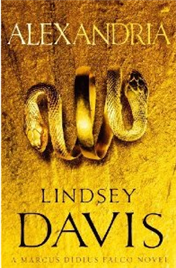
Cover for AlexandriaFor years I avidly collected all of Lindsey Davis’s Didius Falco mysteries. My passion has cooled a bit, as it usually does for series mysteries, but I still enjoy them enough to pick them up when I find them.

Marcus Didius Falco is a cynical, rascally, wisecracking “informer” during the Roman Empire of Vespasian. I have followed his path from the first book when he met Helena Justina, the fiery, unconventional daughter of a senator. Falco has had to work his way up from the plebeian rank and earn enough money so that he can legally be permitted to marry her.

In Alexandria, the 19th novel in this series, Falco and Helena Justina have been married for awhile when they travel to Alexandria with their two daughters, their adopted teenage daughter, and their mongrel dog for a vacation and visit to his uncle. Almost immediately upon arrival Falco is plunged into an investigation when his uncle’s dinner guest of the night before, Theon, the head of the famed library, is found dead, locked in his own office.

Of course, Falco has to figure out how Theon was murdered and why. He soon finds that several of the library’s scholars may want Theon’s job. Of course, people begin dropping like flies, including a philosophy student who is mauled by a crocodile. Falco begins to suspect that something else might be going on.

Davis’s books always involve a multitude of interesting, shifty characters and lots of dirty politics and other shenanigans, and Falco is always engaging and amusing. Davis does a convincing job of re-creating the ancient world in her books.

If you are interested in this series, I recommend that you start with the first book, Silver Pigs (recently renamed The Silver Pigs). Although the mysteries are stand-alone, developments in Falco’s personal life make it more enjoyable if you read this series in order.

Day 134: A Red Herring Without Mustard

Cover for A Red Herring Without MustardBest Book of the Week!
A Red Herring without Mustard is another of Alan Bradley’s delightful, comic mysteries featuring Flavia de Luce, the eleven-year-old detective and chemist.

In this book a mysterious gypsy woman is nearly beaten to death after Flavia allows her to camp on de Luce land. Something odd is going on. After Flavia surprises a neighborhood thug in the de Luce’s drawing room when everyone else is in bed, she finds him dead the next day, hanging from the trident of a fountain of Poseidon.

As usual, Flavia races all over the countryside on her bike Gladys, feuds with her sisters, consorts with her father’s shell-shocked batman, and tumbles into trouble in this novel, set in England just after World War II.

Bradley’s plots are implausibly complex, but it is not for the mysteries that I read these books but for the funny, irrepressible character of Flavia.

Day 114: A Walk in the Woods

Cover for A Walk in the WoodsIn A Walk in the Woods: Rediscovering America on the Appalachian Trail, Bill Bryson recounts his attempts to walk the Appalachian Trail. After living in England for years, Bryson has moved back to the States, and he decides to reacquaint himself with America and try to get into better shape by walking the trail. To his surprise, an old friend named Katz, a reformed drug user, decides to come along.

Bryson is an amusing writer. He mixes interesting facts about the trail and information about the environment with stories about who he and Katz meet and what happens to them. I was particularly struck by how two such mismatched companions not only did not kill each other but actually treated each other considerately.

The two out-of-shape and inexperienced hikers start out with far too much equipment and then as they continue, Katz begins throwing things out, including the food. It seems they make just about every mistake a couple of neophyte campers can make, except being eaten by bears.

They run out of time after walking a few hundred miles of the trail in the south, and Bryson’s attempts to finish the trail devolve to what he can accomplish by driving to different portions of it and hiking on long weekends. But the longer hike that the two of them take is the meat of the book.

A few people have criticized the book because Bryson didn’t actually manage to hike the entire length of the trail. I think they are missing the point of the book, which is about friendship, about the interesting things that happen on the trail, and the history of the trail itself. In fact, few people do manage to complete the entire length of the trail, from Maine all the way to Georgia.

Day 99: Good Omens: The Nice and Accurate Prophecies of Agnes Nutter, Witch

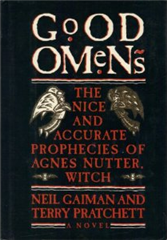
Cover of Good OmensAnd now for something completely different. Good Omens: The Nice and Accurate Prophecies of Agnes Nutter, Witch is an absolutely wacky spoof by Terry Pratchett and Neil Gaiman. In the planning for Armageddon, a demon gives the Antichrist to a Satanist nun to swap with the baby of an American diplomat. But she mixes up the babies, and the Antichrist goes home with an ordinary British family.

Eleven years pass, and the powers, both of light and darkness, gear up for the end of the world. But one angel (Aziraphale) and one demon (Crowley) have decided they like the human race and life on earth too much to want the war between Heaven and Hell. They go off together to find the Antichrist and avert Armageddon. And then there are Agnes Nutter’s “nice and accurate” predictions.

A review on the book cover says it is like a combination of The Omen and Monty Python, and that gets it about right. It contains lots of digs at sources of apocalyptic literature. This book is not for everyone, but many of you will find it hilariously funny.

Day 86: Nightingale Wood

Cover for Nightingale WoodI hardly know how to categorize Nightingale Wood, written in 1938. On Amazon, it is called a romance, but the novel is a little cynical for that. It is described on Wikipedia as a rewrite of the fairy tale Cinderella. If so, neither the heroine or hero is what you would expect. Stella Gibbons, better known for writing Cold Comfort Farm, has written a charming, light novel with a touch of acid.

Viola Withers comes to live with her in-laws after her husband dies, leaving her penniless. The Withers’s home is uncomfortable and gloomy, containing miserly Mr. Withers; socially conscious Mrs. Withers, who thinks her son (Viola’s husband) married beneath her; and two unhappy daughters, Tina and Madge. Viola soon meets Victor, a wealthy cad who is almost engaged, and falls in love with him.

Gibbons’s characters are quirky and obsessive, and even the heroine and hero are not totally sympathetic. Viola is silly and not very bright, Tina is in love with the chauffeur, and Madge cares only about getting a dog. And I think we know enough about Mr. and Mrs. Withers already. What makes Gibbons’s books appealing is that people turn out to be better than they seem at first, and everyone gets what he or she deserves.

Day 82: Cotillion

Cover for CotillionOne of my favorite authors if I want the lightest of reading material and a good laugh is Georgette Heyer. Although I am not a romance reader, for her meticulously researched and comic Regency romances I have to make an exception. Her period pieces are absolutely convincing, as she was an expert on Regency dress, deportment, and speech. In fact, she became such an expert on the period’s idioms that she once was able to successfully sue a plagiarizer by proving that the expression the other writer copied appeared only in some records to which she had been granted private access.

But Heyer was also an expert at creating charming comic characters and situations. Cotillion is one of my favorites of her books, and one of the silliest.

Kitty Charing is an impoverished orphan who has been raised in discomfort by her miserly old guardian, “Uncle” Matthew Penicuik. A great one for manipulating his putative heirs, Uncle Matthew announces that he will leave his entire fortune to Kitty, but only if she marries one of his four grandnephews. Then he invites them all to come calling. Priggish Reverend Hugh Rattney and doltish Lord Dolphinton arrive, and the married Lord Biddenden comes to represent his rakish brother Captain Claud Rattney, but dashing Captain Jack Westruther, whom Kitty has grown up hero-worshipping, does not make an appearance, as he is unwilling to be manipulated.

Kitty is furious that Jack doesn’t appear, but even more furious at being put in this position. She soundly rebukes all of her “cousins,” except Lord Dolphinton, who is too stupid to be responsible for his actions and has been compelled to come by his mama. But then Uncle Matthew announces that if Kitty refuses to marry one of her cousins, he will leave her with nothing. What is a spunky Heyer heroine to do but run off into a snowstorm with only a few possessions and an impractical plan to get a job as a house maid?

She arrives at the local inn to find her cousin Freddy Standen, who has absolutely no idea why he has been summoned. Freddy, not the brightest of bulbs but a kind-hearted young man, is perfectly wealthy in his own right and has no intention of getting married. When he meets Kitty at the inn, she talks him into pretending an engagement with her and inviting her to go up to London so she can acquire some “town polish,” buy some nice clothes, and (she hopes but doesn’t tell Freddy) enchant Jack into a proposal.

Freddy, an expert in deportment and fashion who can always be relied upon to accompany a young married woman to a dance or concert, is not really a lady’s man. When he and Kitty arrive in London to find his harassed mother attempting to care for a house full of children with mumps, he is dismayed to find he is left responsible for a naïve girl who tends to fall into difficulties and odd friendships.

The novel is crammed with comic characters, such as Kitty’s foolish governess “Fish,” who has a turn for quoting romantic poetry; Freddy’s frippery married sister Meg, who wears color combinations that shock him to the core and spends her time trying to avoid her mama-in-law; Camille, Kitty’s real French cousin, who is impersonating a lord; Lord Dolphinton, who is terrified of his mother but strictly charged by her to get Kitty to dump Freddy and marry him; and the silly doe-eyed Olivia, whom Kitty befriends but Jack is pursuing to be his mistress.

Day 27: Major Pettigrew’s Last Stand

Cover for Major Pettigrew's Last StandBest Book of Week 6!

A touching love story, Major Pettigrew’s Last Stand is also a wry and witty jibe at small village life in England. Major Pettigrew is a proper widower who leads a life of quiet and habit, comfortable in his village and local golf club. Still suffering from the loss of his wife, he has just learned about his brother’s death and he is so shaken by this that he has a dizzy spell. Mrs. Ali, the widow of a Pakistani grocery store owner, has come to his house collecting for charity and helps him recover. The two begin a friendship based around discussions of books.

Besides missing his brother and wife, Major Pettigrew has other worries. He is concerned about his son, who seems only interested in money and prestige, and at times lacks gentility and honor, for which Major Pettigrew cares deeply. He is also concerned about his brother’s greedy wife and daughter, who do not seem likely to honor his father’s request that two valuable heirloom shotguns given to each of the sons be reunited when one of them dies.

Mrs. Ali is having her own battle with relatives. Her husband’s family wants her to give over her store to her religious fundamentalist nephew while she takes her expected widow’s place as a family servant.

Major Pettigrew must navigate the murky waters of village and family disapproval of his relationship because of racism and class snobbery and decide how much he wants to keep his quiet life. Mrs. Ali must in turn decide how much duty she owes to her family.

This novel is charming and delightful, one of my favorite books of 2011. Major Pettigrew’s dry and clever comments amused me throughout. The novel is beautifully written. I have been eagerly waiting to see what Ms. Simonson does next.