Day 1219: In a Strange Room

Cover for In a Strange RoomBest of Five!
It’s not clear to me whether In a Strange Room is a novel or three slightly linked short stories. I’ve seen it referred to as both. The linkage comes from journeys, as each section deals with a journey the narrator takes with different people.

This narration is complex. South African novelist Galgut himself is the narrator, but he speaks both in first and third person, the one hinting at intimacy, the other, more often used, at distance.

The first section, or story, “The Follower,” deals with a journey in the early 1990’s with a German named Reiner. The narrator meets him on another trip, and although they do not know each other well, they correspond. Eventually, Reiner comes to Africa, and the two take a journey through Lesotho. It’s difficult to understand what the narrator sees in Reiner besides good looks, and eventually the trip becomes a battle for control.

The second section, “The Lover,” starts with Damon latching on to a group of Europeans traveling in Africa after he leaves the group he started with. He keeps running into them when he is with the first group and offers to help them when they are turned away from the Malawan border for not having visas. Damon and Jerome are attracted to each other, but they can barely communicate, as Damon doesn’t speak French and Jerome barely speaks English.

In “The Guardian,” Damon takes his old friend, Anna, on a trip to India. She has recently been hospitalized for mental illness, and Damon finds it increasingly difficult to deal with her.

I didn’t really enjoy Galgut’s novel about E. M. Forster, so I wasn’t exactly looking forward to reading this novel for my Booker Prize project. But I am happy to say that I found In a Strange Room powerful and touching. It is sparsely written but completely involving. Even though it doesn’t explicitly express emotion, it still evokes an emotional response. I am happy to have changed my mind about Galgut.

Related Posts

Arctic Summer

Olive Kitteridge

A Place Called Winter

Day 896: No Country

Cover for No CountryA story about Irish immigrants to India seemed like an interesting change to me. But I decided not to finish this 500+-page book.

It begins in 1989 in upstate New York, where the bodies of a couple are found and their daughter is being questioned. The promise is that the novel will answer the question of who killed them or whether they committed suicide, but at least in the first 200 pages, after this brief opening, the book doesn’t return to the crime.

Instead, the story goes back in time to 1843 Ireland. There, we meet two boyhood friends, Brendan and Padraig. Through several unlooked-for occurrences, Padraig ends up on a ship to Bangladesh with every intention of returning immediately, while Brendan adopts Padraig’s illegitimate daughter Maeve and ends up fleeing the famine for Canada.

Everything about the Irish section of the novel seemed clichéd to me, and because Ray spends no time at all on characterization, we’re not especially interested in the characters. The point of view switches between characters, but they don’t have distinctive voices or personalities. Finally, there is no sense of place to the novel. So, I decided to stick it out until the novel moved to India, hoping that would change things.

In Calcutta in 1911, we meet Robert, Padraig’s Anglo-Indian grandson. I didn’t stay with Robert very long because I still didn’t feel very interested, and again there was no sense of place. It seems obvious that the couple who die in 1989 are going to find they are related in some unanticipated way, but by then the relationship will be so distant, it would hardly seem to matter.

In fact, the story seems to be one of unrelenting misery, but a misery so detached that we feel little empathy as we read the catalog of horrors experienced by Brendan and his family in Ireland and on the way to Canada. The novel is ambitious to tell the story of these families but in a way that didn’t capture me or make me want to invest the time to finish it. From reviews I’ve read, it just becomes more complex, one reviewer mentioning it needed a family tree. But that would probably give away the ending.

Related Posts

Galway Bay

The Lives of Others

The Lowland


Day 865: Arctic Summer

Cover for Arctic SummerFrom its description, I thought that Arctic Summer might be one of the most interesting books I’m reading from the Walter Scott Prize list. It is described as a fictional biography of E. M. Forster, particularly leading up to his publication of A Passage to India.

That is certainly the time period the novel covers, and A Passage to India is one of its preoccupations. But the novel spends most of its time on Forster’s obsession with his homosexuality and his desire for sexual experience. As I’m not all that interested in reading about anyone’s obsession with sexuality, this novel was not the best fit for me.

The novel begins in 1912 on Forster’s first trip to India. While he is there, he will visit a good friend, Masood, and he has hopes that his life will open up, particularly in regard to sex. At the age of 33, he is still a virgin, his fear of disgrace holding him back from expressing his sexuality at home. Perhaps in India he will have an experience, maybe with Masood, whom he loves.

Unfortunately, Forster, who goes by Morgan, has a tendency to fall in love with heterosexual men and prefers men from a lower class, so nothing quite works out the way he wishes. Even when he finally has some encounters, years later, what he is actually looking for is love, which he never finds. The novel follows him during the long gestation of his novel about India, back to England, to Alexandria during World War I, and back to India again. During this time, his most significant relationships are with two friends who do not return his feelings.

The novel is extremely well written, and Galgut deeply characterizes Morgan, if not the other characters. It did make me wonder if any person could be so relentlessly focused on sex, although of course he is also lonely. It also made me wonder how, if he really felt this unrelenting focus, he ever got anything written. Certainly this novel makes you feel for Forster—he was a sad man.

Related Posts

The Master

Under the Wide and Starry Sky

Studio Saint-Ex


Day 856: A God in Every Stone

Cover for A God in Every StoneA God in Every Stone is a novel that seems to be trying to convey some profound truths. The trouble is, I couldn’t figure out what they were.

It begins in pre-World War I Turkey, where young Vivian Rose Spencer is on an archaeological dig. She is entranced by the thought of the history of artifacts, particularly by a story told her by Tahsin Bey, a friend of her father. He tells her of a circlet worn by the 5th century explorer Scylax, which he believes may be found in Peshawar, where the Persian King Darius sent him to explore the Indus. Viv’s visit is cut short by the start of the war, but by then she has promised herself to Tahsin Bey, who says he will fetch her in London after the war.

Viv begins the war nursing, but after a while she is unable to take the stress. Her mother agrees to allow her to journey to Peshawar as an archaeologist, but first she is drawn by patriotism and naiveté into a betrayal.

Qayyam Gul is a proud Pushtun soldier whose regiment is practically wiped out at Auber’s Ridge. He loses an eye, but it is his experience of being an Indian soldier in England that makes him begin rethinking his loyalties.

In Peshawar, Viv befriends a young Pathan boy, Najeeb, who becomes fascinated by the objects in the museum. She begins giving him lessons in the classics, but when his mother finds out, she makes him stop. Najeeb is Qayyam’s brother, and Qayyam accompanies Najeeb to Viv’s house to return her books. Not much later, Viv is forced to return to London.

Fourteen years later, Viv is enticed back to Peshawar by Najeeb’s letters. He is now employed by the Peshawar Museum and wants her to excavate the site that she hoped to explore years before. Qayyam has in the meantime become involved in the Congress, which wants to separate India from England. Viv arrives, but after violence has already begun.

Although I was interested in the characters and wanted to know what happened to them, I felt that Shamsie presents us with threads of different stories, all unexplored. We don’t learn very much about Qayyam’s experience at Auber’s Ridge or Viv’s nursing experiences, for example, or what’s going on in the Congress. We never find out what happened to Scylax’s circlet. It is almost a McGuffin. The best parts of the novel are her depictions of Peshawar. But even there, the readers’ experience seems fragmentary. In a dramatic portion of the end of the novel, a girl is introduced as an apparent partner for Najeeb, only to be killed within a few pages. The author’s intentions seem confused, as if she started with too many stories to tell and couldn’t decide between them.

Related Posts

An Atlas of Impossible Longing

The Lives of Others

The Daughters of Mars

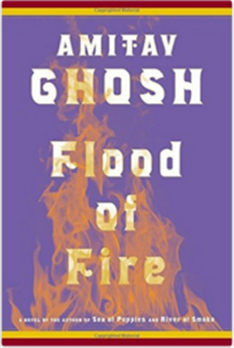
Day 827: Flood of Fire

Cover for Flood of FireBest book of the week!
In the third book of his Ibis trilogy, Flood of Fire, Amitav Ghosh slowly draws most of his characters to China during a momentous period in history. The only major character missing from the first book is Deeti, making a home on Mauritius. And of course Bahram Modi, who died at the end of River of Smoke.

It is with the absent characters that we start, in a way, for at the beginning of the novel, Kesri Singh, Deeti’s brother, is unaware of what has happened to her. It is through Kesri that Deeti’s family met her husband, for he was brother to Subedar Nirbhay Singh, the highest-ranking sepoy in the battalion to which Kesri belongs. Kesri is a new character, and we go back in time to learn how Deeti helped him join the battalion and how Kesri, although wary of the character of Deeti’s proposed husband, encouraged the match to further his own ambitions. As those who have been following the series know, that did not turn out well.

Shireem Modi, Bahram’s wife, is finding her life uncomfortable since her husband died. Because his opium was confiscated by the Chinese government, she is left with nothing, dependent upon her own family. But soon her husband’s friend Jadig Karabedian arrives and tries to talk her into traveling to China to represent herself in the opium sellers’ claims against the Chinese government; otherwise, her claim may be disregarded. He also finds it necessary to tell her about Ah Fat, her husband’s illegitimate son.

Zachary Reid has finally been acquitted of blame for the incident on the Ibis but finds himself assessed fees that he cannot pay because his mate’s license has been suspended. He goes to work for the mysterious Mr. Burnham (who, although barely present, seems to affect all the events in the series) restoring a boat. There he is led into a dangerous relationship with Mrs. Burnham.

Neel, the rajah who ended up in prison for his father’s debts because of Mr. Burnham’s desire for his property, is still in China working at an English-language press. As the British Empire draws together a force to invade China, bringing most of the other characters there, Neel begins working for the Chinese government as a translator.

This trilogy clearly depicts Britain, driven by the greed of the opium growers and sellers, as the bully of Asia. Sea of Poppies shows how the Indian farmers were forced to abandon food crops to grow opium poppies, and how then the price of opium was manipulated to make them subsistence farmers. River of Smoke shows British efforts to force the Chinese to import opium, including the lies conveyed back to the British public about the behavior of the emperor. Flood of Fire draws all of our friends back to China to culminate in the First Opium War, when the British stuff opium down the throats of the Chinese.

Overall, I was very satisfied with this series. Ghosh is able to get you completely involved with his characters and is playful and inventive with language. Although I was not happy with the evolution of the character of Zachary Reid from a naive young man to the person he becomes, this is a great series.

Related Posts

Sea of Poppies

River of Smoke

The Siege of Krishnapur

Day 793: The Lives of Others

Cover for The Lives of OthersI probably haven’t read enough contemporary Indian novels, or maybe I wouldn’t be surprised that two of them are partially about the Naxilite rebellion of the 60’s and 70’s. Apparently, a good deal has been written about it without my being aware of it before.

The Lives of Others deals with the rebellion on the one hand and the lives of an upper-class family, the Ghoshes, on the other. Prafullanath Ghosh is a member of the wealthy Ghosh family, owners of an expensive jewelry store in Calcutta. But Prafullanath was robbed of his inheritance by his older brother when he was a young man. So, he has worked his way up to become the owner of several paper factories.

His family, however, is not so much interested in the business as in the benefits that accrue from it. His two oldest sons are dilatorily employed by the business while the third son wastes money through a publishing concern. The poor economic climate and Prafullanath’s ill-advised business decisions as an old man threaten the business, and then a strike shuts down the most productive factory.

But the family’s floundering fortunes aren’t so much the focus of the novel as the decadence of the family itself. With nothing much to occupy themselves, some of the wives and the sister bicker endlessly. The four-floor house is occupied according to prestige, with the more important family members living higher, away from the noise and dust. Purba, the widow of the youngest son, and her two children have one room on the ground floor while each other family has a whole floor. Purba is treated worse than the servants.

Although Prafullanath has been ill since his youngest son’s death, his other sons have their vices. Adinath is alcoholic, Priyo is subject to sexual obsessions, and Bhola practically throws money away. At first, Adinath’s son Supratik seems to have escaped the family decadence. He has left home and school without warning to work among the poor farmers and instruct them in Mao’s teachings. He is a Naxilite.

About a third of the novel consists of Supratik’s letters, written to someone who for a long time is not identified. He writes about the plight of the farmers, who are being plundered by large landowners in league with the police. He also writes about the activities of his small cadre.

Even though his deeds eventually become savage, for a long time Supratik seems to be the only Ghosh with praiseworthy motives, but this account is more nuanced than to paint anyone as simply good or evil. Almost all the adults in the novel are in some way corrupt.

Although set mostly in the 60’s and early 70’s with flashbacks to earlier times, an epilogue shows that the same kind of corruption is going on today. The Lives of Others is a novel that is powerful but difficult to read. It is an indictment of class and caste divides, corruption, and the imbalance between the rich and the poor.

Related Posts

The Lowland

The Circle of Reason

An Atlas of Impossible Longing

Day 716: The Siege of Krishnapur

Cover for The Siege of KrishnapurThe Siege of Krishnapur, the second in J.G. Farrell’s trilogy about the British Empire, is a novel of ideas, full of the mordant humor and irony that characterizes the first book, Troubles. Farrell based his novel on the true-life 1857 siege of Lucknow, during which British residents held out for five months against attacks from Indian sepoys.

As author Pankaj Mishra explains in the introduction, this siege and similar incidents generated at the time a popular romantic genre of fiction, wherein two young English people meet in India just before the rebellion and bravely withstand privation to prevail in the end. In The Siege of Krishnapur, Farrell is among other things satirizing this genre.

George Fleury arrives in Calcutta with his sister Miriam just before news of the first sepoy rebellions. Like Farrell’s protagonist of Troubles, Fleury is an unformed young man, and worse, he tends to the pedantic. He is inclined to the romantic and likes to lecture about the supremacy of feelings and ideas over the new plethora of objects and inventions resulting from the current Industrial Revolution.

In Calcutta, Fleury and Miriam meet another brother and sister, Harry and Louise Dunstable, offspring of one of Krishnapur’s doctors. Harry is a young lieutenant, and Louise is thought to be the prettiest (English) girl in India. Fleury is taken by her, but she spends her time flirting with the young soldiers.

Once the young people reach Krishnapur, it is not long before the rumors of trouble turn into reality. The Collector, who is in charge of the district, has been paying attention, though. The others have been ridiculing him for surrounding the Residency with trenches and sending his wife home to England.

The Collector can’t quite comprehend why the natives would want to attack the British, who in his mind are bringing them the wonderful benefits of civilization. He himself attended the Great Exhibition and has filled his house with some of the marvels exhibited there, including electroplated busts of some of the great poets. (Shakespeare’s head turns out later to make a great cannonball; Keats’ does not.)

Once the British are under attack, there are thrilling yet funny descriptions of the fighting, bravely and innovatively conducted by Harry and the other soldiers, who have limited resources, and incompetently assisted by Fleury. Fleury is continually arming himself with some bulky and impractical weapon. Inside the Residency, the British begin by maintaining strict social levels and having tea parties. Once Fleury and Harry have rescued Lucy, a suicidal fallen woman, from her bungalow outside the compound, the other ladies are horrified at having to share quarters with her, even though they are sleeping on billiard tables.

Many vibrant characters inhabit this novel. The Padre is an Anglican clergyman who endlessly tries to convert his flock’s thoughts into more pious channels, haranging them even in the midst of battle. Dr. Dunstable is so incensed by the more modern treatments of his rival, Dr. McNab, that he challenges him to verbal debates and eventually gets himself killed trying to prove Dr. McNab is wrong about the cause and treatment of cholera. Even when Dr. Dunstable’s death proves Dr. McNab is right, the supposedly rational and enlightened British still somehow believe he is wrong. The Magistrate is so interested in phrenology that he shocks everyone by feeling the back of Lucy’s head to determine its amativeness and is slapped for it.

As conditions in the Residency deteriorate, the true nature of the British rulers of India emerges, petty, jingoistic, and chauvinistic, caring little for the natives, who do not appear much in the novel except as servants or attackers. In one revealing speech, an opium grower rejoices at how much money has been made by forcing the Indians to grow opium and then using it to addict the Chinese. In fact, it was just at this time that the 8th Earl of Elgin stopped to hear about the rebellion in northern India while he was on his way to China to force the Chinese emperor to admit British opium dealers.

The novel tells a great story, while still being full of wit and philosophy.

Related Posts

Troubles

Sea of Poppies

River of Smoke


Day 698: The Namesake

Cover for The NamesakeIn 1968, Ashima Ganguli gives birth to her first child. She has travelled from Calcutta to Cambridge, Massachusetts, to live with her husband, whom she barely knows, and is missing her family in India. When she has a boy, she and her husband Ashoke run into difficulty because they are waiting for a name to arrive from her grandmother. But the American hospital needs to put a name on the birth certificate. Finally, Ashoke picks Gogol, after Nikolai Gogol, a favorite author whom he credits with saving his life after a horrendous train accident when he was a young man.

Gogol grows up embarrassed by his name and rejecting the traditions of his Bengali parents. He is bored through the endless Saturdays spent with his parents’ Bengali friends and the biennial trips to India where they do almost nothing but visit family. His mother, on the other hand, has never stopped missing India. His parents want him to observe the customs of his homeland, while he just wants to be American.

This novel insightfully explores the stresses for Indian immigrants adjusting to American ways and the tensions between the traditional and the present for their first-generation American children. Lahiri’s prose is full of minutely observed details as well as empathy for both generations.

Related Posts

The Lowland

Unaccustomed Earth

Under the Lemon Trees


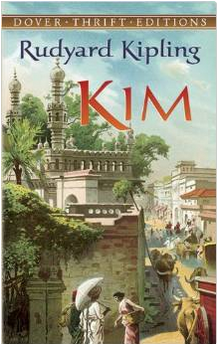
Day 633: Kim

Cover for KimBest Book of the Week!
Up until now, the only book I read by Rudyard Kipling was Puck of Pook’s Hill, which is definitely a children’s book. I always assumed that Kim was a children’s book, too, or at most a boy’s adventure story, but I don’t think I would describe it that way.

Kim is the son of an Irish soldier in India, but both of his parents died impoverished when he was young. He has been brought up by a Eurasian woman who leaves him to himself most of the time, only insisting that he wear European clothing. But he keeps some native clothing hidden away, and when he is wearing it, he cannot be discerned from any other street urchin. He knows everyone in Lahore, and they call him Friend of All the World.

One day he is playing outside the Lahore museum when a holy old lama comes to look at the wonders inside. Kim sees that he is a truly guileless man with no one to help him in a foreign country. The lama explains that he is searching for a holy river that will wash clean all his sins. Kim decides that he will go with the lama as his chela, his disciple who begs for him and takes care of him. Before leaving Lahore, though, Kim goes to see Mahbub Ali, an Afghani horse dealer for whom he has run some errands. Mahbub gives him a dispatch to take to a British Colonel Creighton.

The description of the journey of Kim and the lama is very colorful and interesting, reflecting Kim’s joy in the bustle of the road and a love of the country on the part of the author. But Kim’s father told him long ago that he would be saved by a red bull on a green field, so when he sees a regimental flag flying the device, he goes nearer to look and is suspected of being a thief.

He has always carried his papers in an amulet, and when he is captured, his identity as Kimball O’Hara is established. The priests in the regiment, of which Kim’s father was a member, plan to send him away to a Masonic orphanage. Kept a watch on and forbidden to see his lama, Kim writes to Mahbub for help. Mahbub makes sure that Colonel Creighton understands how valuable a boy like Kim would be as part of the Great Game, of spies and explorers in the far regions of the area.

So, Kim’s fate is taken out of his own hands and he is sent to school to learn to take his part in the Raj. But the lama pays for his schooling and makes sure he goes to a better school than originally intended.

This is really a great novel. I came to it prepared for perhaps some outmoded racism or hints of British superiority but found a novel that reflects a deep love of India and of all its peoples. Of course, there is an implicit assumption that the Raj is a good thing, but the British characters in the novel are as varied as any, and there are comments about mismanagement and misplaced airs of superiority on the part of the British. Kim is rich in colors and smells, in the flavors of language and the stories of the orient, and in this complex tale of a boy with loyalties both to the soldiers who raised him and to his beloved lama.


Day 490: The Glass Palace

Cover for The Glass PalaceBest Book of the Week!
In the late 19th century, the kingdom of Burma was one of the wealthiest in southeast Asia. Its people were all literate, and no one in the country went hungry. Hundreds of thousands of Indians and people from other nearby countries traveled there to work on the waterways or the teak plantations.

In 1885, the Burmese government imposed a fine on a British trading company for avoiding taxes by under-reporting the amount of teak it was exporting. The British government used this incident as a pretext for invading the country and taking the royal family captive. King Thebaw and Queen Supalayat and their children, along with a few servants, were deported to India, where they were kept captive for the rest of the king’s life in a crumbling, poorly maintained house. Their personal possessions, including the king’s valuable jewelry collection, were confiscated and returned to England.

It is around this shameful incident that the beginning of The Glass Palace is constructed, an ambitious novel that tells the recent history of India and Burma/Myanmar through the stories of several related families. Rajkumar is a 10-year-old Indian orphan whose mother died in their attempt to reach Burma, and he is working at a small cooking stall near the palace when it is breached. He witnesses the removal of the queen and the princesses, and is struck by the beauty of Dolly, their young servant. Dolly is the only one of the lady’s maids who chooses to follow the royal family into exile.

Rajkumar goes to work for a Malayan businessman named Saya John Martins. With Saya John’s help and advice, Rajkumar eventually makes his fortune in the teak industry and finally travels to India to look for Dolly. She accepts his proposal and returns to Burma with her friend Uma, the recent widow of the first Indian Collector, the official in charge of the Burmese royal family.

These are just the bare bones of a dual story rich in characters and detail, on the one hand that of Rajkumar’s efforts to better himself, on the other hand that of the lives of Dolly and the royal family in exile. But this novel is not a love story, and that is just the beginning of this novel, which continues until the present. The novel follows the fates of Rajkumar and Dolly’s children and grandchildren and those of Uma’s nieces and nephews in India and Burma as the families intermarry with each other and with Saya John’s children. As we follow the fortunes of some family members in Burma and Malaya, other family members get involved in the Indian movement for independence from the British empire.

During the Japanese invasion and bombings of Burma and Malaya during World War II, various family members struggle to survive, one an Indian soldier in the British army, one a rubber plantation owner, one a photographer who disappears in Malaya. Rajkumar and Dolly and their daughter-in-law and grandchild are forced with thousands of other Indians to make the thousand-mile trek back to India.

Ghosh is interested in telling a complex story of culture and  history, so he keeps us at a remove from his characters, but that does not make the novel any less moving. The novel does an amazing job of exploring the roots of problems in Myanmar and India through its exposition of events and the varying points of view of its characters. This is a captivating and ambitious novel.