Day 416: The Lowland

Cover for The LowlandBest Book of the Week!
Today we have a treat–one of the novels that made the short list for this year’s Booker Prize.

As boys in Calcutta, brothers Subhash and Udayan Mitra are inseparable, even though their personalities are so different. Udayan, the younger boy, is bold, reckless, and charismatic. Subhash is quiet and responsible.

As they reach college age, Subhash dedicates himself to his studies while Udayan becomes involved with the Naxalites, an obscure radical leftist group that takes its name from solidarity with the poor farmers of Naxalbari who rose up against their landlords in 1967. Subhash, who is apolitical, stays away from these activities and soon goes to Rhode Island to attend graduate school.

Subhash is called back to India because Udayan is dead. He returns to a home of grief, where his parents hardly speak to him or move from their balcony overlooking the street, where his mother goes out periodically to tend the small stone marker in the Lowland, a marshland where the boys had played and where the police shot Udayan in custody.

Subhash’s parents do not speak to his brother’s wife Gauri, and soon he understands that they hope to drive her away and take custody of her unborn child. So, Subhash offers to marry her and bring her back to the States so that he can care for her and the child. Gauri agrees.

Although Lahiri chooses to begin her novel in turbulent times, both in India and the United States, where demonstrations against Vietnam are taking place, her characters seem distanced from this activity, even though their lives are irrevocably changed by what happened in India. Incidents are described, but at a level that seems far removed from their reality. Only at the very end of the novel do we understand Udayan’s viewpoint, and it is just of the last few moments of his life.

I don’t know if this is a criticism, though. This novel is not so much about these political activities as about Udayan’s actions and their results, about the emotions that arise from them. The novel is about the complexities of grief and how they evoke other emotions–anger, isolation, inertia. As Maureen Corrigan remarks in her review of Unaccustomed Earth, “All that lushness electrifyingly evokes the void.” In The Lowland, we’re not so much faced with lushness as a marshy wasteland. This wasteland is in itself a metaphor. In the monsoon season it is one marsh, but when it becomes drier, it is separated into two ponds, just as Subhash and Udayan, and later Subhash and Gauri, are together and separate, each failing to comprehend the other.

Finally, the novel is about betrayal. Spanning more than 50 years and four generations, this novel, apparently broad in scope, is actually more concerned with private and personal tragedies. It evokes an atmosphere that is at once poignant and arid.
Day 361: The Circle of Reason

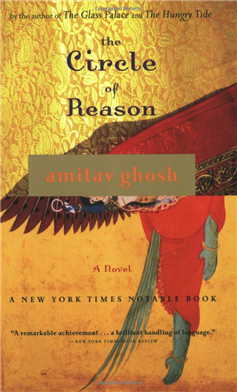
Cover for The Circle of ReasonBest Book of the Week!

Although magical realism is often mentioned in reference to The Circle of Reason, as Amitav Ghosh said himself in an interview for the New York Times review, there is nothing fantastical that happens in the book. Still, it continues to be compared to the works of magical realists such as Gabriel García Márquez or Salman Rushdie.

These comparisons may be because of the book’s rambling narrative style or its peculiar characters. The main character is Alu Bose, but we get to him only slowly through his uncle Balaram, a scholar turned teacher in a small village in India who develops a mania for the pseudo-science phrenology and worships Louis Pasteur. As Alu’s head is covered with odd-looking bumps, like a potato, he provides a subject of endless study for his eccentric relative.

Later, Balaram becomes obsessed with cleansing the village and begins a campaign to convince the villagers to coat every object with carbolic acid. His feud with the local politician combined with his obsession results in disaster, and Alu ends up fleeing India because of being mistaken for a terrorist. He is pursued by a policeman named Jyoti Das, who would rather be an ornithologist.

Thus begin Alu’s adventures, first in the Middle Eastern port of al-Ghazira, where he develops his own obsession for cleanliness, and then moving farther west, ending up in Algeria. On the way, readers encounter a myriad of other characters and stop to hear the stories of their lives or learn a little bit about weaving, say, or the history of al-Ghazira.

I was less reminded of magical realism than of One Thousand and One Nights, the tales of Scheherazade in which, in the middle of one tale, another begins. I attempted to read them at one time but despaired that I would ever get to the end of a tale or keep the various stories straight. Luckily, Ghosh’s narrative is a little more coherent, although not much. It is purposefully rambling, running off in delight to tell one fabulous story after another.

The novel is wonderfully well written, beautifully written, but sometimes I wondered where it was going or what the plot actually was. The feeling was only momentary, however, because I was always compelled onward. The ending is actually satisfying and less chaotic than I expected.

When I read that Ghosh wanted to write something like Moby Dick, that explained a lot about the novel’s narrative style. Fortunately for us, Ghosh’s style is a lot more accessible than Melville’s. Still, I prefer some of his more recent novels, particularly Sea of Poppies and River of Smoke. The Circle of Reason is Ghosh’s first novel, and he keeps getting better and better.

Day 304: Flashman

Cover for FlashmanHaving enjoyed Fraser’s The Candlemass Road, I thought I would give his satirical Flashman series another try. I read one years ago but wasn’t prepared to be met with such an unmitigated scoundrel as the main character.

Flashman is the first of the series, and it begins when Flashman is expelled from Rugby. Apparently, the character is based on a bully who appears in Tom Brown’s School Days, a novel I have never read but which is frequently referenced in other literature.

Flashman at a young age is already a complete scoundrel, cheat, and poltroon, so the comedy in the novel centers around his ability to be successful and eventually to be lauded as a hero despite his true nature. Having set his sights on a position as officer in the Eleventh Light Dragoons, a unit he selects as unlikely to see combat, Flashman is getting along swimmingly under the ridiculous Lord Cardigan until he makes the mistake of seducing a Scottish merchant’s daughter and being forced to marry her. To the snooty Lord Cardigan this fraternization with the middle class is unacceptable, so Flashman is forced into an Indian regiment.

Flashman is not happy to be consigned to what was then regarded as second class service, but once he arrives in India he finds he enjoys bossing around the natives and discovers in himself a facility for languages. Unfortunately from his point of view, this talent gets him assigned to Afghanistan as an aide to Lord Elphinstone just before the infamous and harrowing 1842 retreat.

This satire of the army and society reminds me of Thackeray’s more subtle Vanity Fair. I think you have to be in the mood for Flashman’s antics, but the novel is based on solid historical research and is certainly entertaining. Fraser’s prose is incisive as he cuts swaths through Victorian society and skewers the ineptitude of the British army.

Day 218: Sea of Poppies

Cover for Sea of PoppiesSea of Poppies is an absolutely enthralling historical novel, the first of a trilogy. Set in India in the 1830’s, it is centered around the opium trade, which the British East India Company forced upon both India and China. The novel is an ensemble piece, following the fates of several characters who all find themselves by the end of the book on the Ibis, an old slave ship bound for Mauritius.

The novel begins with Deeti. Like the other Indian farmers in her area of eastern India north of Calcutta, she has been forced to replace her food crops with poppies, destined for the Ghazipur Opium Factory. Now she can barely grow enough to feed her family, while the price for poppies sinks. As a girl, she was tricked by her husband’s family into marrying a hopeless opium addict. Soon fate will cause her to leave her home and flee down the Ganges.

Zachary Reid is a mulatto sailor who ships out from Baltimore on the Ibis as an ordinary seaman. A series of misfortunes onboard leave him without officers to sail the ship to Calcutta from Africa with only the help of Serang Ali and his fellow lascars. Once in Calcutta, his employer Benjamin Burnham hires him to help refit the ship and take the third mate position for the voyage to Mauritius.

Raja Neel Rattan Halder, the zemindar of Rashkali, is deeply in debt because of poorly timed investments in the opium trade. Although Neel is careful of the welfare of his hundreds of dependents, he is careless of business and expects to go on in his pleasure-loving ways. But the self-righteous Burnham wants the Raja’s estates for himself.

Paulette Lambert, the daughter of an eccentric French naturalist, has been left destitute by his death. Burnham has taken her into his family out of charity, but she is having a hard time adapting to his household. She is expected to behave like a proper young English lady, but she was primarily raised by an Indian woman, treats her son Jodu like a brother, and prefers to dress in a sari. Jodu has recently returned to Calcutta after his mother’s death and wants to be taken on as a hand on a sailing ship.

The fates of all these characters, and others, converge aboard the Ibis, which is scheduled to journey across the Indian Ocean to Mauritius with a load of indentured workers and then to sail to China to participate in the impending Opium Wars.

The novel is filled with entertaining characters and the colors, smells, and languages of India. It is beautifully written and crammed full of unusual words–Bengali words, sailor and lascar jargon, ornate oriental English, and various patois. The book has a glossary, but it is ironically intended. Comic, cruel, vivid, and deeply engrossing, the novel is rich and teeming with life. Amitav Ghosh’s novel, which was shortlisted for the Man Booker Prize, is wonderful.

Day 103: Dark Road to Darjeeling

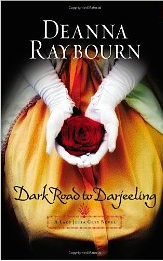
Cover for Dark Road to DarjeelingMy interest in the Lady Julia Grey series by Deanna Raybourn waxes and wanes. Although it is unusual for me to like books that mix mystery and romance, I usually enjoy reading this series, but I enjoy some books more than others. The books have followed the relationship of Lady Julia Grey and Nicolas Brisbane–who solves crimes for a living and whose breeding makes him an unsuitable mate for Julia–since they first met when her husband was murdered. Now, after several books following the ups and downs of their relationship as they solve crimes and get each other into and out of danger, they are married.

In Dark Road to Darjeeling, Lady Julia and Brisbane have been persuaded to interrupt their honeymoon in the Mediterranean by Julia’s sister Portia, who is worried about her friend Jane. In a previous novel, Jane left Portia to be married, and she is now a widow on a tea plantation near Darjeeling. Portia has asked Julia and Brisbane to investigate the possible murder of Jane’s husband. Jane herself is obsessed by her own pregnancy and the mysterious death of her husband Freddy, who may have been murdered for his inheritance.

The Brisbanes take along part of her eccentric family, Portia and brother Plum. Upon arriving at the plantation, they get to know the potential suspects, including Freddie’s aunt, his cousin Harry, several neighboring families, and the mysterious White Rajah.

I was unable to guess the murderer but figured out which family the murderer belonged to. Although this series sometimes resorts to the typical conflict between romantic co-investigators about the danger of the job, a conflict that I find extremely tedious, the dynamic between Julia and Brisbane still holds my attention. If you are interested in this series, I recommend that you start with the first book, Silent in the Grave.

Day 63: An Atlas of Impossible Longing

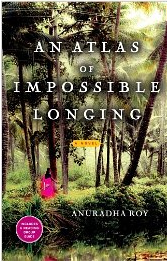
Cover for An Atlas of Impossible LongingIn An Atlas of Impossible Longing by Anuradha Roy, a family in turn of the (20th) century Bengal lives in a small remote village where the husband has moved for business. He, Amulya Babu, neglects his wife Kananbala for work, but he supports a boy in the local orphanage named Mukunda. Amulya and Kananbala have two grown sons, Kamal and Nirmal. Nirmal marries Shanti and is happy with her. But after she dies at her father’s house in childbirth, he deserts his family. His daughter Bakul is brought up in his father’s house by Kamal and his wife and by Kananbala, who is soon widowed.

On one of Nirmal’s visits after his father’s death, he goes to the orphanage to see who his father has been supporting for years and brings back Mukunda, who is casteless because no one knows his parentage. Mukunda and Bakul are raised together and allowed to run wild as each other’s only friends and companions.

The story eventually becomes about the relationship between Mukunda and Bakul and in the last section is narrated by Mukunda.

I had an ambivalent reaction to the book. I felt that the glimpses of Indian life were interesting and so was the historical context, even though momentous events are touched upon lightly. The book spans about thirty or forty years and three generations, ending in the 1940’s or 50’s. For a novel of such scope, however, it seemed too short to adequately develop the material. In the multigeneration story and the themes of the book, I was reminded of two other recent books, The God of Small Things by Arundhati Roy and The House of Blue Mangoes by David Davidar. But both of these books were much more satisfying.

I felt little connection to any of the characters, who seemed sketchily depicted. The love story that the book focuses on in the final part of the book is the least interesting part of the story because Roy has not made me care about either of the lovers. I was curious about what would happen but at the same time did not care very much about which way things would go.

Day 33: The Great Game: On Secret Service in High Asia

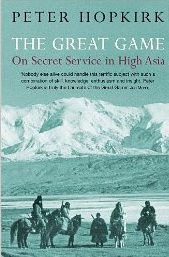
cover for The Great GameThe Great Game by Peter Hopkirk details the history of the 19th century shadow war for supremacy in Central Asia–that is, the spying, territory-grabbing, and general skullduggery accompanying the land grab of the Central Asian states and countries by Tsarist Russia and Victorian Great Britain. A great deal of the activity was centered around Afghanistan, which provides a lot of background about why the situation is so messed up today.

Investigations (exploring and snooping) were first begun in the area because of the British occupation of India. The greatest fear of the British occupiers was that the Russians would come swooping down on them through the Khyber Pass to take away what they had gained in India. So they sent small groups of men into the forbidding, wild regions to investigate the terrain, establish outposts, and try to make pacts with local war lords, khans, and other rulers.

This history is written by a Brit, so the Russians are the tacit bad guys. However, it would seem that often the Russians were more reliable partners to these states and countries than the British, who consistently let down their allies by doing nothing when the Russians invaded their territories. For their part, the Russians seemed often to be more brutal, but not always.

The book contains the enthralling stories of many young officers and civilians who took on dangerous missions into unknown, very wild territory with little or no backup from the British government, some of them simply to explore the areas but others to actively spy. Often these young men received no thanks from the British government for their efforts.

Note that a different edition of this same book is called The Great Game: The Struggle for Empire in Central Asia. I believe these are both the same book but that On Secret Service has been updated, taking into consideration recent events. I am not exactly sure which one I read because my edition was a special one from the Folio Society (just called The Great Game), but was published around the same time as the more recent book.