
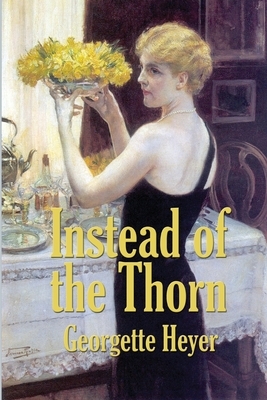
I’m on my second of three recently discovered (by me, anyway) Georgette Heyer books, and I’m beginning to think there’s a reason they’re not well known. Although the print-on-demand book I purchased has astonishingly few errors, it also contains absolutely no publication information, not even the name of the POD company. But I see that Instead of the Thorn was published in 1924. It is one of Heyer’s few contemporary novels that aren’t mysteries.
Elizabeth Arden is brought up by her Aunt Anne, a Victorian spinster who disapproves of everything modern and has taught Elizabeth to bury her own feelings and always be agreeable. Her father doesn’t pay attention to her, and when his old friend Mr. Hengist warns him that Anne may not be the best person to raise his daughter, he thinks that’s ridiculous.
When Elizabeth reaches her older teens, she is old-fashioned but beautiful (and probably doesn’t dress like the girl on the cover above). Her father begins to take an interest, and soon she is attending parties and dances.
She meets Stephen Ramsey, a famous author who is about 10 years older, and he falls in love with her. She likes him and finally agrees to marry him, hoping for a long engagement. But it is not to be, and three months later, knowing absolutely nothing about what to expect, she marries him.
Elizabeth is young for her age, and she has been raised to be a prig. She is shocked by what marriage entails, and so she begins finding fault with Stephen’s habits and so on. Eventually, they split.
Interestingly, but perhaps not surprisingly, their problems are all Elizabeth’s fault (except for how their marriage got its start, which is blamed on Aunt Anne). Aside from being messy, unpunctual, and intellectual, Stephen is perfect. Elizabeth has a long, perhaps unlikely way to go.
There are some hints of a sense of humor here, but not many. One scene between Elizabeth’s father and his sister is quite funny, and Stephen’s mother is a fun but lovable character. I guess I should give this book points for showing the harm that can occur by not telling girls the facts of life—but that problem was probably much more prevalent at that time.
Stephen’s family and friends are so much more interesting than her own that you’d think Elizabeth would go over to them immediately, but she is too much of a prig. She becomes quite unlikable for a while.
It’s clear that Heyer was still finding her feet as a novelist as well as her genre. This is not it. I will give Heyer some credit, because she does seem to be trying to capture the clash between the Victorian and Edwardian generations in both this book and Helen.
 What? Me Read?