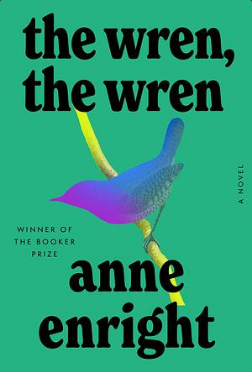
Review 2456: The Wren, The Wren

Just a quick note before my review: I’ll be posting during the next three weeks from various locations in the U. S., and Europe. So, my reviews may come out at funny times or may even be sporadic. I hope not.

The Wren, The Wren is the story of three generations of an Irish family and how they are affected by the desertion of a father.

The first section of the novel is narrated by Nell, the granddaughter of the Irish poet, Phil McDaragh. At first, her section is delightful—exuberant, funny, it made me laugh out loud. But then she unfortunately falls in love with Felim, neglectful and abusive.

The next section is from the point of view of Carmel, Nell’s mother and Phil’s daughter. She has a close relationship with Nell until Nell’s teen years, but she is haunted by memories of her father, who deserted his family while Carmel’s mother Terry was ill with cancer. It is Carmel’s memory that the last thing he did before he left was throw a tantrum about a missing wristwatch, which Carmel later spots on his wrist during a TV interview.

We briefly see a few things from Phil’s point of view, mostly about his own childhood, and chapters are separated by his poetry or by old songs translated from Celtic. There is a lot of bird imagery in all the sections. The McDaraghs are conscious of birds.

This is a powerful novel about lasting damage from a harmful act and the time it can take to heal. It is often funny, with a dry humor, and just as often sad.

Related Posts

The Green Road

The Gathering

So Late in the Day

Review 2433: Prophet Song

When I’m reading books for my projects, I don’t really look to see what they’re about, I just find them and read them. Prophet Song was for my Booker project, and I was dismayed when I realized it is a dystopian novel, since that is not my thing and I had recently read another one.

However, I soon realized I had read another novel by Lynch, Grace, a historical novel about the Irish famine, and I had forgotten how much I liked it. When you think of it, the famine was dystopian in its own way.

This novel rings lots of bells. It makes you think not only of Nazi Germany, but of Putin’s Russia, the Ukraine, and our own refugee crisis. Actually, refugee crises around the world.

The novel starts with a knock on the door. Ireland has recently voted in an ultra-right party, and the government has declared a sort of martial law, against what, it is not clear. A newly formed department, the GSNB, has sent officers to investigate a complaint about Larry Stack’s role as a union representative for the Irish Teacher’s Union. Larry answers that there is nothing wrong with him helping the union bargain for better pay and conditions, but it’s clear they’re trying to head off a planned strike with threats.

When Larry attends the strike, he doesn’t return. Nor can his wife Eilish find out what happened to him. Nor can the union solicitor. Normal rights have been suspended.

Eilish is left to care for her father, who is slowly succumbing to dementia, and her four children—Mark 16, Molly 15, Bailey 13, and Ben, a baby. Eilish goes on planning her Easter visit to her sister Áine in Canada, hoping that Larry will be free by then, but then Mark and Ben are denied passports.

Things go from bad to worse: Larry’s name is published in a list of subversives in the paper, and their house and car are vandalized. Mark receives a call-up to the military on his 17th birthday. Eilish’s sister keeps urging her to leave, but she won’t leave Larry and Mark, after Mark disappears to join the rebels.

This is an absolutely gripping story that keeps building and building. It is written in Lynch’s poetic prose, with long paragraphs that pull you along and create a sense of urgency.

Dystopian or not, this novel is excellent.

Related Posts

Grace

The Memory of Animals

American War

Review 2432: The Hunter

I always look forward to Tana French’s latest novel, and when it arrives, it jumps to the top of my pile. This one follows up on her last novel, The Searcher.

And really, it’s necessary to spoil the ending of The Searcher to explain this novel, although readers who haven’t read it may be able to get along without reading it. The main character of both novels is Cal Hooper, a retired detective from Chicago who moved to the countryside outside the Irish village of Ardnaskelty because he liked the look and feel of it. In the previous novel, Trey, a girl from a no-hope family, asked Cal to find out what happened to her older brother, Brendan, who disappeared. Cal did, and here’s the spoiler for that book—he had to make her promise not to take revenge against her brother’s murderers, who are all men of Ardnaskelty, although she doesn’t know which ones.

Now Trey is a teenager. Cal has been teaching her to do woodworking, and they have been buying furniture, fixing it up, and selling it and even occasionally making custom furniture. Trey’s family has been considered trash, but Trey herself is starting to earn some respect despite rough edges.

Then Trey’s father, Johnny Reddy, who abandoned his family years ago, returns. Cal dislikes and distrusts him on sight. Soon, the villagers find out that Johnny has a big plan for getting rich.

He has befriended a British man named Cillian Rushborough, a rich man whose people came from Ardnakelty. Rushborough is full of his grandmother’s story that gold used to be found on the mountain, and that it will have been swept down to the river. Johnny has convinced the villagers who own land along the river to go in together and salt the river with gold so that Rushborough will pay them to look for gold on their land. Cal isn’t invited to take part in this scheme, but he pushes his way in to keep an eye on Reddy. Once he meets Rushborough, he knows something else is going on.

Unfortunately, Trey sees her father’s scheme as a way to get back at the men who killed her brother. So, although she wants her father to leave, she starts helping him with it. Then, a body is found.

French usually pulls me right into her books, but for some reason, the setup of the scam kept losing my attention. Finally, though, things got moving and, as usual, French does not fail to fascinate.

Related Posts

The Searcher

The Witch Elm

The Trespasser

Review 2428: The Green Road

The Madigan family centers its activities around Rosaleen, the mother. At the beginning of the novel, she takes to her bed, assuming the horizontal, after she learns her favorite son Dan is planning to become a priest. The family has to run itself around her until youngest daughter Hanna, the narrator of this chapter, returns from a visit to her brother with information that gets Rosaleen out of bed and on the attack.

In that chapter we learn of the tangled history of the village. The Considines, Rosalee’s family, always looked down on the Madigans, Rosaleen mocks other families for their pretentions, but it’s true that she married below her, and the Madigans have never made very much money. But Rosaleen doesn’t care about money. She would like her husband to fix a few things around the house, but he generally doesn’t.

The next chapter picks up eleven years later in 1991 New York City. This chapter is narrated by Greg Savalas, a gay man deeply in love with a man named Billy. Dan Madigan comes on the scene, and although he is not out, he begins an affair with Billy. This is the time when men are dying of AIDS, and Billy is suddenly stricken. Dan is not helpful.

Eleven years later we encounter oldest son Emmett, who is an aid worker in Mali. This chapter details his insufficiencies in his relationship with his girlfriend Alice.

The Madigans all seem to reserve themselves from deep attachments. The second half of the novel is set in 2005, when they all gather together for Christmas for the first time in years because Rosaleen decides to sell the house. It’s clear that everything is still revolving around her. We get more insight into Constance, the oldest daughter, who has her own family but is the only one left in the area to meet Rosaleen’s demands. Finally, there is Hanna, an actress who is not coping well with motherhood.

I always feel that Enright’s characters are absolutely believable and her families fraught with realistic complications. Her descriptions, too, of the Western Ireland scenery are gorgeous.

Related Posts

The Gathering

Small Things Like These

This Is Happiness

Review 2318: Elegy for April

This third of Benjamin Black’s Quirke series begins with Quirke drying out in a clinic. In the city, his daughter, Phoebe Griffin, is worried about her friend, April Latimer, a doctor and the daughter of a powerful family. No one has seen April for some time, and although she has gone away before, Phoebe thinks she would have told her.

Phoebe first goes to Dr. Oscar Latimer, April’s brother, even though she knows April is estranged from her family. Oscar doesn’t seem interested and says April probably ran off.

Phoebe is beginning to believe that April is dead. After Quirke gets out of the clinic, Phoebe turns to him. He talks to his friend Inspector Hackett, and the police eventually find a cleaned up pool of blood next to April’s bed.

The Latimers seem to be more concerned about their family reputation than they are about April and use their connections to get the investigation shut down. In the meantime, Phoebe is falling for Patrick Ojukuru, a Nigerian student in the small group of friends that included April. When Quirke tells her a Black man was seen visiting April, Phoebe denies knowing of any Black man.

Quirke is falling off the wagon with a vengeance, but he continues looking into the case.

An investigator with a drinking problem is such a cliché, but otherwise I find this series set in 1950s Dublin to be well written and interesting.

Related Posts

Christine Falls

The Silver Swan

The Secret Guests

Review 2307: The Geometer Lobachevsky

In 1950 Ireland, Soviet citizen Nikolai Lobachevsky has been working in the western bogs, trying to help a team survey the bog lands. He receives a letter from the Soviet government summoning him home to take up a “special assignment.” He knows that probably means execution, so he hides on a remote estuarial island.

Readers who look for a rousing plot aren’t going to find one here. Nothing much happens except for work and exact observations. First, Nikolai is helping with the surveying. Later, he helps farm seaweed. But he is homesick, and once he hears of Stalin’s death, he decides to return to Russia, taking a gamble that Malinkov, for whom he used to work, will pardon him for whatever sins he’s supposed to have committed.

I just felt meh about this novel, which I read for my Walter Scott project. It excels at descriptive passages, but it was hard to know Lobachevsky. Also, I am not that into strictly contemplative novels.

Related Posts

The Fawn

The Bogman

The Secret Guests

Review 2300: So Late in the Day

So Late in the Day is a collection of three of Claire Keegan’s short stories. Unfortunately for me, I had already read one of them, “Antarctica,” in her collection Antarctica. All three stories focus on relationships between men and women.

In “So Late in the Day,” we get to know Cathal. We follow him in the course of what was to be an important day for him, as he considers his relationship with his fiancée, referred to only as “she.”

In “The Long and Painful Death,” an unnamed writer starts a residency in the home once owned by a revered Nobel-Prize-winning author. On her first day, however, she has to deal with a visit from a man who claims he has permission to view the house but turns out to have a different agenda.

The story “Antarctica” was a reread for me. It’s about what happens when a married woman decides one time to have a fling.

As always with Keegan, the stories are written in lucid, precise prose. They reflect a good deal of cynicism about relations between the sexes.

Related Posts

Antarctica

Foster

Small Things Like These

Review 2283: Foster

Foster is so good it made me cry. It is beautifully and sparely written, about a little girl who is sent away to stay with strangers, the Kinsellas, while her mother has yet another baby. Her father, we learn very quickly, has gambled away their heifer and tells lies for no reason. He tells the Kinsellas, “You can have her as long as you want her.” He forgets to leave her clothes.

The girl is scared and mistrustful. When she wets the bed, she expects to be punished and sent home, but Edna Kinsella says the old mattress has been weeping and merely cleans and airs it. The Kinsellas are kind. They give her clothes to wear and feed her well, and she helps Edna with chores. She begins to love living on the farm.

I will say no more except this is a lovely book.

Related Posts

Small Things Like These

Antarctica

Our Endless Numbered Days

Review 2278: The Romantic

In the 19th century, Cashel Greville grows up in Ireland under the care of his aunt, who is governess to Sir Guy Stillwell’s family. But it’s clear to the reader, if not to Cashel, that all is not what it seems. Sure enough Cashel’s aunt moves them to Oxford, where they take up residence with Sir Guy under the name of Ross, and Cashel’s aunt Elspeth gives birth to twins, Hogan and Buckley. It is not until Cashel is 15 that Elspeth reveals she is his mother and Sir Guy his father.

Outraged, Cashel runs away from home and joins the army as a drummer boy. If you think I’m giving too much away, this all happens within the first 50 pages of this 450-page book, in which Cashel is on the field at Waterloo, hangs out with the Shelleys and Lord Byron, writes a best-selling novel but is cheated by his publisher and ends up in the Marshalsea, attempts to form a commune in Massachusetts, and so on. Oh yes, he also meets the love of his life in Ravenna, Italy, but she is married to a rich old man.

Cashel’s eventful and perhaps not altogether believable life (he claims to have discovered the source of the Nile before Speke and to have thwarted an antiquities smuggling scheme with the help of Sir Richard Burton) is supposedly documented by an autobiography and other papers that came into Boyd’s possession. With this claim, Boyd begins another of his “whole life” novels, maybe the most picaresque and least believable.

I usually like Boyd’s novels—in fact, some of them I have loved—but I had trouble connecting with this one. I’m not sure why, especially since it received uniformly positive reviews. It is fast moving despite its length. Maybe too fast. I didn’t feel like I got to know Cashel or really any of the characters. All of the women are ciphers, even Cashels’ great love. Boyd spends more pages on a sexual encounter with her than on Cashel’s marriage and its subsequent breakup.

Given Boyd’s plans for the adventures in this novel, maybe he needed to make it a lot longer.

Related Posts

Love Is Blind

Sweet Caress

Passion: A Novel of the Romantic Poets

Review 2266: Old God’s Time

I started reading Old God’s Time without any idea of what it is about, and at first it seemed to be just meandering inside a retired policeman’s head. But eventually, a story begins to crystalize.

In the 1990’s, Tom Kettle is a retired Irish cop who has spent the last nine months alone in his seaside apartment. He has found the time peaceful, but he’s been retreating into memories of his life with his beloved wife June and his children Winnie and Joseph. He’s not always sure whether has has dreamt of scenes with them or not.

Then two police detectives come to his home to ask him questions about an old case concerning a priest’s abuse of children that was shut down by higher-ups. Oddly, though, they don’t ask him anything but spend the night during a storm and leave.

Next his old chief Fleming stops by to ask him to come in and help them with the case, Slowly, with the discussion of this case, the secrets and sorrows of Tom’s life are revealed. At the same time, Tom gets more involved with his immediate neighbors.

This is an eloquent novel but also a very sad one, with a strong message about the effects of child sexual abuse.

Related Posts

On Canaan’s Side

Days Without End

Edinburgh