Day 705: The Spinning Heart

Cover for The Spinning HeartDonal Ryan achieves a remarkable feat in The Spinning Heart. In this very short novel, he manages to depict the effects of the recent Irish financial collapse from the viewpoints of 21 different small town residents. (My caveat: I didn’t actually count them. I am relying for the number on an article about the novel.)

First we hear from Bobby Mahon, who is absorbed in his contempt for his father Frank and his betrayal by his employer. Frank drank away his own inheritance, his father’s farm, and as soon as it was gone, stopped drinking. This all because Bobby’s grandfather said that at least Frank, at that time a teetotaler, wouldn’t drink away the farm. Frank himself was so verbally abusive that Bobby and his beloved mother stopped talking to each other to avert his wrath. That pretense eventually grew into an actual estrangement.

Bobby was the foreman of a crew for a successful construction company until the downturn, when the company folded and the boss, Pokey, disappeared. Now, Bobby and the other men have found out that Pokey did not pay in for their government benefits, instead pocketing the money, so none of them will get unemployment or their pensions.

Josie, Pokey’s father, laments his decision to turn his company over to Pokey and feels sorry for the men left without an income. He blames himself for loving Pokey’s other brother more than Pokey.

Vasya, a contract construction worker from the Caucasus, has even fewer options than Bobby and his men. He relates how Pokey gave him a ride and lied to him about work the last time he saw him, on Pokey’s way out of town.

And so the novel goes, written in many different voices in Irish slang. As the novel moves forward, tensions rise, finally ending in violence. A well-regarded young man is accused of murder. A small child is kidnapped.

Using an unusual technique, this novel conveys the perspective of an entire small community and the impact the economic calamity has had on all their lives. Surprisingly, considering the subject matter, the book is rough and funny, as well as poignant.

Related Posts

Broken Harbor

We, the Drowned

The Gathering

Day 668: The Sea

Cover for The SeaIn this contemplative novel, recently widowed Max Morden returns to the small Irish seaside resort where his family used to live when he was a boy. It was there he met and became fascinated by the Grace family, much above his own in social strata.

Max’s memories are assisted by his residence as a boarder at The Cedars, the house where the Graces stayed that summer. The Cedars has become a boarding house that is now managed by Miss Vavasour.

The young Max became the companion of the Grace’s oddly feral twins, Chloe and Myles. They are two very unpleasant children who torment their teenage nanny Rose. At first infatuated with the voluptuous Mrs. Grace, Max eventually turns his attentions to the spiky Chloe.

Through his memories of the extraordinary events of that summer and his feelings about his wife’s death, Max eventually gains some self-knowledge. Looking back, he also gains some understanding of the dynamics between people that he did not grasp as a child.

The Sea is stylistically exquisite, with its sussurating and rhythmic prose a striking meditation on death, grief, and memory. Although I guessed one of its revelations much earlier than intended, that did not take away from the power of the prose.

Related Posts

The Sense of an Ending

Bridge of Sighs

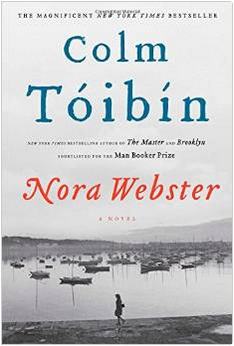
Nora Webster


Day 650: Nora Webster

Cover for Nora WebsterIt took me awhile to place Nora Webster in time. Irish readers may be quicker to identify its setting from some events, but I am not familiar enough with recent Irish history. Finally, I identified the novel as set in the late 60’s and early 70’s. It wasn’t long after gaining that knowledge that I began to wonder how autobiographical the novel is. Since then, I have read that it is indeed autobiographical, as details about Nora’s husband match those of Toíbín’s father.

Nora Webster is in her 40’s a recent widow. She is finding it difficult. Not only does she miss her husband Maurice, but she finds the attention paid to her as a widow painful. She feels comfortable only with a few people, those who stayed with her and Maurice during his painful death.

Making things more difficult is the fact that she is left with little money. One of the first things she is forced to do is sell the holiday cottage where the family stayed every summer. She finds it hard to return there, especially under those circumstances.

She also has her children to worry about, particularly her two young sons. Donal has begun stammering since his father’s death, and when her Aunt Josie comes to call, it is immediately clear to Nora that all did not go well when the boys stayed with Josie while their father was dying.

Soon Nora is forced to return to her old job at Gibney’s, where she has not worked since she married 20 years before. She must report to Mrs. Kavanaugh, a woman she disliked when they were girls at work there together and who bullies the office staff.

There are no big events in this novel, which is more of a character study. It is about grief and the act of making a new life after a major event.

Nora is an interesting character. She doesn’t say much of what she thinks, so is sometimes misunderstood. She does not listen to other people’s opinions of who she should like or what she should do. She is intensely private and does not discuss things with her family, even things that she should perhaps discuss. She is also fiercely protective of her family.

This is a quiet, contemplative book and is not for those who read only for plot.

Related Posts

The Master

The Year of Magical Thinking

The Gathering

Day 609: Good Behaviour

Cover for Good BehaviourMolly Keane was a successful author and playwright in the first half of the 20th century. Although she was known mostly for romantic frolics, Good Behaviour is certainly not in that category. In fact, at the time that she wrote it, it was rejected as being too dark. It was not published until years later, when Keane’s friend Peggy Ashcroft encouraged her to try again.

Good Behaviour is a comedy of manners and a satirical look at the life of a certain type of the Irish upper class. It startlingly begins with a murder, but I’ll leave it to readers to find out who the victim and murderer are.

After the murder, the book returns in time to recount the childhood and upbringing of Aroon St. Charles. But first it oddly shoots off to explain how Mrs. Brock, Aroon’s governess, came to them. It is telling to learn that the proper and kindly Mrs. Brock was “let go” by a friend of St. Charles, notwithstanding a good reference, because she committed the crimes of encouraging one of the boys to read poetry and comforting him after he was whipped by his father. The boy, Richard Massingham, becomes important to Aroon in later years.

Aroon is a large, unattractive girl who is desperate for affection and some acknowledgment of her own importance. She is not stupid, but she sees only what she wants to see and is incredibly naive. Although she loves Mrs. Brock, it is indicative of her character that she nevertheless makes fun of her later in life as a way to fit in with Richard and her brother Hubert. She loves her father, who treats her with casual affection, but expressiveness is considered bad form in their set.

Her relationship with her mother is more complex. Although Aroon steadfastly maintains the fiction that her parents are devoted to each other, it is clear that they are not. Mrs. St. Charles is cold and removed from her family. She has no interests in common with her husband, who spends most of his time pursuing outdoor sports and philandering. Aroon knows that, but does not seem to notice what is going on in her own house.

The events in this novel are largely trivial except for some deaths. The novel is not plot-driven but centers around the behavior of Aroon and her horsey upper-class friends, who maintain their snobbishness despite a consistent lack of funds. We see the irony when Aroon throws away her opportunity to escape her unhappy household through a combination of willful blindness and snobbery. Aroon finds her place eventually and it is a deserved one.

Although we can find some sympathy for Aroon, she is definitely an anti-heroine. If you appreciate a sly, dark, understated humor and a masterly characterization, you should look for a copy of this novel.

Day 582: The Secret Place

Cover for The Secret PlaceDetective Stephen Moran has been stuck on the Cold Case squad ever since he made his move to claim responsibility for a solved case in Tana French’s last book, Broken Harbor. But when Holly Mackey comes to see him, he thinks he’s found his opportunity to join the Murder squad.

A witness in a previous case, Holly is now 16 and attending St. Kilda’s, a private girl’s school where Chris Harper, who attended a nearby boy’s school, was found dead the year before on the grounds. It is so far an unsolved case, and Holly has information about it.

Holly explains that the school has a bulletin board called the Secret Place, where the girls can post anonymous messages. The school thinks this board is preferable to allowing the girls to use a social media site. That morning Holly found a message that said, “I know who killed him.” As she is a cop’s daughter, she removed it carefully with gloves and put it in a plastic bag to bring to Moran.

Moran takes the note to Antoinette Conway, the lead on the Harper case, hoping she’ll allow him to work with her. She has not had a lead in the case for awhile and is eager to follow it up. Once the two detectives begin looking into it, they find their suspects for posting the note and for being the murderer limited to two groups of four girls—one Holly’s group of close friends and the other a bunch of mean girls lead by a girl named Joanne.

Although this is not my favorite of French’s novels, she writes a strong, atmospheric mystery. I believe she is the premier writer of contemporary Irish crime fiction, and her work in many ways reminds me of that of Gillian Flynn. I like that her books are not series, yet they are linked by a minor character in one novel being the major character of another.

http://www.netgalley.comIn The Secret Place, French evokes an eerie atmosphere in the grounds of this posh girl’s school. This novel creates a fascinating psychological portrait of these two groups of teenage girls.

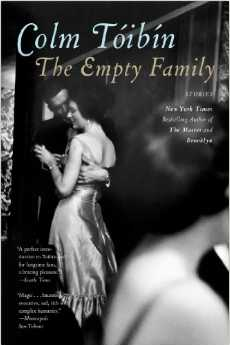
Day 517: The Empty Family

Cover for The Empty FamilyIn this collection of short stories, Colm Toíbín writes empathetically about the human condition. People remember how they have loved, their desire, their loneliness.

In the only historical fiction story, “Silence,” Lady Gregory tells Henry James a tale over dinner. Even though her story is not true, it encapsulates a kind of truth about her relationship with her lover during her marriage to her much older husband.

In “The Empty Family,” a man returns to a seaside village in Ireland after years of absence in California. He meets some old friends and considers his former life in that town and the life he just left.

In my favorite story, “Two Women,” an elderly Irish set dresser remembers her affair with the only man she ever loved. One day on the set where she is working, she meets his widow, the woman who married him after they parted.

In “One Minus One,” a man returns home to be with his dying mother. He is full of regret and longing because she never cared much for him.

These stories are precisely written, sad, and evocative.

Day 512: Troubles

Cover for TroublesBest Book of the Week!
It is the summer of 1919. Major Brendan Archer has just left the hospital after his experiences in the trenches of France. When on leave in 1916, he met Angela Spencer. Although he has no recollection of having asked her to marry him, she has ever since then written him exhaustive letters signed “Your loving fiancée.” Determined to find out if he is engaged, the Major travels to the Majestic, Angela’s family hotel in County Wicklow, Ireland.

Troubles is about the decline of the once powerful Anglo-Irish aristocracy. Nothing symbolizes this decline quite as effectively as the state of the Majestic. Once a grand resort hotel, the Majestic is now the crumbling permanent home for a handful of old ladies who knew it from their heyday.

The Palm Court is so overgrown that it gets more and more difficult to find the chairs. No staff is visible when Archer checks in, and he is finally vaguely shown around by Ripon, Angela’s brother, who urges him to pick a room. When Archer retires, he finds his bed has no sheets, and his investigation of a sickly smell leads to the discovery of a sheep’s head in a pot in his room. Most frustrating, though, is that he can find no opportunity to speak to Angela, who shortly after his arrival shuts herself up in her room.

Major Archer soon finds himself drawn into the activities and personalities of the household. Angela’s father Edward seems unconcerned about the increasing decrepitude of the house. He occupies himself with projects such as raising piglets in the squash court or conducting bizarre experiments in “biological research.” He is most concerned with preventing Ripon from marrying the daughter of a merchant, whom Ripon has made pregnant. Edward’s objection? She is Catholic.

It is the time leading up to the partition of Ireland, with events that 40 years later will result in The Troubles. To Edward’s way of thinking, along with most of his class, those who want independence from Britain are nothing but hooligans. He refuses to recognize that his impoverished and desperate tenants have legitimate grievances.

The growing sense of dissolution both in Ireland and—periodically interjected by newspaper articles—in other parts of the British Empire keeps the novel from being simply a comedy such as Cold Comfort Farm. That, and Farrell’s writing style of cool and precise satire. As poor Major Archer bumbles in a well-meaning way through the political briars and Edward becomes more detached from reality, the Majestic slides perceptibly into ruin.

This is another book from my Classics Club list.

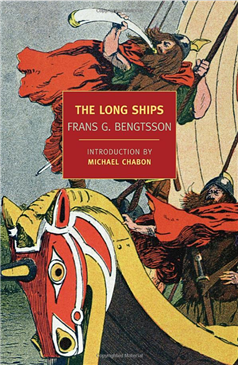
Day 496: My First Classics Club Review! The Long Ships

Cover for The Long ShipsBest Book of the Week!
Today I’m posting my first review for The Classics Club, the one chosen for me by the Classics Club Spin #5!  The Long Ships is a great start to the Classics Club for me. I found it to be a rousing adventure story full of deadpan humor.

This book is the result of Bengtsson’s desire to write a realistic novel about the Vikings. A poet, Bengtsson also wrote essays and a biography of Charles XII, but he became more widely known for The Long Ships.

His protagonist Orm Tostesson is only a boy when the novel begins. Orm is eager to go a-viking to Ireland with his father and older brother, but his mother tends to be protective of him, so he stays home. Shortly after the men leave, he attempts to stop some sheep stealing on the part of a group of Vikings from Lister and is kidnapped by them. The Vikings soon find him an able and intelligent companion, so he becomes part of their crew rather than being kept a slave.

In the course of their adventures down the western coast of Europe, they are initially successful but eventually are captured and sold as galley slaves. In return for a service they performed for a Jew from Córdoba, they are freed to serve as bodyguards for lord Almansur, the regent and imprisoner of the young Caliph of Córdoba. There they serve for years until circumstances force them to flee for home.

This voyage is the first of three related in the novel, during which “Red” Orm meets his bride to be, loses her when his best friend Toke steals her father’s concubine, goes a-viking to England to try to retrieve her from English priests, and many years later travels down the Dnieper to bring back a stash of hidden gold. Even when he is settled at home, he is involved in tiffs with his neighbors, attempts to murder him on the orders of the evil King Sven, visits from unusual acquaintances, rowdy celebrations, and a Thing, a convocation of various groups of Vikings for settling their differences.

There is plenty of action in this novel, but what I find most charming are its air of insouciance and its ongoing (although somewhat grisly) humor. It has a sense of playfulness, especially about the differences between the Norsemen’s old religion, Christianity, and Islam, to which Orm and his fellows are temporarily forced to convert. Take, for example, this passage from the prologue, about the arrival of the shaven men, or priests, in Skania:

They had many strange tales to relate, and at first people were curious and listened to them eagerly, and women found it pleasant to be baptized by these foreigners and to be presented with a white shift. Before long, however, the foreigners began to run short of the shifts, and people wearied of their sermons, finding them tedious and their matter doubtful . . . . So then there was something of a decline in conversions, and the shaven men, who talked incessantly of peace and were above all very violent in their denunciation of the gods, were one by one seized by devout persons and were hung up on sacred ash trees and shot at with arrows, and offered to the birds of Odin.

To give you another idea of the humor in this novel, a Viking tells a story of a wedding that broke up into a fight. When the bride sees the groom’s friends beating up one of her relatives, she hits the groom with a torch, which starts his hair on fire, beginning another fire in which 11 people are killed. Everyone agrees that it was the best wedding they ever attended.

The story of Red Orm is told in a detached manner but by a truly talented storyteller. It is full of sly humor and observations of human folly. I really enjoyed it.

Day 380: Lady Gregory’s Toothbrush

Cover for Lady Gregory's ToothbrushLady Gregory’s Toothbrush is more of a biographical essay than an extensive biography of Lady Gregory, one of the founders with William Butler Yeats of the famous Abbey Theatre in Dublin and a huge figure in the Irish cultural revival of the 1890’s and early 1900’s. The title of the book is based on a comment she made that reflected her own inconsistencies, that is, her firm roots in the Protestant aristocracy against her support for the culture of rural, Catholic Ireland. When Playboy of the Western World was being produced by the Abbey, there was a huge uproar by Catholic nationalists. Lady Gregory remarked that the dispute was between “those who use a toothbrush and those who don’t.”

Tóibín’s sketch effectively shows the contradictions in Gregory’s character. It would be easy to dismiss her as an elitist snob, but Tóibín makes very clear her contributions to Irish theatre and folk lore. She was one of the first people traveling to rural Ireland to collect Irish folk tales before they were forgotten. As well as writing her own plays as part of the movement to encourage and advance Irish culture, she collaborated with Yeats on his without credit, and some of her contemporaries believed she wrote the bulk of one or two.

An interesting detail from Lady Gregory’s life is how this redoubtable woman cossetted and gave in to Yeats. Tóibín recounts her son Robert’s indignation, for example, when he found that his mother had served Yeats “bottle by bottle” the entirety of his prized Tokay handed down to him by his father.

Copper Beech in Coole Park
The copper beech at Coole Park

Tóibín makes very clear the love she had for her husband’s estate, Coole, which she carefully preserved for her son while he was in his minority. There she entertained many of the great talents of Ireland, including Yeats, his brother Jack, J. M. Synge, George Bernard Shaw, and Sean O’Casey. The home no longer stands, Tóibín says it has been covered in concrete, but I myself have seen the great copper beech bearing their initials.

If I have any complaint of this short book, it is at my own ignorance (even though I have done some reading), for my lack of knowledge of the events of this time and particularly of the plays discussed makes it difficult to understand some of Tóibín’s remarks, particularly the furor around some of the plays. Having never read or seen Playboy of the Western World, for example, I don’t understand what was so upsetting (and indeed he implies that a modern audience may not).

Tóibín effectively and elegantly draws a brief but balanced portrait of this complex woman, showing us both her accomplishments and faults. Although I have read some of Yeats’ poems and some of Shaw’s plays, this short work makes me want to do more exploring around these figures in the Irish cultural nationalism movement and their works.

Day 295: The Gathering

Cover for The GatheringA large family in Ireland is gathering together for the wake of their brother, Liam, who drowned. Veronica Hegarty, his sister, travels to London to collect the body and keep vigil with it.

This novel follows her consciousness as she thinks about her relationships with her own husband and the rest of her family and considers why her brother’s life turned out the way it did. She describes Liam as a “terrible messer,” who was an alcoholic and finally put stones into his pockets and walked into the sea.

She also remembers her grandmother Ada, and imagines scenes involving her grandmother’s relationship to Veronica’s grandfather and to another man when she was a young woman. Veronica muses about life growing up in her grandparents’ house and the connection with her brother’s secrets and troubles. She feels guilty that she did not help him and that no one sympathized with him when he was alive.

This novel is angry, heavy, and sometimes repels the reader. By page 55, I felt that the narrator was inordinately concerned with the mechanics of men’s penises. Still, it is an evocative story about a woman’s grief and her struggle to understand her brother.