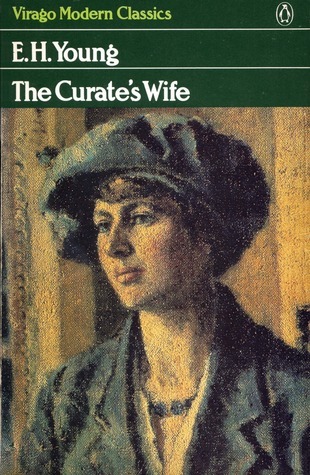
Review 2309: The Curate’s Wife

When I reviewed E. H. Young’s Jenny Wren, I remarked that I preferred Jenny’s sister Dahlia to Jenny. So, I was delighted to find that The Curate’s Wife is about Dahlia (although Jenny’s romantic fate is also involved).

Dahlia has married the curate, Cecil Sproat, on the basis of a friendship in which she feels she can say anything. But very soon, she finds that’s not true when it applies to religion, which has not formed part of her upbringing and which she finds silly. For his part, Cecil is rigid and has been unthinking in his religious beliefs. There is also the problem that Cecil is in love with Dahlia, but the reverse is not true.

Another issue is created by Mrs. Doubleday, the wife of Rector Doubleday, Cecil’s boss. She is an unpleasant woman who already dislikes Cecil and takes a strong dislike to Dahlia. She makes it her business to listen to gossip about the girls’ mother’s inferior social standing and her affair during the war. Their mother foolishly married farmer Thomas Grimshaw at the end of Jenny Wren, hoping that would remove a bar to Jenny’s marriage with Cyril Merriman, but that only made the situation more hopeless. Jenny has gone off to live with Mr. Cumming’s sisters and father and learn about the antique business.

Dahlia begins to feel as if she missed out. After school, she was first isolated on the farm and now is living with a dedicated man doing good works. She has never even been to a party or enjoyed other types of amusements. She begins to fancy herself in love with Simon Tothill, a young man she met at a theater rehearsal.

Just as Dahlia and Cecil are beginning to understand each other, Jenny arrives without warning. She has left the Cummings and expects to live with Dahlia and Cecil. Although Dahlia is happy to see Jenny, she begins to realize just how selfish her sister can be. For his part, Cecil is a little jealous of how close the sisters are.

Dahlia’s problems with Cecil have an interesting parallel in the relationship between the Doubledays. Mr. Doubleday is easy going and tries to avoid trouble but is afraid of his ill-natured wife. Their son is returning after three years of service in Africa, and Mrs. Doubleday wants him all to herself. But she soon makes a mistake in a remark that frees Mr. Doubleday from trying to please her.

This novel takes a complex look at new marriage and the lack of preparation people have for its problems. I didn’t like Jenny any better, but I have been impressed by how far below the surface Young’s novels go.

Related Posts

Jenny Wren

The Misses Mallett

Chatterton Square

Review 2261: Jenny Wren

This novel is called Jenny Wren after its main character, Jenny Randall, but I actually preferred her sister, Dahlia. The two sisters are the daughters of a mismatched couple, beautiful but lower-class Louisa and Randall, who is her social superior. Once her husband got over his infatuation, he criticized her actions and her manners and made himself responsible for their daughters’ education. Both have the right accents and manners, but Jenny cares more about what people think than Dahlia does and is ashamed of her mother, particularly because while their father was away at the war (WWI), Louisa had an affair with Thomas Grimshaw, a local farmer.

Now their father has died, and Louisa has sold the farm and purchased a large house in a fashionable neighborhood in Upper Radstowe to open a boarding house. The Dakins next door are friendly to the girls until they mistake Louisa for the cook. Miss Jewel, who also runs a boarding house, is hostile and on the look out for hints of scandal, such as that suggested by Thomas Grimshaw’s visits every Saturday. Louisa isn’t happy to see him, but she sold him the farm and borrowed money from him to buy the house. He’s hoping she will fail and be forced to marry him.

Jenny has dreams of meeting some young upper-class man and falling in love with him, but she sees the very existence of her mother as a threat to this “future.” She is disposed to like Edwin Cummings, their boarder, but looks down on him as worker in a shop. He is an expert on antique furniture and wants to have his own shop, and she is beginning to be friends with him when she meets the son of the local gentry, Cyril Merriman, and falls in love with him. After a misunderstanding, she lets him believe her name is Jenny Wren and is afraid to tell him who she actually is.

In the meantime, Dahlia goes from making fun of Mr. Sproat, the curate, to beginning to like him. However, the family’s second boarder, Miss Morrison, hopes to marry him.

Louisa, who makes several badly misjudged decisions based on wrong assumptions, invites her sister Sarah to stay with them. Sarah turns out to be an unpleasant woman who wants to take the boarding house over from Louisa. To do that, she decides both girls must leave the house and Louisa must marry Grimshaw, and she sets out to bring these outcomes to pass.

The novel concentrates on Jenny, because she undergoes the most personal growth. I found her to be quite foolish at times, and her attitude to her mother made it hard for me to relate to her, but she grows up in the end.

Related Posts

Chatterton Square

Miss Mole

Four Gardens