Day 440: Sleep, Pale Sister

Cover for Sleep, Pale SisterA gothic novel that involves a haunting and characters in opium-fed delirium? What’s not to like? Unfortunately, there is quite a bit not to like in Sleep, Pale Sister, an early book by Joanne Harris.

In Victorian England, Henry Chester is a twisted, hypocritical man who maintains an upright, righteous reputation in society while justifying to himself his own dark secrets. He is an artist who loves to paint romantic pictures of virginal young women.

Henry has been unable to find a wife who meets his fastidious criteria, but one day he spots a young girl of pale, ethereal beauty in the park. He pays her family to allow him to paint her and eventually decides that, even though she is yet too young to marry, he will raise her to be the wife he wants, someone passive, docile, and asexual.

Unfortunately, he is doomed to eventual disappointment, for when he finally weds her, he finds his young wife, Effie, has married him for love, and her very ardor on their wedding night disgusts him. Soon, she is an ailing wife whom he keeps drugged with opium, and he takes his pleasures elsewhere.

Sitting in church one day, Effie finds she can lift herself out of her body at will and look at those around her from above. Whether this is an effect of the opium is unclear, but in these states she seems to see and hear things that she should not know about.

At an exhibition of Chester’s paintings, Effie meets a rival artist, Mose Harper, who is struck by her beauty. Mose is a total scoundrel who dislikes Henry, so he sets out to seduce Henry’s naive wife. Mose soon finds himself with an unexpectedly passionate lover.

These three characters alternate the narration of the novel, but there is a fourth voice, Fanny Miller, the madam of a whore house who has her reasons for wanting revenge against one of her clients. As soon as she is sure which client it is, she will know what to do.

And I also hinted at a ghost.

Almost everyone in this novel is vile. Effie is the most sympathetic character, but she is too submissive to Henry and too naive about Mose to really capture us. Essentially, she has very little dimension to her character, is too easily bent to the will of another to be very interesting.

The setting in the Victorian era gives Henry almost complete control over Effie’s fate, and he is soon planning a way to rid himself of an inconvenient wife.

Day 189: The Girl with No Shadow

Cover for The Girl with No ShadowI just reviewed Chocolat recently, so I thought I’d continue with a review of The Girl with No Shadow, Joanne Harris’ sequel to that novel.

The wind is blowing trouble toward Vianne Rocher, now running a small chocolatierie in Montmartre in Paris. The trouble is coming in the form of a con woman with many names, whom Vianne will know as Zozie de l’Alba.

Vianne herself has another name. She is going by Yanne Charbonneau because of some problems that developed after the birth of her second daughter, Rosette, now four. Vianne has been doing everything she can to avoid standing out. Anouk is now known as Annie. Gone are the red dresses with bells hanging from the hems. Yanne is demure and nondescript and doesn’t use her magic, even to know what a customer’s favorite chocolate is.

Annie, at eleven, is unhappy with school and with the changes in their lives. Soon more seeds of discontent are sown. As Zozie weasels her way into their lives and prises away their secrets, she decides that when she leaves, she is taking Annie with her. So, she does her best to encourage Annie’s rebellion against her mother.

Again, Harris combines the gentleness and kindness of Vianne’s temperament with a fair amount of suspense. As we learn more about Zozie’s past, we find out just how dangerous and devoid of conscience she is.

As usual the writing is beautiful, sprinkled with the scents and flavors of the chocolatierie and a dash of magic.

Another novel about Vianne and her family is just out, Peaches for Father Francis, so I guess I had better get reading!

Day 182: Chocolat

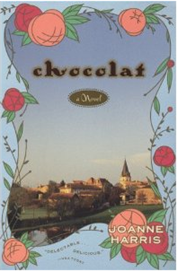
Cover for ChocolatI decided to review Chocolat today because I just started reading The Girl with No Shadow, Joanne Harris’s sequel. Even though I have always enjoyed reading Harris’s books, I didn’t read Chocolat until long after seeing the movie, perhaps because I saw it first. The movie is pleasant enough but anemic and inexplicable, and as I found later, does nothing to convey the magic of the novel.

Vianne Rocher and her six-year-old daughter Anouk blow into the small village of Lansquenet-sous-Tannes with the wind. They are distinctly odd. Vianne wears red skirts with bells on them, and Anouk has an imaginary friend, a rabbit named Pantoufle, that some folks occasionally think they’ve glimpsed.

Vianne opens a chocolate shop, making her own wonderful confections. She seems to have an almost sixth sense about which chocolate will be each person’s favorite, and she creates miraculously inventive window displays for special days. She also begins befriending some of the village’s misfits.

This all sounds very pleasant, but Pére Reynaud, the local priest, hates Vianne on sight. She has opened a chocolate shop during Lent! Right across the street from the church! He begins a campaign to try to force her out of town. When Vianne plans a chocolate festival to celebrate Easter, he believes she is being sacrilegious and vows to ruin the festival.

Vianne herself has lived like a vagabond her entire life and wants to settle down. Her witch mother died on the streets of New York, and she wants her child to have a better life than hers has been.

The novel is colorful and teems with eccentric characters, as well as lovely descriptions of food. It is beautifully written. As I read it, I was able to understand why the book is so beloved.