Review 2281: Who Killed Father Christmas?

British Library Crime Classics’ latest book is another of their holiday mystery collections. This one includes some clever puzzles, some ghost stories, and one truly exciting chase.

“The Christmas Thief” by Frank Howel Evans, published in 1911, features the adventures of two endearing young men, Tommy and Harry, two homeless boys who thwart a gang of thieves.

In “The Christmas Spirit” by Anthony Gilbert from 1952, Sedley busts the ghost of the Green Girl—or does he?

In Patricia Moyes’ “Who Killed Father Christmas?” from 1980, someone murders the substitute Father Christmas in the toy department of a store, and he turns out to have been an undercover policeman. The motive for the murder was fairly obvious, I thought, but not so much identity of the murderer.

In “Death at Christmas” by Glyn Daniel from 1959, a colleague dies of a heart attack after telling Dilwyn Rees he is being haunted by his dead wife. Although his boss thinks an overactive imagination killed him, Rees isn’t so sure.

Another crime in the toy department takes place in “Scotland Yard’s Christmas” by John Dickson Carr from 1957. Detective Inspector Robert Pollard is accompanied by his girlfriend and her nephew, and all I can say is, he’d better not marry her.

Will Scott’s “The Christmas Train” from 1933 features a Simon Templar-ish thief who intends to steal some jewels on the train, even though the owner is accompanied by the police.

“Herlock Sholmes’ Christmas Case” by Peter Todd from 1916 is a spoof of another mystery writer’s detective stories.

“A Present for Two” by Ellis Peters from 1958-9 features a quite exciting kidnapping and chase after someone steals a priceless manuscript from the village museum.

As usual, I enjoyed some of the stories more than others, but this is a fun seasonal read for mystery lovers.

I received this book from the publishers in exchange for a free and fair review.

Related Posts

The Christmas Card Crime and Other Stories

Silent Nights

Murder at the Manor

Review 2256: He Who Whispers

I was going to schedule this review for November, but this novel was at times so exciting and with a plot point so appropriate for the season that I had to move it to October.

Miles Hammond thinks of a meeting of the Murder Club for the first time in five years as another indication that life is returning to normal after the war. He is not a member, but he has been invited by his friend Gideon Fell. However, when he arrives for the meeting, only the speaker, Professor Rigaud, a woman named Barbara Morrell, and himself are there.

The three decide to hold the Murder Club anyway, so Professor Rigaud tells the story of an unsolved French case, in which Howard Brooke was murdered at the top of a tower that no one else had entered. Implicated in the crime but found not guilty was the fiancée of Brooke’s son Harry, Fay Seton. A verdict of suicide was found, but no one could account for a missing briefcase that Brooke took up to the top of the tower.

Miles has recently inherited his uncle’s estate, including an extensive library. The next day he has an appointment to hire a librarian, and to his surprise, the applicant turns out to be Fay Seton. He hires her and they travel to his house in the New Forest.

Miles and Miss Morrell did not hear all of Professor Rigaud’s presentation, because it was interrupted, so Miles does not know that before the murder, a whispering campaign accused Fay of infidelity and vampirism. But during the next night, something terrifies Miles’s sister so much that she is almost scared to death. And Gideon Fell and Professor Rigaud are already on their way there, because the inhabitants are in danger.

This attack on Miles’s sister leads them all to re-examine the original case. How was Howard Brooke murdered when no one else was on the tower? Is Fay Seton a murderer or has her past somehow followed her to the New Forest?

I received this book from the publisher in exchange for a free and fair review.

Related Posts

The Seat of the Scornful

The Lost Gallows

The Black Spectacles

Review 2174: The Black Spectacles

Detective Inspector Andrew Elliot is vacationing in Italy when he overhears an English party discussing some poisonings in a town back home. He is struck at first sight by Marjorie Wills. This proves to be unfortunate, because when he returns home, he is assigned the poisoning case and Marjorie is a suspect.

The poisoning case involves someone substituting poisoned chocolates for harmless ones in a local shop. One boy has died. However, this case is soon overshadowed by the murder of Marcus Chesney, Marjorie’s uncle, under bizarre circumstances. Chesney has a hobby horse that people aren’t observant, so he designs a demonstration of his point. During the demonstration, a bizarrely dressed man comes in to the room where Chesney is manipulating objects at a desk and forces a capsule down his throat. Although this is part of the demonstration, it is not part of it for the capsule to be poisoned. Chesney dies and his assistant is found outside bashed over the head. Later, the unconscious assistant is also poisoned.

Present are Chesney’s friend Dr. Ingram, the assistant, Marjorie, and Marjorie’s fianceé, George Harding, whom she met on the trip. Not present is Dr. Joe Chesney, Marcus’s brother, out on a house call.

As Elliot investigates, things keep pointing to Marjorie, but he can’t prove anything. Finally, he asks Gideon Fell for help.

The Black Spectacles is supposedly Carr’s most popular book, even though it doesn’t feature a locked door mystery, his specialty. I enjoyed it a lot, more than the other books I’ve read by Carr, although I immediately picked out the killer and never wavered. Still, I never figured out exactly what was going on during the demonstration.

I received this book from the publisher in exchange for a free and fair review.

Related Posts

The Seat of the Scornful

The Lost Gallows

Sad Cypress

Review 2061: The Seat of the Scornful

In the first scene of The Seat of the Scornful, we meet Justice Ireton, who really believes that an innocent man cannot be found guilty in his court. He lets a convicted man leave the court thinking he is going to be hanged when the justice intends to sentence him to life, as if that’s not punishment enough.

Later, his daughter Connie comes to see him at his seaside retreat, bringing along her fiancé, Anthony Morrell, a flashy dresser of Italian extraction whom Ireton immediately distrusts. Morrell, once alone with the justice, accepts an offer of £3000 to leave Connie alone.

The next night, the girl at the telephone exchange receives a call asking for help at the justice’s cottage followed by a gunshot. The justice is discovered seated at his desk holding a gun with Morrell’s body on the floor, shot in the head. Ireton claims to have been cooking in the kitchen when he heard a shot and came in to find the body and the gun.

Carr’s ungainly amateur detective, Gideon Fell, works with Inspector Graham to figure out what happened. Early the next morning Morrell’s lawyer explains that Morrell is actually a wealthy man with his own candy company who intended to give Ireton the £3000 as a gift for Connie to teach him a lesson.

Although the actual solution to this murder is very simple, it is followed by a series of fairly unbelievable events. However, I have a much bigger problem, without saying too much, with how Fell wraps up the case. Let’s just say that the victim, who was obviously not a nice guy but wasn’t the creep Ireton thought him, is not regarded at all. The introduction to the British Library edition says that other readers have questioned the book’s ethics. Let me say that I think the ending is extremely classist, that if Morrell had been a different type of person, the ending would have been different. Edwards states that Carr, Agatha Christie, and Anthony Berkeley were all pondering whether any murder is justified. Well, this one isn’t.

I received a copy of this book from the publishers in exchange for a free and fair review.
Related Posts

The Lost Gallows

Jumping Jenny

Murder on the Orient Express

Review 1616: The Lost Gallows

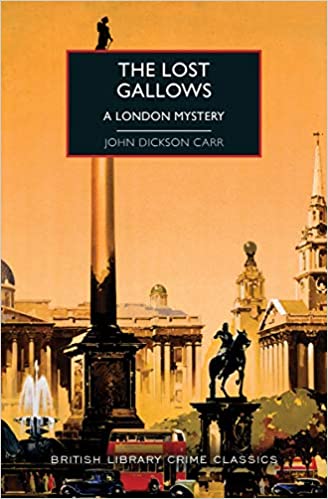
The famous French detective Inspector Bencolin and his friend Jeff Marle are sitting with Bencolin’s friend Sir John Landervorne in the Brimstone Club in London while Bencolin tells a strange tale of a man seeing a gallows in the fog. Upon leaving the room, they find a toy model of a gallows there. Later that evening, Marle encounters a wealthy Egyptian, El Moulk, on the floor of his rooms in the club. He appears terrified.

On the way back from the theater that evening, Marle is nearly run down by El Moulk’s limousine. When he looks into the window, he sees the chauffeur is dead. Returning to the club where the car has stopped, they receive a message saying that El Moulk will die on the gallows at Ruination Street.

The three investigate the case along with Inspector Talbot, trying to rescue El Moulk and locate Ruination Street even though they become convinced that the Egyptian is guilty of a heinous crime for which someone is taking revenge.

Like many Golden Age crime novels, this one is extremely complicated, almost to the point of the ridiculous, as the perpetrator takes a bizarre revenge. However, it is fast-paced and even contains a love interest for Marle. I believe that long ago I read a locked room mystery by Carr. I liked this one a lot better.

I received this book from the publishers in exchange for a free and fair review.

Related Posts

Weekend at Thrackley

Thirteen Guests

Calamity in Kent