
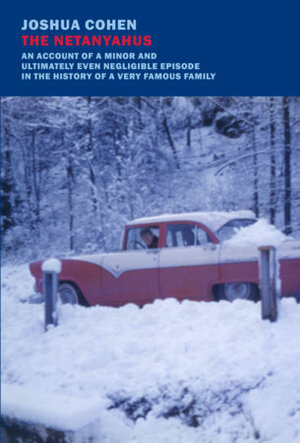
When I realized that the family in this novel was the Netanyahus—I mean, the Netanyahus, as in the prime minister of Israel, I was not looking forward to this book. However, it is part of my Pulitzer Prize project, and in fact won it, although I have never heard anyone talking about it.
Before I start my review, I’m beginning to find the quotes and book blurbs ridiculous, I have to say. Maybe some people actually read the quotes to select a book, but I avoid them then and only sometimes read them later when I am perplexed about a book’s reception. Here are some of the words on the back of this book—“genre-bending,” “exuberant,” “funny beyond belief.”
First, let me address “genre-bending,” which apparently applies to this novel because it combines nonfiction and fiction. Excuse me, but isn’t that what any historical fiction book based on real events does? Isn’t that the definition of historical fiction except perhaps in the case of some light romances or maybe gothic novels?
The novel is set at a small college in upper New York state, where Ruben Blum is the only Jewish faculty member—an American History professor—in 1959-60. Blum is asked to serve on the hiring committee when it interviews Ben-Zion Netanyahu, a scholar of the Spanish Inquisition and its treatment of Jews. Although Netanyahu is living in the U. S., he is from the new nation of Israel. Blum doesn’t know how he’s supposed to judge the applicant’s knowledge since he knows very little about Medieval Europe, and he finally realizes he’s been chosen because he’s Jewish and he is mostly needed to provide hospitality.
For about the first half of the book, there was a lot of standard campus satire. My husband, whose first wife is an academic, always says that politics on campus are so brutal because the stakes are so low. I started wondering where the exuberance lay or when the book was going to become funny beyond belief as it made stereotypical humor out of two holidays with the in-laws, examined the different beliefs Jews have about Zionism, and explained Netanyahu’s beliefs.
I suffered through a ridiculously long, glowing letter of recommendation, which was countered by an even longer letter telling Blum that the reason Israeli scholars were gushing so much about Netanyahu was because they wanted him out of the country. Okay, that was kind of funny, but not funny beyond belief.
Finally, more than halfway through the novel, the Netanyahus show up for the interview and lecture—not just Ben-Zion but all of them: his wife Tzila and his three young sons—Jonathan, Benjamin (yes, him), and Iddo, ages 13, 10, and 7. And their behavior is outrageous. The book picked right up, and I can only assume that the critics who are gushing about it can only remember the second half.
I won’t say what they do—that’s the fun—only that in essence if not in detail, this part is based on a true story told to Cohen by Harold Bloom—although Cohen hastens to assure us that his character Ruben Blum is not meant to be Harold Bloom (right).
All I can say is, tearing things down seems to be more the style of these characters than building them up, and I guess that has continued up to today.
 What? Me Read?