Review 2126: The Flight Portfolio

As soon as I finished reading Julie Orringer’s The Invisible Bridge, I looked to see what else she had written, and that’s how I found The Flight Portfolio. This novel is based on true events with real historical characters except for Elliott Grant and some main invented characters.

It’s 1940, and American journalist Varian Fry is working in Marseille as the head of a charitable organization. Its mission is to help as many European artists, writers, and other intellectuals as it can to leave Europe and escape the Nazis. This mission is supposed to be legal but of course Fry has to use illegal means to evacuate people sought by the Nazis or by the Vichy government. The book begins with him trying to persuade the Chagalls to leave, but they think they are unassailable.

Into the chaos of the office work, including the eviction of the charity, comes a request for a meeting. It is from Varian’s old schoolmate at Harvard, in fact his ex-lover, Elliott Grant, who disappeared when Varian decided to pursue marriage and a normal life. Grant has come to ask Varian’s help in finding the son of his own lover, Professor Gregor Katznelson, a brilliant nuclear physicist who is somewhere in Europe trying to evade the Nazis.

While Varian works hard trying to get exit papers and arrange routes of escape, his relationship with Grant rekindles. He is forced to face his old decision and determine whether he wants to continue hiding his real self. His office faces searches and arrests, closures of escape routes, arrangements made only for clients to refuse to leave, blockages by government officials, and other obstacles.

The novel is riveting. Orringer is not only an excellent writer but a great story teller. I love it when I discover someone who is this good.
Related Posts

The Invisible Bridge

Down Below

Dark Palace

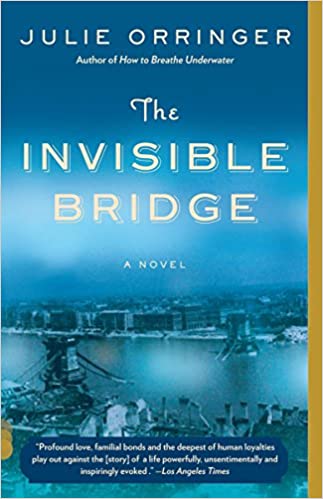
Review 2065: The Invisible Bridge

One of the reasons I learned to love reading was that I got swept up into another time or place or even world. As I got older and more discriminating, this experience happened less often. It happened most recently within a few pages of starting The Invisible Bridge, which I read for my James Tait Black project.

Andras Lévi, a young Hungarian Jew, arrives in Paris in 1937 to study architecture. He has brought with him a letter that an acquaintance asked him to mail once he was in Paris. He mails the letter but notices the address.

Soon he is involved in the technicalities of art school, made more difficult because he almost immediately loses his scholarship, a first act of the anti-Semitisim that is perceptibly increasing, although not as bad in Paris as it was in Budapest. He seeks a job at a theater from Zoltán Novak, a man he met on the train from Hungary. When he begins a friendship there with an older actress, she sends him to lunch with friends at the address on the envelope he mailed, and that’s how he meets Klara, an older woman with whom he falls madly in love.

This novel, which starts out seeming very particular, about a love affair between two people, grows into a novel of great breadth, covering events of World War II, the Hungarian Holocaust, life in work camps, the siege of Budapest. All of it is centered in the importance of family.

I absolutely loved this novel. It is sweeping, wonderfully well written, touching, harrowing. And what a story, based on the lives of Orringer’s grandparents. I can’t recommend this book enough.

Related Posts

Great House

A Town Like Alice

Between the Woods and the Water: On Foot to Constantinople: From the Middle Danube to the Iron Gates