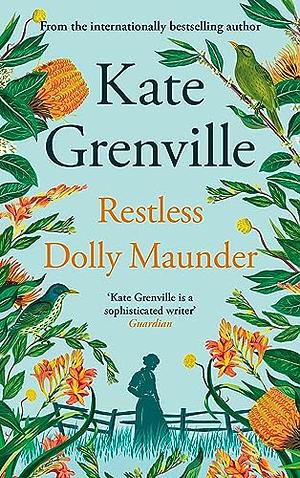
Review 2634: Restless Dolly Maunder

I’ve enjoyed a couple of books by Kate Grenville, but Restless Dolly Maunder seemed different, written in a stripped-down style and very matter of fact. It wasn’t until I got to the end that I realized Grenville was writing about her own grandmother. That explained things to me, because I’ve noticed the tendency in some historical fiction writers to be a little too careful when writing about people who actually lived, afraid to take liberties, maybe (while other have no trouble telling outright lies).

Dolly is born in 1831 to a hard-working farmer and a mother who married down and seems to be disappointed about it. Although Dolly is the baby of the family, she doesn’t feel any particular affection from anyone. She is very intelligent and plans to become a teacher, but her father has been waiting for her to reach the legal age to quit school, 14, as he sees no benefit in educating girls. Soon, she has to face up to the fact that if she doesn’t marry, she’ll be a spinster stuck on her father’s farm all her life.

Twice she thinks she’ll be asked by men she cares about, but she is not because she’s not Catholic in one instance or from a good enough family in the other. She waits a long time, but finally settles on Bert Russell, her only choice, really, a pleasant, outgoing handsome man whom she doesn’t really like, but he’s a hard worker.

Her anger about her lack of options follows her throughout her life, affecting her relationships with other people. It is intensified when she learns a few months after the wedding that Bert had a daughter out of wedlock with her family’s servant girl while he was courting her and that her family had to have known it.

Dolly stays with Bert, but it is her ideas that take the couple off the sheep farm and from one opportunity to another, amassing money as they go. This novel follows her through World War I, the Depression, and World War II.

I liked this novel well enough, but the entire time I was reading it, I felt as if it was the bones of a longer, more satisfying novel. We don’t really get to know any of the characters except Dolly, for example. Once I understood this was about a real person, I realized that Grenville didn’t want to play loose with her family history.

Related Posts

A Room Made of Leaves

The Secret River

Salt Creek

Review 2133: The Secret River

Kate Grenville started out writing a nonfiction account of her great-great-great grandfather’s family, but she ended up with too many questions. So, she fictionalized their story and combined it with what she had read about other Australian pioneers.

William Thornhill grows up in poverty in early 19th century London, but he sees a future for himself when Mr. Middleton, a waterman on the Thames, takes him on as an apprentice. William has grown up with Sal Middleton, his boss’s daughter, and he marries her shortly after he reaches journeyman status. However, things go wrong for Middleton, and William finds his livelihood is much more difficult to earn. Finally, he is caught stealing part of a cargo to support his family.

Although he is sentenced to death for theft, William manages to get his sentence reduced to transportation, and his family is allowed to accompany him. In Australia, although life is primitive, it doesn’t take him long to realize he can make money there and maybe return to England in style. However, when he takes a job ferrying goods from a river where settlers have begun farming, he sees a piece of land he can own by settling on it.

Now begins a conflict, with William realizing he will never return to England and Sal only wanting to return. The conflict is heightened when some of the settlers have clashes with the aboriginal people.

I was certainly engaged by this novel, and I felt that Grenville did a good job of portraying the conflicts with the aborigines. Grenville’s characters are flawed but totally believable. She looks unflinchingly at Australia’s brutal origin story, which is very similar to our own.

Related Posts

A Room Made of Leaves

Salt Creek

Rush Oh!

Review 1852: A Room Made of Leaves

Even from the Editor’s Notes of what purports to be Elizabeth Macarthur’s memoirs, we get a hint of what’s coming—the husband getting the credit for establishing the wool industry in Australia while the wife did all the work. The husband revered as an important founder of the nation when he was actually disliked and hated during his life and was away for many years.

As Elizabeth grows, she loses her family—her beloved father to death, her mother to a second marriage, her grandfather to her own marriage. She learns to hide her real self behind a docile, submissive mask. When she meets Ensign James Macarthur, part of her sees him for who he is, but she is curious and has no prospects, and her curiosity ends in her pregnancy. Her first lesson in her husband’s character comes before marriage—James is more interested in the pursuit than the capture.

James is in fact ferociously ambitious, but his touchiness about his lack of breeding makes him angry enough to work against himself. Elizabeth learns he is vengeful and likes to weave vast conspiracies to advance himself and bring down others. But his judgment is poor.

Posted to Gibraltar, James sees the possibility of a posting at the newly established prison in New South Wales as an opportunity and believes the brochures extolling the new colony. Elizabeth is skeptical, but she handles James poorly and finds herself on her way, again pregnant and with a new baby. However, eventually she discovers opportunity when James finagles 100 acres of Australian land by his manipulations of the governor. She and her two convict servants begin establishing a herd of sheep.

I found this novel vivid and deeply interesting, as Elizabeth learns how to handle her horrible husband and make a satisfying life for herself and her children. The novel evokes the raw early days of the 18th century colony as well as, occasionally, its beauties. I read it for my Walter Scott project and liked it very much.

Related Posts

Salt Creek

Rush Oh!

A Town Like Alice