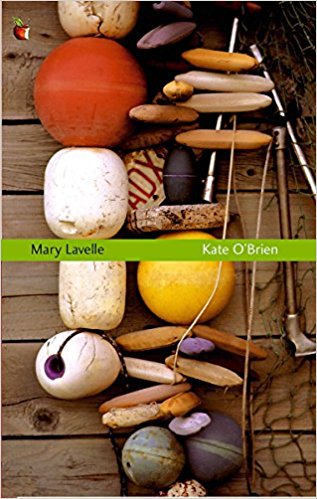
Review 1539: Mary Lavelle

It was interesting to me to learn that Mary Lavelle had been banned in Ireland as an immoral book, for in its own way, it’s very moral. Still, I guess it was shocking for 1936.

Mary is a young Irish woman who is engaged to be married to a kind and worthy young man who must wait to marry her until he can earn enough. His prospects are good, but he is paid a niggardly wage by his miser father.

Almost on a whim and despite her fiancé’s objections, Mary decides to take a governess job for a year in Spain, and the beginning of the novel finds her on the way there by train. Spain is not as she imagined it, but from the first she likes it. The Areavaga family are gracious and kind, and their three daughters soon like Mary very much. She makes some friends within a group of British governesses she meets at the local café, although she is sometimes shocked at their behavior and their airs of superiority toward the Spanish.

Mary is unconsciously beautiful and innocent. She is immediately attractive to Pablo Areavaga, her charges’ father, but he is too principled to show it. Trouble comes, though, with the arrival of Juanito, Areavaga’s married son, for Juanito falls in love with her at first sight.

I have read two books now by O’Brien, and both gave me a sense of a ferocious intelligence. Both are set in Spain, and in both, she examines the conflict between religion, principle, and emotional drives. The descriptions of the scenery and people of Spain are vivid and sometimes lyrical. This is another good book from my Classics Club list.

One comment on my new edition of Virago Modern Classics. Almost as soon as I began reading the book, the last six or eight pages fell out. Thereafter, I was constantly tucking them back in, afraid I was going to lose them.

Related Posts

That Lady

Hot Milk

Alas, Poor Lady

Day 897: That Lady

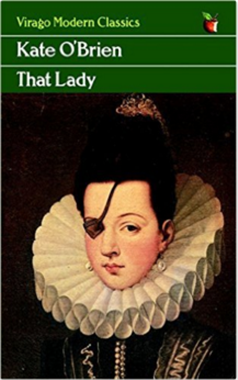
Cover for That LadyThat Lady is another book I’ve read for my Classics Club list, and a good one it is, too. In the Preface to the novel, Kate O’Brien states that it is not a historical novel because, although all of the events are real, the scenes between characters are wholly imagined. But I would argue that this is the very definition of a historical novel, with the proviso that the author attempt to preserve the true nature of the peoples’ characters, if they are known. That Lady is based on a curious interaction between Philip II of Spain and Ana de Mendoza, Princess of Eboli, that historians are still struggling to understand.

The novel begins in 1576, when Ana is a 36-year-old widow. Her husband was Ruy Gomez de Silva, Philip’s secretary of state. But Ruy has been dead for several years, and Ana has been living a retired life with her children on her country estate of Pastrana.

Philip comes to visit, however, and tells her he wishes her to return to Madrid. He and Ana have enjoyed friendship and a mild flirtation, and he misses her company.

Ana does not return to Madrid immediately, but she eventually does in the fall of 1577. There, she becomes reacquainted with Don Antonio Perez, her husband’s former protégé and friend, who is Philip’s current secretary of state.

Although Ana has heretofore been a virtuous woman, she begins an affair with Perez, partially because she realizes she has done nothing of her own volition for years. This relationship eventually becomes a complication in a political battle.

This novel is primarily a character study of a fascinating woman and to a lesser extent of Philip II, whose poor government of Spain has stricken with poverty the inhabitants of what was at the time the wealthiest country in the world. It is also a very interesting study of the politics of the region of Castille.

At first, I found it difficult to grasp Ana’s character, but the novel centers on her strong sense of principle and protection of her privacy. It is also about the tension between her religious beliefs and her principles. That is, having committed herself, she refuses to abandon her lover when he is in trouble, even to save her soul or her life.

That Lady is a powerful novel about an unusual, strong woman who struggles against the restrictions of her life based on sex and station. I highly recommend it. By the way, the picture on the cover above is of a painting of the actual lady.

Related Posts

La Reine Margot

People of the Book

The Marriage Game