Day 587: Harvest

Cover for HarvestBest Book of the Week!
Harvest seems to be concerned with exploring the dark side of human nature. Set in an unspecified time in the past, it focuses on unusual events in a small, remote village.

The villagers are celebrating the harvest. They are so busy drinking and eating that they forget to appoint their harvest queen. Groggily awakening the next morning, they spot two fires. One is green wood burning in the distance, a signal that some new family is establishing itself. The other is the master’s resented dovecote and the stables. Someone has set fire to the dovecote, and the fire has spread.

The novel’s narrator, Walter, noticed three young men return the night before with a load of hallucinogenic mushrooms and a dried puffball. He knows there is no use for the puffball except to spread a fire. Still, he decides to say nothing.

After the fire is out, Walter notices how the men he believes guilty behave over-helpfully to Master Kent and insist that the newcomers must have set it. So, the master and some of the villagers go off to see them.

Walter has injured his hand in the fire, so he stays home. But he soon hears how the villagers caved in the roof of the hovel so that it injured the young woman inside and how the master sentenced her two companions to a week in the stocks.

For some reason I felt dread from the onset of this novel, and this feeling was not wrong. Although the villagers have already started trouble by not confessing their actions, much worse is to come. For kind Master Kent has lost his property through an entailment to his wife’s cousin, a ruthless and cruel young man who is only interested in enclosing the common land and putting it to sheep. Now that he is master, it is up to him to mete out justice when the next incident happens.

Although Walt’s main fault is inaction, he soon finds himself being treated like a stranger again, for he came to the village long ago as a servant to Master Kent. Soon the village he loved is unrecognizable.

This novel is masterfully written, about how greed and ignorance can destroy a community. It is a dark and twisty tale.
Day 581: Reread! A Visit from the Goon Squad

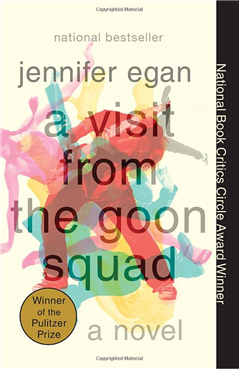
Cover for A Visit from the Goon SquadWhen I first read this quirky book last year, I said I wanted to reread it so that I could pay better attention to the minor characters in each story. I intended this because Egan’s clever technique to tie these stories together is to make a minor character in one story be the primary character in another.

So, this is my second review of this collection, which is really great. If you didn’t run right out and get it after my last review, I urge you to do so now. The stories are hip, aware, funny, and terrifically smart, centering around the music and public relations industries.

The stories in the first half of the book all touch on two characters—Benny Salazar, who is a music business executive when we first encounter him, and Lou, his mentor. The stories move backward and forward in time, so Benny is first at the height of his career but beginning to realize his taste is falling out of fashion. In a later story he is a teenager in a punk band called the Flaming Dildoes. He has several more appearances before making a comeback in his 60’s with a sensational concert starring his old friend Scotty from that first high school band.

Lou is at the height of his powers in one of the earlier stories, when he seduces one of the girls from the Dildoes, Jocelyn. Her friend Rhea watches their behavior in dismay. Later a dying old man, Lou is delighted to receive a visit from Rhea and Jocelyn, together again after years. But Jocelyn fights an urge to push him into the swimming pool as she considers her 30 years of wasted life as a drug addict, started on her way by Lou when she was 17.

The funniest stories skewer the public relations field. Dolly, once the premier public relations agent in New York (and the boss of Benny Salazar’s wife), has given up her career after a disastrous party she planned. Her brilliant idea to suspend translucent pans of colored oil from the ceiling near spotlights so that the oil would move as it heated was ruined when the plastic pans melted, sending hot oil down to burn all the celebrities. She sees an opportunity to revive her career in a job rehabilitating the reputation of a brutal third-world general. Even though this job almost ends in a murder, when her strategy actually works, she is contacted by a slew of dictators and assorted thugs wanting to hire her.

The has-been starlet Dolly used as the general’s “girlfriend” is the focus in her early career of a hilarious vituperative mock PR piece by the journalist who physically attacked her during an interview (Benny Salazar’s troubled brother-in-law). And finally, a short time in the future, Benny Salazar brings together his smash concert by appealing to the tastes of babies (“pointers,” as they are termed by the marketeers) and using the equivalent of likes on Facebook.

I understood a few things better on rereading the book. In an interview, Jennifer Egan said the stories were about pauses. One of them, a delightful Powerpoint presentation written by a preteen girl (the daughter of Benny Salazar’s ex-assistant Sasha, whose story is the first one in the book), talks about her little brother’s fascination with the pauses in rock music. In the book, we revisit the characters at different times in their lives, after pauses when we don’t see them. This approach leads us to consider the events of their life that we don’t see. Finally, there is the title, explained by the remark of a character. “Time is a goon.”


Day 571: The Goldfinch

Cover for The GoldfinchBest Book of the Week!
Theo Decker is hiding in an Amsterdam hotel, ill and terrified. He is afraid to set foot in the street. Through most of The Goldfinch, Theo relates the roots of his troubles, which lie 15 years in the past.

Thirteen-year-old Theo is out in New York City for a day with his mother. Normally, this would be a day he’d enjoy, but he is in trouble at his prep school, and they are on the way to school for a meeting. They are early, though, and his mother wants to stop at the museum to look at an exhibit.

Inside the museum, he spots an unusual couple—a hunch-backed old man and a fairy-like red-haired girl. He is only half attentive to his mother’s explanations of the paintings because he is looking at the girl. They stop to view a painting called The Goldfinch, one of the few remaining works by a Dutch artist named Fabritius.

Theo’s mother goes off to the gift shop while Theo trails after the girl. A few minutes later, Theo is knocked out by an explosion from a terrorist attack. When he comes to, the museum is oddly empty, but he finds the old man dying. The man gives him a ring and tells him to take it to an address, and then he suggests that Theo pick up The Goldfinch from a pile of dust and take it with him. He does, an act that becomes a defining moment of his life.

Assuming that his mother got out okay, Theo goes home, but he soon finds that she was killed. Since his ne’er-do-well father disappeared from their lives, it has been just the two of them for years. Social services ends up taking him to stay with the wealthy family of one of his school friends, the Barbours.

Suffering from grief and untreated post-traumatic stress disorder, Theo tries to hide his insecurity and discomfort. As formal as the Barbour household is, he likes Mrs. Barbour and worries that the family might want him to leave. Eventually, he takes the old man’s ring to the address and meets the man’s partner Hobie and the girl, Pippa, who was badly injured in the explosion. She soon goes away to live with her aunt, but Theo continues to visit Hobie, who is a furniture restorer. And he is always in love with Pippa.

Just after Theo is invited to spend the summer in Maine with the Barbours, his whole life changes again. His father arrives and removes him abruptly from New York to Las Vegas. Theo is left to himself most of the time in a deserted suburb at the edge of the desert. His father at first appears to be well off, but soon it is clear he is living on the edges. Theo befriends another outcast, a Ukranian boy named Boris, and the two begin a slide into drugs and alcohol and the margins of society. Even after he returns to New York and tries to pull his life together, the secret of the painting serves as both a pleasure and a hidden terror.

It seems as if I am giving away a lot, but I have covered only the beginning of this long, involving novel. It explores such themes as the trauma of loss, the yearning for love, and the fragility of happiness and the present. In losing his mother, Theo seems to have lost his moral compass, so that even as he tries to help people, he creates problems for them and himself.

Tartt’s characters are complex and fully realized. Even the villains have facets to their personalities. Although Theo thinks of his father as a scoundrel—and he certainly has few redeeming qualities—Boris points out to him that when Boris was alone with nothing, Theo’s father took him in. An older Theo fears he has too much of his father in him.

The Goldfinch remains a golden, potent symbol throughout the novel. Theo loves the painting and feels that owning it somehow gives him stature. Yet at the same time he is terrified he’ll be found with it. Just as the bird in the picture is shackled, so Theo is captive to the painting.

Throughout the novel Theo disappointed me with his self-destructive tendencies even though he has good intentions. Still, Tartt tells a story that absolutely impels you to keep reading. This is a wonderful job of storytelling.

Day 562: We Are All Completely Beside Ourselves

Cover for We Are Completely Beside OurselvesBest Book of the Week!
Reading Karen Joy Fowler’s fluffy The Jane Austen Book Club made me willing to try a novel that did not sound appealing on the surface. But my experience with Fowler’s previous books in no way prepared me for the profound and moving We Are Completely Beside Ourselves.

Rosemary Cooke starts her story in the middle, when she is at college and has just been arrested for a small release of her inner “monkey girl.” Rosemary has worked hard to hide her past from her new friends at college. The daughter of a behavioral scientist, Rosemary was raised with a chimpanzee Fern as her sister until she was five years old. Then Fern was abruptly removed from the household when Rosemary was away visiting her grandparents. Rosemary’s beloved brother Lowell was angry with the entire family from then on and disappeared completely during his senior year of high school.

Since then, Rosemary’s family has been broken. Her mother had a breakdown from which she never entirely recovered, and her father is remote and alcoholic. Rosemary herself has never felt as if she fits in, after years of being teased by her classmates as the “monkey girl.” Although she seldom stopped talking as a child, now she rarely says anything.  Then Lowell comes to see her, and she has a chance to recover her own history.

Although this novel is written in a light and lively tone, it eventually brought tears to my eyes. It explores such subjects as reconciliation with oneself and others, human relationships and responsibilities toward other species, and the complexities of issues surrounding scientific experiments with animals. It is odd and unusual and incredibly intelligent.

Day 559: Snow Country

Cover for Snow CountryPerhaps I did not spend enough time considering Snow Country, because I kept feeling as if I was missing something. I couldn’t figure out if this problem was cultural or more an issue with the misogyny of the 1950’s, when it was written.

The novel follows the affair of Shimamura, an effete and sophisticated intellectual, with Komako, a simple country girl who during the novel becomes a geisha. Part of my initial problem had to do with understanding the implications of being a geisha. After all my prior reading lead me to believe that a geisha is different and in fact higher in status than a prostitute, I had to read the introduction to understand that in these hot springs villages, at least in the time the novel is set, a geisha was essentially a prostitute.

Nevertheless, when Shimamura meets Komako, she is a geisha in training, so clearly not a prostitute. Shimamura has come down from traveling in the mountains and immediately asks the hotel clerk for a geisha. None are available, so she sends him Komako. Shimamura spends the night talking to Komako but then asks her to send him a geisha. It is clear what he wants, but he seems to think he deserves some kind of credit for “behaving well” with her, whereas I, and Komako as well, understood his request as insulting. I do not think we’re supposed to like Shimamura, and I didn’t.

We know far more about Shimamura than we do about Komako. We first encounter him on a train on the way back to Komako’s village after the affair is already started. He is struck by Yoko, a girl who is tending to a sick man. Throughout, though, he is far more interested in his fantasies around Yoko than in actually getting to know her. The essence of Shimamura’s personality comes clear when we learn that he is an expert on occidental ballet even though he has never seen a ballet performed—and prefers not to.

For her part, Komako throws herself into the affair with Shimamura even though it is clearly doomed. Although Shimamura’s behavior remains consistent and it is clear that he is incapable of love, Komako is erratic. Toward the end of the relationship she says one thing and does another, she arrives roaring drunk, and she seems to have an inexplicable love/hate relationship with Yoko, as Yoko does with her.

Of course, the future for Komako is not bright, and she becomes more dissipated as the novel progresses. Although I feel we are supposed to sympathize with her, I found her exasperating. The love affair seems sterile, and I don’t see the point of it.

But this novel is set in the cold and gray snow country. Although part of the affair takes place in other seasons, the most important scenes are in the beginning of winter, and the affair ends in the fall. A sense of isolation permeates the novel.

The writing is beautifully spare, as Kawabata is a poet. I feel it is dense in meaning, but if so, I probably missed a lot of it.

Day 548: The Good Lord Bird

Cover for The Good Lord BirdBest Book of the Week!
Henry “Onion” Shackleford is a boy working with his father in a barber shop when John Brown and his followers ride into town. He relates his story many years later when he is more than 100 years old.

Henry and his father are African-American slaves living in the Kansas Territory near Laurence, a hotbed during the Border Wars, referred to as Bleeding Kansas. Brown has come to help the Free Staters, those who want Kansas to be free of slavery. But Brown’s ultimate goal is to rid the country of slavery, and he doesn’t care how he does it. In the resulting fight, Henry’s father is killed, and Brown “frees” Henry by kidnapping him.

Because, as Henry points out several times in his narrative, John Brown sees only what he wants to see, he mistakes Henry in his potato sack clothing for a girl. From then on, Henry is a girl as far as Brown’s followers are concerned, and Brown calls him Onion.

What follows is an an account of the deeds of John Brown, leading up to the assault on Harper’s Ferry. This tale is often cynical or ironic, boundlessly energetic, irreverent, and funny as well as touching. Brown is depicted as a sort of half-crazed, raggedy zealot, who is capable of stopping midway across a stream while being pursued by his enemies to pray for half an hour. Only his son Owen is brave enough to interrupt him and try to get him on his way.

Onion and other slaves they encounter are reluctant to be freed, afraid they’re going to end up in hotter water than they started. They have some cause. Onion, in fact, is almost always planning how he’ll escape the group and does so several times. But he always ends up back with Brown. His adventures lead him to residence in a whorehouse, a visit with Frederick Douglass (who gets drunk and tries to seduce “Henrietta”), and a more impressive meeting with Harriet Tubman in Canada. All the while, Brown attempts to “hive the Negroes” to revolt at the appropriate time.

The wonder is that with all this poking fun, McBride somehow manages to make us care deeply for John Brown and to honor his place as a trigger for the Civil War. This is an unusual novel—highly entertaining yet also deeply serious.

Day 539: The Hours

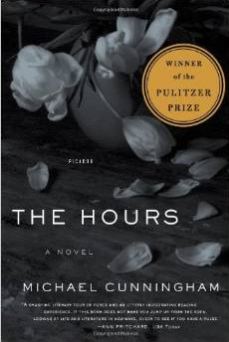
Cover for The HoursBest Book of the Week!
One of our Pandora channels repeatedly plays Philip Glass’s music from the movie soundtrack of The Hours. So, as soon as I began reading it, the intricate notes of the score became a mental accompaniment to the novel. That is, I got an ear worm.

I came to the novel with the slight disadvantage of being unfamiliar with Mrs. Dalloway, having been traumatized by To the Lighthouse in a college English class. But you don’t have to be familiar with it to appreciate this lovely, cleverly constructed novel, an homage to Woolf’s own.

The novel begins with Virginia Woolf’s suicide. But later it returns to 20 years before, when she is writing Mrs. Dalloway.

First, though, we meet a middle-aged woman, Clarissa Vaughn, whose best friend calls her Mrs. Dalloway. Like her namesake, Clarissa is eagerly going out into a crisp, clear morning to buy flowers for her party. This is New York, though, in the late 1990’s, and Clarissa’s party is for her dearest friend Richard, a poet who is dying of AIDS. He has recently been chosen to receive a prestigious prize for poetry, and the ceremony is that night.

Back in 1920’s Richmond, England, Virginia Woolf is trying to decide the plot of Mrs. Dalloway. Someone will die, she thinks, but will it be Mrs. Dalloway herself? Woolf also copes with her own fears about her mental state, her yearning to return to living in London, and a visit from her sister Vanessa Bell.

In 1950’s Los Angeles, Laura Brown struggles with being a suburban housewife and mother. Although she loves her husband and small son, she feels unsuited to this life.

Cunningham presents us with three stories, and a theme of threes recurs. Woolf has bouts of mental illness, Richard suffers from dementia caused by his illness, and Laura is struggling with depression. The jellyfish shapes and voices of Woolf’s migraine visions appear in Richard’s episodes of dementia. And Laura briefly sees a grayish jellyfish cloud floating over her son’s head. A forbidden kiss and the color mustard feature in more than one story. And other links that I will not name are more intrinsic to the plot. The three stories are so cleverly interwoven, we’re not sure if the events of one cause the events of the other.

This is a novel of astonishing beauty, cleverly constructed and entertaining. I’m going to find a copy of Mrs. Dalloway.

Day 535: The Known World

Cover for The Known WorldBest Book of the Week!
I found The Known World disorienting for some time. I think this was because the standard blurb describes it as being about Henry Townsend, an African-American owner of slaves who is mentored by his white owner. The novel starts with Henry Townsend’s death, and I kept waiting for it to circle back around and cover his history. But it’s not so much about him as about the world around him. Once I settled in to the world Jones creates, I began to appreciate the novel.

Henry Townsend’s act of becoming a slave owner is so shocking to his parents that they refuse to stay in the house he built with his slave, Moses. His parents, Augustus and Mildred Townsend, worked hard to buy themselves and their son free. Augustus at one point muses that he may have made a mistake in buying Mildred first, leaving Henry too long under the influence of William Robbins, his white master and the richest man in the county. We actually don’t see much mentoring going on between Robbins and Henry, except when Robbins chides Henry for rough-housing with his new slave Moses.

Jones’ focus is on a larger story than that of one man. His story is about the life on Henry Townsend’s plantation and in the county and how it is affected by slavery—particularly by the decision of African-Americans to own slaves.

At first, I found it difficult to keep all the characters straight—or even the timeframe—for Jones has a habit of fixing on a character for a brief moment and telling about that character’s entire life. He also interjects facts and census details about Manchester County. These details are so convincing that he had me believing it was a real place. It is not.

This nonlinear narrative means we don’t fully know any one character. Henry himself is one of the biggest enigmas, and we see more of his slave Moses than we do of Henry himself. Certainly, a handful of characters are more important than others, but that handful keeps changing. Still, some threads of the people’s stories are captivating, and even surprising. Does Augustus, kidnapped by unscrupulous slave dealers when he is returning from a job, ever see his home again? Did Moses actually murder his wife Priscilla in hopes of marrying Henry’s widow?

If I had to state briefly the theme of this unusual novel, I would say that slavery corrupts. Characters who start out with good intentions do despicable things because they have absolute power over other people. When we see the effect of the “institution” of slavery on people, especially upon Henry’s blameless parents, it is sometimes shocking.

There are true villains in this novel but no heroes. Some of the characters are doing the best they can; others are not.

Day 522: Véra (Mrs. Vladimir Nabokov)

Cover for VeraBefore I start on my review of Véra, I just wanted to comment on the death of Mary Stewart, which I just heard about. I have been reading and re-reading Mary Stewart’s books since I was a young girl. Not only did she write some of the best romantic suspense stories ever, but she also wrote a much-praised historical-fantasy series about Merlin. Her works were well grounded in their settings and beautifully evoked places (some of which we will never see again, such as 60’s Damascus and Beirut). To my surprise, my post about her book This Rough Magic continues to be one of the most visited on my site. We are going to miss Mary Stewart. I have re-read Stewart’s books so many times that I can write reviews of them from memory. I’ll post another one soon.

***

I’ve read two biographies now by Stacy Schiff, and both of them are about elusive women. Cleopatra was elusive because most of the information about her life is available only from prejudiced sources. Véra Evseevna Nabokov was elusive because she wanted to be.

Véra considered Nabokov to be a genius and his work to be of sole importance. She never publicly acknowledged her own contribution to it. Even the subtitle of this biography reflects the way she presented herself, always as Mrs. Vladimir Nabokov.

I don’t know a lot about Nabokov. I have read only one of his books, Lolita, but I found it astounding. Despite my dislike of the subject matter, reading it was an amazing experience, and I found the use of language astonishingly beautiful. But you do not need to be familiar with Nabokov’s oeuvre to find this biography, which won the Pulitzer, fascinating.

The Nabokovs had a truly collaborative relationship even though they never publicly acknowledged it. Although Véra denied helping him write, he often called her his first reader. Visitors heard her tell him to reword phrases or even remark, “You can’t say that!” For years, she typed up his manuscripts from his note cards or his dictation. She oversaw the translations of his work into different languages, even laboriously correcting them in the several languages she spoke. She was exacting about the use of words. She took care of all Nabokov’s correspondence, even to friends and family, as well as his business and financial affairs. She was the gatekeeper for interviews and visitors. She also drove him everywhere (and carried the luggage). Her entire married life was dedicated to providing him time and peace to write.

In areas even more directly affecting the success of his literary career, it was at Véra’s suggestion that Nabokov begin to write fiction in addition to poetry. Once the Nabokovs emigrated to America, Véra convinced Vladimir to begin writing in English. She pulled the manuscript of Lolita out of the fire on three different occasions, and it became his most famous work. Students taking his classes at Cornell were bemused by his “assistant,” who provided quotations or page references just when he needed them, drew complex diagrams on the blackboard, and erased it after class. Véra also taught his literature and language classes for him on many occasions and was acknowledged as a better, more systematic Russian language teacher than her husband.

Véra never seemed to resent this role she had taken on; she fostered it. But she was in no sense a nonentity. In correspondence she was much more direct than her husband. Although they tended to share correspondence—he would start a letter, perhaps; she would finish it; he would sign it—she was always left to impart the hard news—the refusal of contracts, the dictation of terms, the correction of translations. Many people believed that she was a dragon who was screening Nabokov’s mail or keeping people away from him, but she was doing what he wanted.

The couple was seldom seen apart. Although Nabokov had an affair early in their marriage and liked to flirt with women, he dedicated almost all his books to Véra. They had an extraordinary marriage, and this is an extraordinary, surprisingly entertaining book.

Day 512: Troubles

Cover for TroublesBest Book of the Week!
It is the summer of 1919. Major Brendan Archer has just left the hospital after his experiences in the trenches of France. When on leave in 1916, he met Angela Spencer. Although he has no recollection of having asked her to marry him, she has ever since then written him exhaustive letters signed “Your loving fiancée.” Determined to find out if he is engaged, the Major travels to the Majestic, Angela’s family hotel in County Wicklow, Ireland.

Troubles is about the decline of the once powerful Anglo-Irish aristocracy. Nothing symbolizes this decline quite as effectively as the state of the Majestic. Once a grand resort hotel, the Majestic is now the crumbling permanent home for a handful of old ladies who knew it from their heyday.

The Palm Court is so overgrown that it gets more and more difficult to find the chairs. No staff is visible when Archer checks in, and he is finally vaguely shown around by Ripon, Angela’s brother, who urges him to pick a room. When Archer retires, he finds his bed has no sheets, and his investigation of a sickly smell leads to the discovery of a sheep’s head in a pot in his room. Most frustrating, though, is that he can find no opportunity to speak to Angela, who shortly after his arrival shuts herself up in her room.

Major Archer soon finds himself drawn into the activities and personalities of the household. Angela’s father Edward seems unconcerned about the increasing decrepitude of the house. He occupies himself with projects such as raising piglets in the squash court or conducting bizarre experiments in “biological research.” He is most concerned with preventing Ripon from marrying the daughter of a merchant, whom Ripon has made pregnant. Edward’s objection? She is Catholic.

It is the time leading up to the partition of Ireland, with events that 40 years later will result in The Troubles. To Edward’s way of thinking, along with most of his class, those who want independence from Britain are nothing but hooligans. He refuses to recognize that his impoverished and desperate tenants have legitimate grievances.

The growing sense of dissolution both in Ireland and—periodically interjected by newspaper articles—in other parts of the British Empire keeps the novel from being simply a comedy such as Cold Comfort Farm. That, and Farrell’s writing style of cool and precise satire. As poor Major Archer bumbles in a well-meaning way through the political briars and Edward becomes more detached from reality, the Majestic slides perceptibly into ruin.

This is another book from my Classics Club list.