Day 391: Brother of the More Famous Jack

Cover for Brother of the More Famous JackBest Book of the Week!

It seems as if many American readers are not familiar with the British writer Barbara Trapido. She is one of my favorites and yet I sometimes find her books hard to come by. I think she is absolutely delightful. Brother of the More Famous Jack is her first book, but I have not run across it until now, when I explicitly searched for it.

Katherine Browne is a naive but stylish eighteen in the early 1970’s when she meets the family of her philosophy teacher, Jacob Goldman. She immediately falls in love with their untidy, chaotic household and their witty brilliance, but particularly with their oldest son, Roger. Jane is the dowdy, schoolmarmish, upper-crust wife and mother, who plays gorgeous duets with Roger and tends cabbages. Jacob is witty, sometimes vulgar, and subversive. He flagrantly fondles his wife over the kitchen sink. The beautiful Roger is studying to be a mathematician. Jonathan has large feet, loves to fish, and is somewhat gauche. Katherine finds him a bit alarming. And there are the littler ones, bright and noisy. Everyone speaks his or her mind without fear. To Katherine, brought up quietly by a middle-class, widowed mother, this is a heady environment.

After a summer in Kenya, Roger returns to begin at Oxford and immediately starts seeing Katherine. Their affair does not end well, however, for Roger has embraced the snobbery that the rest of his family disdains. When he drops her, he catalogues all her “faults,” including her lack of interest in math and science and her middle-class background. Katherine’s self-esteem plummets and she flees to take a position teaching English in Rome.

She does not return to England until, after ten years, a tragedy brings her home to her mother. Eventually she begins a renewed acquaintance with the Goldmans.

Written in a humorous, breezy style, the novel is still touching and affecting. The dialogue is the best part of it, vivid, witty, and literate. (The title of the novel is Jacob’s appellation for W. B. Yeats.) Katherine is an engaging heroine as she learns to find her own way through life. Full of high spirits and eminently readable, this novel is a gem.

Day 351: The Fixer

Cover for The FixerBest Book of the Week!

In 1911 Russia, Yakov Bok is tired of his difficult life in the shtetl. So, after his wife leaves him for another man, Yakov travels to Kiev in hopes of making a better living. When he helps a drunken man who is passed out in the snow, Yakov is offered a job supervising a brick yard. However, in order to take this job, Yakov must live in a part of the city forbidden to Jews.

It is this circumstance followed by a series of mishaps that ends up with Yakov being accused of murdering a boy he chased away from the brick yard. As the case continues, it becomes clear that the murder is being used by authorities an an excuse to trump up charges of ritual murder against the Jewish community.

The novel becomes more and more difficult to read as literally everything that happens to Yakov makes things worse for him. The gentiles he knows in Kiev tell lies about him. Once he is in prison, the jailers do everything they can to incriminate him, including trying to entrap him into breaking the rules or admitting his guilt.

Yakov goes into jail a nonpolitical, irreligious, naive man who hopes for justice, and the novel is partially about his development into an angry man who refuses to be beaten. Although almost nothing in the way of plot or action happens from the time he goes to jail, I was absolutely compelled to finish reading.

Written in a storytelling fashion that I associate with the tales of Sholem Aleichem or Isaac Bashevis Singer, this novel is more grim than most of the stories I’ve read by these other writers. However, both The Fixer and The Bloody Hoax, by Aleichem, are based on a true event from 1911 Kiev, called the Beiliss blood libel case.

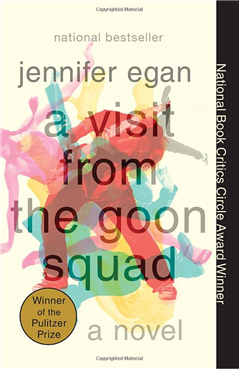
Day 339: A Visit from the Goon Squad

Cover for A Visit from the Goon SquadBest Book of the Week!

Describing this delightful and quirky novel is going to be difficult, so I hope curious readers will try it even if I am unable to convey a sense of it.

First, I call it a novel, but it can be just as accurately described as linked short stories. Each chapter is written from the point of view of a different character who knows one or more of the other characters. The chapters all center around the subjects of music and public relations.

The book begins in New York with Sasha, who is the assistant to Bennie, a music executive, sometime after 9/11. She is on a desultory date with Alex, but she also has a problem with kleptomania. While in the bathroom, she steals a woman’s wallet and then has to watch while Alex gets involved in helping the woman.

Next is a middle-aged Bennie, who torments himself with feelings of shame about past experiences. He takes his son to visit a sister act in order to fire them for not producing an album in the specified amount of time. He realizes he is beginning to see his legendary taste diverge from that of his younger coworkers.

Then we jump back thirty years to Rhea, a teenager in San Francisco who is a member of a punk rock band called the Flaming Dildoes with her friends Bennie (yes, the same Bennie), Scott, Alison, and Jocelyn. Rhea observes Jocelyn’s budding relationship with a middle-aged record executive named Lou, who will become Bennie’s mentor. Rhea is dismayed as Lou gives Jocelyn drugs and gets her to perform sexual acts in public.

These are just the first of the vignettes, which range forward and backward in time over 40 years and extend in structure to a touching PowerPoint presentation and a parody of a celebrity interview. They make stops in Arizona, Italy, and South America but somehow center on New York. Fans of Egan will already be familiar with a certain type of hip, aware New Yorker that appears in her fiction.

By turns funny, touching, and sharp as a razor, Egan’s observations are always entertaining and her intelligence apparent. An obvious theme of this work is the effect of time on characters but another one is how technology seems to have sped time up, the book ending in a futuristic world where public relations is centered on the tastes of babies. The PowerPoint chapter shows us that another theme is pauses, in music and in life.

One of the things I wanted to do when I finished reading A Visit from the Goon Squad was to read it again so that I could know what I was looking for from the beginning and fully understand all the connections. And that is what I plan to do, having inserted the book into my pile of future reading to enjoy again.

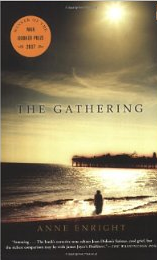
Day 295: The Gathering

Cover for The GatheringA large family in Ireland is gathering together for the wake of their brother, Liam, who drowned. Veronica Hegarty, his sister, travels to London to collect the body and keep vigil with it.

This novel follows her consciousness as she thinks about her relationships with her own husband and the rest of her family and considers why her brother’s life turned out the way it did. She describes Liam as a “terrible messer,” who was an alcoholic and finally put stones into his pockets and walked into the sea.

She also remembers her grandmother Ada, and imagines scenes involving her grandmother’s relationship to Veronica’s grandfather and to another man when she was a young woman. Veronica muses about life growing up in her grandparents’ house and the connection with her brother’s secrets and troubles. She feels guilty that she did not help him and that no one sympathized with him when he was alive.

This novel is angry, heavy, and sometimes repels the reader. By page 55, I felt that the narrator was inordinately concerned with the mechanics of men’s penises. Still, it is an evocative story about a woman’s grief and her struggle to understand her brother.

Day 281: Gilead

Cover for GileadBest Book of the Week!
Gilead is the novel that precedes Marilynne Robinson’s Home, although it is set in the same time frame and covers some of the same territory. This novel won the Pulitzer Prize for fiction.

John Ames is an elderly Congregationalist minister in 1956 who believes he is dying. He has a much younger wife and young son, a surprising blessing in his old age. The novel is in the form of a diary addressed to his son in the expectation that he will not live long enough to personally pass on his family history and advice.

Ames lives in Gilead, a small Iowa town on the prairie near the border with Kansas. The town was founded by abolitionists during the Free State wars in Kansas as a refuge for slaves and fighters the likes of John Brown. Ames’ grandfather, also a minister of the warrior-for-God ilk, had visions of God and once preached a sermon in a bloody shirt with a gun in his belt. With that upbringing, his son was naturally a pacifist, who left the church for awhile after that sermon to worship with the Quakers. One of Ames’ most powerful memories is of the journey he made with his father to Kansas, in terrible conditions, to retrieve the body of his grandfather, who had returned there.

Although Gilead is certainly about the history of the town–the wars, the Depression, the Dust Bowl years–it is more about the relationship between fathers and sons, both from the secular and religious points of view. Not only does it explore the relationships within Ames’ own family, but it also looks at that between Ames and the son of his best friend the Presbyterian minister–Ames’ surrogate son–John Ames Boughton.

The story of John Ames Boughton is the one more thoroughly explored in the sequel Home, although interestingly enough, Gilead tells Boughton’s story more explicitly, while Home, narrated by Boughton’s sister Glory, only hints at some of the facts.

The novel, a celebration of life and faith, is beautifully written and full of ideas to ponder. That being said, as I do not particularly have a religious background or bent, I did not fully understand some of the narrator’s ideas and preoccupations. I found Home, although told from the point of view of the same goodness and piety, a more accessible novel than Gilead.

Day 257: Galore

Cover for GaloreA whale comes ashore at the remote coastal town of Paradise Deep, Newfoundland, in the early 19th century. The people, who have been starving all winter, come out to scavenge what they can of the meat. When Devine’s Widow, an old Irish “wise woman,” cuts open the belly of the whale, a man falls out, pale as an albino, mute, but still alive. Although he stinks like a fish, the Devine clan gives him room in a shed and calls him Judah. Nevertheless, he is treated with dread and superstition until he goes out fishing one day with Colum Devine and they take a huge load of fish in waters that have been barren that season.

The Devines have been at odds with the powerful King-Me Sellers since he proposed marriage to a young Irish bondswoman years ago and she refused him rudely, then went off to marry Devine, practically the first young man she met. Their relationship was not improved years later when King-Me’s daughter Lizzy married Colum Devine.

When King-Me’s spite turns against Judah, the only way the Devines can save him is by marrying him to Mary Trephyna Devine, Colum and Lizzy’s daughter and King-Me’s granddaughter.

Michael Crummey’s multigenerational novel captures the relationships between these two families along with the history of the town, with all its eccentric characters, ghost stories, myths, and tall tales. The novel is fascinating, unusual, and beautifully written. I don’t usually enjoy magical realism, but in this novel it is handled so well that I accepted it and was engrossed in the story. Galore is probably unlike any novel you are going to read, although in its focus on a sea-going people and its occasional feel of a sea tale, it reminds me a bit of We, the Drowned  by Carsten Jensen.

Day 233: The Moviegoer

Cover for The MoviegoerWalker Percy’s classic novel The Moviegoer is a novel about alienation. Binx Bolling is an idle young man living in New Orleans during the late 1950’s. His experiences in the Korean War seem to have cast him adrift, or perhaps he has always been adrift. He spends his time chasing women and going to the movies. He cares for his cultured and prominent family, yet he seems strangely indifferent to them at the same time. He claims to be on a search, but it is not clear what he is searching for–perhaps a purpose, but his search is strangely aimless. Although he has a job as a stockbroker, he doesn’t devote much time or attention to it.

Kate, his cousin, is mentally ill in an undefined way. She and Binx seem to understand each other, and he genuinely cares what happens to her. From drifting for quite awhile in the same waters, the story finally moves forward when Kate insists on coming with Binx to attend a convention in Chicago, where he has an important work assignment.

New Orleans features as a colorful setting, but in some ways the city’s possibilities are neglected. Some of the most interesting scenes are set in a small house over a bayou, where Binx goes to visit his mother and younger siblings.

This is an existentialist novel that is supposedly heavily influenced by the writings of Søren Kierkegaard. Although Jack Kerouac’s On the Road reflects the alienation experienced by some young men following World War II, The Moviegoer shows that this alienation was still felt by young men following the Korean War, ten years later. Essentially, these two novels examine the same themes, only Binx’s explorations are followed in more socially acceptable ways.

I have to admit that these themes don’t personally strike any chords with me. For most of the novel I wasn’t that interested in Binx’s search or in the things that he finds interesting. However, I liked the ending of the book, when he finally accepts responsibility for something.

Day 214: The Sense of an Ending

Cover for The Sense of an EndingBest Book of the Week!

The Sense of an Ending is a quiet novel that made me stop and consider. It is a meditation on memory–how we reinterpret past events. It is also about the lost opportunities of life.

Tony Webster begins the novel by considering his past, particularly his relationships with his pals from school. He and two other close friends chose to enlarge their circle to include a new boy, Adrian Finn, who was extremely intelligent and analytical. Adrian’s indifference to seeming cool made him very cool indeed. The four friends remained close throughout college and for awhile after, until Adrian committed suicide.

Tony also remembers his first serious relationship, with Veronica Ford, particularly an unpleasant weekend he spent with Veronica’s family. After they broke up, Adrian went on to date Veronica. He wrote Tony a letter apprising him of this as if he were asking permission to date her, and Tony’s recollection is that he ironically assented.

Tony has lead a comfortable life avoiding too much effort in his relationships. He sees himself as a “peaceable man.” He believes he understands the events from the past until he receives a legacy from Sarah Ford, Veronica’s mother–the only member of her family who seemed sympathetic during that long-ago visit. In addition to a small bequest, she has left him Adrian’s diary. This legacy confuses him. Why would a person he only met once leave him anything, and why would she possess Adrian’s diary? When Tony asks for it, he finds that Veronica has taken it.

In Tony’s attempts to gain the diary and his subsequent inquiries, he learns things that force him to re-examine and reinterpret his memories of long ago events and to reconsider the consequences of his own actions. He ends up also contemplating where his own life has gone and how he has evolved into this “peaceable man” from a boy full of curiosity and promise.

This very short novel is crammed with thoughtful observations, often wittily and wryly expressed. I found myself turning back to re-read and reconsider certain passages, which is something I seldom do. Sparely and beautifully written, the novel is an excellent illustration of the use of an unreliable narrator.

Day 200: Stranger in a Strange Land

Cover for Stranger in a Strange LandDay 200 for the blog!

First, let me preface this review of Robart A. Heinlein’s Stranger in a Strange Land by saying that I know this is a cult classic and my review may offend some die-hard Heinlein fans, if I have any readers who are die-hard Heinlein fans. So, let that be your warning.

The first sentence in my notes is “What an overrated book.” I read this novel long, long ago, and I vaguely remember thinking the first part was interesting but disliking the second part. Other than the barest outlines of the plot, that’s all I remembered. This time through, I liked the first part less and hated the second part.

Valentine Michael (Mike) Smith is the only survivor of the first manned mission to Mars. He was born on the mission to two of the astronauts and raised by Martians. Since that mission disappeared without a trace, no one knew he existed, so he is only discovered when a second mission goes to Mars. He is brought back as a young man, and political shenanigans ensue, especially when he turns out to be heir to a fortune. Besides these plot elements, the first portion of the novel deals, sometimes cleverly, with his adjustment to life on Earth. In the second part of the novel, he decides to start his own religion, which practices free love and teaches the psychic abilities he learned from the Martians.

The novel does not translate very well to the 21st century because of its blatant sexism and use of slang that I suspect was out of date when the book was published. The sexism is ironic in a way, because I believe that Heinlein would have thought his book was sexually liberating. Frankly, though, I don’t think that patting your female employees on the butt was considered liberated even in the early 1960’s.

Another criticism is that Heinlein appears to have no coherent vision of what a future world would be like. The novel reads as if he came up with a few ideas that he thought would be cool and interesting but not as if he sat down and imagined what fundamental changes might have taken place. For example, carpets are made of real grass, but he lacks the imagination to figure out that computers wouldn’t always need punch cards and we might not be using typewriters forever. As far as futuristic prescience is concerned, I would give a better grade to Jules Verne. My final point in this regard is that for a science fiction writer, he seems to know very little about science, and I mean the science that was known in his own time.

I think I could bear with these things because I generally have a rule not to judge a book on standards that are not of its own time. But the worst feature of the book for me was the hundreds of pontificating speeches made by Jubal Harshaw, a crusty author who I’m sure is meant to be Heinlein himself. Despite being presented in a conversation style, the speeches are pompous and pedantic and go on for pages and pages. Heinlein seems to be very proud of the ideas expressed and of the world Mike creates with his religion, but I think the environment in his church would give most people the creeps.

I made a good faith effort to finish the book, but I finally gave up less than 50 pages from the end. And if anyone says “grok” to me ever again, I’ll scream.

Day 192: Home

Cover for HomeBest Book of the Week!

The beautifully written, subtle novel Home by Marilynne Robinson makes me thoughtful. It is 1957. After a failed ten-year engagement, thirty-eight-year-old Glory Boughton has moved home to Gilead, Iowa, to care for her elderly father, a retired Presbyterian minister.

Her father has been waiting 20 years for the return of his best-loved son, Jack. Finally, they hear that Jack is coming home. Always unreliable and setting himself apart from the family, he arrives late, and Glory feels ambivalent about his return. Soon, though, she sees that he is tired and having difficulty being there, and she tries to help him.

The novel carefully explores the relationships between the three of them–Glory loving but distrustful of the pain Jack has caused and protective of her father, Jack trying to make a new life in painful and distressed conditions, and their father forgiving and unforgiving at the same time. In the background are the events of the civil rights movement, toward which Jack and his father have radically different views.

Jack is delicate and fragile. He tells Glory he lived as a vagrant, drunk, and cheat until he met a woman named Della, and now Della has gone back to her parents. He tries to find work in town and writes countless letters to Della.

This novel is apparently related to a previous one, Gilead. I do not know whether it could be considered a sequel, although I know it shares some characters.

To modern readers the manners and dress of this devout Iowa family seem very old-fashioned, and some readers may find the novel slow, but I found it engrossing. It is, of course, a retelling of the tale of the prodigal son.

This is a simple story on the surface, but it depicts complex characters and relationships. It is a novel about family relationships and love, written with a delicate touch. I find it difficult to express how fine I felt it to be.