Day 157: Empire Falls

Cover for Empire FallsBest Book of the Week!

I’ve been picking up Richard Russo novels at the bookstore for years and putting them back down because I wasn’t sure I’d like the subject matter, but now that I’ve read Empire Falls, I wish I’d been reading them all along.

Miles Roby’s life hasn’t been going too well. He quit college to run a diner in his dying home town in Maine when his mother was ill, and 20 years later he’s still flipping burgers. His wife Janine has left him for her dim-witted personal trainer. He has been in love with one of his waitresses, Charlene, since high school but sees no sign that she returns his feelings. He has an uneasy relationship with the owner of the diner, Mrs. Whiting. The only thing that seems right in his life is his teenage daughter Tick, and she is having problems at school.

Miles’s father is an alcoholic ne’er-do-well who was hardly ever around when he was a child. He comes around when he wants to earn a few dollars or hit up Miles for money. The mill has been shut down for years, and most of the townspeople don’t feel like they have much of a future.

Miles’s brother David is recovering from a drug habit, but his cooking and new ideas have recently been responsible for an increase in the diner’s business, and he wants Miles to move the business to a larger restaurant. Miles has been avoiding a decision. He has only been hanging on because he doesn’t know what else to do and because Mrs. Whiting long ago promised to leave him the diner in her will. She owns most of the town and behaves as if she owns him, too.

Miles doesn’t realize it, but his fortunes have been stymied for years because of events in the past. His only clue to these events is his recollection of a summer spent with his mother on Martha’s Vineyard when he was a small boy.

A pleasure of this book is its myriad of small-town characters and the warm, witty way that Russo depicts them. Russo is skilled at involving you in the fortunes of Miles, his friends, his family, and even his town. This novel is delightful.

Day 147: Quo Vadis

Cover for Quo VadisI picked up Quo Vadis because I so much enjoyed Henryk Sienkiewicz’s Polish history trilogy, as you know if you read my review of With Fire and Sword. This novel is about a young Roman patrician, Vinicius, who falls in love with Ligia,  a Christian, in the time of Nero’s rule. Sienkiewicz did extensive research on the period to get the details right.

About half of the book is about Vinicius’s pursuit of Ligia, first through ruthless means, including kidnapping (presumably pagan patricians have no morals), and later through conversion to Christianity. I was frankly uninterested in either Vinicius or Ligia, who are cardboard characters, and I couldn’t care less about whether they got together.

The last half of the book is about the burning of Rome and the persecution of the Christians. It features the last days of St. Paul.  The pace picks up a little here, but overall the novel is marred by its focus on extolling Christianity. All of the Christians are noble, and most of the other characters are not. Sienkiewicz was a devout Catholic, as is obvious from a few scenes in all his books, and I can only think that the added emphasis on this aspect in this particular novel gets in the way of the book’s effectiveness, at least as viewed by a modern audience.

I know that Quo Vadis was extremely popular in its time (it was published in 1896) and contributed toward Sienkiewicz winning the Nobel Prize for Literature. I also know that Sienkiewicz was capable of creating more interesting characters and writing more exciting scenes. Perhaps the times have just changed too much since this book was written for it to appeal to a wide audience now.

Day 84: Bring Up the Bodies

Cover for Bring Up the BodiesBest Book of the Week! Year!

If Wolf Hall was a wonderful historical novel, Bring Up the Bodies is masterly. In this second of a trilogy, Hilary Mantel continues the story of Thomas Cromwell. Bring Up the Bodies is more focused than the last book, because it deals with a much shorter time period and defined subject–the downfall of Anne Boleyn.

The writing is elegant and impeccable. I have read a few comments that Wolf Hall was sometimes difficult to follow because the readers could not always tell who was meant by “him” or “he.” Mantel has written both books using a strict third person limited point of view, from that of Cromwell, and people don’t think of themselves by their first names. Hence, the difficulty, which I did not notice as a problem in Bring Up the Bodies. This technique is very difficult to employ successfully–we are much more used to a third person that changes from character to character or even to third person omniscient. But Mantel uses it effortlessly to create a memorable character in Cromwell–kind but implacable, one who fosters the growth of others but does not forget the crimes and indignities committed against Cardinal Wolsey, whom he loved as as a father.

Henry VIII has already decided he wants to rid himself of Anne Boleyn and marry Jane Seymour, but Anne has one more chance. She is carrying a child, and if it is born alive and is a boy, she is safe. Henry must have an heir, and he has decided that if he hasn’t been given one, God must have found some fault with his marriage to Anne just as there was one for his marriage to Katherine of Aragon. Thomas Cromwell must find him some way out of his difficulties.

Of course, Cromwell helped Anne to her position in the first place, but the Boleyns have made many enemies in their enjoyment of power, and they have treated him with disdain. More importantly, Anne Boleyn destroyed the Cardinal, and her brother mocked him in his downfall.

From the moment you begin reading, you find yourself plunged into the Tudor world of shifting politics and intrigue. Of course, we know what happens to Anne Boleyn, yet the novel maintains its suspense. The Boleyn and Howard families are going to suffer a huge defeat, but they will go down fighting.

Day 77: Wolf Hall

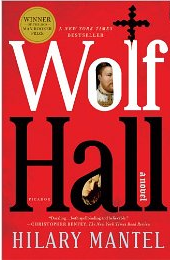
Cover for Wolf HallBest Book of Week 16!

This is a good time to write about Wolf Hall, because I was thrilled to learn that Hilary Mantel’s sequel to it has just come out. My copy is arriving soon. Mantel is always an interesting writer whose work does not occupy any one genre, although her last few books have been historical fiction. Wolf Hall won the Man Booker Prize and was one the best books I read in 2010.

The novel looks at the political and religious machinations of Henry VIII through the eyes of Thomas Cromwell, who rose from low origins to become Henry’s chief minister. Although Cromwell has traditionally been viewed as Henry’s “heavy,” recent historians have looked at his career more kindly, showing that his work as chief minister brought England into more modern statehood and that his changes created more order for government functions that were less controlled by the whims of nobility.

Mantel depicts Cromwell as a loyal man who cares for his dependents and works to reform England. He builds up a great household as he moves from the position of secretary to Cardinal Wolsey to work for the king. Later, after the Cardinal’s downfall, he slowly, almost imperceptibly, works to bring down those who furthered their own interests by destroying the Cardinal, including the rapacious Boleyns.

Cromwell is loving to his family and friends, completely faithful to the Cardinal and then to Henry, intelligent, able in many spheres of work, and decent. Mantel paints a charming pictures of his home life. In contrast, she turns the tables on Thomas More, venerated for centuries, showing him as a sadistic torturer of Protestants who is in love with his own martyrdom.

Cromwell meets Jane Seymour when she is a young, lonely lady’s maid to the queen, teased and neglected by the rest of the court, and feels pity for her. Later, after he is long widowed, he falls in love with her. The title of the book is the name of her ancestral home, Wolf Hall.

Mantel’s approach is understated, leaving the reader sometimes to connect the ideas. The details in this novel seem completely authentic, and Mantel handles the period brilliantly. She somehow manages to generate tension and suspense even about things we know all about, like what will happen to Anne Boleyn.

Day 66: The Lacuna

Cover for The LacunaBest Book of Week 14!

My experience with reading Barbara Kingsolver has been uneven. Her first books were interesting and heartwarming, but some of her later work is more political and sometimes degenerates to lecturing on certain causes. However, The Lacuna is an absolutely enthralling historical novel.

Harrison Shepherd is a young man, half Mexican and half American, who survives an upbringing by a feckless mother and a cold father and finally begins making his own way in 1930’s Mexico. He finds a job working in Diego Rivera’s kitchen and ends up as the cook and plaster mixer in Rivera’s household with Frida Kahlo. Later, when they give Leon Trotsky a home, Shepherd works for Trotsky as a secretary and translator, and finally he returns to the United States to write Aztec historical potboilers.

The novel covers major historical events in a turbulent period, including the Communist Worker’s Movement, Trotsky’s assassination, FDR’s terms in Washington, World War II, and the House Unamerican Activities Committee. Although Shepherd’s life is extraordinary by any standards, Kingsolver was able to make it feel absolutely persuasive. While I usually dislike historical novels where ordinary people keep running into famous people, I completely accepted every sentence of this book.

Told by diary entries, newspaper articles, and letters, the novel gets going a little slowly, but eventually enthralls. Kingsolver does a great job of creating colorful and believable characters from the lives of real, historic people, something that is not simple, and completely involves readers in the events of their lives.

Day 51: With Fire and Sword

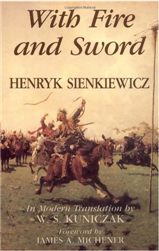
Cover for With Fire and SwordBest Book of Week 11!

Two years ago I read an exciting trilogy of Polish novels written in the 19th Century by Henryk Sienkiewicz, a Nobel prize winner for lifetime achievement in writing epic literature. The books were wildly popular for about 50 years, and Polish friends of mine tell me that they were their childhood reading. My review of the trilogy was published on Nancy Pearl’s blog (the librarian who has her own action figure), and I wrote to her awhile back asking if I could republish it here. She did not respond, so without further ado, I am going to write another review of the first book, With Fire and Sword. I will of course crib from my original review. The three books are stand-alone but with recurring characters, so you can read just one without missing important plot points.

It is 1647, and the Polish-Lithuanian Commonwealth is having some trouble—there are rumblings of rebellion among the Cossacks, who are a major force in the Polish army. Yan Skshetuski is a young Polish officer in the hussars of the Ukrainian Prince Yeremi Vishnovyetski. Prince Yeremi sends him on a mission as an emissary to Bohdan Hmyelnitzki, the leader of the Cossack rebellion. Yan has just become engaged to the beautiful Helen, but duty calls, so he makes his way through down the river to where the Cossacks are gathering.

Yan has been sent too late, though, for the rebellion has already started when he arrives, and he is made a prisoner. He escapes with difficulty and makes his way through the war-torn landscape, all the time worrying about Helen.

The political situation in Poland is very unstable, so no one comes to Prince Yeremi’s aid as he is attacked by hoards of Cossacks from the southeast. Even though Helen has been kidnapped by the wild Cossack Bohun, Yan cannot take time to look for her because he is embroiled in another mission for the Prince. So, his friends, the fat buffoon Pan Zagloba, the lovelorn knight and master swordsman Michal Volodyovski, and the gentle Lithuanian giant Longinus Podbipyenta decide to help Yan by rescuing Helen themselves.

This novel is all adventure and romance, and it is truly exciting. Along the way, you learn something about 17th century Polish history.

If you are interested in reading the book, you may have  a hard time finding it (although I see it is available in a print-on-demand basis). It is also available in several translations, about which there is some debate. The original translation by Curtin is said to be truer to the book, but I took a look at it, and it is also fairly badly written. The translation that I read by Kuniczak takes some liberties with the structure of the novel, but is eminently readable, if you can find it. The cover picture at the beginning of the article is from the edition that I read.

Day 45: The Possessed: Adventures with Russian Books and the People Who Read Them

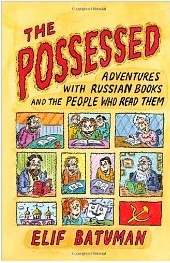
Cover for The PossessedMaybe not many of you would be interested in a book like The Possessed: Adventures with Russian Books and the People Who Read Them by Elif Batuman, but as a previous student of Russian and also a previous literature graduate student, I found it very funny.

Batuman has written a book about her years as a graduate student of Russian language and literature that skewers many things, but particularly academic conferences with their absurd presentation topics and academic thinking, with the oblique reasoning process that sometimes accompanies it. For example, on the way to a conference on Tolstoy’s estate, Batuman loses her luggage and is forced to dress in flip-flops, sweatpants, and a flannel shirt. Some of the scholars attending the conference assume she is a Tolstoyan and that she has taken a vow to walk around in sandals and a peasant shirt for days. When she calls a Russian clerk to find out about her luggage, the clerk replies, “Are you familiar with our Russian phrase resignation of the soul?”

While relating her adventures in studying, travelling in Russia, and living in Turkey, where she went because her grant was too small for her to afford a stay in Russia, Batuman muses on ideas from literature and compares the lives of the people she meets with the adventures of characters in Tolstoy, Dostoevsky, and Chekhov. Her observations are colored with her own peculiar view of life, which poses that “the riddle of human behavior and the nature of love appear bound up with Russian.” In Turkey, when she is challenged by scholars to study Turkish literature, particularly because of her Turkish heritage, she concludes that no one reads it, even the Turks.

Batuman expanded articles she wrote for Harper’s and The New Yorker into this book, which is named after one of Doestoevsky’s more enigmatic novels. Although her musings are occasionally a trifle too erudite for me to follow (and perhaps my memories of Russian literature too rusty), I found the book amusing and couldn’t put it down.

Day 42: The Invention of Hugo Cabret

Cover for The Invention of Hugo CabretI got interested in reading the Invention of Hugo Cabret by Brian Selznick after I saw the marvelous movie Hugo, which is based upon it. The book has been called a masterpiece, and it really is. A combination of graphic novel and children’s book, about two thirds of it is told in beautiful charcoal drawings that drive the narrative forward.

Hugo is a mechanically gifted boy living secretly in the Paris train station. He keeps the clocks in the train station running in the hopes that no one will discover the absence of his uncle, who is supposed to do the work. He supports himself by stealing food from the cafés in the train station. He doesn’t go to school.

In his spare time he works on an automaton that his father brought home from the museum where he worked shortly before he died. The automaton can write a message, and Hugo believes that if he makes it work, he will receive a message from his father. To get parts for the automaton, he steals toy parts from a stern old toy maker. But one day he is caught.

I did not actually try to use the drawings as a series of flip books but understand that you can, to create black and white movies. And that is a suggestive way of hinting at one beauty of this novel. In the beginning you think you are reading a more or less traditional children’s story but then it shifts to tell a story about the history of the movies. The book is inventive–a graphic novel, a children’s story, a flip book, almost a movie, and a real delight.

Day 21: The Sweetness at the Bottom of the Pie

Cover for The Sweetness at the Bottom of the PieI don’t know that anyone has invented a more delightful heroine than Flavia de Luce, the eleven-year-old sleuth in Alan Bradley’s funny, charming series. I haven’t read The Sweetness at the Bottom of the Pie in a few years, but for series books I am trying to start with the first one, so I’ll do the best I can.

It is 1950’s Britain, and Flavia is an eccentric in a family full of eccentrics. She spends her time cooking up dangerous chemicals in the laboratory she inherited from a great uncle or riding around on her bicycle, Gladys, looking for trouble. Her father is a reclusive widower who stays locked up in the library with his stamp collection and worries about how to support their ramshackle estate. She engages in all-out warfare with her two older sisters, which includes putting poison ivy extract in Ophelia’s lipstick. Her only ally is the Dogger the gardener, her father’s batman from WW II who suffers from post-traumatic stress disorder.

First, Mrs. Mullet the housekeeper finds a dead bird on the porch with a valuable stamp in its beak. Then a mysterious stranger calls upon her father, and they have an argument. Later Flavia finds the stranger dying in the cucumber patch. When her father is arrested for murder, Flavia decides to investigate. She finds out her father may have been involved in the suicide of a former schoolmaster and the theft of a valuable stamp. As Flavia cycles around the village of Bishop’s Lacey looking for clues and interviewing suspects, she may be putting herself in danger.

If you’re looking for a light mystery with plenty of twists and turns that will make you laugh out loud, look no further than any book featuring Flavia de Luce.

Day Eight: The Virgin Suicides

Cover for The Virgin SuicidesI haven’t read this book in a year, but my brother asked me to review it. So, excuse me if I get the chronology mixed up or something. The book is told mostly in flashbacks, and it’s hard for me to remember what happens first.

The Virgin Suicides by Jeffrey Eugenides is one of those incredible books that make you wonder how they could be someone’s first novel. I was turned off by the title and subject matter of the book so I didn’t read it at first. But I caught the movie one night on TV and was mesmerized by it, so I decided to read the book.

The Virgin Suicides is written from the point of view of a group of boys growing up in the 70s in Grand Blanc, Michigan, a wealthy suburb of Detroit. The boys are fascinated by the five beautiful Lisbon sisters and their family life. Although they all go to the same school, the girls are kept isolated from other teenagers by their mother’s strictness. Their father is an easy-going science teacher at their school.

The boys begin by spying on the girls, then collecting souvenirs of the girls’ lives, which they go over incessantly, trying to understand them. In an experiment of leniency, Mrs. Lisbon allows the sisters to have a few classmates over to the house, including the boys, but the deadly dull party ends disastrously with the suicide of the youngest girl.

As the boys begin to connect more directly with the girls and the family alternates between trying to be more normal and totally isolating the girls, the family becomes more unhinged.

The book is sometimes lyrical, sometimes sophomoric sounding, sometimes witty, and savagely ironic, painting a vivid picture of the time and place. The disintegration of urban Detroit and its surrounding areas, symbolized by the neighborhood losing all its trees to the Dutch Elm disease, parallels the disintegration of the Lisbon family.