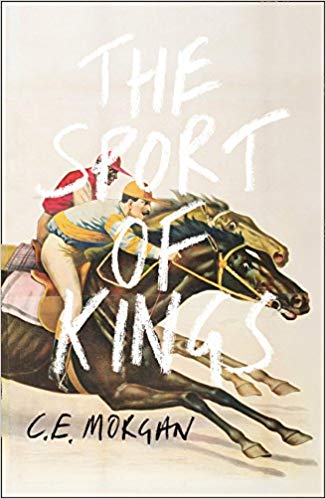
Review 1382: The Sport of Kings

To paraphrase Sophia Brownrigg, a reviewer from The Guardian, The Sport of Kings is about horse racing like Moby Dick is about whales. It is ambitious—attempting to tell the history of Kentucky through that of two families—one white, wealthy, elitist, and bigotted, the other black, poor, and beleagered. It is sometimes magnificent in its prose and sometimes overblown. It is Southern Gothic, focussing on the ramifications of slavery and bigotry.

Henry Forge is the only son of a proud Kentucky family. As a youngster, he was brutalized by his father and lectured about his place in history. We have some sympathy with him until, in his teens, he commits an unforgivable act.

He rebels against his father by turning the family corn plantation into a horse farm, but the nut doesn’t fall far from the tree. When his wife leaves him, his daughter is nine. He takes his daughter out of school and teaches her himself, all his lessons revolving around horses and breeding and including much out-of-date or just plain incorrect information. He is as elitist as his father—and worse.

Henrietta grows up with a talent for working with horses and a keen, cold intelligence. She also likes to pick up men for sex. Then she meets Allmon Shaughnessy, the new African-American groom, fresh from a prison program for working with horses.

Up to that point, the novel seems mostly a multigenerational saga, occasionally discoursing on geology, genetics, or history in the interludes. But after that it becomes wildly overblown at times, reminding me of the characteristics of Moby Dick that I disliked.

Like one other reader on Goodreads, every time I picked up this novel I wanted it to end. It is about deeply unpleasant characters; the least at fault—Allmon—whines his way through the novel. Its long asides are often irritating. It is sometimes beautiful and very dark, but it is often annoying.

Last year I read an essay—I can’t remember who wrote it—complaining about what I call “books only men like,” usually the ones that win awards. (I read this one for my James Tait Black prize project.) This essay commented that because a certain type of book gets attention and wins awards, now some women are beginning to write like men, using All the Birds, Singing as an example. I did not agree with the writer’s example but couldn’t help thinking of this essay while I read this novel.

Related Posts

Mother of Pearl

Wise Blood

Horse Heaven

If I Gave the Award

Cover for Do Not Say We Have NothingHaving posted my review of The Sellout by Paul Beatty, I see it is time for my feature where I give my opinion of the winners for a specific award. The Sellout was shortlisted for the 2016 Man Booker Prize. It was the winner that year. If you read my review, you know that I disliked this book intensely because of its style, which reminded me of a long stand-up comedy routine, and also because of its over-the-top plot. In fact, I did not finish reading it. So, obviously, I would not have picked it for the award.

Another book that did not impress me was All That Man Is by David Szalay. It depicts in barely related short stories (why is it called a novel when nothing but the theme overlaps from story to story?) a series of incidents featuring despicable male characters who at best do nothing and at worst are very bad indeed.

Eileen by Otessa Moshfegh, on the other hand, is a portrait of a despicable woman. Although I thought this novel presented a masterful characterization, it was not my favorite.

Cover for His Bloody ProjectI liked Hot Milk by Deborah Levy more, but I thought some of its events were unlikely. And it was confusing at times, written in an almost hallucinogenic style.

Although I occasionally found its style irritating, since it has a fairy tale-like quality to it, I found Do Not Say We Have Nothing by Madeleine Thien heart-rending. In addition, it informed me about events I knew nothing about.

My selection for the winner, however, would have been His Bloody Project by Graeme Macrae Burnet. I found it absolutely fascinating as it followed a crime as well as depicting the lives of crofters in the 19th century.


If I Gave the Award

Cover for Parrot and OlivierHaving finally posted my review of The Finkler Question, I see that it is time again for my feature “If I Gave the Award,” in which I evaluate the shortlist I have just read and say which book I think deserves the award.

The winning book for the 2010 Man Booker Prize was Howard Jacobson’s The Finkler Question, but if you read my review on Tuesday, you’ll know I’m not going to pick that one. I found most of the characters unbelievable, the humor not funny, the tone irritating, and the preoccupations of the characters kind of ridiculous. In fact, it was my least favorite of the shortlisted books.

I felt too much distance from the action and characters of C, by Tom McCarthy, to pick it. Similarly, I felt that the narrative style of The Long Song by Andrea Levy distances the reader from its characters.

Room by Emma Donoghue was a compelling read, so I can’t complain that I felt distanced by it. However, I don’t think it is in the same league as the other books. It employs an imaginative approach by narrating a difficult situation from the point of view of an innocent boy, but this approach is not always convincing, and it is essentially just a thriller. I almost feel that its selection on the short list was an effort to attract more readers to the prize by selecting a popular novel.

Cover for In a Strange RoomIt has been a very long time since I read Parrot and Olivier in America by Peter Carey, but I still have fond memories of its sly humor. It is my second favorite of the nominated books.

So, we get to the novel that I think should have won the award, In a Strange Room by Damon Galgut. This book is not only beautifully written, but it is affecting and insightful in the behavior of its characters. Although it purposefully keeps some distance from the readers at times, I found it powerful and touching.

If I Gave the Award

Cover for HarvestWhen I began my James Tait Black Fiction Prize project late last year, I had, just coincidentally, already read three of the four shortlisted books for 2014. Having finally posted my review for the fourth, it is time for my feature where I give my opinion about which book I would have voted for.

The year 2014 has some strong entries, the weakest of which, in my opinion, is The Flamethrowers by Rachel Kushner. Although it skillfully depicts two vibrant cultures in the 1970’s, to me there seemed to be something about the main character that was not convincing, and the relationship that the novel pinned its major events on was unexplored.

Cover for All the Birds, SingingI don’t think very many writers can beat Kent Haruf as a prose stylist and was happy to see his Benediction on the list. I also very much enjoyed the winning book, Harvest, by Jim Crace. It was dark and powerful. I strongly recommend both of them.

So, my opinion is simply based on the feeling that All the Birds, Singing by Evie Wyld made the biggest impression on me. Although I read it long ago, in the fall of 2014 (as I did Harvest), it is the one that sticks with me the most and that I find the most haunting. So, All the Birds, Singing is my pick for 2014.

If I Gave the Award

Cover for On Canaan's SideHaving reviewed the last book on the Walter Scott Prize shortlist for 2012, it is time for me to give my opinion on whether the judges got it right. Of all the books in the shortlist, would I have picked On Canaan’s Side to be the winner?

For me, this is a much more clear-cut decision than for my last feature, where I compared the books on the shortlist for 2014. For that list, I felt that all the books were excellent, but I chose Life After Life for its combination of inventiveness and sense of history, acknowledging that the winner, An Officer and a Spy, was an excellent historical novel.

Cover for PureFor 2012, however, I can honestly say that I didn’t enjoy most of the books on the shortlist, or I enjoyed them only mildly. The one book that I enjoyed wholeheartedly was that year’s winner, On Canaan’s Side by Sebastian Barry, about an Irish woman emigrating to the United States during the Troubles. I also thought that Pure was very interesting and showed a strong sense of the period. The books I enjoyed least were The Stranger’s Child and The Sisters Brothers.

So, for 2012, I agree with the judges. If I had picked the winner from this group, it would be On Canaan’s Side.

If I Gave the Award

As I am reading the shortlists for a couple different awards, I thought it would be fun, as I finished a shortlist, to post my opinion of whether the jury picked the best book from that list. Of course, no one may care, but in some cases, I have felt that the best book on the shortlist was not the one chosen for the award.

Yesterday, I posted my last review of the books on the shortlist for the Man Booker Prize of 2013. My reviews of these books have appeared sporadically starting in 2014 until now. Here is the shortlist for 2013:

The Luminaries was the winner for 2013.

This may be an anticlimactic beginning to my little series, but in this case, I think the jury got it right. I put The Luminaries on my list of the best books I read in 2014. It is cleverly constructed and original in approach, but that does not make it any less compelling as a story. Sometimes I think that critics get so jaded that they go for anything original, even if it is not that enthralling to read. This book is great, because it combines a fresh approach with an intricate puzzle of a tale. If you are interested, you can read my original reviews at the links above.