Day 1195: The Long Song

Cover for The Long SongSeveral years ago, I greatly enjoyed Andrea Levy’s Small Island. So, I was happy when I saw that The Long Song was in both my Walter Scott Prize and Man Booker Prize projects.

July is fathered upon her slave mother, Miss Kitty, by the overseer on Amity, a Jamaican sugar plantation. It is early in the 19th century, so July is a slave, too.

July and Miss Kitty are field slaves, but when July is nine years old, the master’s sister, Caroline Mortimer, takes a fancy to her. She takes July away from Miss Kitty to train her as a house slave and calls her Marguerite. The novel is written as July’s memoir, as she recalls the final days of slavery on the island and its transition to freedom.

At first the tone of this novel bothered me. It seemed too sprightly and playful for subject matter that is sometimes appalling. It really tears into its white characters, too, who are portrayed at best as hypocrites but more often much worse. Eventually, though, its sly sense of humor got to me, and I laughed out loud. Still, I did not feel as involved by this novel as I did with Small Island.
Related Posts

Beloved

Jade

The Quality of Mercy

Day 1187: Edgar & Lucy

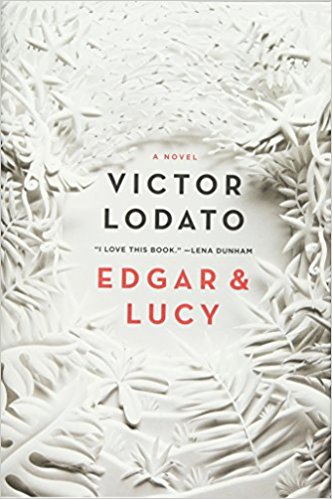
Cover for Edgar & LucyBefore I start my review, I realized I forgot to check the spin number on Friday morning. It seems as if Classics Club always picks the number for the most obscure book on my list. This time, I get to read Le Morte D’Arthur.

* * *

Best of Five!
Eight-year-old Edgar has no idea about the terrible events that took place when he was a baby. He lives with his mother, Lucy, and his grandmother Florence, who tells him innocuous lies about Frank, his father and her son.

Lucy and Florence have not been getting along lately. Lucy, still traumatized by her husband’s death, has been drinking too much and seeing men, when old-fashioned Florence would like her to be a perpetual widow. But Florence dies, and a series of misunderstandings and accidents at the time of her death place Edgar in danger.

Although I wouldn’t describe Edgar & Lucy as a thriller, it kept me pinned to the page much like a good thriller would, and the novel has some thriller-like plot characteristics. But really, it is a thorough examination of several characters under trying circumstances. And one of them is a ghost.

This novel is highly unusual. At times, it is almost meditative while at other times it reveals its characters’ minds as almost hallucinogenically original. If you decide to read it, I don’t think you’ll regret it.

Related Posts

Room

The Burgess Boys

The Good Lord Bird


Day 1186: Toby’s Room

Cover for Toby's RoomI know I’ve talked about this before, but I find it interesting to see what the blurb writer finds to comment about a book versus the book itself. In the case of Toby’s Room, the blurb says something about a family torn apart by war. Well, World War I begins well into the novel, and the family is fairly well torn apart already.

The novel begins in 1912 when, in a weekend break from Slade, where Elinor is an art student, her relationship with her older brother Toby undergoes a shocking change. She and Toby have always been close, but they have difficulty closing the gap after this incident.

Later, shortly after the war begins, the family receives a telegram stating that Toby is missing, presumed dead. Elinor feels there is something not right about the letters she receives from his commanding officer and the chaplain. Letters to her friend Kip, who served with Toby, receive no answer. Elinor asks her friend Paul, who is home wounded, to help her find out what happened.

That makes the book sound like a mystery, but it isn’t. It is more about Elinor’s unresolved feelings for her brother, and latterly about the horrors of war.

Although Toby’s Room is a sequel to Barker’s Life Studies, and I have not read the first book, I felt myself immersed in this fully realized world. This is another situation, like with The Quality of Mercy, where I was reading the novel for my Walter Scott prize project and chose not to read the first one. Unlike The Quality of Mercy, though, I don’t think my not having read the first book affected my appreciation of the second. Although I do wish the Walter Scott prize judges would stop putting sequels on their short list, I enjoyed Toby’s Room. It examines serious issues while still capturing our attention.

Related Posts

The Quality of Mercy

The Stranger’s Child

C

Day 1184: The Garden of Evening Mists

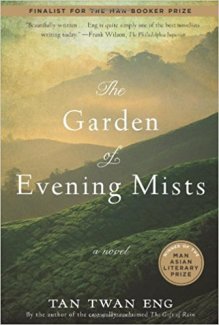
Cover for The Garden of Evening MistsBest of Five!
Yun Ling Teoh, a Malayan federal judge of Chinese descent, has decided to retire early. She has been diagnosed with a neurological ailment that will cause more and more frequent episodes of aphasia and will eventually destroy her language abilities. She decides to return to Yugiri, a Japanese garden in Malaya that she inherited from its creator, Aritomo.

On the advice of her friend Frederik, the owner of a nearby tea plantation, Yun Ling decides to record her memories. She begins in 1951, when she went to Aritomo to ask him to design a garden in memory of her sister, Yun Hong, who died in a Japanese labor camp during World War II. Yun Ling also was in the camp, and her hatred of the Japanese makes it difficult for her to ask for Aritomo’s help. But her sister loved Japanese gardens.

Aritomo refuses her request but makes her a different offer. If she will take on the job of apprentice, he will teach her enough to design her own garden. She decides to accept the offer, having quit her job as prosecutor.

It is a difficult time in Malaya. No sooner did the war end than the government began fighting Communist guerillas, who were attempted to take over the country. And Akitomo has his secrets. He came to Malaya before the war, having resigned as the Japanese emperor’s gardener, but Yun Ling occasionally hears that he played a role for Japan during the war. He had some kind of influence, because he saved his neighbors from the Japanese labor camps. Yun Ling, we find, has her own secrets.

The Garden of Evening Mists is the best kind of historical fiction, immersing me in its time and place while informing me of events I was formerly unaware of. I found it deeply interesting and affecting. The descriptions are delicate and evocative, and the characters feel real yet mysterious. This novel was part of both my Walter Scott Prize and Man Booker Prize projects, as well as the winner of the Man Asian Literary Prize. It is a powerful novel.

Related Posts

The Glass Palace

The Narrow Road to the Deep North

The Ten Thousand Things

Day 1182: Suzanne

Cover for SuzanneSometimes you read a book that makes you want to consider it. Maybe you feel ambivalent about its subject matter or its approach. Maybe you want to ponder the choices made by its characters. Maybe the fact that you want to think about it marks it as good. I had all these thoughts about Suzanne.

This novel was given to me to read by my French-Canadian sister-in-law. It is an imagining of the life of the author’s grandmother, a poet and painter who abandoned her family when her daughter was three.

The novel is written originally in French and translated by Rhonda Mullins. It is written in the second person in short excerpts. Suzanne Meloche was always rebellious, it seems, and when she had to choose, she chose herself. After a difficult, poverty-stricken childhood in rural Ottawa, she struck out for Montréal. There, she almost immediately was taken up by a movement of artists and writers, called Automatism, led by Paul-Émile Borduas. Many of the people she associated with became well-known Quebecois painters. Eventually, she married Marcel Barbeau, an artist.

This novel makes compelling reading, as it explores the question of how far you should go to pursue your own goals. Suzanne is an interesting character who leads a rich life, although I don’t like her very much. In fact, I think her granddaughter is a little too understanding of her foibles. Perhaps her interpretation of Suzanne’s thoughts and feelings is correct—Suzanne did after all keep the pictures of her grandchildren that her daughter sent her. To balance that, though, is the harm she did her children by abandoning them and her reception of her daughter and granddaughter the one time they went to visit her.

As a work of authorship, it’s brilliantly written and compelling. Will you like it? I suppose it depends on how you feel about the subject.

Related Posts

The Blazing World

How to Be Both

The View from Castle Rock

Day 1179: In the Wolf’s Mouth

Cover for In the Wolf's MouthAnother book for my Walter Scott Prize project, In the Wolf’s Mouth is very different from the last novel I read by Adam Foulds. It is about the incompetent “liberation” of Sicily by the Allies during World War II, from the point of view of two characters. Will is a British field security officer who is ambitious to accomplish something. Ray is an Italian-American soldier who gets accidentally detached from his unit.

Although the plot of this novel is disjointed, it hinges upon the use by the American army of Sicilian exiles in its capture of Sicily. Unfortunately, some of these exiles are mafioso who fled the island 20 years before under threat from the Fascists. Ciró Albanese is one of these men, and under the auspices of the American army, he begins taking charge of his old activities. He considers Angilú one of his enemies, as the ex-shepherd took over his job and his house after he was kicked out. He also wants his wife back, even though she has remarried after thinking him dead. Eventually, Will gets wind of his activities.

Although this story is coherent enough, Ray’s story has very little to do with it. His is one of a soldier suffering from too much exposure to violence. His story is loosely connected by place and a link to the Princess, daughter of Angilú’s employer. This looseness gives the novel a disjointed feeling. After enduring a certain amount of tension through the problems of Angilú, we end with a fizzle, with Ray.

Finally, none of the characters are very knowable. We only really see one or two facets of their personalities. The sense of place depends on a few descriptions and a general aura of confusion. Although the novel kept my interest, I felt frustrated by it.

Related Posts

The Quickening Maze

The Information Officer

Siracusa

Day 1178: Do Not Say We Have Nothing

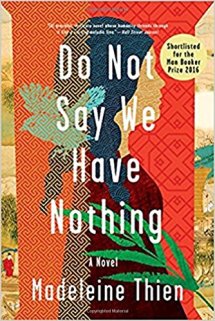
Cover for Do Not Say We Have NothingBest of Five!
When Balzac and the Little Chinese Seamstress was so popular, I was not a fan. I disliked how the two male college students patronized and abused the girl, even though she won through in the end. I also vaguely felt that the events of the Chinese Cultural Revolution were being trivialized, even though I was not really sure about the facts. Reading Do Not Say We Have Nothing confirmed that I was right.

Marie is a young immigrant Chinese girl living in Vancouver, British Columbia, in 1991. She and her mother are confused and grieved, because after the family escaped from China, her father, Jiang Kai, first deserted them to move to Hong Kong and later committed suicide.

Marie’s mother receives a call from China, from Ling, the wife of Jiang Kai’s beloved teacher, Sparrow. Ling says that her daughter, Ai-Ming, has had to leave China because of involvement in the Tiananmen Square protests, but she has missed the amnesty offered by the U.S. Ling asks that they give Ai-Ming a home.

Ai-Ming becomes an older sister to Marie. She tells her stories about her family—her great uncle, Wen the Dreamer, who courted her aunt Swirl with chapters from a forbidden book called the Book of Records; her grandparents, Big Mother Knife and Ba Lute, wandering musicians; and her father Sparrow, a composer of music. Ai-Ming tells of the days of her father, her cousin Jhuli, and Marie’s father, Jiang Kai, at the Shanghai Conservatory. Shadowing all their lives is the Cultural Revolution and its horrible excesses—murder and exile of intellectuals, forced denunciations of relatives, ransacked homes, humiliation and ruining of the innocent.

At first, I was irritated by the style of Ai-Ming’s story, which feels a little like a fairy tale, but it was not long before I was completely absorbed in it. The novel is a heart-rending tale about identity, music, love, and political destructiveness. This was another excellent book that I read for my Man Booker Prize project.

Related Posts

Red Sorghum

The Kitchen God’s Wife

Shanghai Girls

Day 1174: Literary Wives! The Blazing World

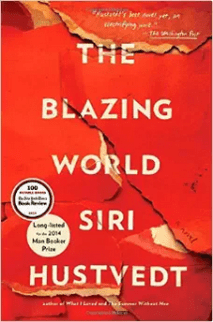
Cover for The Blazing WorldToday is another review for the Literary Wives blogging club, in which we discuss the depiction of wives in fiction. If you have read the book, please participate by leaving comments on any of our blogs. Be sure to read the reviews and comments of the other wives!

Eva of Paperback Princess
Kate of Kate Rae Davis
Lynn of Smoke and Mirrors
Naomi of Consumed By Ink
TJ of My Book Strings

My Review

The Blazing World was one of my favorite books of 2015, so I won’t recap my review but instead provide you the link so that you can read my original review. Then I’ll go on with my comments for Literary Wives.

What does this book say about wives or the experience of being a wife?

Although Harriet is a widow at the beginning of the book, all her actions are centered around her experiences of being first a daughter and then a wife. She has been a good wife, but she has had no support from her art dealer husband for her art. She has sat quietly by and watched him claim credit for her ideas. Fiercely intelligent and original, she has become convinced that as an older woman, she is almost invisible. In fact, her entire focus on the project that she conceives and that drives the plot of the novel is fueled by anger at the paternalism of first her father and then her husband.

Unfortunately, she finds that the art world is paternalistic in just the same way, as she has trouble claiming her own art after conducting her experiment. This is a powerful novel about institutional sexism—particularly the difficulties women still have in being taken seriously in any realm except that of the household, but especially in the creative arts.

Related Posts

A Lady and Her Husband

The Enchantment of Lily Dahl

The Life and Death of Sophie Stark

Day 1173: Atonement

Cover for AtonementBest Book of Five!
Ian McEwan is a master at turning everything you think you know about a novel on its head, and he does that effectively in Atonement. This novel is a reread for me, the first one by McEwan I ever read, and I found it breathtaking. It is just as enjoyable when you know its secrets.

On a hot summer day in 1935, Briony Tallis commits a terrible crime. At thirteen, she is an imaginative but naive girl, a budding novelist. She misunderstands some interactions she witnesses between her older sister, Cecilia, and Cecilia’s childhood friend, Robbie, and this misunderstanding provokes her to tell a dreadful lie that ruins lives.

Five year later, Briony is a nurse at the start of World War II. She is trying to get published as a writer, but she is also concerned to atone for the lives she ruined.

This novel draws you in to the hot summer day and carries you along. It is beautifully written, and it shows great insight into the mind of the romantic, self-important child that Briony was. I can’t say much more about this novel without giving it away to the few of you who haven’t read it or seen the movie, but I believe it to be a postmodern classic. In short, this is a great book. It is intelligent, with ideas to ponder but with a narrative that just sweeps you along.

Related Posts

Amsterdam

Sweet Tooth

The Child in Time

Day 1168: Hodd

Cover for HoddI was never one for the romantic legends of Robin Hood. I always thought that, if he did exist, he was probably just the leader of a gang of thugs. And such, apparently, is indicated by the older ballads about him. In Hodd, Adam Thorpe weaves a story of the man that is closer to that told by the older ballads.

This novel is all about the manuscript, as the text of Hodd is supposedly the find of a medieval manuscript, written by a 13th century monk. The narrator, who remains unnamed, is writing the story of his youth. The novel includes scholarly notes from its translator and comments by its discoverer, a soldier in World War I. Some of these notes are funny, and some, I think, are meant to be parodic.

The narrator is about 14 when he is traveling with his master, a monk named Thomas, to Nottingham. They are held up by Hodd’s men and the narrator’s harp is stolen. He decides to go back and get it and is captured by Robert Hodd and his men.

Hodd is actually a sort of lunatic cult leader, who believes that there is no sin and that he is better than God. His followers believe him. He keeps himself intoxicated and has constant visions. He and his men are utterly ruthless and cruel. But rather than killing the narrator, Hodd decides to keep him as one of his men. He is a musician, and he can write songs about Hodd.

The narrator tells a parallel story of his education and upbringing by a holy hermit. This story continues throughout the book and comes in strongly at the end.

I think Thorpe realistically imagines the workings of the medieval mind, showing us strange beliefs. As such, this is a very unusual novel. I could have done without some of the religious moralizing, which filled the novel, as it would a medieval manuscript.

If you are a reader who needs a character to like, this is probably not the book for you, for even the relatively innocent narrator is perfidious. He so much wants to be loved that his jealousy turns him against people.

This is another interesting book I read for my Walter Scott Prize project.

Related Posts

Ulverton

The Scottish Chiefs

The Owl Killers