Day 862: The Remains of the Day

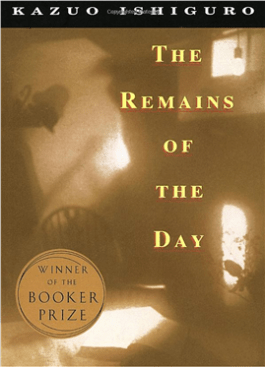
Cover for The Remains of the DayBest Book of the Week!
Having seen the movie The Remains of the Day years ago, I think it is just as well I waited so long to read it. Even so, some of the book’s scenes made me envision the movie, though I had forgotten most of it.

Stevens is the butler for Darlington House in the 1950’s. Lord Darlington, whom he served for 30 years, is gone, and now Stevens works for Mr. Farraday, an American. At Mr. Farraday’s suggestion, he has decided to take a holiday to visit the former Miss Keaton, who used to be the housekeeper in Darlington House. He surmises that her marriage is not altogether happy. She has split from her husband, and Stevens hopes she will agree to return to Darlington House as housekeeper. As he travels, he keeps a diary reflecting his thoughts on the journey.

To Stevens, his professional capabilities are the most important areas of his life. He reflects a great deal on such concepts as what dignity consists of. He has removed himself emotionally from the events of his own life, so much so that when his father is dying in the house, he won’t leave the dinner party he is serving. Stevens’ dedication is taken to such an extreme that when he sees in Mr. Farraday a disposition to banter with him, he, who has no sense of humor, begins to practice witticisms.

The Remains of the Day is the striking portrait of a unique individual as he comes to consider some of his life’s decisions. He has devoted his life to the service of Lord Darlington, whose political decisions before World War II left him a ruined man. Stevens thought he was helping Lord Darlington do important work, but later he had to re-evaluate that idea. In the meantime, Stevens ignored a possible other life for himself with Miss Keaton.

This novel tells a sad, sad story. Stevens is not always a reliable narrator for us, as his perceptions are as limited as his point of view. This is a novel of depth and brilliance, intricate as a puzzle box, as we delve the depth of Stevens’ psyche.

Related Posts

The Buried Giant

Life After Life

A God in Ruins

Day 859: They Knew Mr. Knight

Cover for They Knew Mr. KnightBest Book of the Week!
At the beginning of They Knew Mr. Knight, the Blakes are an ordinary, relatively happy middle-class family. Things are fairly tight for them financially, and their house is too small for the family. The two girls, Freda and Ruth, share a small room, and the boy Douglas lives up in the cold attic. Still, only two family members are discontented. Thomas Blake has always resented his feckless father having sold the family factory just as Thomas was old enough to work there and learn the business. He works there but only as an engineer, not as the owner. And his father left his mother and siblings penniless, so that Thomas and his wife Celia have had to support them ever since, his brother Edward being unable to hold down a job. The other discontented family member is Freda, the oldest girl, who dreams of leading a wealthy and fashionable life.

On the way to work one morning, Thomas saves Mr. Knight from falling on the stair to the train. Mr. Knight is a wealthy financier, and he immediately takes Thomas under his wing. He helps him buy back his family’s factory and gives him tips on investments. Soon, the family is doing enough better to move into a bigger house.

But Celia doesn’t like Mr. Knight or the effect he has on Thomas. She doesn’t like how Mr. Knight leaves Mrs. Knight alone all the time and flaunts his young mistress before her. She doesn’t like how Thomas has become a little self-important and doesn’t confide in her anymore or spend as much time with the family. She doesn’t like their new house and misses her old busy life.

As the Blakes’ fortunes improve, we get a growing sense that all will not be well for long. Celia finds herself in a big house with maids and nothing to do. Her new garden doesn’t inspire her, and the children are grown and going about their business. The two eldest have unhappy love affairs, both with charming but morally lax people they meet at Mr. Knight’s parties.

Through all this, Mr. Knight himself remains a shadowy figure, appearing seldom. He seems generous, but we already know he is restless and prone to losing interest in projects. We wonder what will happen when he loses interest in Thomas, who keeps trying to pay back the money he owes him, only to have Mr. Knight point him toward a new investment opportunity.

Celia is the main character in this novel, which manages to build up a fair amount of suspense over everyday concerns. Part of the novel touches on her spiritual needs, as she has sometimes felt she’s had a glimmer of the knowledge of God and wishes she could get closer to it.

I was completely gripped by this novel and its picture of the fleeting quality of happiness, the corroding effects of greed. Except for Mr. Knight, the main characters are mostly very human and likable. You want the Blakes to come through their acquaintance scatheless, but you know they will not. If it’s not telegraphing too much about the book to say so, this novel reminds me very much of The Way We Live Now by Anthony Trollope, only we are more attached to the characters.

Related Posts

Someone at a Distance

Greenbanks

A View of the Harbour

Day 858: Fates and Furies

Cover for Fates and FuriesFates and Furies is about a marriage. Lotto and Mathilde marry shortly before graduating from college, after knowing each other only two weeks. They are both very tall and blonde, considered by many to be a golden couple. Lotto is charismatic and loud, always the center of attention, with many faithful friends. Mathilde is quiet and aloof.

Although Lotto has had a bit of a Southern Gothic upbringing, he is the son of wealth and privilege. However, his mother cuts him off when she hears of his marriage. Mathilde appears to have no family or money. So, the couple’s first years are tough, as Lotto tries to make it as an actor in New York while Mathilde supports them. But one night Lotto stays up drunk and writes a play. When Mathilde reads it, she knows he has found his vocation.

The first half of the novel is from Lotto’s point of view. Success seems to come easily to him after he writes his first play. Even though he is prone to depression if things don’t go well, he has hit after hit. Mathilde quits her job to take care of the business side, and he becomes a little self-satisfied. Still, all in all they are remarkably happy. He considers his wife a saint.

It is not until the second half of the novel, when we see the marriage and past from Mathilde’s point of view, that we learn a different truth about their lives. Mathilde, who has been alone for much of her life, is fiercely loyal to Lotto. But she is no saint.

Lauren Groff seems to write completely different novels each time out. This one shows the complexities of human relationships. That this relationship is almost operatic in scope gives the novel a slightly gothic trend.

I have mixed feelings about this novel. I think we are supposed to like Lotto more than I did, but I distrust charismatic people. I think Lotto may be a little stereotypical, however, while Mathilde is mostly a cypher until her half of the book, when many secrets come out. It is not until we learn Mathilde’s side of things that the novel really begins to unfold. It is certainly an interesting novel and one that could provoke discussion.

Related Posts

Arcadia

Everything I Never Told You

All the Birds, Singing

Day 840: Juggling

Cover for JugglingI am usually a huge fan of Barbara Trapido, but I have to admit to being slightly disappointed by Juggling. I think my problem is in the depiction of its characters.

Christina is the youngest of two sisters. Her parents, Alice and Joe, decided to get married after Alice’s best friend died and Alice decided to adopt her baby, Pam. They all moved to the U.S. from England, and Christina came along seven months later.

Christina is a pushy, lippy, verbally active child, and from early on she doesn’t get along with her father. She finds him too controlling and manipulative, even though he seems to encourage her sauciness.

When Alice met Joe, she was dating Roland. Later, Roland met and married Gentille, Peter’s French mother. Although Peter gets along with Roland, the move from his quiet Paris apartment to England and boarding school is hard on Peter until he comes under the protection of Jago.

Jago is a popular boy in school, but like many popular boys, he tends to be a bully and hangs with a thuggish crowd. Still, he is good friends with Peter until adolescence, when Peter’s lack of coolness becomes too obvious.

Fatefully, Christina and her gentle sister Pam enroll at the same school as Jago and Peter. Christina is fascinated by Jago, but she and her sister are too clean cut in their American fashions for him to be bothered. Still, Jago finds himself drawn to Pam. Pam is oblivious and begins a friendship with Peter based on a mutual love of music. Then a terrible event occurs that changes everything.

This Trapido novel is all over the place, with a boy who floats in the air, another boy who is a mean bully, a Cambridge don who cheats his student by stealing her paper, reshuffling of partners into too many combinations, a woman who purposefully tries to cause problems between a woman and her daughter. And we’re supposed to like all the characters, I think.

I usually like Trapido characters despite their flaws, but in this case I didn’t. I found it hard to like Christina, who takes everything so personally that she splits from her family about something that happened to someone else, even splitting from that person, who was not at fault. I didn’t buy her antipathy to her father. In fact, if anyone is manipulative, it is she. The more likable characters, such as Peter and Pam and Alice, are neglected for the loudmouths and bullies. About the only one of the more forceful characters I liked was Dulcie, who is loud and exuberant, not a bully.

Trapido seems to have made a thing about people pairing up with the wrong partners. In this case, there are just too many of them and too many coincidences. Hence the title of the book, I suppose.

Related Posts

Sex and Stravinsky

Brother of the More Famous Jack

The Travelling Hornplayer

Day 836: My Name Is Lucy Barton

Cover for My Name Is Lucy BartonBest Book of the Week!
Lucy Barton grew up very poor in rural Illinois. She looks back to a time as a young married woman, living in New York City with her husband and two daughters and learning to write. At the time, she had not returned to her parents’ house since she went to college. Something horrible associated with her father is hinted at.

Much of Lucy’s story centers around a stay in the hospital, where for some weeks she has an undiagnosed illness. Her husband can’t bear hospitals, so he asks her mother to come. Her mother stays with her, never leaving her room and refusing to use the cot the nurses provide. During this visit, her mother tells her stories about people they both know.

For much of their lives, Lucy’s family has been outcasts. At school other children complained that they smelled funny. For many years, they lived in a garage with exposure to extreme cold and no access to running water. When she was a little girl and both her parents were at work, her older siblings at school, her parents would lock her into her father’s truck. One time a snake was in there with her. These are some of the horrors of Lucy’s childhood.

link to NetgalleyWe can see that Lucy loves other people for the slightest show of kindness. We can understand why.

My Name Is Lucy Barton is an affecting story about a woman learning to deal with her own past and loving people despite it. The novel is also about becoming a writer.

Strout’s prose is wonderful as usual, picking out the little details of life that make her prose so convincing. I delight in Strout’s depictions of ordinary life and people.

Related Posts

The Burgess Boys

Olive Kitteridge

Amy and Isabelle

Day 832: Sweetland

Cover for SweetlandBest book of the week!
At the beginning of this novel, Moses Sweetland is an old man living in a small community on an island off the coast of Newfoundland. Although the island thrived at one time, now it is occupied by just a few families, including Sweetland’s niece Clara and her autistic boy Jesse.

All his life, Sweetland has lived on the island, which is called Sweetland after his family. Now, the Canadian government wants to buy out the remaining residents, move them off the island, and decommission it. The lighthouse where Sweetland worked for years is now a battery-driven beacon that gets serviced a couple of times a year.

At the opening of the novel, Sweetland is among only a few people who have refused to take the deal. If they don’t all take it, no one gets it, so someone has been leaving Sweetland threatening notes.

This is a powerful novel that covers most of the major events of Sweetland’s life in flashbacks. We see that events have left him very little except the life on the island, where he traps animals and catches fish, and his relationship with Clara and Jesse.

To tell much more would be to tell too much. Suffice it to say that Crummey gets us to care very much for this crusty old man and also for his community. As in Galore, which I really loved, Crummey brings back even the ghosts of the little island.

Related Posts

Galore

River Thieves

We, The Drowned

Day 828: Sex and Stravinsky

Cover for Sex and StravinskySex and Stravinsky is about two families that live far apart from each other but eventually meet. Caroline and Josh live in England with their daughter Zoe, while Hattie and Herman live in South Africa with their daughter Cat.

Caroline is Australian, tall, beautiful, and vastly capable. All her life she has been striving to please her mother, who continues to favor her other daughter Janet. Caroline leaves Australia to study in England and eventually marries Josh, a small, mild-mannered theatre academic. They struggle financially for their first few years. They are just able to afford their own house when Caroline’s mother moves to England without warning. She demands that they buy her a house and give her an allowance, and they seem unable to resist her commands. So, they continue struggling, living in a bus even though they have two professional salaries.

Hattie was Josh’s girlfriend until she met Herman. She was a ballerina despite the lack of support from her family. But when she married Herman, she started teaching and began writing a series of children’s books about a girl who wants to dance. Herman, a wealthy businessman, is away on business most of the time, and Hattie’s teenage daughter Cat treats her with contempt.

Caroline and Josh’s daughter Zoe has always wanted to learn ballet, and she adores the ballet series written by Hattie, who was Josh’s first love. But Caroline thinks Zoe is being silly about wanting to dance, even though Josh’s career deals heavily with ballet. Caroline says that in any case they can’t afford ballet lessons.

When Josh goes to a conference in South Africa, he reconnects with Hattie. Caroline finds out something shocking about her mother that sends her flying to South Africa to find Josh; Hattie finds out her lodger has a secret identity.

Trapido’s novels are witty and engaging. I always love them. They are sparkling with amusing dialogue, they have likable and not so likable characters, but ones that seem to be real people. Trapido continues to be one of my favorite writers.

Related Posts

Brother of the More Famous Jack

The Travelling Hornplayer

The Weird Sisters

Day 824: The Optimist’s Daughter

Cover for The Optimist's DaughterLaurel McKelva Hand, a widow from Mississippi who now designs fabrics in Chicago, is called to New Orleans, where her elderly father is undergoing an eye operation. Laurel is anxious. Her experiences with the health issues of her mother were not good; there is a sense that something about her mother’s final illness wasn’t handled well.

Judge McKelva’s new wife, Fay, younger than Laurel, is vulgar, frivolous, and stupid. She objects to the procedure. But the judge has a cataract in his other eye, and without the operation at this time, he would end up blind. Dr. Courland thinks the operation will save the judge’s sight, so it is performed.

While the judge struggles to recover, Fay complains about missing Mardi Gras and goes shopping. Unfortunately, as they say, the operation is successful but the patient dies. Although the judge is ordered not to move, his wife shakes him, later saying she was trying to “shake him into life.”

Back home for the funeral in the small town of Mount Salus, Mississippi, Laurel is greeted by old friends who are preparing for the funeral. Fay arrives later and is obviously upset at what she views as an intrusion. It soon appears that Becky, Judge McKelva’s first wife, is the elephant in the room, along with the genteel friends’ incomprehension of what led the judge to marry Fay.

Since Fay has told everyone she has no family, they are surprised when the Chisoms arrive from Texas for the funeral. They are obliviously and cheerfully vulgar, and they add a good deal of macabre humor to the funeral. Fay is so determined that the judge will not be buried next to Becky that she buries him in the unpleasant newer part of the cemetery, right next to the new interstate.

When Fay leaves briefly for a visit with her family, she makes it clear that she expects Laurel to be out of her house when she returns a few days later. Laurel must reconcile herself to the loss of all her parents’ belongings and her childhood home as well as residual pain about both her parents’ and her husband’s death.

This very short novel, written in 1972, is considered Welty’s best, although I confess to a preference for the more lovable The Ponder Heart. The Optimist’s Daughter compresses a lot in just a few pages. At times, the Southern darkness almost reminds me of the grotesque humor of Flannery O’Connor, who is a bit too much for me, but Welty is kinder to her characters.

Related Posts

Wise Blood

The Mansion

The Collected Stories of Carson McCullers

Day 816: Literary Wives! The Kitchen God’s Wife

Literary Wives logoToday is another review for the Literary Wives blogging club in which we discuss the depiction of wives in modern fiction. Be sure to read the reviews and comments of the other wives! If you have read the book, please participate by leaving comments on any of our blogs.

Emily of The Bookshelf of Emily J.
Lynn of Smoke and Mirrors
Naomi of Consumed By Ink

My Review

Cover for The Kitchen God's WifePearl has been keeping a secret from her mother, Winnie. She was diagnosed with muscular dystrophy and is trying to avoid the fuss she is sure her mother will make by not telling her as long as she is mobile. She is dismayed, then, to learn that her cousin Mary has told her own mother, Helen, Winnie’s best friend.

At a family engagement party, Helen tells Pearl that she has a brain tumor. She says she’s sure she is going to die and doesn’t want to go keeping secrets, so she will tell Winnie Pearl’s secret unless Pearl does.

When the two women sit down to talk, it turns out Winnie has secrets, too—a whole life before she came to San Francisco from China and another marriage before her marriage to Jimmie Louie. Winnie’s story makes up the bulk of the novel.

Winnie’s unhappy life begins when she is six and her mother leaves. She never finds out what became of her mother, but Winnie herself is banished from her wealthy father’s house to be raised by aunts. In her aunts’ home, she is given a lower status than her cousins. This even applies to her marriage. She acts as a go-between for her cousin Peanut and Peanut’s suitor, Wen Fu, and then is surprised when Wen Fu asks for her own hand. But she learns later that her aunts have deemed Wen Fu’s family not good enough for Peanut.

And they are not good. They strip Winnie of all her possessions and sell them. Once she sees what they are, she manages to hide away a dozen sets of silver chopsticks. Those are the only things she is able to keep. Worse, Wen Fu is physically and sexually brutal. Along with these difficulties and Winnie’s lack of rights are the hardships imposed by the Second Sino-Japanese War and World War II.

The difficulties between Winnie and Pearl and those between Winnie and Helen serve as the framing of the story set in the past. It is this story that is most interesting, even though I never really warmed up to Winnie. What I found most interesting in this novel were the ways of thinking and the customs of pre-revolutionary China.

What does this book say about wives or the experience of being a wife?

Three marriages are described in this novel, but the most time is that spent on Winnie and Wen Fu. This is a classic abusive relationship, where Wen Fu rapes and terrorizes Winnie, including putting a gun to her head, and Winnie thinks it is her fault. The novel focuses on Winnie’s growth of understanding—that her marriage is different than others’ marriages, that she can stand up for herself by leaving. (Her other attempts to stand up for herself are disastrous.)

There is much less focus on the marriage of Pearl and Phil. We learn that they have tacitly taken the easy way on things, that is, not much confrontation or arguing, partially because of Pearl’s disease. Pearl knows, for example, that Phil disapproves of how easy she is on her girls, but it is important for her to avoid stress. All-in-all, they seem to have a good marriage with the usual minor disagreements, like whether they have to attend her cousin’s engagement party.

The marriage between Winnie and Jimmie is the least explored, as Jimmie is long dead in the present-day story, but it seems to have been a happy one. At the beginning of the novel, Winnie is hurt that Pearl has never seemed to grieve for Jimmy. She doesn’t realize that Pearl’s teenage anger was an expression of her grief. Winnie seems to nearly hero-worship Jimmie, but of course compared to Wen Fu he was an angel.

In what way does this woman define “wife”—or in what way is she defined by “wife”?

This is always the hardest question for me, because unless an author is writing an allegory, nothing about a character should define a whole category of people. Maybe we can say here that as a young girl and according to her culture, Winnie believes that a wife is ruled by her husband. She is naive enough about sex to not realize that some of the things Wen Fu wants to do are not normal practices. So, Winnie suffers, I think, because of a lack of rights for women in China at the time but also because of what her culture and upbringing have taught her—and have not taught her.

The title of the novel speaks to this question. The Kitchen God was a man who left his wife for another woman and then lost everything. When he was a poor, sick man, his wife took him in. After his death, he was rewarded for repenting by being made a minor god. Winnie expresses her disgust for the notion that the husband was rewarded for his bad behavior while the wife’s name was not even passed down in the legend. This is a notion she has had to develop as her notions of marriage change and she develops her own ideas of how women should live.

Related Posts

Shanghai Girls

Snow Flower and the Secret Fan

The Ten Thousand Things


Day 799: The Sunken Cathedral

Cover for The Sunken CathedralThe Sunken Cathedral is Kate Walbert’s homage to Claude Debussy’s piano prelude of the same name. In turn, Debussy’s piano prelude was inspired by folk tales of a sunken city off the coast of Brittany. Walbert’s novel, like Debussy’s prelude, is impressionistic in nature. It begins with images of New York City under water after storms caused by global warming.

The novel moves immediately to a few months earlier, when we meet several different characters living in New York. Marie and Simone are two elderly French women who decide to take a course in painting. Marie is the principal character of the novel. When she was a child, her family members were victims of the Holocaust and she was in hiding.

Elizabeth is the mother of a middle school boy. She becomes obsessed with the Who We Are stories the school assigns the families to write. In this section I think Walbert is gently skewering the upper-class parents who are so wrapped up in their children’s school activities. But Elizabeth is unable to do the assignment, seeming to lack a sense of self.

The structure of this novel is unusual, as it presents us with little shards of each characters’s story, frequently interrupted by footnotes. Sometimes the information in the footnote is more important to our understanding than the main text. It took me a while to get interested in this novel, and at times I was irritated by this technique. I would just be getting involved in what was going on when a footnote would appear, sometimes in the middle of a passage, distracting me from the action.

Still, the novel is beautifully written. At times I wondered where it was going even though it was obvious where it would end up. I’m not certain, though, that I understand the purpose of the novel, except maybe to depict the lives of several people before the flood.

Related Posts

A Visit from the Goon Squad

The Goldfinch

The Interestings