Day 796: Slade House

Cover for Slade HouseBest Book of the Week!
I haven’t read any ghost stories lately, so David Mitchell’s Slade House will have to do for a first nod to Halloween. Fans of Mitchell know to expect something unusual from his work, and Slade House is no exception. This novel features a series of characters over five decades all about to set foot in the mysterious Slade House.

Nathan Bishop, a nerdy teenager perhaps on the autism spectrum, is on his way with his mother down Slade Alley looking for Slade House. In the alley they meet a workman and ask him directions. He has never heard of it. They find the small iron gate leading into the gardens, and the workman is the last person ever to see them.

Nathan has taken a little of his mother’s Valium, so he thinks the drug is affecting his vision when the scenery in the Slade House garden fades. But something more sinister is happening while his mother is in the house attending a concert.

It’s difficult to say much more about this novel without revealing too much. Suffice it to say that people are in peril and the suspense builds accordingly. The book is divided into six sections, beginning in 1979, with each one set nine years further on. Each time a person is drawn into the house, never to be seen again.

link to NetgalleyReaders of Mitchell will pay attention in the last section when the name Marinus is mentioned, for they know that a few of the same characters appear in his books, sort of. Let us say that characters with the same names appear in his books. Slade House continues the complex story of horologists that came to the fore in The Bone Clocks.

As usual with Mitchell’s books, Slade House reflects exciting writing, a complex back story, a large creep factor, and a battle between good and evil. What more could you want?

Related Posts

The Bone Clocks

Ghostwritten

The Thousand Autumns of Jacob de Zoet

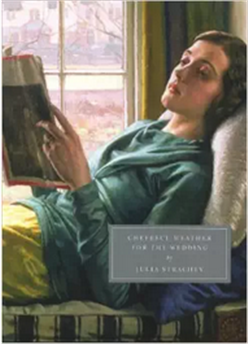
Day 792: Cheerful Weather for the Wedding

Cover for Cheerful WeatherBest Book of the Week!
The house is in chaos on this morning of the wedding of Mrs. Thatcham’s daughter Dolly. Her two sons are arguing about the socks Robert has on and Kitty, the younger daughter, is screaming at the top of her lungs for her maid to find her brooch.

Breakfast has not been served after Mrs. Thatcham’s contradictory commands, and Mrs. Thatcham has just come in from a bitterly cold gale. Still, she thinks the weather is cheerful, as we find that her only criterion for cheerful weather is visibility.

Upstairs, Dolly is putting on her bridal garb with a bottle of rum in her hand. Downstairs, one of the guests, Joseph, has been asking if he can see the bride before the wedding.

At a little more than 100 pages, this novel by Julia Strachey (Lytton Strachey’s niece) is astonishingly rich. Upon its publication in 1932, it was regarded as nearly perfect. And so I find it.

Related Posts

Greenbanks

Someone at a Distance

Mrs. Dalloway

Day 786: Telegraph Avenue

Cover of Telegraph AvenueArchy Stallings and Nat Jaffe own a vinyl record shop on the dilapidated Telegraph Avenue in Oakland. It makes a modest income but mainly provides a hang-out for the locals. Now Archy and Nat are worried because ex-NFL pro Gibson Goode is planning on opening a huge media outlet two blocks away that will include a department for vinyl. Archy and Nat thought that city councilman Chan Flowers was blocking the permits, but now he seems to have changed sides. Curiously, he has also begun asking Archy about the whereabouts of his father, whom Archy has not seen in years.

Luther Stallings and Chan Flowers were involved in a crime years ago before Chan became respectable. Luther went on to star in several Blaxploitation karate films in the 70’s, but for years he has been a has-been and a drug addict. Now, Luther is trying to shake down Chan for the money to make a third film in his famous series.

Archy isn’t altogether certain how he feels about losing his business, but he has other problems. His very pregnant wife Gwen has caught him cheating on her, and his 14-year-old son Titus from a previous relationship, ignored until now, has turned up and made friends with Nat’s son Julie. Furthermore, Gwen, who is in partnership with Nat’s wife Aviva as midwives, has lost her temper with a doctor at the only hospital that allows them admitting privileges, and a hearing is scheduled.

I had a harder time getting involved in this novel than I usually do with Chabon because I found Archy’s behavior reprehensible on many fronts. Of course, Chabon sometimes seems to specialize in the adolescent behavior of grown men, but I have less patience with it. However, Chabon gets in some digs at the lifestyles of Gwen and Aviva’s white middleclass clients, which is fun, and skewers the noir genre in general with the subplot involving Chan Flowers and Luther Stallings.

It takes awhile, but Archy is finally forced to consider his relationships with both his wife and his son. The energy of Chabon’s writing kept me engaged well enough, but the ending of this novel seems overly optimistic, given its web of difficulties.

Related Posts

Gentlemen of the Road

The Child in Time

That Old Cape Magic

Day 785: All Aunt Hagar’s Children

Cover for All Aunt Hagar's ChildrenAs in his wonderful novel, The Known World, Edward P. Jones attempts to depict an entire community in the short stories included in All Aunt Hagar’s Children. This goal is more difficult to accomplish, because the community is a much larger one—the African-American citizens of Washington, D.C.—and the stories take place over much of the 20th century.

Several of the stories have to do with the migration of the characters from the rural South to the city. In “In the Blink of God’s Eye,” Ruth and Aubrey Patterson are a hopeful young couple from across the river in Virginia at the turn of the 20th century. Ruth, though, is homesick, and when she finds a baby boy in a tree one night, Aubrey becomes jealous. This story is first in the collection, but the last story echoes it. Anne Perry, of rural Mississippi, meets George Carter, a sleeping car porter, and moves with him to Washington. In the story “Tapestry,” Jones uses a technique he also employed in The Known World where he breaks off to tell Anne’s entire life. But he twice tells what her life might have been had she married a different man.

The emphasis on rural roots is also important in “Root Worker.” Dr. Glynnis Holloway’s mother has been treated for mental illness for years until her care worker, Maddie Williams, talks the reluctant doctor into consulting a root worker, a wise woman. In the rural North Carolina setting under the care of Dr. Imogene, her mother improves, and Dr. Holloway surprises herself by apprenticing herself to Dr. Imogene.

Another strong theme is that of moving into the middle class. It pervades many of the stories but particularly “Bad Neighbors.” When Sharon is in high school, her family has made it to the middle class, but they are disturbed when the Staggs move in across the street, for they are not considered respectable enough. Sharon’s father is responsible for encouraging the neighbors to club together to buy the Staggs’ house so they can evict the family. Years later, Sharon realizes some truths when she is saved by Terrance Stagg.

Perhaps the thread I least identified with was the presence of folk lore as if it were real, a sort of magical realism. For example, in “The Devil Swims Across the Anacostia River,” Laverne spends a lively afternoon at the grocery store fending off the devil. Years ago, her grandmother got away from him by wading into the Atlantic Ocean to go to heaven.

Although overall, the stories are not as effective as the novel The Known World, they are compassionate to even the lowest of their characters. I particularly found touching “Adam Robinson Acquires Grandparents and a Little Sister,” about Noah Robinson, whose grandson Adam was lost after his drug addict parents abandoned him. The little boy is found, illiterate and frightened, and Noah faces a future of raising his grandchildren instead of the carefree retirement he envisioned.

Related Posts

The Known World

Family Furnishings

Unaccustomed Earth

Day 779: The Quickening Maze

Cover for The Quickening MazeThe Quickening Maze is the first book I read purposefully because it’s one of the finalists for the Walter Scott Prize for Historical Fiction. By coincidence, I had already read half a dozen finalists and winners, and when I learned that Helen of She Reads Novels was trying to read them all, I decided to join her.

This novel is based on events in the life of the poet John Clare, known as the “peasant poet,” a man of rural background who was steeped in his natural surroundings. Unfortunately, Clare is having some mental problems and is staying in an asylum in Epping Forest. Nearby is Alfred Tennyson, whose brother Septimus also resides there.

John Clare seems to be doing well under the treatment of Dr. Matthew Allen. When we first meet him, his movements are relatively unrestrained and except for some confusion about a girl he knew named Mary, he seems sane enough. He is soon given a key to the gate so that he can walk in the forest.

Another patient important to the novel is Margaret, who is regularly transfixed by visions of angels and messages from god. At one point as Clare’s mental state deteriorates, he mistakes Margaret for his Mary.

Dr. Allen seems to have a gift for dealing with his patients during a time when mental health practices were deplorable. However, he also has a fascination with risk, and soon he is trying to talk his friends and the Tennysons into investing in his new invention, a machine for following the shape of furniture and carving additional pieces.

Hannah Allen at 17 has decided that Alfred Tennyson is the man she’d like to marry. She boldly begins seeking him out, not realizing that he is preoccupied with his brother and with grief over the death of a good friend.

Although this novel is more about the internal workings of some of the characters’ minds than its historical setting, it is beautifully written and atmospheric. I was interested in this narrow slice of history and curious to look at some of Clare’s poetry.

Related Posts

Under the Wide and Starry Sky

Parrot and Olivier in America

A Good Hard Look

Day 777: Barchester Towers

Cover for Barchester TowersBest Book of the Week!
As Trollope’s first book in his Chronicles of Barchester was about gentle Mr. Harding’s position as warden, it seems hardly possible that a good portion of Barchester Towers, the next in the series, would be about exactly the same subject. Yet, that is the case, and Trollope finds it to provide more food for satire and social commentary.

Several years have passed since the events of The Warden. The kindly old bishop, Dr. Grantly, is dying, attended by his son, the archdeacon, and his old friend Mr. Harding. Although the younger Dr. Grantly is certainly devoted to his father, he has hopes that he will be appointed to his father’s office, as he has been doing the work for years. However, just before his father dies, a new government comes in, and Dr. Proudie is appointed bishop.

The quarrels in this novel pit low church against high church, which is about all I understand about the religious issues. But all of the clergy in Barchester are high church, and Bishop Proudie is low. Bishop Proudie himself, a meek man, is not so much a problem, but he arrives with a wife who is determined to sit in on every meeting and meddle in diocese business, much to the shock of everyone else. In this she is assisted by Mr. Slope, the bishop’s own chaplain, selected by Mrs. Proudie. And an insinuating, unlikable Uriah Heepish character he is.

One of the first issues to come up for the bishop is the wardenship of the hospital for old men, which has sat vacant since Mr. Harding resigned. Bishop Proudie knows he must offer the position at its lowered salary to Mr. Harding, and Mr. Harding would enjoy returning to the house that was his home for so many years and taking up his old duties. But Mrs. Proudie wants anyone except the entrenched Barchester clergy, so she selects Mr. Quiverful, an impoverished curate with 14 children.

Under instruction from the bishop to offer the position to Mr. Harding, Mr. Slope does so by adding conditions to the position that he knows Mr. Harding will not accept and that Mr. Slope himself, or even the bishop, has no authority to request. Although Mr. Harding does not turn down the job outright, Mrs. Proudie then promises it to Mrs. Quiverful.

But Mr. Slope decides that he can run the bishopric himself if he can cut out Mrs. Proudie, so he and the bishop soon have a silent agreement to throw off the feminine yoke. They do so by offering the wardenship to Mr. Harding again. Mr. Slope has also found out that the beautiful widow, Mrs. Bold, is wealthy. He decides to marry her and feels that he won’t help his chances unless he assists her father, Mr. Harding, back into his position.

In the meantime, Mr. Slope is infatuated with Madeline Neroni, the crippled but beautiful married daughter of Dr. Stanhope. She herself is frankly toying with him and several other men, but she turns out to have some sympathy with Eleanor Bold. However, Madeline’s sister Charlotte Stanhope has decided that her impecunious brother Bertie must marry Eleanor for her money.

Barchester Towers affords another entertaining look at the political and social maneuvers underpinning this mostly religious community. It offers lifelike, engaging characters, plenty of humor, and an empathetic and perceptive view of Trollope’s own time. I enjoyed The Warden particularly because I sympathized with the upright Mr. Harding, but Barchester Towers offers more for our consideration and is an altogether more significant work.

Related Posts

The Warden

Happy Returns

Miss Bunting

Day 774: Miss Emily

Cover for Miss EmilyLast year, I read the novel Amherst, which was mostly about Emily Dickinson’s brother Austin but depicted Emily hazily. The excellent biography White Heat, about Emily’s relationship with Thomas Wentworth Higginson, portrayed her more fully but she still seemed hard to grasp. The Irish poet Nuala O’Connor presents a more fully realized character—Emily in her middle age*—through her relationship to a (fictional) Irish maid.

Ada Concannon is a good worker but a bit too much of a free spirit for her Irish employer. She arrives at work one too many times smelling of the River Liffey, in which she has bathed on the way to work. She is demoted to scullery maid, and her mother decides there is nothing to be done but send her to America to find better opportunities.

Ada has good luck at first. She finds a pleasant home with her aunt and uncle in Amherst, and they soon learn that the Dickinsons need a new maid.

Emily Dickinson has insisted that her parents get a new maid after the old one left, because she is spending all her time on housework and none on writing. Although she loves baking, she is not really interested in most of the other chores. Other than poetry, her main interest is in her warm relationship with her sister-in-law, Sue, but Sue is busy with her family. When Ada arrives, Emily becomes fascinated by the small, neat maid.

Ada soon finds she is being courted. Daniel Byrne shows he likes her right away, and she is attracted to him. His boss’s son, Patrick Crohan, is also trying to get her attention, but she dislikes him.

When Ada finds she needs help, she has only Emily to turn to. Emily, in her turn, goes to her brother Austin.

link to NetgalleyThis novel is beautifully written, sometimes poetically, with delightfully old-fashioned chapter titles. It explores the relationship between two women across a class divide. The two main characters are interesting and convincingly developed. Austin is also developed more fully than the others, but is not as likable.

I enjoyed this novel, which made me feel as if I understood O’Connor’s fictional Dickinson as a person. Although Dickinson at 16 was just beginning to develop some of the quirks she becomes well known for, O’Conner her thinking believable.

*I originally said that Emily was 16, but Caroline of Rosemary and Reading Glasses pointed out that I was mistaken. I thought I saw a reference to her age, but perhaps I got the age reference mixed up with one about Ada. My e-copy is expired, so I couldn’t go back and look it up.

Related Posts

Amherst

White Heat: The Friendship of Emily Dickinson and Thomas Wentworth Higginson

The Invention of Wings

Day 773: We Need New Names

Cover for We Need New NamesI wanted to like We Need New Names more than I did. It is about an interesting topic and is vividly written, sometimes with striking images. But like some of the commenters on Goodreads, I agree that it seems to be trying to deal with too many issues at once. Somehow, I did not get as involved as I expected.

Darling is a tween girl running with her friends from Paradise, a slum of tin shacks in Zimbabwe. They spend their time playing games and stealing guavas from a richer neighborhood called Budapest. Darling’s father has been away in South Africa for years, trying to find work, but they haven’t heard from him or received any money. While Darling’s mother is traveling to sell things, Darling stays with her grandmother, Mother of Bones.

Eventually we learn that Darling’s family used to live a middle class life in a brick house, but the government knocked down their neighborhood. So, they came to live in Paradise.

Bulawayo’s tale is focused enough until, after a vote against the corrupt government results in retaliation, things become too dangerous and she is sent to live with her aunt in Detroit. Perhaps the last third of the novel reflects Darling’s confusion as a teenager, but it packs in scenes of typical teenage years conflated with growing awareness of issues back home, the disconnected feelings of immigrants, the war in Afghanistan, some sneers at the U.S., and her own homesickness. At some times it feels as if Bulawayo thinks America should be responsible for the welfare of all nations, which it can’t possibly do.

Related Posts

Unaccustomed Earth

Once Upon a River

Under the Lemon Trees


Day 766: Miss Bunting

Cover for Miss BuntingMiss Bunting, an elderly governess, has left her usual home at Marling Hall to live with young Anne Fielding in Hallbury. Anne’s health is considered too delicate for her to live with her parents in Barchester, so Miss Bunting has agreed to take her on, with an eye to improving her health, her poise, and her education.

Miss Bunting is an old-school type of governess, a force in herself, whose presence makes others sit up straight. Still, she is fond of her pupils, too many of whom are being killed in World War II.

Jane Gresham has been having a particularly tough war. Her husband Francis is on an island in the Pacific, and he hasn’t been heard of for three years. She has been living with her father, Admiral Palliser, and doing her best to raise her eight-year-old son Frankie.

Robin Dale, son of the rector Dr. Dale, is feeling a bit adrift. He lost his foot in combat. Although his old school has asked him to return to a job as master, he feels he must keep his elderly father company. So, he’s been running a small school for boys preparing for public school.

Jane does a favor for the admiral, going to view housing for Mr. Adams and his daughter. Mr. Adams is a wealthy factory owner looking for a place for the summer, and the admiral is on his board.

This novel is about a disappearing way of life for the British upper class, as personified by Miss Bunting. Class is an important issue in the novel, as the upper levels of Hallbury society are taken aback when Mr. Adams and Heather breach their ranks. Thirkell tells this story with liveliness and wit. Although her tone is sometimes one of asperity, none of her characters are bad, or even ill-meaning, people. Thirkell shows their foibles while still making you like them very much. I’m happy to be rediscovering these novels.

Related Posts

Happy Returns

The Warden

Some Luck

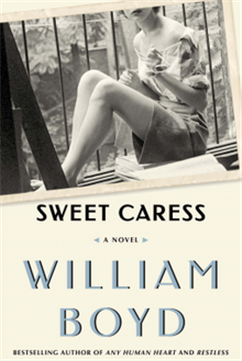
Day 764: Sweet Caress

Cover for Sweet CaressAlthough I have by no means read everything by William Boyd, Sweet Caress reminds me most of his Any Human Heart, perhaps because it’s the story of one person’s life. This novel is about Amory Clay, a photographer born in 1908. Boyd creates the impression that Amory is a real person (so much so that I googled her twice) by interjecting photos of her life into the novel.

Amory leads an unusual life almost from the start of the novel. Although her father suffers from depression and other problems as a result of World War I, she is so content with her home life that she is upset when her parents send her away to school. Her parents are not well off, but Amory learns later that a legacy from an aunt is dedicated to her education.

Her mother wants her to attend university, but she decides early that she doesn’t want to go. Her favorite uncle, Greville, gave her a camera on her 10th birthday, and she wants to be a professional photographer.

Then a violent incident brings her home. Her father arrives at school unexpectedly to take her to tea. But his intention is to commit suicide, and he doesn’t want to go alone. Amory survives the drive into the lake and even saves her father, who is committed to an institution for a long time.

Soon after, Amory becomes Uncle Greville’s assistant. He is a society photographer, and although Amory does not enjoy this type of work, she must start somewhere. But she takes a risk with an unusual betrothal photo, and its reception ruins her chances. Soon Amory is off to capture the decadent night life of Berlin.

Amory leads an extraordinary life that contains many sorrows and triumphs. She is a war correspondent for both World War II and the Vietnam War, she is attacked by fascists rioting in London, she travels with lesbians to Mexico, she encounters a Charles Manson-like figure in 1960’s California. She almost unwittingly marries a lord and has a family. These are just some of the events of her life, its story punctuated with paragraphs from the “present time” of 1978, when Amory is an old woman.

link to NetgalleyI found this novel involving, although not as much as I did Any Human Heart. For one thing, I wasn’t always convinced I was hearing a woman’s voice, and in no way was this because of Amory’s adventurous life. Also, Amory’s voice is a reserved one, with certain exceptions. Still, it is a fascinating story that manages to cover a great deal of modern history.

Related Posts

The All-True Travels and Adventures of Lidie Newton

The Signature of All Things

The Lacuna