Review 1615: Swimming Lessons

Best of Ten!
I was interested in reading Swimming Lessons when it came out, but I never actually got hold of a copy. Then I read Fuller’s next novel, Bitter Orange, and liked it so much that I had to read Swimming Lessons.

Gil Colman, a famous writer who hasn’t written anything for years, is now elderly and dying of cancer. He has discovered letters from Ingrid, his wife who was presumed drowned years ago, tucked away in his thousands of books, many of which were removed from his house by his daughter Nan and sold to a bookstore. He is in the bookstore, having discovered one of the notes, when he thinks he sees Ingrid out in the street. Rushing after her, he gets injured.

That is the setup of the novel. From there, chapters alternate between the letters telling the story of their marriage from Ingrid’s point of view and Gil’s daughter Flora’s point of view as she returns home because her father is in the hospital. She tries to learn more about Ingrid, who she believes is alive. Although the sections about the current time and Flora’s struggles are interesting, most enthralling are Ingrid’s letters to her husband, describing a marriage in which, as a naïve girl thirty years Gil’s junior, she falls into a life she does not want, of marriage and children, to a husband who is serially unfaithful, and who, in a way, co-opts her past.

This is a fascinating and haunting story about the secrets of a marriage.

Related Posts

Bitter Orange

The Wife

The World’s Wife

Review 1611: Flights

Olga Tokarczuk’s Drive Your Plow over the Bones of the Dead was unusual, but Flights is in another category altogether. It is an attempt to escape the boundaries of the conventional, linear novel.

It is written in snippets. Some of them are stories, some little vignettes or descriptions, some philosophical discursions, some lectures. Some of the snippets are observations from the narrator, an unnamed Polish woman who likes to be constantly traveling, often to visit museums of curiosities, particularly those that show the workings of the human body. Others are stories about people she meets on her journeys or just stories about people. Some of the threads recur in the novel; most do not.

Anchoring all this is the theme of movement. Most of the stories are about people on their way somewhere else, occasionally to another stage of being.

This novel was widely acclaimed by reviewers and won the Man International Prize. How it will strike ordinary readers is hard to guess. It’s not easy. I found parts of it interesting and other parts, particularly the lectures on travel psychology, which I doubt anyone would ever listen to, incomprehensible, as if someone were reading from a dense professional manual.

Related Posts

Drive Your Plow over the Bones of the Dead

Outline

Ducks, Newburyport

Review 1599: The Mayor of Casterbridge

At a small county fair in the early 1800’s, a drunken Michael Henchard sells his wife and child to a sailor. Twenty years later, his wife and her daughter come seeking him, the sailor having disappeared at sea and the two being nearly destitute. When they arrive at Casterbridge, they find he is wealthy and the town’s mayor.

To his credit, Henchard looked for his wife and child twenty years ago, but they had emigrated to Canada. Wanting to make amends, he suggests that Susan Newson, as his wife calls herself, and Elizabeth Jane stay in Casterbridge. He will appear to court Susan and will marry her.

At the same time, he meets a young Scotsman, Donald Farfrae, and likes him so much that he offers him a job. But Henchard has a hasty temper and a jealous, unforgiving nature, and as Donald becomes successful, Henchard takes a dislike to him that grows into enmity. A final issue is caused by another incident from Henchard’s past.

Henchard is not a likable character. Although he is often repentent of his actions, his temper creates situations, like the sale of his wife, that lead to his downfall. This is an interesting novel for Hardy, whose main characters, although flawed, are usually more sympathetic. Still, it is an absorbing and dramatic story about a man who is his own worst enemy.

Related Posts

Far from the Madding Crowd

Tess of the D’Urbervilles

That Lass o’Lowrie’s

Review 1586: Literary Wives! The Age of Innocence

Cover for The Age of Innocence

Today is another review for the Literary Wives blogging club, in which we discuss the depiction of wives in fiction. If you have read the book, please participate by leaving comments on any of our blogs.

Be sure to read the reviews and comments of the other wives!

Cynthia of I Love Days
Eva of Paperback Princess
Lynn of Smoke and Mirrors
Naomi of Consumed By Ink

* * *

I reviewed this novel, one of my favorites, back in 2015, and I find I still agree with my original review. So, I will not re-review it, but instead am providing the link to the original review. Then I will go on to consider our usual question for this club.

What does this book say about wives or about the experience of being a wife?

“Ah, no, he did not want May to have that kind of innocence, the innocence that seals the mind against imagination and the heart against experience!” So thinks Newland Archer in contemplating May Welland, his fiancée. But of course, that’s the kind of innocence May has, as he is too slow to discover, just as he is too slow to discover he is actually in love with May’s cousin, the Countess Olenska. Newland has fastened on May’s shining purity, so that even as he hopes never to live a life of sameness, to teach May to appreciate the arts and travel, he hasn’t seemed to notice the sameness that the Wellands pursue as they cater to their hypochondriacal patriarch, spending the late winters in St. Augustine and the summers in Newport, carefully following the dictates of society.

In this novel, we don’t so much see what it’s like to be Newland’s wife as to be May’s husband. On their honeymoon, after May has dismissed the tutor Newland wishes to invite for dinner as “common,” with her limited, provincial thinking, Newland “perceived with a flash of chilling insight that in future many problems would be thus negatively solved for him, but . . . he took refuge in the comforting platitude that the first six months were always the most difficult in marriage. ‘After that I suppose we shall have pretty nearly finished rubbing off each other’s angles,’ he reflected; but the worst of it was that May’s pressure was already bearing on the very angles whose sharpness he most wanted to keep.”

Two years into the marriage, he makes plans to take flight with Ellen Olenska, thinking he can talk her into it when she is resolved not to betray her family. Wharton has just explained that Newland has given up reading poetry in the evenings because May “had begun to hazard her own [opinions], with results destructive to his enjoyment of the works commented upon.” In that scene, where he finds himself literally stifling, “As she sat thus, the lamplight full on her clear brow, he said to himself with a secret dismay that he would always know the thoughts behind it, that never, in all the years to come, would she surprise him by an unexpected mood, by a new idea, a weakness, a cruelty or an emotion.”

The other important marriage in this novel is only hinted at, but it underlies all of the action. That is Ellen’s marriage to Count Olenski. We are told the man is a brute, that he is a womanizer. When the Count’s secretary comes to make Ellen an offer to return to her husband, he tells Newland he has seen a change in her—that she must not go back.

Literary Wives logo

Ellen herself is reticent about her marriage, and I am actually not sure what Olenski’s brutishness is supposed to consist of, but I think we are to understand that she has found, despite its faults, New York society possesses a fineness and honesty that is not present in her former milieu. She wants to become a better person, so she will not go back and she does not wish to betray May and the rest of the family despite her love for Newland. And May, despite her false assumption that the two are having an affair, finds the best way to thwart Newland’s plans.

Related Posts

Madame de Treymes

The Master

Middlemarch

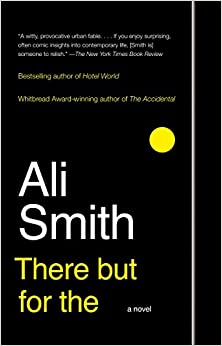
Review 1577: There but for the

I have enjoyed most of what I have read by Ali Smith, but at first the premise of There but for the seemed a little too absurdist for me. The novel is really four separate stories that are related to the event in the first story and share characters.

In “There,” Anna is summoned by Gen Lee to Gen’s house, because Gen found Anna’s contact information in Miles’s jacket pocket. At a dinner party at Gen’s, Miles, whom Gen does not know, locked himself in a guest room and refuses to come out. At first, Anna barely remembers Miles from a trip to Europe when she was 18, 30 years before, but then she remembers his act of kindness.

In “But,” Mark Palmer, who took Miles to the Lee’s dinner party, recounts his initial meeting with Miles, notable for Miles’s kindness, and invites him to Lee’s party. Some of the conversation of the party is marked by astounding stupidity, rudeness, and bigotry by some of the guests, so much so that I found it hard to believe, especially as a mixed-race child was there.

In “For,” a dying old lady is determined not to be sent to a depressing nursing home she visited long ago. After the death of her youngest daughter, she has been visited every year by one of her daughter’s friends, even though she doesn’t like him. This year he doesn’t come, because he is Miles, locked up in the Lee’s spare room, outside of which has formed a circus-like gathering of observers. But Miles has sent a substitute.

In “The,” Brooke, a precocious nine-year-old who also attended the party, recounts her ideas and memories, particularly a meeting with Miles.

Almost despite myself, I got caught up in this novel even when impeded by its verbal gymnastics, which were sometimes amusing but often annoying. I had a great deal of trouble, though, with the semi-stream-of-consciousness approach to the last section. At first, it was fun, but eventually I got tired of it and felt it could use some editing.

I read this book for my James Tait Black project and found it inventive but a bit overwhelming. Too many ideas are thrown out to us, in the end.

Related Posts

How to Be Both

Autumn

Winter

Review 1576: Smile of the Wolf

Best of Ten!
During a long winter night, Kjaran, a skjald, or poet, tells his host, Gunnar, about stories of a ghost on the farm of the recently deceased Hrapp Osmundsson. Gunnar, a Viking who retired to a farm and family, decides they should go kill the ghost.

At Hrapp Osmundsson’s farm, they find a ghost and challenge him to a battle. Gunnar kills him, and only then do they realize he is a neighbor, Erik Haraldsson, dressed as a ghost. He had been conspiring with Vigdis, the widow, to scare the neighbors off their lands so they could take them.

According to Icelandic law, the death would call for blood money paid to the man’s relatives, perhaps followed by a feud. But Vigdis urges the men not to report the death because of the shame to Erik of his deception. To not report the death is a worse crime than the killing, but Kjaran and Gunnar agree.

They soon learn what a mistake they’ve made, because Vigdis comes to Gunnar’s house and demands he put aside his wife and children and marry her. Gunnar refuses, and Vigdis begins making trouble that results in a feud and outlawry for Kjaran.

This gripping tale set in 10th century Iceland is modeled after the Icelandic sagas. Kjaran tells his story to someone who remains unidentified until the end. It is beautifully written, a memorable novel that is heart-breaking and powerful.

Related Posts

The Long Ships

Iceland’s Bell

The Greenlanders

Review 1568: The Cross

The Cross, the final book of Kristin Lavransdatter, begins after Kristin’s husband Erlend Nikulaussön’s political intrigue has resulted in the loss of all his property to the crown. Kristin and her family have resettled on her farm, Jörundgaard, which she inherited from her father. Erlend is no farmer, however, so Kristin and Ulf Haldorssön must see to everything. Kristin despairs because her sons are not learning how to keep the estate. Instead, they go running off with Erlend to hunt and occupy themselves as knights do. The likelihood of their being able to lead a knightly life is little, though, because of Erlend’s disgrace.

Although Kristin believes that her relationship with her sister, Ramborg, and brother-in-law Simon Andressön is good—in fact, she turns to Simon when she needs help—she finds that Ramborg is jealous of her.

This novel is the last volume of the series, and I found it more touching in several places than I did the other two. Kristin has found that her headstrong insistence on marrying Erlend has brought her to a life of unending care, and she must somehow resolve this.

This is a really interesting series which endeavors to show the  whole of this medieval woman’s life.

Related Posts

The Bridal Wreath

The Mistress of Husaby

The Greenlanders

Review 1557: Idaho

Best of Ten!
If you prefer the kind of novel that answers all your questions and ties everything up in a neat little bow, then Idaho is probably not for you. It is a haunting, atmospheric novel that ponders the depths of the human heart—love, guilt, friendship, regret.

The novel begins with Ann, married to Wade, a man with a tragic past. A year before his marriage to Ann, while he and his first wife Jenny were out cutting firewood, Jenny killed their youngest daughter, May, with an ax. Thinking only to keep his wife away from their older daughter, June, Wade drove the truck containing his wife and dead daughter down the mountain looking for help, leaving nine-year-old June there. Misunderstandings with the police prevented him from immediately returning, and June was lost.

Now Ann lives with Wade on their remote mountain farm, but she doesn’t really understand what happened. Wade prefers not to discuss it, and anyway, his memory is beginning to fail from hereditary early-only Alzheimers.

This novel explores this event and its ramifications through about 50 years of time and the viewpoints of a number of characters, some only peripheral to the story. It is beautifully written, provocative, and tragic. It is absolutely a wonderful novel.

Related Posts

Solace

Elmet

Wild Decembers

Review 1526: Olive, Again

Best of Ten!
Reading Olive Kitteridge years ago was a revelation to me, first about structure—how Strout could create a novel of a bunch of loosely connected stories—and second about her empathy for her characters, ordinary people in a small Maine town. Finally, there was that force of nature, Olive herself.

Olive, Again is no disappointment. This novel is structured much the same as Olive Kitteridge, stories about Olive and stories in which she is a secondary character or is simply mentioned or thought of. Olive herself is an old woman, who nevertheless toward the beginning of the novel embarks on her second marriage. The novel revisits her difficult relationship with her son, who brings his family for a disastrous visit that gives Olive insight into their relationship as well as that between herself and her first husband, Henry.

Olive is still her straightforward, brusque self, but many of the stories are about troubled people who feel better after encounters with her. Because they live in a small town, people who are the focus of one story appear or are mentioned in the others. For example, in “Helped,” Suzanne Larkin, from a disturbed family, has a heartfelt talk with her father’s lawyer, Bernie, whom Olive meets when she is living in an assisted living facility later in life.

Characters from some of Strout’s other books appear here, too, perhaps more characters than I remembered. Certainly, there are Jim and Bob Burgess from The Burgess Boys, a story about Jim and his wife visiting from New York, as well as Isabelle from Amy and Isabelle, whom Olive befriends in assisted living.

This is another warm and empathetic novel about complex but ordinary people. Strout is a master crafter of a tale.

Related Posts

Olive Kitteridge

The Burgess Boys

Amy and Isabelle

Review 1518: Chances Are

When Lincoln decides to sell the cottage on Martha’s Vineyard that has long been in his mother’s family, he thinks it’s a good opportunity to reunite with his friends from college, Mickey and Teddy. Although it’s more than 40 years since they spent Memorial Day weekend at this cottage, they’ve kept in touch all these years. Back in the day, they were the three students at an elite college who did not share their classmates’ blue-blooded, wealthy backgrounds.

Being on the island brings back memories of Jacey, the girl all three of them loved. She also shared that last Memorial Day weekend with them. Then she left and apparently disappeared from the face of the earth.

Lincoln, a successful real estate dealer who’s had some difficulties since 2008, begins looking into Jacey’s disappearance. Teddy, an editor who sometimes suffers from mental illness, is troubled by his memories of that weekend.

This novel explores friendship, difficult relationships, and even muses on fate. It is well written, as Russo’s novels always are, and engaging. I haven’t had as much enjoyment from Russo’s latest efforts as I did for his earlier ones, but this one comes close to being as good as, say, Empire Falls or Nobody’s Fool.

Related Posts

Empire Falls

Everybody’s Fool

Bridge of Sighs