Day 620: Literary Wives! The Shoemaker’s Wife

Cover for The Shoemaker's WifeToday is another meeting of Literary Wives, where a group of bloggers get together and review a book about being a wife. If you have read this month’s book and would like to participate, leave comments on any of our blogs. Be sure to read the reviews and comments of the other wives!

One thing I can say about The Shoemaker’s Wife. It provoked discussion in our household. After reading the novel’s first two paragraphs to my husband, I asked, “Does this qualify as purple prose?” and he answered, “It’s at least very mauve.” In any case, the novel is packed with labored metaphors, some of which leave us readers with very odd mental images—for example, a comparison of the Alps to silver daggers.

The novel is based on the story of Trigiani’s grandparents, a couple who met as teenagers in the Italian Alps and then were separated by circumstances for years. I haven’t read any of Trigiani’s other books, but along with many other writers these days, she doesn’t seem to understand in this novel that making things happen to her characters doesn’t automatically make readers care what happens to them. Her characters have traits, but they don’t have any emotional depth, so we don’t care about them.

A specific example of this comes early in the book, when the girl Enza’s little sister dies. Abstractly, the death of a child is sad, but since we barely know Enza and we just met Stella a few paragraphs before she died, we don’t feel much about it. If we had a sense of the child or the older sister, we would care more.

I was unable to finish this book, so I can’t answer the usual Literary Wives questions about it. Realizing I was not enjoying it at all, I decided to read a quarter of it and if I still felt like I was wasting my time, to stop. It is a very long book, so I read about 120 pages, and Ciro and Enza had just met by then, with Ciro banished to America immediately after. When I quit reading, Ciro was on the ship to New York. So, no answers to questions about how wives are depicted in this book, not even about the main character’s mothers. Ciro’s mother abandons her sons at a convent at the beginning of the book because she can’t support them and is never seen again, and Enza’s mother is a vaguely drawn figure who simply works hard.

All novels aren’t character driven, but for me there has to be something that makes a novel interesting besides the plot. Sometimes it’s the voice of a compelling character, sometimes a puzzle, sometimes a fascination with the subject or world view being described, but it has to be something.

Literary Wives logoWhile I’m writing this, I’m thinking of examples, about how Agatha Christie could create a distinct character in a few sentences, not a nuanced one, but a distinct one nevertheless. I’m thinking how in The Secret Garden we immediately recognize Mary as an unlikable child, but we can see how the fear of waking to find everyone gone from her home in India has made her more demanding, and we sympathize. I’m thinking of how hard I cried when Beth died in Little Women. And I’m thinking how fascinated I was by 18th century Japan in The Thousand Autumns of Jacob De Zoet.

Read along with us in February, when we will be reading and commenting on The Last Wife of Henry VIII by Caroly Erickson.

Day 592: Literary Wives! Wife 22

Cover for Wife 22Today is another meeting of Literary Wives, where a group of bloggers read and discuss depictions of wives in fiction.

* * *

I guess by definition chick lit is predictable, so perhaps it is unfair to criticize Wife 22 because I could tell where it was going before it got there. Still, I do criticize it for that, although it is well written, has funny, believable dialogue, and is quite enjoyable to read.

Alice Buckle is feeling a little dissatisfied with life. She has a handsome husband, but he has seemed withdrawn of late. She is often at loggerheads with her fifteen-year-old daughter, although she is very close with her younger son. She enjoys her work as a drama teacher at an elementary school. Still, the spark is gone between her and her husband.

She is invited by email to take part in a survey about marriage. To maintain anonymity, she is assigned a login of Wife 22 and a caseworker, Researcher 101. She finds it exciting to have a harmless secret and cathartic to answer the questions.

But it isn’t too long before the two are emailing each other outside the survey. Alice feels as if Researcher 101 really listens to her and understands her. Soon, she is fighting to keep herself out of an emotional affair. The situation is made more difficult because her husband William has abruptly lost his job.

I liked all the characters in this novel except the one I wasn’t supposed to like. However, I seldom read chick lit and again, I felt that this novel was predictable.

Literary Wives logoWhat does the book say about wives or about the experience of being a wife? In what way does this woman define “wife”—or in what way is she defined by “wife”?

I have to admit this portrait of a modern wife is more well rounded than we have seen in some other books. Alice is a failed playwright—her one produced play was a flop—but she really enjoys her job working with children. As a mother, she is actively engaged with her children, although inclined to worry unnecessarily and feel inadequate. Her relationship with her husband is friendly but a bit distant. When she tries to feel him out about emotional issues, he is abrupt and dismissive. In this regard, she is needy, letting a feeling of being unloved and inadequate prevent her from dealing honestly with her husband. I’m not sure, though, that any of this says something about being a wife. I feel as if this novel comments more on marriage itself and what can happen to it if it’s allowed to grow stale. There are problems between Alice and her husband, but her husband also has his own troubles that Alice is too preoccupied to pay attention to.

The Wives

Be sure to read the reviews and comments of the other wives!

Day 564: Literary Wives: The World’s Wife

Today is another posting for Literary Wives, where a group of bloggers get together to discuss the same book about wives and invite others to join in the conversation. Please take a look at the reviews of the other members, listed below.

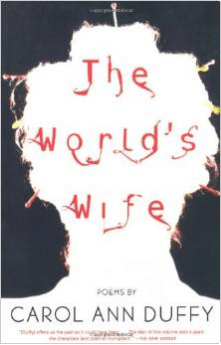
Cover for The World's WifeMy Review

My relationship with poetry is not so comfortable that I expect to burst out laughing when reading it. But that’s exactly what I did several times when reading The World’s Wife.

This book contains a clever, brilliant collection of poems united by a single conceit. Duffy looks at legendary figures, that is, some figures of myth and fairy tale and a few from real life, from the points of view of their wives. Occasionally, male figures become females. In any case, the result is to turn the myth, be it legendary or real, on its head.

The first time I laughed out loud was when reading the Poem “from Mrs. Tiresius.” Regrettably, I did not know who Tiresius was, so I looked him up. It turns out he was a blind prophet who managed to offend Hera, so she turned him into a woman. In the poem, when Tiresius comes back as a woman, his wife at first tries to help him, takes him shopping, teaches him to blow-dry his hair.

Then he started his period.

One week in bed.
Two doctors in.
Three painkillers four times a day.

That’s when Mrs. Tiresius loses patience, and I laughed.

These poems are cheeky, earthy, inventive, and sometimes extremely powerful. Although many of the wives view their men’s activities with cynicism, the poems are not always so, as in the beautiful sonnet called “Anne Hathaway,” in which Hathaway fondly remembers the activities that took place in the second best bed. I love this book.

What does this book say about wives or the experience of being a wife? In what way does this woman define “wife”—or in what way is she defined by “wife”?
Literary Wives logoThere are 30 poems in this collection, each of them from the point of view of a different woman. The most common viewpoint is a certain cynicism about the wives’ husbands or their activities, but that is by no means true of every poem. In many, though, the man or the love of man is a source of pain.

At first, Penelope looks for her husband and waits for him to come home. Then she gets involved in her embroidery and meets his return with a certain dismay. Mrs. Sisyphus laments that ever since he started pushing that stone up the hill, he’s been ignoring her for his work. Mrs. Midas cannot believe the greed and stupidity that made her husband wish for something that keeps him from eating or touching her ever again. Mrs. Aesop is bored stiff by her husband’s constant platitudes. Naive Little Red Cap let the wolf seduce her with poetry, but ten years later she sees he is a dog with no new tricks.

Some of the poetry can be somewhat misandrist, and most of it ends in some sort of triumph for the woman, occasionally one that is gruesome.

The Wives

Be sure to read the reviews and comments of the other wives!

Day 530: Literary Wives! The Crane Wife

Cover for The Crane WifeToday is another Literary Wives review, where the wives explore the depiction of wives in contemporary fiction. Please be sure to check out the reviews of all the Literary Wives.

Also, you can join in by adding comments on any of our pages or on our Facebook page!

***

George is awakened in the middle of the night by a strange cry. When he looks out the window, he is astonished to see a wounded crane in his garden. He removes an arrow from the crane’s wing, and the crane flies away.

The next day he is doodling at work when he gets the urge to cut up an old book. He makes a paper crane. When a woman named Kumiko arrives at the shop, she takes away his crane and unites it with a tile of feathers she has made, creating a wonderful sculpture.

Women have always left George, deeming him to be too nice. Kumiko, though, quickly becomes his lover and promises to be his wife.

George’s daughter Amanda is feeling lonely. Because of her anger and acerbic wit, she has never kept her friends. It is beginning to look like her friendship with coworkers Rachel and Mei is going south. She loves her ex-husband Henri, but her anger drove him away. Only her four-year-old son JP and her father seem to stay.

The stories of these characters are periodically interrupted by a fable about the love/hate relationship between a goddess and a volcano. Eventually, these two threads intersect, overlaying the everyday story with mythic and magical overtones.

I was much more interested in the everyday story of George, Amanda, and Kumiko than I was in the mythic elements, which at times seemed to be trying too hard to be profound. The everyday story was touching and sometimes funny, the character Mehmet being particularly amusing.

What does this book say about wives or the experience of being a wife? In what way does this woman define “wife”—or in what way is she defined by “wife”?

There are two wives in the story. One is Amanda, who loves Henri. But her self-hatred is so strong that she feels something must be wrong with Henri for him to love her back. So, she fights with him until he leaves her. Eventually, she has to settle for being his friend.

Although she and George never actually marry, the other wife is Kumiko, the crane wife. She is a self-sacrificing figure. To stay with George and make their works of art, she tears the feathers from her own body. In her mythic self, though, she offers forgiveness at a terrible price, by ripping out a person’s heart and blinding him, then turning him to stone.

Is Ness saying that we’re only forgiven if we are blind, heartless, and turned to stone? Or are we only free of pain in that condition? Ness’ vision of love, that it is greedy, angry, or self-sacrificing, is a strange one. The goddess’s love is harrowing while Kumiko’s makes her give up everything. All of these ideas seem at once confused and simplistic. Literary Wives logo

I think Ness is saying more about love than about being a wife—that true love is more self-denying than greedy. George becomes obsessed with learning everything he can about Kumiko instead of accepting what she can give—and that leads to unhappiness.

But my question is, is either view of love a true one? Is it healthy or even right to be so self-denying that you literally mutilate yourself for love?

Day 466: Literary Wives: The Inquisitor’s Wife

Today the Literary Wives blog group members all review The Inquisitor’s Wife. Be sure to check out the other reviews at the links at the bottom of this review. We encourage you to participate by submitting your comments or a link to your own review to any of our blogs, or you can submit a comment or link on our new Facebook page! For more information, see my Literary Wives page.

Cover for The Inquisitor's WifeThe Review

The Inquisitor’s Wife is a historical novel with a promising concept that is not fulfilled. Although set in an interesting era and place, its characters behave as they need to just to drive the plot.

Marisol Garcia is the daughter of Diego, a respected Old Christian of 15th century Seville, and Magdalena, a converso, or Jewish woman forcibly converted to Christianity. Although as a child Marisol observes her mother’s celebration of the Sabbath on Friday nights without understanding what it means, when she is 11, she is ridiculed by the neighborhood children for being a Jew. Humiliated, she turns against her mother and refuses to take part in her rituals.

This, aside from a complete lack of a sense of their household and daily life, was my first problem with this novel, because Marisol’s loyalties and feelings about her heritage shift back and forth throughout the novel. Having adored her mother, she turns against her in an instant after one incident. Later, she changes her mind several times, and in general her behavior as a young woman is more like that of a spoiled adolescent.

As Queen Isabella gains power, the conversos of the city hope she will protect them, as she herself has married one of them, King Ferdinand. They are about to be gravely disappointed.

Eventually, everyone hears rumors of an Inquisition, and Magdalena becomes terrified that the horrible events of her childhood will recur. She urges Diego to move the family to Portugal, but secure in his own innocence and unaware of his wife’s activities, he is firm in his belief that they are not in danger. Marisol follows her mother outside one night to the river and sees her drown herself, apparently from despair.

Marisol has been in love with her neighbor Antonio since they were children. They are engaged while he is away studying, but after she does not hear from him for over a year, she believes he has abandoned her. Shortly after her mother’s death, she finds out her father has made some kind of deal with another neighbor, whom she detests, Gabriel Hojeda, who is a civil administrator for the Inquisition. She is forced to marry him, and her father renounces her.

Of course, he is trying to protect her as the Inquisition is going after him (for no apparent reason but that his wife was a converso), but it takes her awhile to figure this out. She continues to be clueless throughout the novel, not picking up on any of the hints that are strewn everywhere. Then, on her wedding night, Gabriel’s intimidating brother Fray Hojeda asks for a promise that the two will not consummate their marriage for a month. There is no apparent reason for this request either except the plot’s need to save Marisol for Antonio and to introduce a sadistic sex scene toward the end of the novel.

I can go on and on about the unlikeliness of the plot as Marisol and her father fall deeper into danger. But one tiny spoiler reveals how poorly thought out this novel is. Marisol and Antonio don’t hear from each other in a year. Why? Because jealous Gabriel is stealing their letters. How he does this is not explained, but mail is not exactly sitting out in the mailbox. Oh, let’s have another example. In a late scene in the novel, Marisol and Antonio swim to safety—this in a time when most Europeans didn’t swim, even sailors, not to mention gently born Spanish ladies dressed in enveloping and heavy garb. She would have sunk immediately.

As I mentioned before, there is no sense of the characters’ daily lives except for Magdalena’s time spent painting ceramics, and that is in service of the plot. When Marisol gets married, instead of taking over the household as a well-trained wife of her class would do, she asks her husband what she should do and since he gives her nothing to do, apparently does nothing except run around town unchaperoned. Except for Marisol, all of the characters are completely undeveloped. Everyone is either good or bad. Although this novel has the opportunity to say something about the Inquisition, it disintegrates into a messy damsel in distress story that becomes more absurd as it continues. If it was purely a romp, I wouldn’t judge it so harshly, but it seems to have pretensions to something more serious.

Literary Wives logoWhat does this book say about wives or the experience of being a wife?

Marisol’s marriage to Gabriel is just a plot device. Even its motivation doesn’t make sense, because if she and her father are in danger just because of her mother, Gabriel’s having married Marisol would logically put him in danger. He would not be able to protect her and in fact, does not really try to. As to the other marriage, her parents’ is warm but only scantily depicted. The only true family, that of Marisol’s uncle, comes to the novel late, and we don’t see much of it.

In what way does this woman define “wife” or is defined by “wife”?

This novel doesn’t really concern itself with wifehood. Gabriel’s definition of a wife is someone who is in his power. Other than being another threat to the damsel and a way to keep her and Antonio apart, Marisol’s status as a wife is hardly even regarded or treated with. In fact, in another unlikely plot twist, she is asked to keep her marriage a secret, even though she is living in her husband’s house unchaperoned and would have her reputation damaged if she was not thought to be married. Diego and Magdalena love each other, but Magdalena deceives Diego in continuing to observe her religion, and we don’t see much of them together.

Be sure to view the posts of the other “wives,” as follows:

Ariel of One Little Library
Audra of Unabridged Chick
Carolyn of Rosemary and Reading Glasses
Cecilia of Only You
Lynn of Smoke and Mirrors

Day 401: Literary Wives: Ahab’s Wife Or, The Star-Gazer

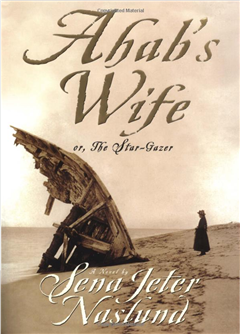
Cover for Ahab's WifeToday I am doing something a little different–participating in a virtual book-discussion group with Literary Wives. Literary Wives is a group of bloggers who are wives and are reading books about how wives are depicted in fiction. Toward the end of my normal review of this month’s choice, I will answer some specific questions that appear in every Literary Wives review. Be sure to check out the other reviews by Audra of Unabridged Chick, Ariel of One Little Library, Emily of The Bookshelf of Emily J., Carolyn of Rosemary and Reading Glasses, Cecilia of Only You, and Lynn of Smoke and Mirrors.

I have quite got to like what appears to be a newish fashion of rewriting works of fiction from a different viewpoint. Although it has produced some mediocre results, it has also produced some gems, a few of which are Wide Sargasso Sea by Jean Rhys, The Solitary House by Lynn Shepherd, and now, Ahab’s Wife by Sena Jeter Naslund.

I was somewhat put off by Naslund’s writing style in her most recent novel, The Fountain of St. James Court; however, it is imminently suited to her most well-known novel, this one, which is a reworking of Moby Dick. This novel is truly an adventure. It begins with a brief look forward to Una Spenser’s delivery alone in a cabin in the wilds of Kentucky of Ahab’s child, which does not live long, and the subsequent discovery that her mother has died in the snow while going for help. If this isn’t enough going on, while she is in labor, Una also has an encounter with bounty hunters looking for an escaped slave. Later, she helps the slave girl escape.

After this glimpse ahead in time, the novel returns to take a relatively straightforward path, beginning with twelve-year-old Una’s banishment from this same cabin in Kentucky. Una has faced some abuse at the hands of her father because of a difference in religious beliefs, so her mother sends her to her Aunt Agatha and Uncle Jonathan, where they live on a lighthouse island off Massachusetts. So begins Una’s fascination with the sea.

Although not every 19th century woman would think life with a loving, thoughtful, intellectually curious family confining, Una eventually finds it so, when she is sixteen. Her feelings are complicated by the arrival of two young men who come to prepare for the installation of a new light for the lighthouse. They are best friends Giles Bonebright and Kit Sparrow. Una knows she likes them both but is not at first sure which one she likes best. This fateful meeting is to affect the rest of Una’s life.

But I am writing nothing here that reflects how unusual this novel is. First, it documents the extraordinary life of an extremely uncommon character. If some of the other characters are not so fully drawn, you really feel as if you know Una. Next, in its occasional long asides and fits of oratory, it is a fitting companion to Moby Dick, with its dissertations on bits of whaling gear and its exhortations by Ahab. If any woman is a match for Ahab, Una is. Finally, its language and ideas are lyrical and soaring, as Una grows intellectually, meets her own life full on, and becomes acquainted with historical figures from her time and place.

If I have a caveat, it is that I feel the exceptional Una would have had more problems of acceptance in the actual 19th century American setting. In keeping with a theme about the enjoyment of life, not only does Una throw off debillitating experiences with little trouble or regret, but she also finds warm friends and acceptance everywhere she goes. It would give away too many plot points to discuss why I find this unlikely.

For Literary Wives: What does this book say about wives or about the experience of being a wife?Literary Wives logo

This novel does not draw on a conventional idea of a wife, particularly for the time it is set. For Una, being a wife seems to mean giving unstinting loyalty up to a point, but this loyalty can vanish fairly quickly if the relationship becomes disrespectful, and Una’s natural ebulliance takes her over some terrible difficulties with relative (and perhaps unlikely) ease.

I don’t think Una lets the conventional notions of wifehood affect her at all. She just does what she wants and what she thinks is right, but her ideas of right are different from other people’s. For her, a husband seems to be the more modern idea of a partner. Certainly, mutual respect, sexual attraction, and love enter into this equation but not so much the typical 19th century idea of duty.

In what way does this woman define “wife”–or in what way is she defined by “wife”?

I don’t think Una is defined by “wife” at all. I think “person” is more what Naslund is interested in. In a review of this book, it was referred to as a feminist, earth mother, reinterpretation of Moby Dick. I don’t see the earth mother so much, but the feminism is certainly there. “What was a promise? A way to enslave the future to the past,” Una thinks at one point.