Day 528: A Tale of Two Cities

Cover for A Tale of Two CitiesIt has been a long time since I read A Tale of Two Cities, and I did not remember anything except its broadest outlines. The novel is unusual for Dickens in two respects. It is his only historical novel, and it is probably the grimmest. Although he handles some weighty subjects in other novels—the poor laws, the civil justice system, mistreatment of children, abusive schools—this novel about the French revolution shows little of his celebrated sense of humor.

The novel centers around a much smaller cast of characters than usual for Dickens. It begins with Dr. Alexandre Manette, long a resident in a French prison for reasons we do not learn until the end of the novel. When the book begins, he is free but severely disturbed from trauma. His daughter Lucie travels with his banker Jarvis Lorry from England to bring him back to London.

Five years later, he is living contentedly with his daughter in England. Their friend French émigré Charles Darnay is tried for treason on bogus charges, but he is released when his defense proves that the principal witness cannot tell him apart from Sidney Carton, a barrister. These characters will soon become well acquainted.

When the novel returns to France, it shows us the extreme poverty of the poor as well as grim depictions of their mistreatment by aristocrats. Darnay returns to France to meet his uncle, the Marquis St. Evrémonde, and renounce his inheritance. St. Evrémonde’s careless slaughter of a young child when he runs over him in his carriage and his disdainful treatment of his nephew are all we see of him before his murder.

Secretly, a revolutionary society is growing and taking note of atrocities such as those committed by Evrémonde. Wine shop owners Monsieur and Madame Defarge are involved, and at first we have sympathy with their cause.

Charles Darnay marries Lucie Manette in London, but Sidney Carton has fallen in love with her as well. Although he considers himself unworthy of her, he pledges to do anything he can for her or for anyone she loves.

Meanwhile, France falls into revolution and brutal chaos. It becomes a place where revenge is more important than justice.

The fates of the main characters reach a climax when Charles returns to Paris to help an old retainer and is denounced by the revolution. Although he has committed no crime, his relationship to St. Evrémonde puts him in peril. Dr. Manette’s sanity is also threatened when he, Lucie, and Jarvis Lorry travel to Paris to try to help Charles.

The novel is a little more melodramatic than I prefer, unleavened as it is by Dickens’ usual antics. Only a couple of major characters provide momentary relief, and Madame Defarge is like a heavy dark cloud hovering over everything. The novel is also a bit disjointed through moving back and forth between the two cities. Still, Dickens always manages to bring tears to my eyes.

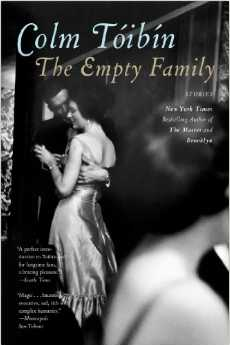
Day 517: The Empty Family

Cover for The Empty FamilyIn this collection of short stories, Colm Toíbín writes empathetically about the human condition. People remember how they have loved, their desire, their loneliness.

In the only historical fiction story, “Silence,” Lady Gregory tells Henry James a tale over dinner. Even though her story is not true, it encapsulates a kind of truth about her relationship with her lover during her marriage to her much older husband.

In “The Empty Family,” a man returns to a seaside village in Ireland after years of absence in California. He meets some old friends and considers his former life in that town and the life he just left.

In my favorite story, “Two Women,” an elderly Irish set dresser remembers her affair with the only man she ever loved. One day on the set where she is working, she meets his widow, the woman who married him after they parted.

In “One Minus One,” a man returns home to be with his dying mother. He is full of regret and longing because she never cared much for him.

These stories are precisely written, sad, and evocative.

Day 512: Troubles

Cover for TroublesBest Book of the Week!
It is the summer of 1919. Major Brendan Archer has just left the hospital after his experiences in the trenches of France. When on leave in 1916, he met Angela Spencer. Although he has no recollection of having asked her to marry him, she has ever since then written him exhaustive letters signed “Your loving fiancée.” Determined to find out if he is engaged, the Major travels to the Majestic, Angela’s family hotel in County Wicklow, Ireland.

Troubles is about the decline of the once powerful Anglo-Irish aristocracy. Nothing symbolizes this decline quite as effectively as the state of the Majestic. Once a grand resort hotel, the Majestic is now the crumbling permanent home for a handful of old ladies who knew it from their heyday.

The Palm Court is so overgrown that it gets more and more difficult to find the chairs. No staff is visible when Archer checks in, and he is finally vaguely shown around by Ripon, Angela’s brother, who urges him to pick a room. When Archer retires, he finds his bed has no sheets, and his investigation of a sickly smell leads to the discovery of a sheep’s head in a pot in his room. Most frustrating, though, is that he can find no opportunity to speak to Angela, who shortly after his arrival shuts herself up in her room.

Major Archer soon finds himself drawn into the activities and personalities of the household. Angela’s father Edward seems unconcerned about the increasing decrepitude of the house. He occupies himself with projects such as raising piglets in the squash court or conducting bizarre experiments in “biological research.” He is most concerned with preventing Ripon from marrying the daughter of a merchant, whom Ripon has made pregnant. Edward’s objection? She is Catholic.

It is the time leading up to the partition of Ireland, with events that 40 years later will result in The Troubles. To Edward’s way of thinking, along with most of his class, those who want independence from Britain are nothing but hooligans. He refuses to recognize that his impoverished and desperate tenants have legitimate grievances.

The growing sense of dissolution both in Ireland and—periodically interjected by newspaper articles—in other parts of the British Empire keeps the novel from being simply a comedy such as Cold Comfort Farm. That, and Farrell’s writing style of cool and precise satire. As poor Major Archer bumbles in a well-meaning way through the political briars and Edward becomes more detached from reality, the Majestic slides perceptibly into ruin.

This is another book from my Classics Club list.

Day 494: A View of the Harbour

Cover for A View of the HarborElizabeth Taylor was a mid-twentieth century writer who was interested in the realistic depiction of ordinary lives, particularly those of the working class. In A View of the Harbour, she provides glimpses into the lives of residents along the harbor of a shabby seaside village in post-World War II England.

Newby has seen better days. The trendy tourist area has moved away around the point, and all that is left aside from a few houses are a wax museum, a pub, a small store, a closed-down fun fair, and a lighthouse.

The main characters of this novel are Beth and Robert, a married couple, and Beth’s longtime friend Tory, recently divorced. Beth labors under the delusion that she is observant, but most of her focus is on her writing, as she is an author. Toward her family she is myopic. She doesn’t see when her five-year-old daughter Stevie is manipulating her, and she pays very little attention to her older daughter, Prudence, or to her husband. All family drama provides fodder for her prose.

Most people in town seem to think Prudence is slow, but she has noticed something that others haven’t—that her father is secretly visiting Tory.

Tory is torn between her feelings for Robert and her loyalty to Beth. She mostly seems to be at loose ends, however. She still cares for her ex-husband Teddy and makes a point of stopping in to see him if she is in London. In Newby she flirts with Bertram, a retired naval officer with ambitions to be a painter but little talent, and dallies with Robert.

Loneliness is a strong theme of this novel. Tory is clearly lonely, even though she is beautiful and has no trouble attracting attention. The attention she wants, from Teddy, is not available. Lily is a recent widow who goes to the pub nightly for companionship. She is timid and terrified of the walk home in the dark. The proprietor of the wax museum, she is afraid to pass the figures on the way up to her flat. The brief attention she gets from Bertram ends unfortunately.

Maisie, the hard-working daughter of invalid Mrs. Bracey, manages to attract Eddie, the boarder, but Mrs. Bracey is immediately jealous of the distraction of Maisie’s attention. Mrs. Bracey is a complex character. We have sympathy for her because she is paralyzed, but she has a terrible tongue and is a vicious gossip. She easily finds a way to squash Maisie’s romance.

Taylor’s characters are too realistic to be entirely likable, although Beth is less at fault than Robert or Tory. I found Maisie and Prudence the most sympathetic of the characters.

Taylor is highly regarded but relatively unknown because she was overshadowed in her time by the more famous Elizabeth Taylor. Her writing is observant of the small details of life. Although there is not much humor in the novel, Tory’s letters from her young son at school are believable and funny. My overall impression of the novel is that the lives of its characters are as sad and dilapidated as the village.

Day 488: As I Lay Dying

as-i-lay-dyingAs I Lay Dying is the first Faulkner novel set in the fictional Yoknapatawpha County, about the death of Addie Bundren and the efforts of her family to cart her body to Jefferson, Mississippi, for burial. As an early Faulkner work, it is one of the first in his experiments with stream of consciousness and is unusual in that its plot is conveyed solely through the thoughts of its many narrators.

At the beginning of the novel, Addie Bundren is dying. Her son Cash is building her coffin right outside her window while she watches. Her husband Anse and sons Darl and Jewell are discussing whether Darl and Jewell should go off to work a job that will earn $3 so close to the time of her death.

The plot is fairly simple—they go, she dies before they get back, there is a big storm that washes out the bridge, and the whole family takes her with great difficulty to Jefferson, trying to find a way to get across the river. The accomplishment of the novel is in revealing the complex relationships among the family members from the sometimes incoherent thoughts of themselves and some of the people they encounter on their journey.

This is a dark and pessimistic novel. Although its characters are uneducated, rough, and bluntly spoken, some of them, particularly Darl, have unexpected sophisticated and even poetic thoughts. On the other hand, there is Anse, shiftless and selfish, but stubborn as the dickens when he makes up his mind to do something.

Although Addie made Anse promise to bury her in Jefferson almost as punishment for the life she hated, it is not clear whether his new teeth or his promise is the reason for the trip. On the road, there are several occasions where his determination not to be “beholden” puts his family to major inconvenience or even danger, yet on another occasion he is outraged that his neighbor refuses the use of his mules for an attempt to cross the river that results in the death of Anse’s own  mules.

We don’t hear much directly from Addie. As Cash builds the coffin she is a staring presence who doesn’t utter a sound. She has only one chapter to herself, in which she reveals her true disdain for her husband and children except for her son Jewell, the fruit of an illicit affair. Why she married Anse in the first place is not entirely clear, except that she hated her life as a schoolteacher.

The trials that the family must face to get to Jefferson are almost epic, but for what? Addie makes clear that her wish was malicious. Anse has ulterior motives. Yet Jewell is driven to Herculean efforts and loses the only thing he loves, Anse’s stubbornness nearly makes Cash lose his leg, and Darl ends up perpetrating an infamous act and being committed. The young boy Vardaman is traumatized on several occasions, and in town the only daughter, Dewey Dell, is cruelly duped.

Some of the themes of this novel are those of selfhood and existence, the contrast between spoken words and thoughts, the treatment of different social classes, and the irony of extraordinary but pointless acts. The ending makes the pointlessness clear by its almost comic mundanity.

Although this novel has echoes of characters who will appear in later novels—mentions of Snopes, Quick, the Tulls, and other characters—it has none of the bleak humor of the Snopes trilogy. It is widely regarded, though, as one of Faulkner’s most powerful novels and as a vivid example of the then new stylistic techniques of Modernism.

Day 479: Jane Austen: A Life

Cover for Jane Austen: A LifeIn Jane Austen: A Life, noted biographer Claire Tomalin has handily accomplished a difficult task. Because most of Jane Austen’s letters and papers were destroyed by well-meaning relatives, very little first-hand information about her life is available. As a 19th century unmarried woman, her experience was circumscribed, so the events of her life are ordinary ones. Descriptions of a life like this could be thin and lifeless, but Tomalin manages to provide us with a biography that is full of interest and lively and creates a convincing idea of Austen’s character.

From records, letters, the remaining few of Austen’s papers, and accounts of her by relatives, friends, and neighbors, Tomalin reconstructs the story of not only Austen’s life but of those who were important to her. Tomalin acquaints us with the members of Austen’s family and the bustling environment in the Steventon Rectory, where Jane’s father ran a small boys’ school. She describes friendships and visits to neighboring families. Even though Austen never used her own neighborhood in her books, it is easy from them to imagine the daily social calls and the housewifely tasks with which she and her female relatives were engaged.

It is not too hard to imagine the relationship between Jane and her sister Cassandra as close to that of Lizzie and her sister Jane in Pride and Prejudice, although Tomalin never mentions that either of these characters were based on real people. Still, the two sisters were extremely close.

Unlike Lizzie and Jane, though, both Jane and Cassandra were disappointed in love, Cassandra because her fiancé died, and Jane because her suitor needed to marry a woman with money. Tomalin makes the points that a married Jane Austen would probably have been too busy or too distracted to produce a body of literature and that later in life she seemed to understand some of the benefits of remaining single. As to the first point, it is certainly true that being removed without warning and against her will from Steventon because of the retirement of her father, and her family’s failure to settle anywhere for ten years afterward, completely cut off Austen’s literary production for that time period.

It seems that Austen’s status as a spinster with no money of her own gave her no control at all in her life about such questions as where she would live and even in one case when she could return home from a family visit. That is, she had no control until her late thirties, when she began to publish her novels. Even then, she ultimately earned very little money from them but enough to give her a small amount of autonomy.

Although most of the events of Austen’s life were relatively small, Tomalin’s book provides an absorbing account. I did not always agree with her interpretations of Austen’s novels, but I feel that this book allows me to know Austen and her family and friends a little better.

Day 471: Unaccustomed Earth

Cover for Unaccustomed EarthBest Book of the Week!

Although all of the stories in Unaccustomed Earth feature characters who are immigrants and first-generation Americans of Indian descent, they are about a lot more than that. They are about the common problems of all people.

In the story “Unaccustomed Earth,” Ruma grieves over the loss of her mother while her father fears she is making the same life for herself that embittered his marriage to her mother. In “Hell-Heaven,” a girl observes her traditional mother’s infatuation with a young graduate student in light of her mother’s detached marriage with her father. Amit and his wife Megan try to create a romantic weekend while attending the wedding of a woman Amit once had a crush on in “A Choice of Accommodations.” The best of the stories are the last three, interlinked, about two people who meet each other several times at significant junctures of their lives.

Lahiri’s stories speak to us deeply. With details of life and human behavior so finely observed, they become stories about characters for whom we care.

I am generally a novel reader, because short stories often feel to me as if a lot is missing. But Lahiri’s gift is for saying so much in so few words. You find yourself pondering her stories and characters long after you stop reading. They reveal a profound insight into the human heart.

My Classics List

I am following my friend Cecilia’s lead and participating in the Classics Spin. It sounds like fun. It isn’t clear to me if you have to be a member of the Classics Club or not, but anyway, here goes. I have to make my own list of 20 classics, and then each month the club will arbitrarily pick a number, and I have to read and review that book that month. Sounds like fun! Most of these are books I haven’t read, although there are a few I want to reread in the near future. Here is my list, in no particular order.

  1. Cover for The Long ShipsThe Remains of the Day by Kazuo Ishiguro
  2. Summer by Edith Wharton
  3. The Call of the Wild by Jack London
  4. Stoner by John Williams
  5. Middlemarch by George Eliot
  6. The Known World by Edward P. Jones
  7. O Pioneers! by Willa Cather
  8. Bleak House by Charles Dickens
  9. Things Fall Apart by Chinua Achebe
  10. Greenbanks by Dorothy Whipple
  11. Brave New World by Aldous Huxley
  12. The Scottish Chiefs by Jane Porter
  13. Robinson Crusoe by Daniel Defoe
  14. Beloved by Toni Morrison
  15. Light in August by William Faulkner
  16. Snow Country by Yasunari Kawabata
  17. The Idiot by Fyodor Dostoevsky
  18. The Beggar Maid by Alice Munro
  19. Their Eyes Were Watching God by Zora Neale Hurston
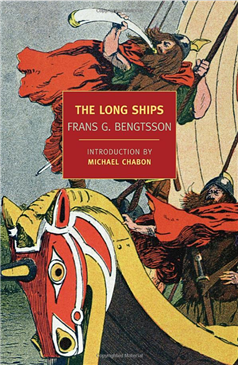
  20. The Long Ships by Frans G. Bengtsson

Day 461: My Life in Middlemarch

Cover for My Life in MiddlemarchMy Life in Middlemarch is a difficult book to categorize and an unusual effort. It is part memoir, part literary criticism, part literary history and biography, part thoughtful examination. Its focus is on George Eliot’s greatest novel, Middlemarch.

New Yorker writer Rebecca Mead muses about what the novel, her favorite as it is mine, has meant to her during different periods of her life, how different parts of the novel and different characters have spoken to her and how her sympathies with characters and comprehension of the novel’s themes have changed as her life was in its varying stages. She also examines events in Eliot’s own life—how they and the people she knew may have contributed to her works.

This book is about all things Middlemarch. Mead visits the towns and homes where Eliot resided and places where she may have set the novel. She reports on the ways that literary criticism of the novel changed over time—how it was immediately popular and then fell out of favor in later years to be rehabilitated, partially by the appreciation of Virginia Woolf. The book provides interesting insights into the novel and into Eliot’s life and possible thought processes as she wrote the novel.

http://www.netgalley.comFor those who have not read Middlemarch, the book still may hold some interest, but a lot will be lost. To those who have read and loved it, you will probably, like me, be compelled to pick it up again and reread it. I’ll be doing that soon.

Day 456: Independent People

Cover for Independent PeopleBest Book of the Week!

Who knew that Iceland had a Nobel Prize winner for literature? I didn’t even notice with his novel in my hands, given to me by my Uncle Fred last summer. I just put it in my pile of books to be read. If I’d known it was so good, I would have paid more attention.

Oddly, I seem to be inadvertently in an islands phase. This is the second book I’ve reviewed recently about Iceland (see my review of Burial Rites), and I have another I will soon review about New Zealand, The Luminaries. (See my review of The Bone People.)

Bjartur Jónsson has worked for the Bailiff’s family for 18 years to earn enough money to buy a small farm and some sheep. He is determined from now on to be beholden to no one else, to be independent. Even though his holding is said to be cursed by the fiend Kolumkilli (Saint Columba) and the witch Gunnvor, Bjartur is not superstitious and refuses to cast a stone on Gunnvor’s cairn to appease her when he first crosses the ridge into his valley. He is determined to make a place for himself and his bride-to-be Rósa on his own efforts.

On his wedding night he has an unpleasant surprise. Someone has already been with Rósa, he claims. At first we’re not certain whether he is being perverse, but one night when Bjartur is out searching for a lost sheep (that Rósa ate out of desperation), Rósa dies in childbirth only a few months after the wedding. Bjartur finds the baby on the edge of death, protected by his bitch sheep dog. Bjartur is a singular character—a lover of the old sagas and a poet, obstinate to the point of stupidity, untrusting, ornery, thinking mostly of his sheep—but he immediately loves this little girl and names her Ásta Sólillja (beloved sun lily).

Although Bjartur soon marries Finna, the woman who comes to care for Ásta Sólillja, and we get to know her and her mother and the couple’s three sons, it is the characters of Bjartur and Ásta Sólillja that dominate the story. Bjartur is so heedless of anything but his own ideas that he refuses anything resembling a gift, even if it would keep his family healthy, and Ásta Sólillja is innocent and gentle as the little flower he calls her.

The time frame of this novel is vague, so we are startled two thirds of the way through to see references to World War I, for the life of these Icelandic farmers seems no different than it would have been in the Middle Ages. Laxness describes a hard, grim existence, where babies die of illness and malnutrition, where Finna lies in bed ill for weeks every winter, where the family lives in one room full of fleas.

This story is not a bleak one, however; rather it is comic, sad, and moving. The novel centers on a rift between Ásta Sólillja and Bjartur. In anger, he throws her out. Although he repents his action, he won’t admit it and stubbornly waits for her to come ask for forgiveness. Well, she will never ask.

Slowly, things begin going wrong for Bjartur. He has already lost his second wife and his oldest son because of obstinacy about a cow. His youngest son Nonni, a brilliantly drawn character whose mother told him he would “sing for the world” (and I think is meant to be Laxness himself) disappears from the novel when he gets a chance to go to America at a young age. Soon Bjartur is left with only his middle son Gvendur, a young man not given to introspection who only knows how to “keep on doing things.”

Along with the story of Bjartur’s family, we learn a bit about the history of Icelandic politics and economy, but the novel centers on this all too human and oddly endearing family. If you decide to read this poetic novel, I think you will have a wonderful and surprising experience. It looks like several of Laxness’s works are out in paperback. I’m going to be buying more.