Day 434: Coriolanus

Cover for CoriolanusCoriolanus is one Shakespeare tragedy with which I was previously unfamiliar, and it is a powerful one. More than any other Shakespeare play I’ve read, it is about politics, class dissension, and the fickleness of popularity. It is also about excessive pride.

The play has references to events of the time it was written, for it begins with a riot over corn, the like of which had taken place in Warwickshire the year the play was written. Its war between the Romans and the Volscians is also a reference to the war the English and Spanish had been carrying on intermittently.

Caius Marcius is a warrior who has spent most of his life as a soldier and has no social graces. He is proud and arrogant and disdains the common man. After he soundly beats the Volscians in battle, particularly his bitter enemy Aufidius, and conquers their city of Corioles, the Roman generals rename him Coriolanus and the senate wants to award him a consulship. This office as ruler of Rome is the one that all great men aspire to. Unfortunately, to have the office, Coriolanus must beg the honor from the public and show them his wounds gained in defending the state.

He is reluctant to do so, knowing that he is unable and unwilling to ask for what he thinks he deserves, but his austere mother Volumnia and his supporters talk him into it. Two jealous tribunes, who are representatives of the people, are afraid that Coriolanus will strip them of their offices. So, the two, Brutus and Sicinius, work to enrage the people after they have already sworn to support Coriolanus.

The result is another riot, and instead of receiving the high honor, Coriolanus is declared a traitor. The tribunes even try to have him executed, but he is banished.

The seeds of Coriolanus’ downfall are sown both by the treachery of his rivals and by his own hubris. Things go downhill from there.

It is interesting that in the class divide, Shakespeare’s sympathies seem to align with the men of power even while he deplores Coriolanus’ flaws. There are several speeches about the public not being able to make a decision, about their fickleness, and so on, and the actions of the public seem to bear these ideas out. You can image what Shakespeare would think about a democracy or about our current political situation.

Day 430: The Mansion

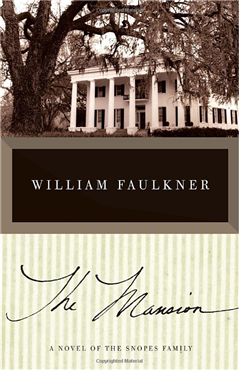
Cover for The MansionBest Book of the Week!

The Mansion is the compelling final novel in Faulkner’s Snopes Trilogy, a series remarkable for the way Faulkner is able to focus the activity on a character, Flem Snopes, who is less and less present in each novel. Told again by multiple narrators, each unreliable in his own way (they are all male), the story’s truth is one we don’t begin to really understand until the final omniscient chapters.

This last novel concludes the events of the previous two and in many ways reinterprets them. It begins with Mink Snopes, serving 20 years for a murder he committed in The Hamlet. This event, not so important in the first book except for demonstrating the sheer cussedness of the Snopes clan, becomes the focus of the third book. The Town related how Mink paid no attention to his own murder trial, simply waiting for his powerful cousin Flem to arrive and get him out of his mess. But Flem never arrived, respectability having bitten him by then, and Mink went to jail vowing to kill Flem when he got out.

The beginning of The Mansion returns us back a few years in the events covered by The Town to when Mink is two years from freedom, having rigorously followed the advice he was given when he went in, to do everything he is told to do and not try to escape. Mink has been concentrating all this time on one thing, getting out and having his revenge.

As he is also a Snopes, Flem knows this, so he frames another cousin, Montgomery Ward Snopes, for an offense that is worse than the one Montgomery actually committed, to get him in to the penitentiary. Then Flem pays Montgomery to convince Mink that Flem is helping him escape, further humiliating Mink by getting him to make the attempt in a dress, and then turning him in during the attempt. Mink earns himself twenty more years in the pen–or Flem earns it for him.

The middle portion of the novel focuses on Linda Snopes, Eula’s daughter, who thinks Flem is her father, and her relationship with the upright Gavin Stevens. Stevens helped her escape Jefferson in The Town, and the largest portion of The Mansion covers her life before and after her return to Jefferson from a more exotic life in New York City. Despite her willingness, Stevens refuses to marry her because of the 20 years difference in their ages. She embarks on an apparently naïve and bumbling career of good works.

Finally, the novel comes back to Mink, as he unexpectedly learns he may be eligible for parole two years early, if only he can find a relative to sign for him. His wife died years ago, his children are long dispersed, but a relative does sign for him, Linda Snopes. The novel builds to a climax after his release, following Mink as he tries to get his final revenge against Linda’s father Flem and Gavin Stevens tries to prevent it.

I think the achievement this trilogy represents is astounding, written as if it were gossip told around an old country store (and later in Gavin Stevens’ law office), centering on one man but leaving that man an enigma, almost a ghost in his own life. Events are told and retold, interpreted and reinterpreted, and so this “oral” history of Faulkner’s fictional county in Mississippi is created.

Day 415: Antony and Cleopatra

Antony and CleopatraOf the Shakespeare tragedies I have been reading, I think I have the least sympathy for the characters in Antony and Cleopatra (except perhaps for Othello–I have no sympathy at all for him). One of the problems is in, of course, how their relationship has historically been portrayed–with Cleopatra as a manipulative slut instead of a sovereign trying desperately to save her kingdom from being swallowed up by the Roman Empire. But the victors always get their way in portraying the conquered.

Antony and Cleopatra is, of course, the play about the last years of the relationship between Marc Antony and Cleopatra of Egypt, their political maneuverings with Rome and particularly with Octavius Caesar, and their deaths.

I believe the traditional way of looking at this play is of the great man brought down by his fascination with a rapacious woman. However, pay attention to the difference between how the characters talk about the nobility of the Romans and how the Romans actually act. I think something more subtle is going on here. I don’t see much evidence of a great man in this play. I see a soldier who pretends to be a noble Roman and is not. I see a female ruler who is more of an enigma, who controls her own shifting image, like a chimera.

image of The Death of Cleopatra by Reginald ArthurNot having the strongest grounding in classical literature, it is not always clear to me what is going on during the political maneuverings and battles, and which characters are on whose side. Of course, it is a historical fact that Cleopatra fled the battle of Actium with her ships at a strategic point, causing the battle to be lost. Why she did so is still a mystery.

For a different view of Cleopatra, although maybe a closer view than Schiff thinks, see Stacy Schiff’s excellent biography.

Day 403: The Town

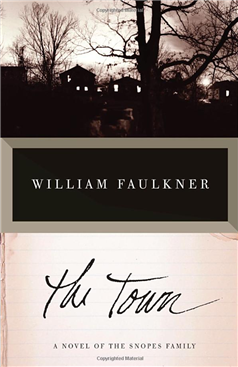
Cover for The TownThe Town is the second of Faulkner’s “Snopes” novels about the rise to power of Flem Snopes in Jefferson, Mississippi. Written in a style that is remindful of a bunch of old Southern men sitting on the porch swapping stories, it is narrated by three different alternating voices. As a pioneer in novels with multiple narrators, Faulkner is a master.

One of the narrators is a character we met already in The Hamlet, V. K. Ratliff, the itinerant sewing machine salesman who is most knowledgeable about Snopes’ true character, having been deeply scorched by him. Ratliff enlists the Jefferson city attorney, Gavin Stevens, in his observations of Snopes. The third narrator is Charles Mallison, Stevens’ nephew, who tells us himself that he wasn’t even alive during the times of his first tales but was told the stories by his cousin Gowan.

The novel covers the events of nearly 20 years, from the arrival of the Snopes family in Jefferson to the events shortly following the death of Flem’s wife Eula. Although some of the events are tragic, the tone of The Town is more comic than that of The Hamlet, perhaps because the lives of the folks in Jefferson are not as grim as those of the poor sharecroppers in the first novel.

The novel focuses first on the young Gavin’s infatuation with Eula Snopes. Rumor has it that Snopes’ appointment as power-plant supervisor–highlighted by his attempted theft of all the plant’s brass fixtures accompanied by an effort to frame the plant’s two black firemen for the theft–is in return for him closing his eyes to his wife Eula’s affair with Manfred de Spain, the town’s mayor. Young Gavin, newly returned from university at the time, is incensed by this rumor and determined to protect Mrs. Snopes’ reputation. Later, as Eula’s daughter Linda grows up, Gavin tries to save her from “Snopesism” by helping educate her and trying to get her a place in an eastern university.

These two novels are fascinating because of Faulkner’s ability to make central a character who barely has a line of dialogue in either book. He effectively makes Snopes the major presence in the novels by having the other characters observe the results of his actions while endlessly speculating about what he actually does and why he does it. As always with Faulkner, the prose is beautiful.

Day 395: Macbeth

Cover for MacbethAs with Hamlet and King Lear, the succession is a theme in Macbeth, even more so as the play was written in response to the Gunpowder Plot, in which Guy Fawkes and others attempted to blow up Parliament with King James I in it. This event was extremely traumatic for the British, as we can clearly imagine. Macbeth is, of course, Shakespeare’s famous tragedy about Macbeth’s attempt to usurp the throne of Scotland.

One theme of the play that harks back to the Gunpowder Plot is equivocation. Many of the statements in the play seem as if they mean one thing when they actually mean something else, from the witches’ predictions to Macbeth’s assurances. Equivocation was a Jesuitical doctrine that said that under examination, the truth could be substituted with “mental reservation,” in which one makes deceptive utterances but thinks the truth. It was used by Henry Garnet, the Jesuit Provincial, who learned of the plot as part of a confession. Edward Coke, a member of the Privy Council, which interrogated Garnet, called it “open and broad lying and forswearing.”

In fact, there are other references within the play that refer to James and demonstrate that the play was written in his support. Most obvious is James’s interest in witchcraft. He attended witch trials and in 1597 wrote Daemonologie, which Shakespeare used as source material for his scenes with the witches.

Banquo, Macbeth’s friend, whom Macbeth has murdered because of the witches’ prediction that Banquo will be the father of kings, was purportedly an ancestor of James I. Finally, there is the reference in the play to the healing of the king’s evil, a practice James observed that was followed after him by the British monarchy up to the Hanovers.

So, the play was written in honor of James I, to demonstrate the havoc wrought by breaking the succession. In the service of what is essentially historical propaganda, Duncan is made purer than he actually was and Macbeth more evil. The facts that Macbeth had a claim to the throne of Scotland and that the Scottish succession was not hereditary at the time are ignored. For an alternate interpretation of the story, see the wonderful King Hereafter by Dorothy Dunnett, one of the best historical novelists of all time, in my opinion.

But these facts don’t really spoil our appreciation of the play, which is one of Shakespeare’s most atmospheric, with its ghosts, witches, sleepwalking, murders, and walking wood. I think I prefer the directness of Macbeth to the convoluted plots of some of Shakespeare’s other tragedies. It is certainly a powerful play.

Day 388: Wise Blood

Cover for Wise BloodFlannery O’Connor stated that she didn’t understand when her works were termed Southern Gothic or grotesque. She continued throughout her life to emphasize that the theme of her works is redemption. Nevertheless, Wise Blood is grotesque.

Hazel Motes has returned from the service after World War II to find his home town in Tennessee deserted and his house crumbling and decrepit, so he goes to live in the city, the fictional town of Taulkinham, Alabama. Having grown up in a fundamentalist environment, he has decided that Jesus was just a man and there is nothing from which to be redeemed. Soon, he is preaching outside movie theaters about the Church of Christ Without Christ.

Haze doesn’t see anything he’s looking at and doesn’t hear anything anyone says to him. He is totally wrapped up in his obsessions about religion. He becomes fascinated by Asa Hawks, an evangelist who supposedly blinded himself for Christ, and can’t see that this man is a con man who is not even blind.

He also meets Enoch Emery, a whining zookeeper who spends his days peeping out of the bushes at the women bathing in the park swimming pool. Enoch tells Haze that his family has “wise blood,” that is, his blood tells him where to go in life and what to do. Enoch’s blood is obsessed with a mummy in the museum, which he thinks would be a Jesus for Haze’s church, not seeming to fully understand the point of Haze’s church. But Enoch doesn’t see or listen either.

In fact, no one in this novel listens to what anyone else says, and all of the characters are incredibly ignorant and uncultured. They are all grotesque, repellent creatures. Although the novel is supposed to be comic, it only made me laugh despite myself, as the situation becomes more and more ridiculous. O’Connor’s humor is brutal.

Everything in this short novel seems significant, is to be paid attention to, even the characters’ names. Both of Hazel Motes’ first and last names refer to the eyes, and Haze can’t see. Enoch Emery is abrasive. Asa Hawks is the “blinded” con artist who can actually see, and his daughter Sabbath Lily is anything but a lily. Hoover Shoats and Onnie Jay Holy try to take over Haze’s church. And speaking of Shoats, keep an eye out for the pig imagery, and think about what pigs are a symbol for in the Bible.

This novel is deemed a work of “low comedy and high seriousness.” Just speaking for myself, the religious theme is not one I find interesting. Yet, when you read O’Connor, you can’t help but be drawn along to the end.

Day 383: The Hamlet

Cover for The HamletWhen I got into The Hamlet a bit, I realized that a bastardized version of it had been released as a movie years ago called The Long, Hot Summer. But Paul Newman’s charming rascal is not at all the same animal as his original, Flem Snopes, a despicable man who rises in life using chicanery, cheating, and blackmail to wrest what he can from the poorest of the poor.

The Hamlet is part of a trilogy of novels about the history of the fictional Yoknapatawpha County, Mississippi, beginning shortly after Reconstruction. In particular, it is about the rise of Snopes, the son of an impoverished sharecropper. It begins when Jody Varner, the son of Frenchman’s Bend’s most powerful citizen, Will Varner, leases a property to Snopes’s father Ab, suspected of being a barn-burner. Jody thinks he’ll be able to cheat Snopes out of his yearly crop by alluding to his alleged crimes at the appropriate time. But soon he is more inclined to fear that Snopes will burn him out, so he offers Snopes’s son Flem a job as clerk in the Varner store as insurance.

Soon Jody has lost his own position as manager of the store to Flem Snopes and Snopes has apparently taken over Jody’s standing with his own father. Somehow Snopes begins accruing valuable property and gives away many of the jobs in the village, over which Will Varner has control, to Snopes cousins, whether they are capable of doing them or not. Eventually, he makes a deal to marry Will Varner’s young daughter, the voluptuous Eula.

Life among the Frenchman’s Creek sharecroppers is grim, and the story of the rise of this gray, tight-lipped, cold man is told through a limited third-person narration that moves from person to person. This narrative style creates a sort of plural viewpoint of all the village folk and is combined with the intelligent observations of itinerant sewing-machine salesman V.K. Ratliff, who alertly follows Snopes’s maneuvers and understands all his cheats–or so he thinks.

This novel is created from a series of tales, and it is really about how the tales of an area form its history. It is elegantly written, reflecting a formidable intelligence and education, and is sometimes grimly comic. It comments on the decay of the South in the aftermath of the American Civil War and the Reconstruction, as Frenchman’s Bend is a run-down little village built on the ruins of a once-stately plantation. The legend of gold supposedly buried on the grounds of the plantation plays a pivotal part in the story.

Day 375: King Lear

Cover for King LearKing Lear is about fathers and their children–in particular, how two fathers misjudge their children, mistaking flattery and trickery for love, and push away those who sincerely love them. It is also about the responsibilities of power.

We all know the plot. King Lear has three daughters, Regan, Goneril, and Cordelia. As he is an old man, Lear wants to rid himself of the cares of governing while keeping the title and prerogatives of his office. So, he proposes to divide his property among his daughters but first sets them a silly test of telling him how much they love him to determine the sizes of their gifts. Regan and Goneril reply fulsomely, but Cordelia, who is not comfortable with expressing feelings, replies with restraint. Lear, who had planned to give her the biggest piece as she is his favorite, banishes her and splits his kingdom between the two other sisters.

In a parallel story, the Duke of Gloucester has two sons. His eldest, Edgar, is legitimate, while Edmund is not. Edmund, who is a lot like Iago but with more cause, decides to take all that Edgar has, so he forges a letter that makes it seem as though Edgar is trying to tempt Edmund into murdering their father. He also keeps Edgar away from Gloucester by making him think that he, Edmund, is on Edgar’s side and telling him that Gloucester is angry.

In both cases the fathers, without considering their own experiences of their children’s qualities, throw away the loving child and favor the conniving children.

One metaphor throughout the play is that of sight. Neither father can see what is plainly before him. Gloucester actually loses his sight during the course of the play, and Lear goes mad before he can see clearly.

Madness also factors heavily in the play. Lear is driven mad with grief when he sees his older daughters for what they are, while Edgar pretends to be a madman to hide from his brother and father. Of course, madness is exciting in the theatre because a mad character is allowed to say anything, but Lear’s lines seem very obscure to me, unlike Hamlet’s when he was pretending to be mad.

This play seems to me to be rather disorganized. A lot of time is spent wandering around on the moors, with different characters running into other characters. I confess to finding that part tedious. Cordelia, who in one way is so important to the play, spends most of it offstage, while the fool, who is a dominant character at the beginning of the play, is ruthlessly killed in the middle of it. I am not sure of the point of the scene where Edgar makes his father think he has committed suicide by leaping off a cliff. All in all, this play seems rather messy to me.

Day 369: The Alchemist

Cover for The AlchemistIn my opinion, a fable for adults requires something striking to hold the attention. Telling the story as one would to a child is not going to cut it. It must be wittily written or beautifully illustrated or have some other compelling characteristic.

I have to admit I did not finish this fable about a Spanish shepherd boy who is told to travel to Egypt to find his “personal legend.” I found it heavy handed in approach and did not find anything special about the way the story was told to make it outstanding. I found the fairy tale writing style irritating.

I know this book has been very popular, but it is not the book for me. I guess I am reminded of the popularity years ago of Jonathan Livingston Seagull, another book I thought was wildly overrated. I could tell where The Alchemist was going within 50 pages, and I didn’t want to go with it.

Day 365: Othello

Poster for OthelloI have been reading and viewing a few of Shakespeare’s tragedies lately. Othello, in contrast to Hamlet, seems to be about very little in terms of overarching themes. Whereas Hamlet makes observations about death, revenge, the place of women in society, the relationships between fathers and their children, Othello is about what? Perhaps trusting too easily? Perhaps trusting not enough? Of course, it is about racism, jealousy, and betrayal, but what does it say about them?

The plot, of course, is that Desdemona elopes to marry the Moor, Othello, having fallen in love with him as he told the tales of all his adventures. Iago sees this marriage as an opportunity to have his revenge on both Othello, who has given the position he expected to Cassio, and on Cassio himself. He does this by making Othello think that Desdemona has betrayed him with Cassio.

To me the play is mostly about trust. Desdemona is a fool, it seems, to entrust her life to a man who would doubt her on so little evidence, actually before there is any evidence. Why is Othello so quick to trust Iago, a man he has overlooked for promotion, who has reason to hate him, and yet so quick to distrust his wife, who has never given him reason to doubt? Of course, this contrast says something about society’s view of women at the time.

Perhaps also Othello is a good excuse to write the part of a truly evil villain, Iago. For certainly Iago’s is the most important part.

Why is this a tragedy? Is Othello a great man brought down? I suppose he is great by virtue of his military adventures, but he is brought down by his own stupidity and gullibility. Desdemona is nothing but a victim, completely helpless to control her fate. This is not my favorite Shakespeare play, filling us with dread as it does from almost the beginning.