Day 361: The Circle of Reason

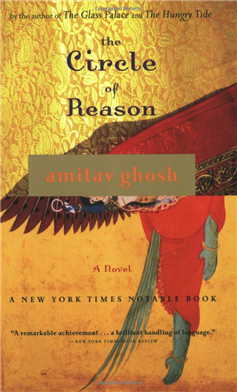
Cover for The Circle of ReasonBest Book of the Week!

Although magical realism is often mentioned in reference to The Circle of Reason, as Amitav Ghosh said himself in an interview for the New York Times review, there is nothing fantastical that happens in the book. Still, it continues to be compared to the works of magical realists such as Gabriel García Márquez or Salman Rushdie.

These comparisons may be because of the book’s rambling narrative style or its peculiar characters. The main character is Alu Bose, but we get to him only slowly through his uncle Balaram, a scholar turned teacher in a small village in India who develops a mania for the pseudo-science phrenology and worships Louis Pasteur. As Alu’s head is covered with odd-looking bumps, like a potato, he provides a subject of endless study for his eccentric relative.

Later, Balaram becomes obsessed with cleansing the village and begins a campaign to convince the villagers to coat every object with carbolic acid. His feud with the local politician combined with his obsession results in disaster, and Alu ends up fleeing India because of being mistaken for a terrorist. He is pursued by a policeman named Jyoti Das, who would rather be an ornithologist.

Thus begin Alu’s adventures, first in the Middle Eastern port of al-Ghazira, where he develops his own obsession for cleanliness, and then moving farther west, ending up in Algeria. On the way, readers encounter a myriad of other characters and stop to hear the stories of their lives or learn a little bit about weaving, say, or the history of al-Ghazira.

I was less reminded of magical realism than of One Thousand and One Nights, the tales of Scheherazade in which, in the middle of one tale, another begins. I attempted to read them at one time but despaired that I would ever get to the end of a tale or keep the various stories straight. Luckily, Ghosh’s narrative is a little more coherent, although not much. It is purposefully rambling, running off in delight to tell one fabulous story after another.

The novel is wonderfully well written, beautifully written, but sometimes I wondered where it was going or what the plot actually was. The feeling was only momentary, however, because I was always compelled onward. The ending is actually satisfying and less chaotic than I expected.

When I read that Ghosh wanted to write something like Moby Dick, that explained a lot about the novel’s narrative style. Fortunately for us, Ghosh’s style is a lot more accessible than Melville’s. Still, I prefer some of his more recent novels, particularly Sea of Poppies and River of Smoke. The Circle of Reason is Ghosh’s first novel, and he keeps getting better and better.

Day 356: Great Expectations

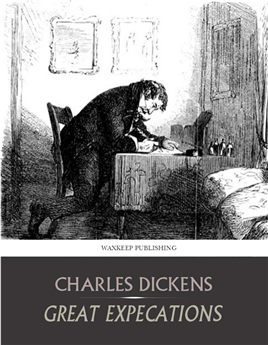
Cover for Great ExpectationsGreat Expectations has long been my least favorite of Dickens’ more substantial novels, because I dislike the character of Pip. However, upon my re-reading it after many years, I’ve changed my opinion, because only in this novel does the main character undergo a complete change of his assumptions and values.

The novel begins with Pip as a young boy growing up in a vast and desolate wasteland of marshes. He is cared for by his ambitious and abusive older sister and kindly brother-in-law Joe Gargery. In the opening scene he is in the cemetery looking at his parents’ graves when he meets the escaped convict Magwich.

Under Magwich’s instructions, the terrified boy steals some food from his sister’s pantry and a file from his brother-in-law’s smithy. Magwich might have got away, but Pip tells him he met another convict on the way, so Magwich throws away his chances of escape to fight the other man, his sworn enemy.

After this odd and atmospherically fraught incident, Pip is soon engaged to entertain the wealthy but deranged Miss Havisham, an old woman who was long ago deserted at the altar and has lived the rest of her life in her bride clothes with her wedding cake rotting away on the table. Miss Havisham introduces Pip to her beautiful ward Estella, and from that time he is captured. He fails to understand, however, that Miss Havisham has brought Estella up to enthrall and torture men.

Pip grows old enough to apprentice as blacksmith to Joe, but his association with Miss Havisham and Estella has made him discontented with his lot. Soon, though, he is informed that he has “great expectations,” that an unknown benefactor has chosen him for his or her heir, and he is to become a gentleman. Pip and his associates assume his benefactor is Miss Havisham, and Pip thinks that she intends Estella to be his.

With only a few qualms of guilt, Pip throws off his childhood, including his gentle, loving friend Joe, to become a gentleman and chase after the dream of Estella. It is only through a series of misfortunes that he realizes he must learn to look at his life differently than he understood it and comes to appreciate his true friends.

I am not at all sympathetic to Pip’s desires and think the pursuit of Estella is a worthless one, but Dickens’ strengths are in his characterizations and complex plots. In addition to a cast of unusual, lovable, or repellent characters, he does a masterful job of developing Pip into a wiser and more honest man.

Day 351: The Fixer

Cover for The FixerBest Book of the Week!

In 1911 Russia, Yakov Bok is tired of his difficult life in the shtetl. So, after his wife leaves him for another man, Yakov travels to Kiev in hopes of making a better living. When he helps a drunken man who is passed out in the snow, Yakov is offered a job supervising a brick yard. However, in order to take this job, Yakov must live in a part of the city forbidden to Jews.

It is this circumstance followed by a series of mishaps that ends up with Yakov being accused of murdering a boy he chased away from the brick yard. As the case continues, it becomes clear that the murder is being used by authorities an an excuse to trump up charges of ritual murder against the Jewish community.

The novel becomes more and more difficult to read as literally everything that happens to Yakov makes things worse for him. The gentiles he knows in Kiev tell lies about him. Once he is in prison, the jailers do everything they can to incriminate him, including trying to entrap him into breaking the rules or admitting his guilt.

Yakov goes into jail a nonpolitical, irreligious, naive man who hopes for justice, and the novel is partially about his development into an angry man who refuses to be beaten. Although almost nothing in the way of plot or action happens from the time he goes to jail, I was absolutely compelled to finish reading.

Written in a storytelling fashion that I associate with the tales of Sholem Aleichem or Isaac Bashevis Singer, this novel is more grim than most of the stories I’ve read by these other writers. However, both The Fixer and The Bloody Hoax, by Aleichem, are based on a true event from 1911 Kiev, called the Beiliss blood libel case.

Day 328: Hamlet

Cover for HamletMy husband likes his jokes. When I told him I was re-reading Hamlet, he said, “It’s full of clichés, you know.” But it was amazing to see how many lines from this play are so familiar to all of us, have almost entered our societal DNA.

Everyone is familiar with the plot. Hamlet’s father, the King of Denmark, has died, and Hamlet’s mother Gertrude has married his uncle Claudius, his father’s brother, who is now king. Hamlet is in grief and dismay at his father’s death and his mother’s quick remarriage. In the first act of the play, Hamlet meets the ghost of his father, who tells him that Claudius murdered him by pouring poison in his ear as he slept. The ghost orders Hamlet to avenge his death.

One of the puzzlers for me about this play is the reason why Hamlet then chooses to fake insanity. It allows Hamlet to continually bait Claudius and Gertrude without consequences, but otherwise does not make sense to me.

An interesting point raised in the introduction of my version of the Collected Works is that Polonius, in appearance and behavior, is meant to be William Cecil, Lord Burghley, Queen Elizabeth I’s chief minister. The claustrophobic feeling in the play of not being able to trust anyone, of being spied on (depicted marvelously in the 2009 Royal Shakespeare Company production, starring David Tennant and Patrick Stewart), reflects the paranoid nature of Tudor society because of the prevalence of espionage at that time.

Of course, Hamlet’s musings on suicide, death, and the nature of revenge are a major focus of the play. An undoubted message seems to be of the unintended consequences of actions, particularly of revenge. Hamlet and Laertes are bent on revenge, but in obtaining it, they manage to wipe out both their families.

I have seen Hamlet played as a drooping figure of indecision, but I don’t think this is a correct interpretation. Hamlet is caught on the crux of a dilemma. He wants to do what is right but knows that whatever action he chooses, the results will not be pretty. Hence, the inaction.

Day 323: Oliver Twist

Cover for Oliver TwistOliver Twist was one of the first adult books I read as a child, although I believe that David Copperfield was the very first one. This book is, of course, Dickens’ famous indictment of the British treatment of and attitudes toward the poor, as followed through the adventures of Oliver Twist, an innocent and hapless young orphan.

Oliver is born in the workhouse after his mother dies in childbirth without identifying herself. He is named by the beadle and brought up at a baby farm, the intent of which seems to be to starve as many babies to death as possible. The story really begins when Oliver is 10 years old and is moved to the workhouse to begin an illustrious career picking oakum, which is unraveling and picking apart old ropes. There he is voted by the boys to be their representative in asking for another bowl of thin gruel at mealtime (or rather is the only one naive enough to agree to do it).

This act brands Oliver as a malcontent, and he is apprenticed out to a coffin maker with dispatch. His employer seems disposed to be kind, but he is bullied by a “charity boy,” Noah Claypole, as well as by the housemaid and the coffin maker’s wife. Finally, after being unjustly punished for standing up for himself, he runs away.

Oliver’s adventures lead him to London, where he innocently falls in with a gang of thieves lead by the infamous Fagin. Oliver’s struggles to make his way in life without becoming a criminal and the mystery of his identity are the focuses of the rest of the book.

Although this novel has a few amusing and lovable characters, it is fairly grim compared to some of Dickens’ later efforts. It is merciless in its satire of institutions such as the workhouse and the law courts. Oliver himself is more of a symbol for goodness than a fully developed character, yet we are touched by his plight.

It is a long time since I read this novel, and I found I had forgotten just how complex the plot is. Although I do not feel that it is as good as some of Dickens’ later works, as his first serious novel, it is compelling reading.

Day 308: Love in a Cold Climate

Cover for Love in a Cold ClimateLove in a Cold Climate is more of a companion novel to Nancy Mitford’s The Pursuit of Love than a sequel, because it focuses on a different group of characters. Fanny is still the narrator, and she returns to tell a little more of her own story but mostly that of her beautiful friend and distant relation Polly Hampton.

When Fanny receives an invitation to stay with the family upon their return from India, she is happy to renew her friendship with Polly. Polly’s demanding mother, Lady Montdore, has been pushing her toward marriage, but Polly resists. Polly has always been difficult to read, unlike Fanny’s Radlett cousins from The Pursuit of Love, who “told everything.” Although Polly is so beautiful that she could have her pick of the eligible bachelors, she tells Fanny that she finds the whole life of the social season boring.

Lady Montdore is a rapacious, snobbish manipulator with social ambitions, although not without charm. Another family member who is important to the novel is also a snob, “Boy” Dougdale, the husband of Polly’s aunt, Lady Patricia. Fanny and her cousins have always called Boy “the Lecherous Lecturer” because of his tendency to furtively grope very young girls. Much to everyone’s surprise, Polly’s secret comes out when, shortly after Lady Patricia’s death, she marries a reluctant Boy, for she has been in love with him for years.

Polly is ostracized from her family and cut out of her father’s will as a result. But the plot thickens upon the arrival of Lord Montdore’s heir, the effeminate and hilarious Cedric Hampton.

As usual with Mitford, we have a strong suspicion that all her ghastly and funny characters strongly resemble real-life society members of her time. Her novels are full of vivid characterizations and incisive dialogue. Even in today’s world, so removed from her own, her novels are extremely funny.

As a side comment about the cover art, I find the covers of the most recent editions of Mitford’s novels to be too romantic and to do nothing to convey the spirit of her novels. I was able to find a better cover for The Pursuit of Love, but this was all I could find for Love in a Cold Climate.

Day 300: The Land of Green Ginger

Cover for The Land of Green GingerJoanna Burton is a naive girl with a huge sense of adventure who has always wanted to travel the world in this most touching of Winifred Holtby’s books. Born in Africa but brought to England as a small child, Joanna has never felt like she quite fit in and has always wanted to return to the “land of green ginger.” During World War I she meets a young officer, Teddy Leigh, who tells her he is going to give her the world as a golden ball, and she believes him.

Several years later, however, she is living on a Yorkshire farm with two little girls and an ailing husband. Not only was Teddy gassed during the war, but he hid from her his history of tuberculosis.

As Joanna struggles to deal ineptly with the farm, her husband, and her children, a nearby landowner asks if they could take a Hungarian man in as a roomer. Joanna is so preoccupied with her troubles that she doesn’t notice her husband’s irrational jealousy or the rumors starting up in the village about her relationship with the Hungarian.

This novel is beautifully written and painful to read at times, as the readers see Joanna unconsciously make misstep after misstep and the neighborhood gossips become vicious indeed. Holtby only wrote a few books before she died at the age of 37, but she was a master at depicting life in the Yorkshire countryside and small towns.

Day 297: Persuasion

Cover for PersuasionMost people have probably read Pride and Prejudice, which is a wonderful book, but if I had to pick my favorite Jane Austen heroine, it would be hard to decide between Elinor Dashwood of Sense and Sensibility and Anne Elliot of Persuasion. Probably fewer people are familiar with Persuasion.

Anne is no longer in the bloom of youth. Seven years ago she fell in love with a young naval officer named Frederick Wentworth, but Sir Walter, her superficial, supercilious father, did not approve. Perhaps the gentle Anne would not have been dissuaded from marriage, but her older friend and mentor, Lady Russell, talked her out of the engagement because of Wentworth’s lack of wealth and social position. Anne listened because she viewed Lady Russell as a surrogate mother, and she hasn’t heard from Wentworth since.

Now the family has fallen upon hard times, and Sir Walter is forced by his profligacy to lease their house and take rooms in Bath. He and Anne’s fashionable sister Elizabeth care very little for Anne, and they leave her to close up the house and make all the arrangements for its occupation by an Admiral Croft. Much harassed, she readies the house and tends to her hypochondriac, selfish sister Mary Musgrove. At least she enjoys the company of the children and Mary’s genial in-laws, with their two daughters Henrietta and Louisa and Anne’s brother-in-law Charles.

Anne meets the friendly Admiral and Mrs. Croft, and between their society and that of the Musgroves, begins to find a little pleasant enjoyment. However, she is soon dismayed to learn that Frederick Wentworth is Mrs. Croft’s brother, and he will be arriving soon. Wentworth is now wealthy and has retired from the service.

When he arrives, Wentworth pays little attention to Anne; in fact, she overhears him saying that she has changed so much he would not have recognized her. This remark distresses her very much, as her feelings have not altered. Soon he appears to be courting Louisa Musgrove. Anne finds it easiest to send Mary off into company while she stays home with her nephews.

After Louisa has a fateful accident on an outing in Lyme Regis, Anne finds herself taking charge and summoning help. Then she returns with Wentworth to notify Louisa’s parents. Feeling superfluous after the Musgroves leave with Wentworth for Lyme Regis, Anne decides she has no choice but to join her unpleasant father and sister in Bath.

What I love about Anne is her understated good will. Despite the insults by her family members and their general bad treatment of her, she tries to help them and to be a true sister and daughter to them. Despite Wentworth’s slights and attention to Louisa, she hides her feelings and remains faithful in her heart. Anne has much in common with Elinor Dashwood, except that Elinor is well regarded by her family and Anne is not. There is something delicate and understated in this novel, and in all of Austen’s work, that I appreciate in this more tempestuous modern world.

Day 272: Moby Dick or, The Whale

Cover for Moby DickThose who know me well will be surprised to see me reviewing this book, because one of my stories is of my horror, when first trying to read it, to find an entire chapter about one rope. At that point, Moby Dick became the first book I ever stopped reading. However, I got interested in trying it again by listening to the Moby Dick Big Read. I listened to the beginning chapters and finally picked up a copy to finish it.

The plot, of course, is about the sailor Ishmael, who decides to go whaling for the first time, the people he meets, and his experiences–and about the obsession of his captain, Ahab, to kill the whale that took his leg.

Moby Dick is not for everyone. The novel is not simply an adventure tale about whaling but also a dissertation on whaling history, a series of philosophical essays, an explication on types of whales, on the different parts of a whale, on pieces of whaling equipment (hence, the chapter on the rope), even a musing on the color white.

The novel also has a sort of schizophrenic narration, starting out as first-person limited from the point of view of Ishmael, but then at other times taking the point of view of Ahab. The writing style rips back and forth from simple story telling to a kind of heightened, bombastic oratory. Characters do not so much speak as give speeches.

The novel is immense, but it is meant to be immense–the way Melville saw America and its possibilities. I have over the years read different interpretations of this work (the whale as a symbol of evil, etc.), but one that strikes a chord with me is that it is a reflection on some of the American political ideas of the time, particularly Manifest Destiny. While seeming to admire the grandiosity of such ideas, Melville is, with one whaling story, also warning of their possible effects and ramifications.

I can see why some academics have devoted their careers to this work, because it can be endlessly examined and interpreted. I finished reading it this time, but I can frankly admit that it is still a bit too much for me and is probably better suited for someone who is more contemplative in his or her reading.

Day 255: Anderby Wold

Cover for Anderby WoldMary Robson is a young married woman who has been working for years to save her family farm, Anderby Wold. She even married John, her much older husband, whose hard work has kept it going these past years. She is a managing woman who thinks it is her duty to oversee the welfare of the village, making herself disliked by many. Because of her preoccupations, she seems much older than she actually is.

One day she encounters David Rossiter, a young radical journalist who disagrees with everything Mary believes in. David is trying to get farm workers interested in unionizing, and Mary becomes unsuitably obsessed with the younger man. The schoolmaster, Coast, becomes involved in the unionization issue expressly to make trouble for Mary, whom he detests.

Anderby Wold is an interesting slice of Yorkshire life in the 1920’s. It reflects the issues of the times, when farmers were facing increased demand for workers’ rights. Another of Winifred Holtby’s consistent themes that appears here is getting on with life after the death of a loved one. This novel is Holtby’s first, and its realistic depictions of village life of the times reflect her background as a journalist.