Day 243: The Pursuit of Love

Cover for The Pursuit of LoveIt’s always fun to re-read Nancy Mitford’s charming and funny autobiographical novel about her youth and young womanhood. Mitford’s alter ego is Linda, a young woman with terrible taste in men, who throws herself from one extreme to another in pursuit of love.

Mitford’s strength is her portrayal of peculiar but lovable characters, all modeled upon her own eccentric family or on figures in society. The novel is narrated by Fanny, a sensible but lonely girl who spends a lot of time with her cousins, the Radletts. Her terrifying Uncle Matthew (modeled on Mitford’s father) loves to hunt his children instead of foxes, a game the children love. Aunt Sadie is unutterably vague, which she probably has to be to live with Uncle Matthew. Uncle David is a cultured hypochondriac. The Bolter, Fanny’s mother, is supposedly a portrayal of Lady Idina Sackville, a famous society woman who kept leaving her husbands and was a member of Kenya’s famous Happy Valley set.

Mitford starts the novel with childhood–the children are hunted, hang out in the linen cupboard fantasizing about running away, and generally run wild–and follows the older girls into young adulthood. The novel finally centers on the story of how Linda first impetuously marries a stuffy banker who bores her silly, then leaves him for a communist who only thinks about his causes, and finally falls into the arms of Fabrice, a French duke who is a world-class womanizer. Characterized by facetious observations of society life and dialogue brimming with zingers, Mitford’s novel is a joy to read.

Just as an aside because I’ve recently read a few posts about cover design, I originally copied into this post the most recent cover of the book, which shows a romantic black and white photo of a debutant holding a bouquet of flowers with a pink banner for the title. I decided to replace it with this older cover (the one on the copy I have), which I think does a much better job of conveying the type of novel it is, much more of a social commentary than a romantic novel.

Day 239: Lucky Jim

Cover for Lucky JimI hate to use the word “hapless” two days in a row, but here goes. Hapless Jim Dixon is an unhappily employed lecturer in history at a “new university” in England. (I believe even that phrase is supposed to be fraught with meaning, but I am not British, so I don’t know what it might be.) Uncertain of whether he’ll be keeping his job in the coming year, he is forced to listen with an attentive air to the endless prosings of his boss Professor Welch and to take on all the tedious chores he is assigned. He vents his frustration through silly pranks and grotesque grimaces when he thinks no one is looking.

He has also gotten himself entangled with Margaret, a manipulative coworker whom he pities because she recently attempted suicide when her fiancé left her.

During a stultifying weekend of amateur theatrics and madrigal singing at the Welch’s, Jim meets the beautiful Christine, the girlfriend of the horrible Bertrand, Welch’s pretentious and belligerant son. Jim is startled to find that perhaps Christine returns his interest.

Amis’ amusing skewering of academic life comes to a climax at Jim’s well-attended lecture on Merrie England. Amis’ novel is known both for being the first “campus novel,” one that takes the point of view of a lecturer rather than a student, and for its down-to-earth, witty writing style, an approach that was unusual at the time. Although it was published in 1954, it holds up pretty well in modern times.

Day 233: The Moviegoer

Cover for The MoviegoerWalker Percy’s classic novel The Moviegoer is a novel about alienation. Binx Bolling is an idle young man living in New Orleans during the late 1950’s. His experiences in the Korean War seem to have cast him adrift, or perhaps he has always been adrift. He spends his time chasing women and going to the movies. He cares for his cultured and prominent family, yet he seems strangely indifferent to them at the same time. He claims to be on a search, but it is not clear what he is searching for–perhaps a purpose, but his search is strangely aimless. Although he has a job as a stockbroker, he doesn’t devote much time or attention to it.

Kate, his cousin, is mentally ill in an undefined way. She and Binx seem to understand each other, and he genuinely cares what happens to her. From drifting for quite awhile in the same waters, the story finally moves forward when Kate insists on coming with Binx to attend a convention in Chicago, where he has an important work assignment.

New Orleans features as a colorful setting, but in some ways the city’s possibilities are neglected. Some of the most interesting scenes are set in a small house over a bayou, where Binx goes to visit his mother and younger siblings.

This is an existentialist novel that is supposedly heavily influenced by the writings of Søren Kierkegaard. Although Jack Kerouac’s On the Road reflects the alienation experienced by some young men following World War II, The Moviegoer shows that this alienation was still felt by young men following the Korean War, ten years later. Essentially, these two novels examine the same themes, only Binx’s explorations are followed in more socially acceptable ways.

I have to admit that these themes don’t personally strike any chords with me. For most of the novel I wasn’t that interested in Binx’s search or in the things that he finds interesting. However, I liked the ending of the book, when he finally accepts responsibility for something.

Day 214: The Sense of an Ending

Cover for The Sense of an EndingBest Book of the Week!

The Sense of an Ending is a quiet novel that made me stop and consider. It is a meditation on memory–how we reinterpret past events. It is also about the lost opportunities of life.

Tony Webster begins the novel by considering his past, particularly his relationships with his pals from school. He and two other close friends chose to enlarge their circle to include a new boy, Adrian Finn, who was extremely intelligent and analytical. Adrian’s indifference to seeming cool made him very cool indeed. The four friends remained close throughout college and for awhile after, until Adrian committed suicide.

Tony also remembers his first serious relationship, with Veronica Ford, particularly an unpleasant weekend he spent with Veronica’s family. After they broke up, Adrian went on to date Veronica. He wrote Tony a letter apprising him of this as if he were asking permission to date her, and Tony’s recollection is that he ironically assented.

Tony has lead a comfortable life avoiding too much effort in his relationships. He sees himself as a “peaceable man.” He believes he understands the events from the past until he receives a legacy from Sarah Ford, Veronica’s mother–the only member of her family who seemed sympathetic during that long-ago visit. In addition to a small bequest, she has left him Adrian’s diary. This legacy confuses him. Why would a person he only met once leave him anything, and why would she possess Adrian’s diary? When Tony asks for it, he finds that Veronica has taken it.

In Tony’s attempts to gain the diary and his subsequent inquiries, he learns things that force him to re-examine and reinterpret his memories of long ago events and to reconsider the consequences of his own actions. He ends up also contemplating where his own life has gone and how he has evolved into this “peaceable man” from a boy full of curiosity and promise.

This very short novel is crammed with thoughtful observations, often wittily and wryly expressed. I found myself turning back to re-read and reconsider certain passages, which is something I seldom do. Sparely and beautifully written, the novel is an excellent illustration of the use of an unreliable narrator.

Day 199: South Riding

Cover for South RidingI had never heard of Winifred Holtby until I watched the excellent Masterpiece series South Riding. I enjoyed it so much that I picked up several of Holtby’s books. Holtby published 12 novels in the 1920’s and 1930’s, as well as pursuing a successful career as a journalist and nonfiction writer. She is known for regional fiction about Yorkshire and has a prize for regional fiction named after her.

Set post-World War I, South Riding is the story of the conflict between the landed gentry and social progressives in a Yorkshire town. Sarah Burton comes to town as the headmistress of a girl’s school. She has many progressive ideas and wants to improve the school and the quality of education provided to the girls. To accomplish her goals, she asks the town to invest more money in the school.

She immediately runs afoul of Robert Carne, a local landowner. He has very conservative ideas about the town and school, but he also has some heavy concerns. Previously prosperous, he has spent all his money on care for his mentally ill wife. He also has the care of a young daughter who is having her own problems.

Unlike the television series, the novel has a huge sweep and does not concentrate on Sarah, but presents the stories of about fifteen other major characters. It deals with issues like education, poverty, and governmental corruption as well as family relationships. The characters are all carefully delineated so that you feel that you know each one.

The novel is beautifully written, although it gets just a little preachy at the end. Some reviewers have compared Holtby to George Eliot because of her interest in local social issues and her breadth of scope.

Day 192: Home

Cover for HomeBest Book of the Week!

The beautifully written, subtle novel Home by Marilynne Robinson makes me thoughtful. It is 1957. After a failed ten-year engagement, thirty-eight-year-old Glory Boughton has moved home to Gilead, Iowa, to care for her elderly father, a retired Presbyterian minister.

Her father has been waiting 20 years for the return of his best-loved son, Jack. Finally, they hear that Jack is coming home. Always unreliable and setting himself apart from the family, he arrives late, and Glory feels ambivalent about his return. Soon, though, she sees that he is tired and having difficulty being there, and she tries to help him.

The novel carefully explores the relationships between the three of them–Glory loving but distrustful of the pain Jack has caused and protective of her father, Jack trying to make a new life in painful and distressed conditions, and their father forgiving and unforgiving at the same time. In the background are the events of the civil rights movement, toward which Jack and his father have radically different views.

Jack is delicate and fragile. He tells Glory he lived as a vagrant, drunk, and cheat until he met a woman named Della, and now Della has gone back to her parents. He tries to find work in town and writes countless letters to Della.

This novel is apparently related to a previous one, Gilead. I do not know whether it could be considered a sequel, although I know it shares some characters.

To modern readers the manners and dress of this devout Iowa family seem very old-fashioned, and some readers may find the novel slow, but I found it engrossing. It is, of course, a retelling of the tale of the prodigal son.

This is a simple story on the surface, but it depicts complex characters and relationships. It is a novel about family relationships and love, written with a delicate touch. I find it difficult to express how fine I felt it to be.

Day 173: David Copperfield

Cover for David CopperfieldBest Book of the Week!

I believe that David Copperfield was the very first book I ever received as a young girl that was not a children’s book. My dad brought it home for me one day when I was sick (beginning my collection of Modern Classics back when they were hardcover), and it transported me to another world.

People have differing opinions about which Charles Dickens book is best. For example, author Nick Hornby blogged that Great Expectations was one of the greatest books ever written. I myself have never fallen under the spell of Great Expectations, though. David Copperfield is my favorite. Tolstoy thought Dickens was the best of all English novelists and considered this book Dickens’s finest work.

David is the narrator of his own story, and he begins it on the night of his birth. David is a posthumous baby, and the novel begins with the first appearance of Aunt Betsey Trotwood, who comes to greet the appearance of her niece and terrifies David’s gentle, foolish mother. When David turns out to be a boy, Aunt Trotwood is mightily offended and departs.

Although David’s early childhood is idyllic, worshipped as he is by his mother and Peggoty the maid, it soon takes a turn for the worse. David’s mother is courted and won by the stern, apparently upright (and ultimately cruel and hypocritical) Mr. Murdstone, and the house is taken over by his cold and fault-finding sister Jane. David is a true innocent with only good intentions, but at every turn he is found to be in the wrong. He is soon shipped off to a typically horrible (if you know Dickens) boarding school.

After a bit of a rocky start, David finds himself made a pet of the popular Steerforth and also befriends Tommy Traddles. However, his mediocre education is interrupted when his mother and baby brother die. Mr. Murdstone sends him to London to lodge with the feckless Micawber family and work in a factory. When the well-meaning but impecunious Micawber is sent to debtor’s prison, David tires of his degrading life and runs off to find the only family he has left, Aunt Betsey Trotwood.

Although Aunt Trotwood is still disappointed that he isn’t a girl, she is kind, and from here, David’s life improves. The story continues with his education, marriage, and young adulthood. It is loaded with some of Dickens’s most delightful characters and a few villainous ones. Alternately turning from comedy to pathos, Dickens expertly drives the story along.

I believe one reason I find David Copperfield so touching is that David’s early life is taken from Dickens’s own. Dickens’s father was sent to debtor’s prison and Dickens went to work in a factory at an early age. This connection translates into a moving experience for the reader.

When innocent and loving David is punished by his stepfather because he is so terrified he can’t recite his lessons or when he is sent off to work in a factory, who remains untouched? When Barkis is willin’ or Mr. Micawber appears on the scene, who doesn’t laugh out loud? When steadfast and valiant Ham dies trying to rescue his rival, who isn’t tearful? When the slimy Uriah Heep finally gets his comeuppance, who isn’t delighted?

If you are not used to reading Victorian literature, you may find the writing old-fashioned, but you will almost certainly be carried along by the story.

Day 152: The Master

Cover for The MasterThe Master, Colm Tóibín’s engrossing novel about Henry James, is virtually plotless. Over the course of five years, James works, visit friends, and remembers significant events in his life and people who are important to him. At the same time he muses on how the people, tales they tell, or incidents he has observed have informed or will inform his writing.

I have often found James’s work perplexing, feeling as if there is a lot going on under the surface that I don’t understand. A novel about him, therefore, is not an intuitive choice for me. Nevertheless, I found myself extremely involved in this story about a man who appears to have always stood back and watched. In Tóibín’s view, James lived a life of “pure coldness.”

The book delicately depicts a complex man, social on the surface but always at an emotional remove from others, homosexual but so concerned about propriety and public opinion that he never acts on it (perhaps–that is not entirely clear) and avoids situations where he may be tempted. He is sometimes very cold in his inaction, such as when he deserts his best friend, Constance Fenimore Woolson, because she has been too open for his taste about their completely innocent relationship, causing some friends to blame him for her subsequent suicide.

The most fascinating part of the novel, in my opinion, is how it illuminates the way that a writer may take a situation, a sentence, thoughts about how a pair of people interact, and turn them into a complete work of fiction. For example, a tale told to him about two children alone on an estate reminds him of his relationship with his sister Alice. As children, both of them had been abandoned as their family toured Europe and have never been fully included in the events and emotions of the family. These memories finally emerge in the ghost story “The Turn of the Screw.” Similarly, his memories of his intelligent, vivacious cousin Minny Temple are brought back to life in first The Portrait of a Lady and then The Wings of a Dove.

Meticulously researched and beautifully written, The Master is an evocative novel about the inner life of an emotionally crippled writer.

Day 126: Dombey and Son

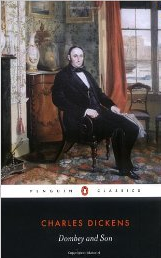
Cover for Dombey and SonI recently re-read Dombey and Son after not having read it in so long that I could not remember its plot. The novel is Charles Dickens’s tale about Paul Dombey, a wealthy, cold, self-important man who cares only about his son, not about his wife or his gentle, loving daughter Florence. His wife dies in childbirth, and his son Paul is weak and often ill, but Paul and Florence have a loving relationship. When Florence is kidnapped as a child, she is rescued by Walter Gay, a young employee of Dombey. Dombey ships him off to Barbados to get him away from Florence, but Walter’s ship is lost and he is presumed drowned.

With Walter gone, Florence has only her brother Paul for her friend. Then Paul dies, and her father even resents Florence for the love his son had for her, which he did not give to his father.

Dombey meets a beautiful widow, Edith Granger. She is a cold, haughty but impoverished woman, and Dombey essentially “buys” her by marrying her. She despises Dombey for his pride and herself for having married him for his money. The only person she is kind to is Florence, which provides more fuel for Dombey’s dislike of his own daughter. His attempts to subdue his wife end in her disgracing him as best she is able by running away to Dijon with Mr. Carker, one of Dombey’s rivals. When Florence attempts to offer sympathy, Dombey strikes her and she leaves the house, friendless and destitute.

Although the novel is not critically accepted as one of Dickens’s major works, it is still enjoyable. It is full of vibrant characters–mostly those of good will but also some villains–and it is gripping to the end. Some critics have noticed a change in the novel that takes place with the death of the young Paul, believing that having the colorless Florence and the unlikable Dombey as the main characters is not enough to carry the story forward. The absence of Walter and his uncle through much of the book is also thought to be a problem. However, the novel has all of the Dickens hallmarks–social commentary, comic absurdity, realism, pathos, and transformation. Dombey and Sons was written before most of Dickens’s real masterpieces like Bleak House or David Copperfield, but it certainly shows the movement from his lighter, shorter works toward the qualities of his more major works.

Day 84: Bring Up the Bodies

Cover for Bring Up the BodiesBest Book of the Week! Year!

If Wolf Hall was a wonderful historical novel, Bring Up the Bodies is masterly. In this second of a trilogy, Hilary Mantel continues the story of Thomas Cromwell. Bring Up the Bodies is more focused than the last book, because it deals with a much shorter time period and defined subject–the downfall of Anne Boleyn.

The writing is elegant and impeccable. I have read a few comments that Wolf Hall was sometimes difficult to follow because the readers could not always tell who was meant by “him” or “he.” Mantel has written both books using a strict third person limited point of view, from that of Cromwell, and people don’t think of themselves by their first names. Hence, the difficulty, which I did not notice as a problem in Bring Up the Bodies. This technique is very difficult to employ successfully–we are much more used to a third person that changes from character to character or even to third person omniscient. But Mantel uses it effortlessly to create a memorable character in Cromwell–kind but implacable, one who fosters the growth of others but does not forget the crimes and indignities committed against Cardinal Wolsey, whom he loved as as a father.

Henry VIII has already decided he wants to rid himself of Anne Boleyn and marry Jane Seymour, but Anne has one more chance. She is carrying a child, and if it is born alive and is a boy, she is safe. Henry must have an heir, and he has decided that if he hasn’t been given one, God must have found some fault with his marriage to Anne just as there was one for his marriage to Katherine of Aragon. Thomas Cromwell must find him some way out of his difficulties.

Of course, Cromwell helped Anne to her position in the first place, but the Boleyns have made many enemies in their enjoyment of power, and they have treated him with disdain. More importantly, Anne Boleyn destroyed the Cardinal, and her brother mocked him in his downfall.

From the moment you begin reading, you find yourself plunged into the Tudor world of shifting politics and intrigue. Of course, we know what happens to Anne Boleyn, yet the novel maintains its suspense. The Boleyn and Howard families are going to suffer a huge defeat, but they will go down fighting.