Day 36: Collected Stories of Carson McCullers

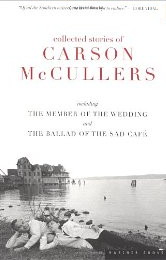
Cover of Collected Stories of Carson McCullersI sometimes feel frustrated with modern short works because I want them to tell more. Unlike short stories from earlier times, they don’t close any loops but simply capture a moment. This statement explains why I prefer the novel form and may not be very avant garde in my tastes.

Collected Stories of Carson McCullers contains a large number of short stories–some set in New York and some in the south–and two longer works, “The Ballad of the Sad Café” and “A Member of the Wedding,” only the last of which I had read before.

McCullers captures mostly sad moments, many of them autobiographical from what I understand from the introduction. Three of the stories are about her marriage to an alcoholic, although in one it is the wife who drinks.

Although McCullers is known as a “Southern Gothic” writer, the only piece in this collection that truly fits that description is “The Ballad of the Sad Café.” This story illustrates her ideas about love–that people love other people who are unattainable and that even the most unlikely people can be the recipients of adoration or even obsession. Several of the other stories are also about this theme.

“A Member of the Wedding” explores the unhappy adolescent, also one of McCullers’s themes. Frankie, a 12-year-old girl, becomes fixed on the idea that when her brother marries his fianceé they will take her with them on their honeymoon. She is obsessed with this idea and won’t allow herself to admit that they probably won’t. Her obsession is ultimately rooted in the degree to which she hates her town and herself.

Readers familiar with McCullers do not expect cheerful tales, but they are beautifully written and evocative.

Day Six: Waverley

Cover for WaverlyI have been trying to offer a mix here, not just mystery mystery mystery, and so far I have just reviewed books I’ve liked. But I plan to also review books I didn’t like. This book isn’t one of them; I’m just warning you.

I had a hard time even getting interested in reading anything by Sir Walter Scott after having been forced to plow through the dreaded and deadly dull Ivanhoe in high school. I tried rereading it again some years ago because sometimes things you find dull in high school are more interesting when you’re older, but it wasn’t. I have often wondered what criteria high schools use when picking the English curriculum, when there are much more vibrant classics available. I can only suppose that they thought a tale of knights, derring-do (whatever that is), and Richard the Lionheart would interest high school students. When you read Ivanhoe, it’s hard to imagine that at one time Scott’s books were waited for with bated breath by the whole family.

But most of us probably haven’t tried to read his Scottish novels, or the Waverley novels, as they are called. This review is about the novel called Waverley, presumably the one the others are named after. It was written in 1814 but is set in 1745. Scott’s Scots dialects are a little difficult—a glossary would be nice—and he can occasionally be a bit long-winded, but his Scottish novels are much more interesting and amusing than Ivanhoe.

Waverley is a dreamy, wealthy youth brought up in England who has been neglected by his father and raised by his uncle, a man of Jacobite sympathies. A romantic man of undetermined principles, he cannot decide what to do with himself, so he is sent off by his uncle to join the army.

On leave from a regiment stationed in Lowland Scotland, he goes to visit an old friend of his uncle. He makes a visit to the Highlands out of curiosity and ends up embroiled in the Jacobite conspiracy. He is charged with desertion and treason, mostly because he’s in the wrong place at the wrong time.

Part of Scott’s intent, I believe, was to show the British of the times that the Highland Scots were not just a bunch of savages and to depict them realistically.

The book is entertaining and humorous at times, and also occasionally a little ponderous. Waverley is a hapless hero who finds himself drawn into one fix after another, which perhaps makes him a more modern protagonist than you would expect.